Short answer: the O.S. Acoustics DBS8. It ranks #35 of 119 powered bookshelf speakers by sound quality, rated 4.4/5, at $5,600; the Meyer Sound Amie ranks #64, rated 4.2/5, and costs $8,200, so there is little reason to consider the other one.
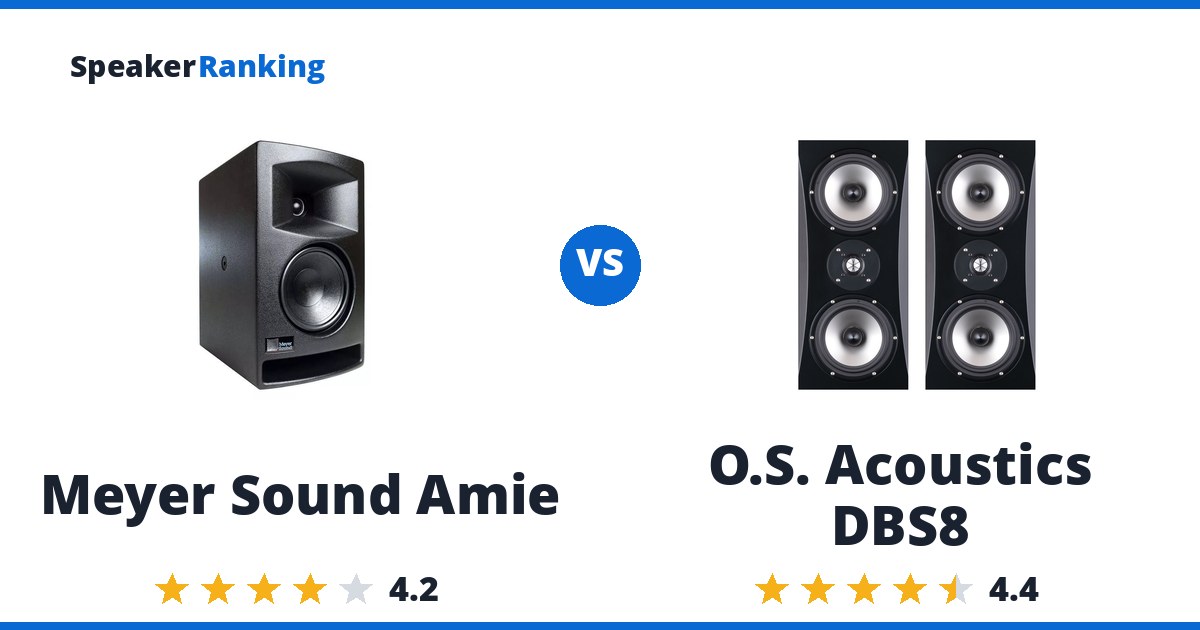
Why pick the Meyer Sound Amie: Professional nearfield monitors with a reasonably even midrange, best paired with a subwoofer in a dedicated studio setup. Watch for: Measured -3dB extension is 48.3Hz, so full-range monitoring benefits from bass support.
The O.S. Acoustics DBS8 is the more accurate choice. Sealed active studio monitors with balanced sound and DSP adjustment, a good fit for a system with a subwoofer. Its measured preference score, a predictor of how neutral it sounds, is 5.88 against 4.85 for the Meyer Sound Amie. Watch for: The measured -3dB point is 48.5Hz, not especially deep for a large monitor.
Buy the O.S. Acoustics DBS8. It is rated higher for sound quality than the Meyer Sound Amie and costs less, so only choose the other one for a particular feature it does better.
Want more options? Browse the full Powered Home rankings.
Prices on this page were last checked November 7, 2026 at 7:34 PM UTC. Product prices and availability are accurate as of that date/time and are subject to change; the price and availability shown on Amazon at the time of purchase will apply to the purchase of this product.
As an eBay Partner, we may be compensated if you make a purchase.
Specifications Side By Side
| Meyer Sound Amie | O.S. Acoustics DBS8 | |
|---|---|---|
| Price | $8,200 per pair | $5,600 per pair |
| Ranked | #64 of 119 in Large Size Powered Bookshelf Speakers | #35 of 119 in Large Size Powered Bookshelf Speakers |
| Enclosure | 2-way active, sealed, multi-ply birch cabinet | Sealed MTM |
| Drivers | 1” silk dome tweeter (constant-directivity waveguide), 6.5” long-excursion cone woofer | Two 6.5-inch aluminum woofers; 1.1-inch ceramic-coated magnesium tweeter |
| Dimensions | 15.3H x 9W x 13.24D in | 19.8” x 8.7” x 17.2” (502 x 222 x 437 mm) each |
| Weight | 24.9 lbs (11.3 kg) each | 34.8 lbs (15.8kg) each |
| Amplifier Power | 2-channel Class D, one channel per driver | 500W LF + 150W HF per speaker |
| Country | United States | - |
| Maximum SPL | 117.5-120.5dB (manufacturer specified) | 105dB (manufacturer specified) |
| Spinorama Preference Score | 4.85 | 5.88 |
| Spinorama Preference Score with Perfect Sub | 6.99 | 7.85 |
| Inputs | XLR (balanced analog) | Balanced XLR |
| XLR Input | Yes | Yes |
| RCA Input | No | No |
| TRS Input | No | No |
| Optical Input | No | No |
| Coaxial Input | No | No |
| USB Input | No | No |
| HDMI Input | No | No |
| AES Input | No | No |
| Aux Input | No | No |
| Bluetooth | No | No |
| Frequency Response | 45Hz - 20kHz (±4dB) (Manufacturer specified) | 35Hz - 21.5kHz (±2 dB > 50Hz) (Manufacturer specified) |
| Bass Extension (-3dB) | - | 48.5Hz (measured, spinorama.org) |
| Bass Extension (-10dB) | - | approximately 35Hz (measured, spinorama.org) |
Related Speaker Comparisons
More worthwhile head-to-heads for O.S. Acoustics DBS8: