Short answer: the Dynaudio LYD 5 on measured sound quality, the M-Audio BX5 D3 on price. The Dynaudio LYD 5 ranks #6 of 65 powered bookshelf speakers at $1000. The M-Audio BX5 D3 ranks #30 at $149.50, $850.50 cheaper.
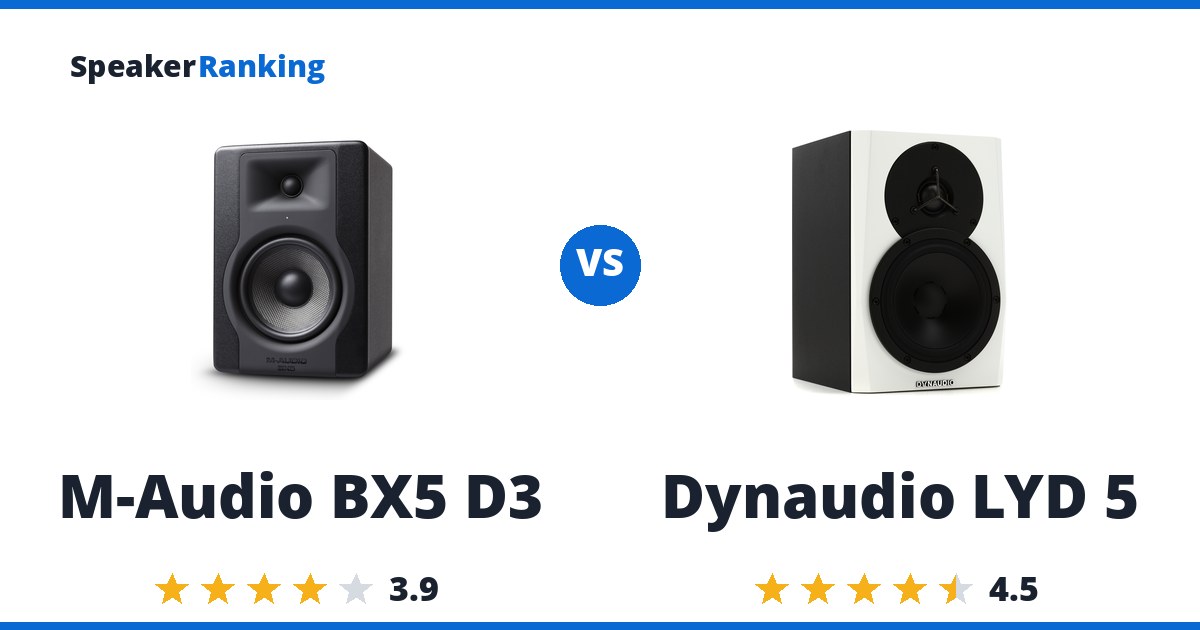
What the M-Audio BX5 D3 offers: The third-party measurements suggest scores of 3.34 standalone and 5.94 with an ideal subwoofer, with a 2.4dB midrange span. Balanced inputs and acoustic-space adjustment are useful for a basic studio setup. The measured -3dB estimate is about 64Hz. Watch for: The response slopes downward by about 0.65dB per octave, potentially softening treble relative to the midrange. There is no digital input or automatic calibration, and the preference estimate does not verify distortion or output headroom.
What the Dynaudio LYD 5 offers: ASR’s Klippel data is substantially stronger than a low ranking suggests: 4.72 standalone and 7.38 with an ideal subwoofer, with a 1.9dB span from 300Hz to 5kHz. Low listening-window narrow-band deviation of 0.242 supports relatively uncolored midrange reproduction. It is particularly competitive when used with a subwoofer rather than judged only by bass reach. Watch for: Bass reaches -3dB around 72Hz, so it gives up low-frequency weight to deeper-reaching monitors. The existing review identifies a dip near 1.6kHz, upper-bass emphasis and uneven crossover-region dispersion. These issues and limited deep-bass capability keep it below the leading all-rounders despite its strong bass-normalized score. A subwoofer does not correct upper-frequency directivity errors.
Buy the M-Audio BX5 D3 when the price outweighs sound quality for you, and the Dynaudio LYD 5 when sound quality outweighs the price instead.
Still deciding? The full Powered Home rankings cover every ranked option.
Specifications Side By Side
| M-Audio BX5 D3 | Dynaudio LYD 5 | |
|---|---|---|
| Price | $299 per pair | $1000 per pair |
| Ranked | #30 of 65 in Medium Size Powered Bookshelf Speakers | #6 of 65 in Medium Size Powered Bookshelf Speakers |
| Enclosure | Active 2-way, rear-ported | - |
| Drivers | 1-inch silk tweeter, 5-inch Kevlar woofer | 5" woofer, 28mm soft dome tweeter |
| Frequency Response | 52Hz-35kHz | 50Hz - 21kHz (Manufacturer specified) |
| Amplifier Power | 100W each | 100W total (50W LF, 50W HF) |
| Maximum SPL | 110dB | - |
| Inputs | XLR and TRS | - |
| Dimensions | 10H x 6.9W x 7.8D in | 10.2"H x 6.7"W x 8.3"D (260 x 170 x 211 mm) |
| Weight | 12.3 lbs (5.6 kg) each | 11.9 lbs (5.4 kg) each |
| Spinorama Preference Score | 3.34 | - |
| Spinorama Preference Score with Perfect Sub | 5.94 | - |
| Bass Extension (-3dB) | - | 68Hz (measured, Audio Science Review) |
| Bass Extension (-10dB) | - | 50Hz (measured, Audio Science Review) |
| App | - | No |
| EQ | - | No |
| DSP | - | No |
Related Speaker Comparisons
More top alternatives to Dynaudio LYD 5:
- Dynaudio LYD 5 vs Genelec 8331A
- Neumann KH120 MKII vs Dynaudio LYD 5
- Genelec 8030C vs Dynaudio LYD 5
- Neumann KH80 DSP vs Dynaudio LYD 5
- Dynaudio LYD 5 vs Genelec 8330A
Prices on this page were last checked September 16, 2026 at 12:41 AM UTC. Product prices and availability are accurate as of that date/time and are subject to change; the price and availability shown on Amazon at the time of purchase will apply to the purchase of this product.
As an eBay Partner, we may be compensated if you make a purchase.
The Two Speakers In Full
 M-Audio BX5 D3: $299 per pair Amazon eBay
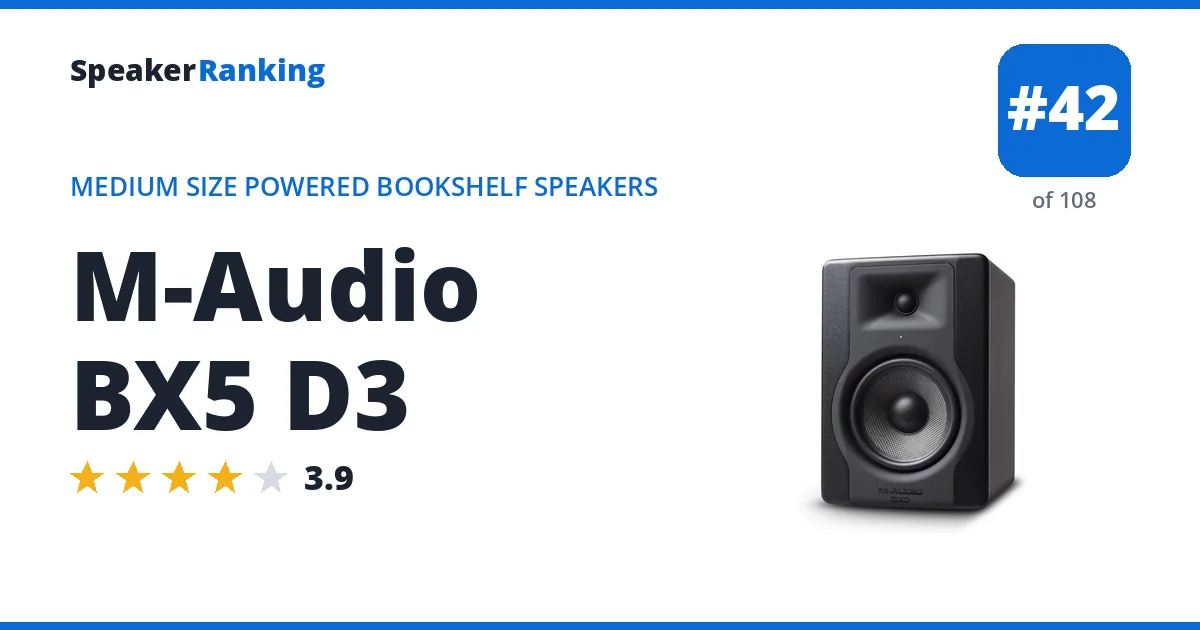
Pros: The third-party measurements suggest scores of 3.34 standalone and 5.94 with an ideal subwoofer, with a 2.4dB midrange span. Balanced inputs and acoustic-space adjustment are useful for a basic studio setup. The measured -3dB estimate is about 64Hz.
Cons: The response slopes downward by about 0.65dB per octave, potentially softening treble relative to the midrange. There is no digital input or automatic calibration, and the preference estimate does not verify distortion or output headroom.
Full M-Audio BX5 D3 review and specifications →
| Amplifier Power | 100W each |
|---|---|
| Dimensions | 10H x 6.9W x 7.8D in |
| Drivers | 1-inch silk tweeter, 5-inch Kevlar woofer |
| Enclosure | Active 2-way, rear-ported |
| Frequency Response | 52Hz-35kHz |
| Inputs | XLR and TRS |
| Maximum SPL | 110dB |
| Spinorama Preference Score | 3.34 |
| Spinorama Preference Score with Perfect Sub | 5.94 |
| Weight | 12.3 lbs (5.6 kg) each |
- Links
- Reviews, Comparisons and Sound Samples
- Head-to-Head Comparisons
- M-Audio BX5 D3 vs Kanto YU6
- M-Audio BX5 D3 vs Kali LP-UNF
- M-Audio BX5 D3 vs Adam Audio T5V
- M-Audio BX5 D3 vs Audioengine A5+ Classic
- M-Audio BX5 D3 vs Vanatoo Transparent Zero Plus
- M-Audio BX5 D3 vs KEF LSX II LT
- M-Audio BX5 D3 vs Airpulse A100
- M-Audio BX5 D3 vs Focal Alpha 50 EVO
- See all 37 comparisons
 Dynaudio LYD 5: $1000 per pair B&H Photo Video eBay
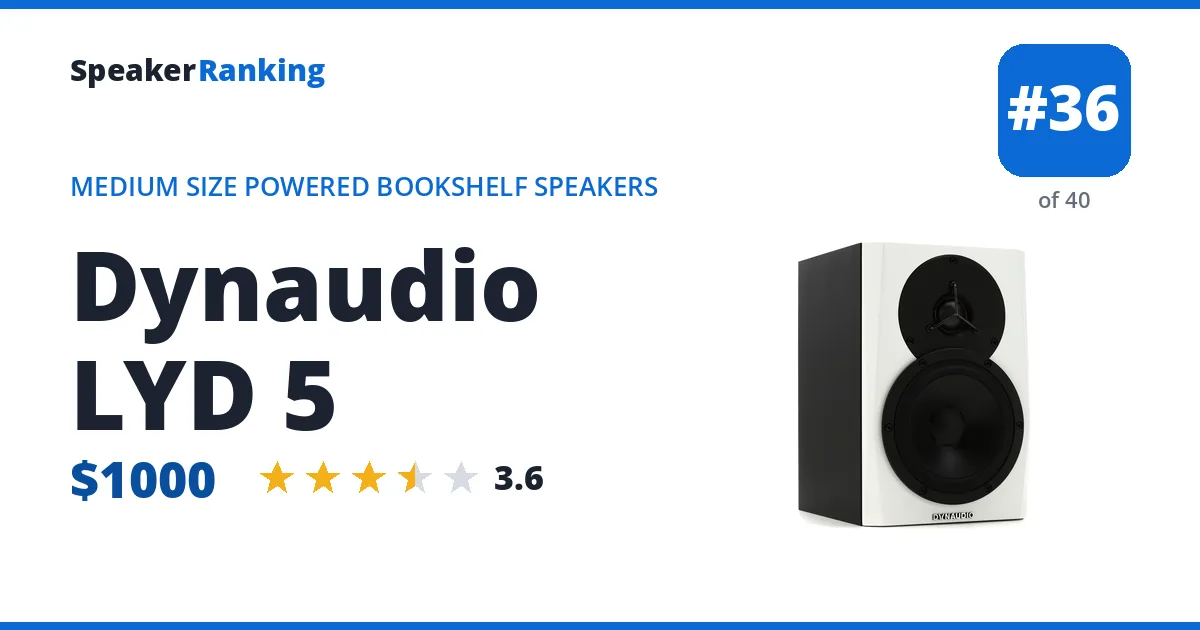
Pros: ASR’s Klippel data is substantially stronger than a low ranking suggests: 4.72 standalone and 7.38 with an ideal subwoofer, with a 1.9dB span from 300Hz to 5kHz. Low listening-window narrow-band deviation of 0.242 supports relatively uncolored midrange reproduction. It is particularly competitive when used with a subwoofer rather than judged only by bass reach. Measured bass extension of 68Hz (-3dB).
Cons: Bass reaches -3dB around 72Hz, so it gives up low-frequency weight to deeper-reaching monitors. The existing review identifies a dip near 1.6kHz, upper-bass emphasis and uneven crossover-region dispersion. These issues and limited deep-bass capability keep it below the leading all-rounders despite its strong bass-normalized score. A subwoofer does not correct upper-frequency directivity errors.
Full Dynaudio LYD 5 review and specifications →
| Amplifier Power | 100W total (50W LF, 50W HF) |
|---|---|
| App | No |
| Bass Extension (-10dB) | 50Hz (measured, Audio Science Review) |
| Bass Extension (-3dB) | 68Hz (measured, Audio Science Review) |
| DSP | No |
| Dimensions | 10.2"H x 6.7"W x 8.3"D (260 x 170 x 211 mm) |
| Drivers | 5" woofer, 28mm soft dome tweeter |
| EQ | No |
| Frequency Response | 50Hz - 21kHz (Manufacturer specified) |
| Weight | 11.9 lbs (5.4 kg) each |
- Links
- Reviews, Comparisons and Sound Samples
- Head-to-Head Comparisons