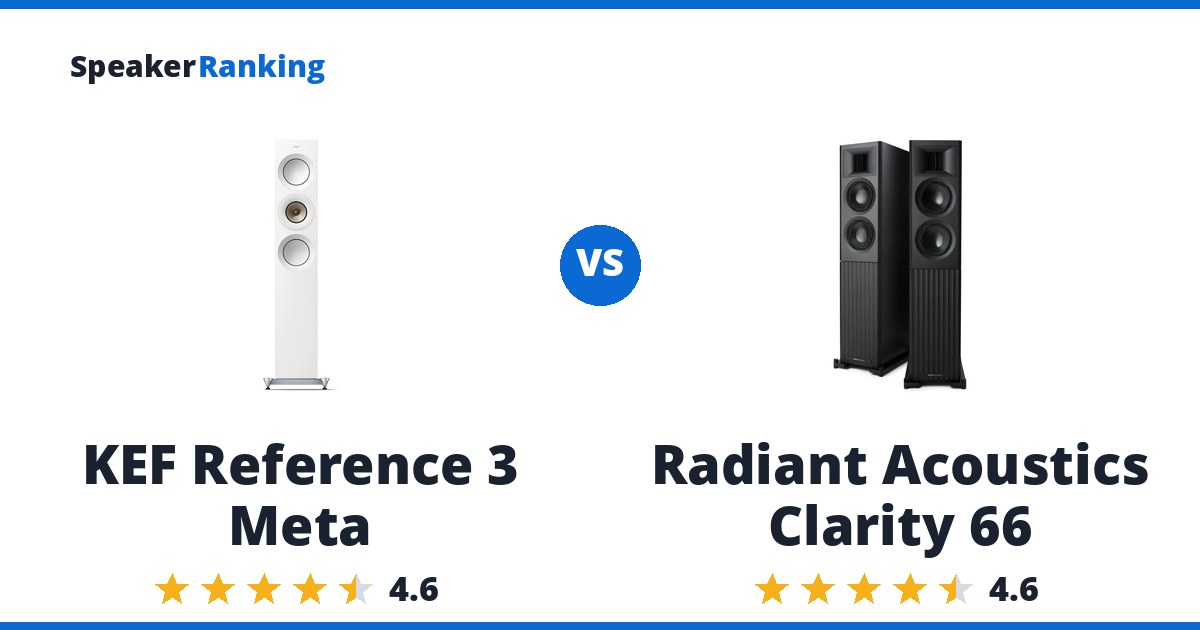
Short answer: the Radiant Acoustics Clarity 66. Both are rated 4.6/5 for sound quality (#6 and #13 of 73 floorstanding speakers), and the Radiant Acoustics Clarity 66 costs $7,998 against $15,999.98 for the KEF Reference 3 Meta, so with nothing between them on sound quality, price settles it.
The case for the KEF Reference 3 Meta: Three-way bass reflex tower built around KEF’s 12th generation Uni-Q driver, a 125mm aluminium midrange with a 25mm aluminium dome tweeter and MAT at its centre, plus two 165mm aluminium woofers. Watch for: The only measurements are KEF’s own, not independently verified, and spinorama.org computes no preference score for them.
Why pick the Radiant Acoustics Clarity 66: ASR’s revised Spinorama measurement shows bass reaching 32.2Hz at -3dB and 27.8Hz at -6dB, giving substantial low-end weight without a subwoofer. The tradeoff: Vertical directivity is narrow and horizontal coverage is uneven, so listening height and placement affect tonal balance.
Buy the Radiant Acoustics Clarity 66. Both are rated the same for sound quality, and it costs $8,001.98 less than the KEF Reference 3 Meta.
Want more options? Browse the full Passive Home rankings.
Specifications Side By Side
| KEF Reference 3 Meta | Radiant Acoustics Clarity 66 | |
|---|---|---|
| Price | $15,999.98 per pair | $7,998 per pair |
| Ranked | #13 of 73 in Large Size Floorstanding Speakers | #6 of 73 in Large Size Floorstanding Speakers |
| Drivers | Uni-Q: 125mm aluminium cone midrange, 25mm aluminium dome tweeter with MAT; 2x 165mm aluminium cone woofers | Custom waveguide-loaded tweeter with beam-expansion fins, 2x 6.5” Purifi USHINDI aluminum-cone woofers |
| Frequency Response | 43Hz-35kHz ±3dB (manufacturer specified) | - |
| Bass Extension (-3dB) | 42.2Hz (measured, KEF vendor data via spinorama.org) | 32.2Hz (measured, Audio Science Review) |
| Bass Extension (-10dB) | about 31.1Hz (measured, KEF vendor data via spinorama.org) | 24.4Hz (measured, Audio Science Review) |
| Sensitivity | 86dB (2.83V/1m, manufacturer specified) | 85.9dB (2.83V/1m, measured, Audio Science Review; 86dB manufacturer specified) |
| Impedance | 4 ohms nominal, 3.2 ohms minimum (manufacturer specified) | 4 ohms nominal |
| Recommended Power | 50-300W | - |
| Maximum SPL | 113.5dB (manufacturer specified) | - |
| Crossover Frequency | 450Hz, 2.1kHz | 2.4kHz |
| Woofer Cabinet | ported | ported, large rear port |
| Dimensions | 45.5”H x 8.1”W x 18.2”D (1155 x 205 x 462 mm) | 40.4”H x 8.7”W x 14”D (1025 x 222 x 355 mm) |
| Country | United Kingdom | - |
| Weight | - | 101.4 lbs (46 kg) each |
| Spinorama Preference Score | - | 6.01 |
| Spinorama Preference Score with Perfect Sub | - | 7.03 |
| DIY Kit | - | No |
Related Speaker Comparisons
More worthwhile head-to-heads for Radiant Acoustics Clarity 66:
- Radiant Acoustics Clarity 66 vs KEF Blade Two Meta
- Radiant Acoustics Clarity 66 vs MoFi SourcePoint V10 Master Edition
- Radiant Acoustics Clarity 66 vs MoFi SourcePoint 888
- Radiant Acoustics Clarity 66 vs Revel F328Be
- Radiant Acoustics Clarity 66 vs Ascend Acoustics ELX Ribbon Tower
Prices on this page were last checked September 26, 2026 at 11:14 PM UTC. Product prices and availability are accurate as of that date/time and are subject to change; the price and availability shown on Amazon at the time of purchase will apply to the purchase of this product.
As an eBay Partner, we may be compensated if you make a purchase.
The Two Speakers In Full
 KEF Reference 3 Meta: $15,999.98 per pair KEF eBay
Older model: the KEF Reference 203 (rated 4.6/5).
Pros: Three-way bass reflex tower built around KEF’s 12th generation Uni-Q driver, a 125mm aluminium midrange with a 25mm aluminium dome tweeter and MAT at its centre, plus two 165mm aluminium woofers. KEF’s own Spinorama measurements, published on spinorama.org, hold the 300Hz to 5kHz response within 1.4dB, one of the flattest results in this category, and the listening window is very smooth (0.90), so tonal balance stays even across a normal seating area. Measured bass reaches 42Hz (-3dB) and about 31Hz (-10dB), deep enough that many rooms won’t need a subwoofer for music. Measured bass extension of 42.2Hz (-3dB).
Cons: The only measurements are KEF’s own, not independently verified, and spinorama.org computes no preference score for them. Sound power directivity is good but not class leading (3.15dB index deviation). Sensitivity is a moderate 86dB and impedance drops to 3.2 ohms, so it needs a capable amplifier (KEF recommends 50 to 300W).
Full KEF Reference 3 Meta review and specifications →
| Bass Extension (-10dB) | about 31.1Hz (measured, KEF vendor data via spinorama.org) |
|---|---|
| Bass Extension (-3dB) | 42.2Hz (measured, KEF vendor data via spinorama.org) |
| Country | United Kingdom |
| Crossover Frequency | 450Hz, 2.1kHz |
| Dimensions | 45.5”H x 8.1”W x 18.2”D (1155 x 205 x 462 mm) |
| Drivers | Uni-Q: 125mm aluminium cone midrange, 25mm aluminium dome tweeter with MAT; 2x 165mm aluminium cone woofers |
| Frequency Response | 43Hz-35kHz ±3dB (manufacturer specified) |
| Impedance | 4 ohms nominal, 3.2 ohms minimum (manufacturer specified) |
| Maximum SPL | 113.5dB (manufacturer specified) |
| Recommended Power | 50-300W |
| Sensitivity | 86dB (2.83V/1m, manufacturer specified) |
| Woofer Cabinet | ported |
- Links
- Reviews, Comparisons and Sound Samples
- Head-to-Head Comparisons
 Radiant Acoustics Clarity 66: $7,998 per pair Radiant Acoustics eBay
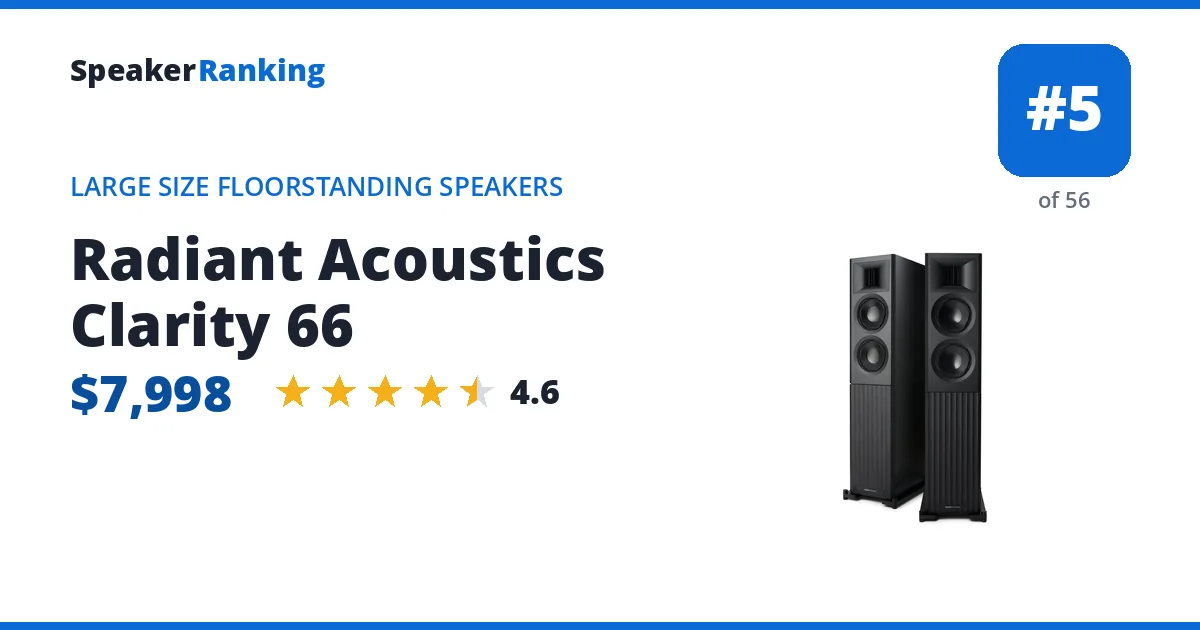
Pros: ASR’s revised Spinorama measurement shows bass reaching 32.2Hz at -3dB and 27.8Hz at -6dB, giving substantial low-end weight without a subwoofer. The response spans 2.3dB from 300Hz to 5kHz, with preference scores of 6.01 standalone and 7.03 with an ideal subwoofer. The review’s exceptionally low bass distortion at ordinary levels complements that extension, while dual 6.5-inch Purifi woofers provide a strong foundation for full-range listening. Measured bass extension of 32.2Hz (-3dB), with a measured sensitivity of 85.9dB.
Cons: Vertical directivity is narrow and horizontal coverage is uneven, so listening height and placement affect tonal balance. Treble resonances and response irregularities keep it from reference-level neutrality. Spinorama’s modeled EQ improves the scores to 6.85 standalone and 7.75 with an ideal subwoofer, but those are corrected results, not stock performance. Measured sensitivity is 85.9dB at 2.83V/1m with a nominal 4-ohm load; use an amplifier comfortable driving 4 ohms. Distortion rises at very high playback levels.
Full Radiant Acoustics Clarity 66 review and specifications →
| Bass Extension (-10dB) | 24.4Hz (measured, Audio Science Review) |
|---|---|
| Bass Extension (-3dB) | 32.2Hz (measured, Audio Science Review) |
| Crossover Frequency | 2.4kHz |
| DIY Kit | No |
| Dimensions | 40.4”H x 8.7”W x 14”D (1025 x 222 x 355 mm) |
| Drivers | Custom waveguide-loaded tweeter with beam-expansion fins, 2x 6.5” Purifi USHINDI aluminum-cone woofers |
| Impedance | 4 ohms nominal |
| Sensitivity | 85.9dB (2.83V/1m, measured, Audio Science Review; 86dB manufacturer specified) |
| Spinorama Preference Score | 6.01 |
| Spinorama Preference Score with Perfect Sub | 7.03 |
| Weight | 101.4 lbs (46 kg) each |
| Woofer Cabinet | ported, large rear port |
- Links
- Reviews, Comparisons and Sound Samples
- Head-to-Head Comparisons
- Radiant Acoustics Clarity 66 vs Ascend Acoustics ELX Ribbon Tower
- Radiant Acoustics Clarity 66 vs Revel F328Be
- Radiant Acoustics Clarity 66 vs MoFi SourcePoint 888
- Radiant Acoustics Clarity 66 vs MoFi SourcePoint V10 Master Edition
- Radiant Acoustics Clarity 66 vs KEF Blade Two Meta
- Radiant Acoustics Clarity 66 vs Revel F226Be
- Radiant Acoustics Clarity 66 vs JBL 4367
- Radiant Acoustics Clarity 66 vs Revel F228Be
- See all 24 comparisons