Short answer: the KEF Reference 203. It ranks #12 of 73 floorstanding speakers by sound quality, rated 4.6/5, at $5,000. The Triangle Esprit Antal Ez ranks #70, rated 2.5/5, at $1,799, $3,201 cheaper, a saving that is not big enough to make up the sound-quality gap.
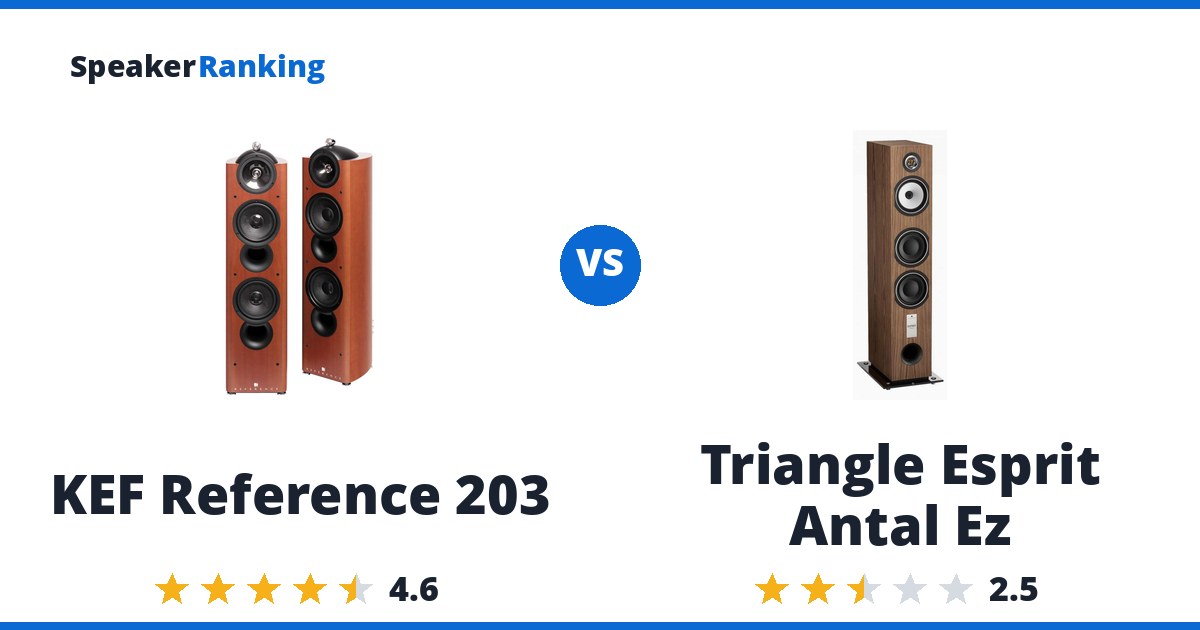
Why pick the KEF Reference 203: An unusually accomplished 4-way design for its era: excellent on-axis linearity (within about +/-3dB), genuinely good directivity both horizontally (~55 degrees) and vertically (~40-50 degrees), and an estimated in-room response that closely matches what the reviewer actually heard. The catch: This is a 20+ year old, long-discontinued speaker only findable secondhand (Facebook Marketplace, Craigslist, audio forums): condition, driver matching, and component aging vary by unit, so audition before buying if at all possible.
Why pick the Triangle Esprit Antal Ez: Predicted in-room response sums rather nicely aside from the resonance and bass issues. The tradeoff: Resonance around 260Hz and a number of other resonances show up on-axis, along with a dip in bass response.
One note: the KEF Reference 203 is discontinued, but it still ranks #12 of 73 floorstanding speakers by sound quality, ahead of most of what is still sold new, so it is worth considering used.
Buy the KEF Reference 203. It is rated higher for sound quality, and saving $3,201 with the Triangle Esprit Antal Ez does not make up for the sound-quality gap.
Looking for alternatives? See the complete Passive Home rankings.
Specifications Side By Side
| KEF Reference 203 | Triangle Esprit Antal Ez | |
|---|---|---|
| Price | $5000 per pair Discontinued | $1799 per pair Discontinued |
| Ranked | #12 of 73 in Large Size Floorstanding Speakers | #70 of 73 in Large Size Floorstanding Speakers |
| Bass Extension (-10dB) | 37Hz (measured, Erin’s Audio Corner) | 62Hz (measured, Audio Science Review) - low confidence - on-axis curve shows an unusual notch/dip around 250-300Hz for this floorstanding tower |
| Bass Extension (-3dB) | 51Hz (measured, Erin’s Audio Corner) | 85Hz (measured, Audio Science Review) - low confidence - on-axis curve shows an unusual notch/dip around 250-300Hz for this floorstanding tower |
| Dimensions | 42”H (1067H mm) | 43.9”H x 11.8”W x 15.7”D (1115.0 x 300.0 x 400.0 mm) |
| Impedance | 8 ohms nominal (3.6 ohms minimum, measured, Erin’s Audio Corner; 3.2 ohms per manufacturer spec) | 8 ohms nominal (2.7 ohms minimum, measured by Audio Science Review) |
| Sensitivity | 88dB (2.83V/1m, measured by Erin’s Audio Corner) | 90.7dB (2.83V/1m, measured by Audio Science Review) |
| Drivers | 1x 0.75” supertweeter, coaxial 1” dome tweeter + 6.5” midrange, 2x 6.5” woofers | 2x 6.5” (160mm) fiberglass cone woofers, 1x 6.5” (160mm) natural cellulose midrange, 1x 1” (25mm) titanium dome tweeter |
| Weight | 58 lbs (26.3 kg) | 98.5 lbs (44.7 kg) |
| Woofer Cabinet | Bass reflex, with switchable flat/cut/lifted bass ports for wall placement | ported, front |
| Crossover Frequency | 400Hz, 2.7kHz, 15kHz | - |
| Frequency Response | 55Hz - 55kHz ±3dB (Manufacturer specified) | - |
| Recommended Power | 50-200W | - |
| Spinorama Preference Score | 5.83 | 2.76 |
| Spinorama Preference Score with Perfect Sub | 7.84 | 5.37 |
| DIY Kit | No | No |
Related Speaker Comparisons
More top alternatives to KEF Reference 203:
- KEF Blade Two Meta vs KEF Reference 203
- MoFi SourcePoint 888 vs KEF Reference 203
- Revel F328Be vs KEF Reference 203
- KEF R5 Meta vs KEF Reference 203
- Revel F226Be vs KEF Reference 203
Prices on this page were last checked September 29, 2026 at 3:43 PM UTC. Product prices and availability are accurate as of that date/time and are subject to change; the price and availability shown on Amazon at the time of purchase will apply to the purchase of this product.
As an eBay Partner, we may be compensated if you make a purchase.
The Two Speakers In Full
 KEF Reference 203: $5000 per pair Discontinued eBay
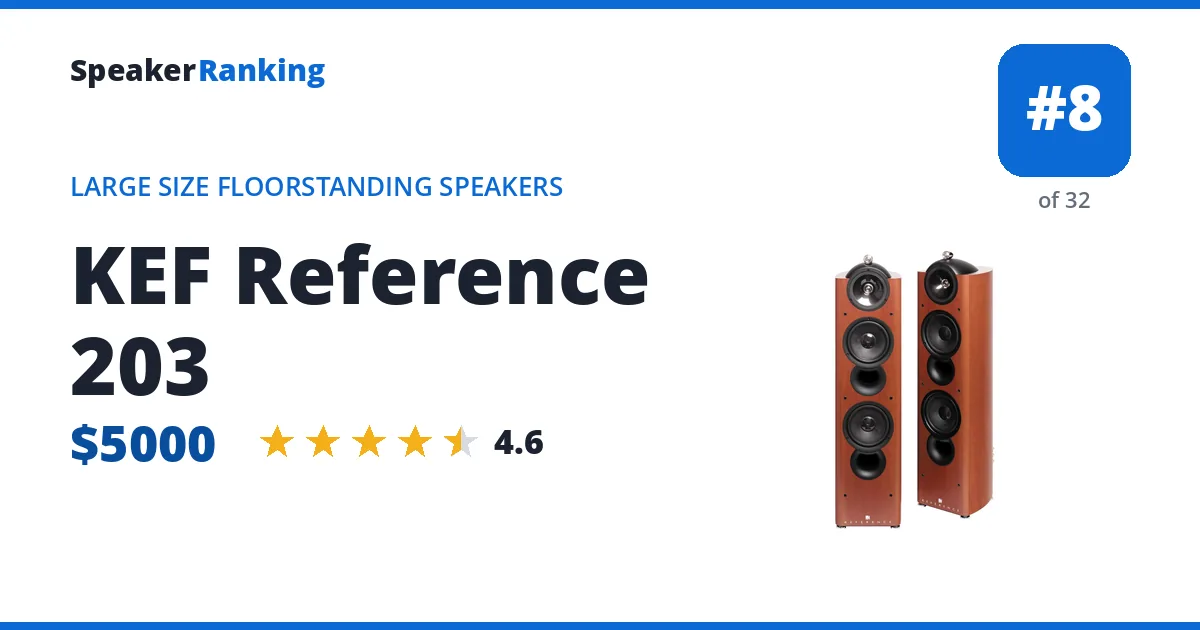
Newer model: the KEF Reference 3 Meta, ranked lower, rated 4.6/5.
Pros: An unusually accomplished 4-way design for its era: excellent on-axis linearity (within about +/-3dB), genuinely good directivity both horizontally (~55 degrees) and vertically (~40-50 degrees), and an estimated in-room response that closely matches what the reviewer actually heard. Distortion is excellent: under 1% harmonic above 80Hz at both 86dB and 96dB, and multitone stays around 1% even at 96dB. Bass reaches a real F3 of 51Hz (F10 37Hz), with in-room extension into the low-mid-40s. The reviewer’s overall listening notes were essentially “nothing stood out bad or good”: a genuinely neutral, accurate speaker with a distinctive rounded-baffle look that avoids the diffraction issues a flat baffle this wide would normally have. Measured bass extension of 51Hz (-3dB), with a measured sensitivity of 88dB.
Cons: This is a 20+ year old, long-discontinued speaker only findable secondhand (Facebook Marketplace, Craigslist, audio forums): condition, driver matching, and component aging vary by unit, so audition before buying if at all possible. Demands a robust amplifier: impedance dips to about 3.6 ohms with an EPDR of 2.2 ohms. The small supertweeter shows minor breakup artifacts at the extremes of the vertical polar plot and some compression at very high output in the top octave, though neither was audible in normal listening.
Full KEF Reference 203 review and specifications →
| Bass Extension (-10dB) | 37Hz (measured, Erin’s Audio Corner) |
|---|---|
| Bass Extension (-3dB) | 51Hz (measured, Erin’s Audio Corner) |
| Crossover Frequency | 400Hz, 2.7kHz, 15kHz |
| DIY Kit | No |
| Dimensions | 42”H (1067H mm) |
| Drivers | 1x 0.75” supertweeter, coaxial 1” dome tweeter + 6.5” midrange, 2x 6.5” woofers |
| Frequency Response | 55Hz - 55kHz ±3dB (Manufacturer specified) |
| Impedance | 8 ohms nominal (3.6 ohms minimum, measured, Erin’s Audio Corner; 3.2 ohms per manufacturer spec) |
| Recommended Power | 50-200W |
| Sensitivity | 88dB (2.83V/1m, measured by Erin’s Audio Corner) |
| Spinorama Preference Score | 5.83 |
| Spinorama Preference Score with Perfect Sub | 7.84 |
| Weight | 58 lbs (26.3 kg) |
| Woofer Cabinet | Bass reflex, with switchable flat/cut/lifted bass ports for wall placement |
- Links
- Reviews, Comparisons and Sound Samples
- Head-to-Head Comparisons
 Triangle Esprit Antal Ez: $1799 per pair Discontinued eBay
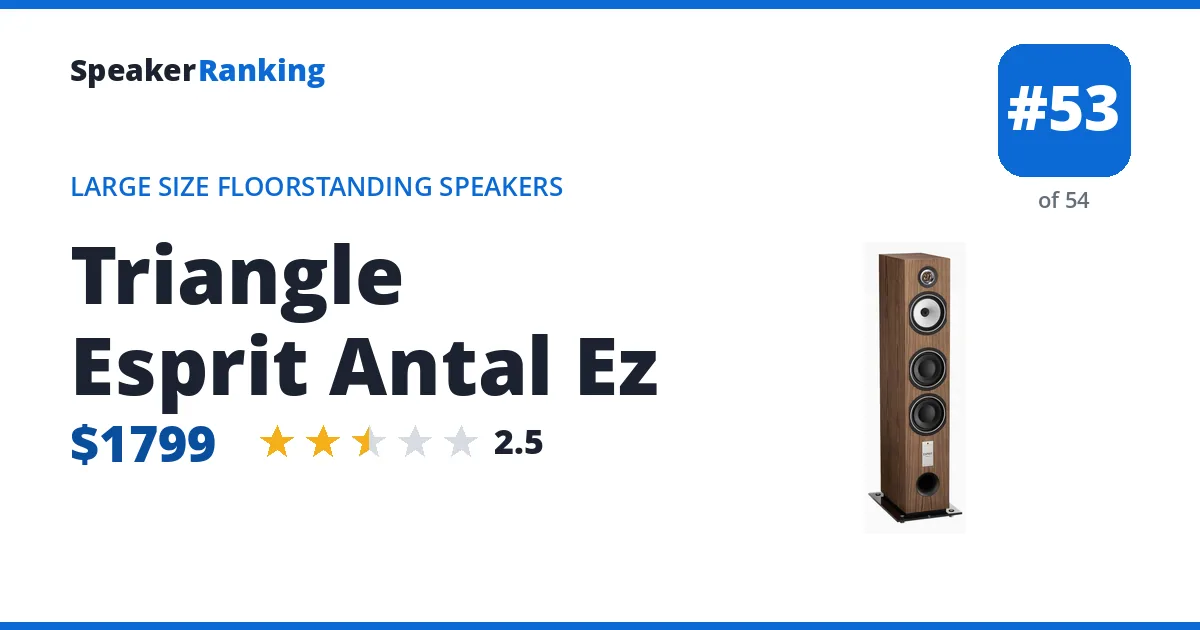
Pros: Predicted in-room response sums rather nicely aside from the resonance and bass issues. Horizontal beamwidth of about ±50 degrees is reasonably controlled. Measured bass extension of 85Hz (-3dB), with a measured sensitivity of 90.7dB.
Cons: Resonance around 260Hz and a number of other resonances show up on-axis, along with a dip in bass response. Two distinct distortion sources (one around 250-300Hz, another around 3-4kHz) already cross the reviewer’s audibility threshold even at moderate output, and get much worse at 96dB SPL/1m, where distortion broadly exceeds 50% relative level across large parts of the spectrum. Directivity is not great overall. The reviewer does not recommend it. Discontinued.
Full Triangle Esprit Antal Ez review and specifications →
| Bass Extension (-10dB) | 62Hz (measured, Audio Science Review) - low confidence - on-axis curve shows an unusual notch/dip around 250-300Hz for this floorstanding tower |
|---|---|
| Bass Extension (-3dB) | 85Hz (measured, Audio Science Review) - low confidence - on-axis curve shows an unusual notch/dip around 250-300Hz for this floorstanding tower |
| DIY Kit | No |
| Dimensions | 43.9”H x 11.8”W x 15.7”D (1115.0 x 300.0 x 400.0 mm) |
| Drivers | 2x 6.5” (160mm) fiberglass cone woofers, 1x 6.5” (160mm) natural cellulose midrange, 1x 1” (25mm) titanium dome tweeter |
| Impedance | 8 ohms nominal (2.7 ohms minimum, measured by Audio Science Review) |
| Sensitivity | 90.7dB (2.83V/1m, measured by Audio Science Review) |
| Spinorama Preference Score | 2.76 |
| Spinorama Preference Score with Perfect Sub | 5.37 |
| Weight | 98.5 lbs (44.7 kg) |
| Woofer Cabinet | ported, front |
- Links
- Reviews, Comparisons and Sound Samples
- Head-to-Head Comparisons
- Triangle Esprit Antal Ez vs JBL Studio 590
- Triangle Esprit Antal Ez vs Sony SS-CS3
- Triangle Esprit Antal Ez vs Rockville RockTower 68B
- Triangle Esprit Antal Ez vs Bose 901 Series V
- Triangle Esprit Antal Ez vs JBL Stage 2 280F
- Triangle Esprit Antal Ez vs Magnepan LRS+
- Triangle Esprit Antal Ez vs Infinity Reference 253
- Triangle Esprit Antal Ez vs Focal Aria Evo X N°2
- See all 12 comparisons