Short answer: the KEF R11 Meta. It ranks #44 of 188 floorstanding speakers by sound quality (rated 4.4/5) at $6,999.98 and is still sold new; the Infinity Reference 253 ranks #148 (rated 3.5/5) and is discontinued, so it is only an option used.
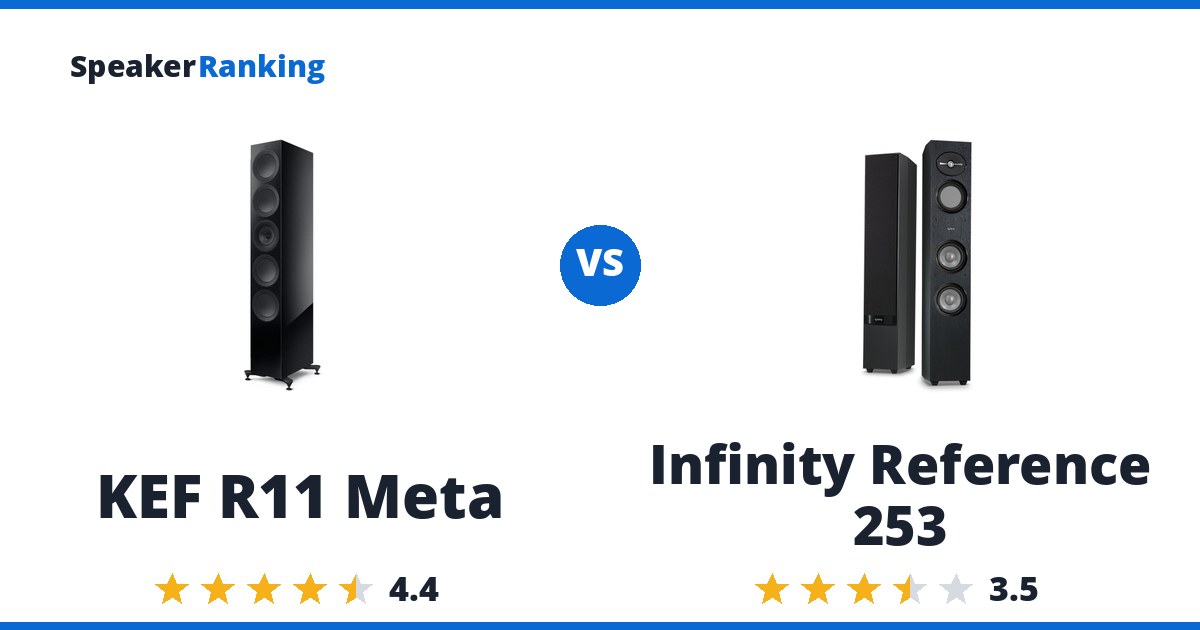
The KEF R11 Meta is the better-sounding, deeper-bass choice. CEA2034 spinorama shows a generally flat on-axis response with good directivity and very deep bass extension (F10 of 30Hz). Its bass reaches about 64Hz before falling 3dB, against 78Hz for the Infinity Reference 253. The catch: A dip around 1-1.2kHz on-axis is attributed to a diffraction effect, and shows up as a smaller dip in the predicted in-room response.
The case for the Infinity Reference 253: Horizontal beamwidth of about ±60 degrees is fairly smooth and well controlled. The tradeoff: CEA2034 spinorama and predicted in-room response both show elevated treble above 4kHz (“too hot”), a dip around 2kHz, and bass shelved down relative to the midrange.
Buy the KEF R11 Meta. It is rated higher for sound quality and still sold new, while the Infinity Reference 253 is discontinued.
Still deciding? The full Passive Home rankings cover every ranked option.
Specifications Side By Side
| KEF R11 Meta | Infinity Reference 253 | |
|---|---|---|
| Price | $6,999.98 per pair | $400 per pair used, Discontinued |
| Ranked | #44 of 188 in Large Size Floorstanding Speakers | #148 of 188 in Large Size Floorstanding Speakers |
| Bass Extension (-10dB) | 31Hz (measured, Audio Science Review) | 38Hz (measured, Audio Science Review) |
| Bass Extension (-3dB) | 64Hz (measured, Audio Science Review) | 78Hz (measured, Audio Science Review) |
| Dimensions | 51”H x 12.2”W x 15.1”D (1295.4 x 309.9 x 383.5 mm) | 40.3”H x 6.8”W x 12.4”D (1023.6 x 172.7 x 315 mm) |
| Impedance | 4 ohms | 6 ohms |
| Drivers | 4 x 165 mm (6.5 in.) hybrid aluminium cone woofers, 125 mm (5 in.) aluminium cone midrange, 25 mm (1 in.) vented aluminium dome with MAT tweeter | Dual 5.25” (130mm) CMMD™ woofers, 5.25” (130mm) flat-piston CMMD™ midrange, 1” (25mm) CMMD™ tweeter |
| Sensitivity | 89.5dB | 86.9dB (measured by Audio Science Review; 88dB manufacturer specified) |
| Weight | 80.5 lbs (36.5 kg) each | 39.2 lbs (17.8 kg) each |
| Woofer Cabinet | ported, rear | ported, rear |
| Spinorama Preference Score | 5.91 | 5.43 (spinorama.org) |
| Spinorama Preference Score with Perfect Sub | 7.32 | 7.31 (spinorama.org) |
| DIY Kit | No | No |
Related Speaker Comparisons
More top alternatives to KEF R11 Meta:
- KEF R11 Meta vs KEF Blade Two Meta
- MoFi SourcePoint V10 Master Edition vs KEF R11 Meta
- KEF R11 Meta vs MoFi SourcePoint 888
- KEF R11 Meta vs Revel F328Be
- Radiant Acoustics Clarity 66 vs KEF R11 Meta
Prices on this page were last checked October 7, 2026 at 9:25 PM UTC. Product prices and availability are accurate as of that date/time and are subject to change; the price and availability shown on Amazon at the time of purchase will apply to the purchase of this product.
As an eBay Partner, we may be compensated if you make a purchase.
The Two Speakers In Full
 KEF R11 Meta: $6,999.98 per pair Amazon eBay
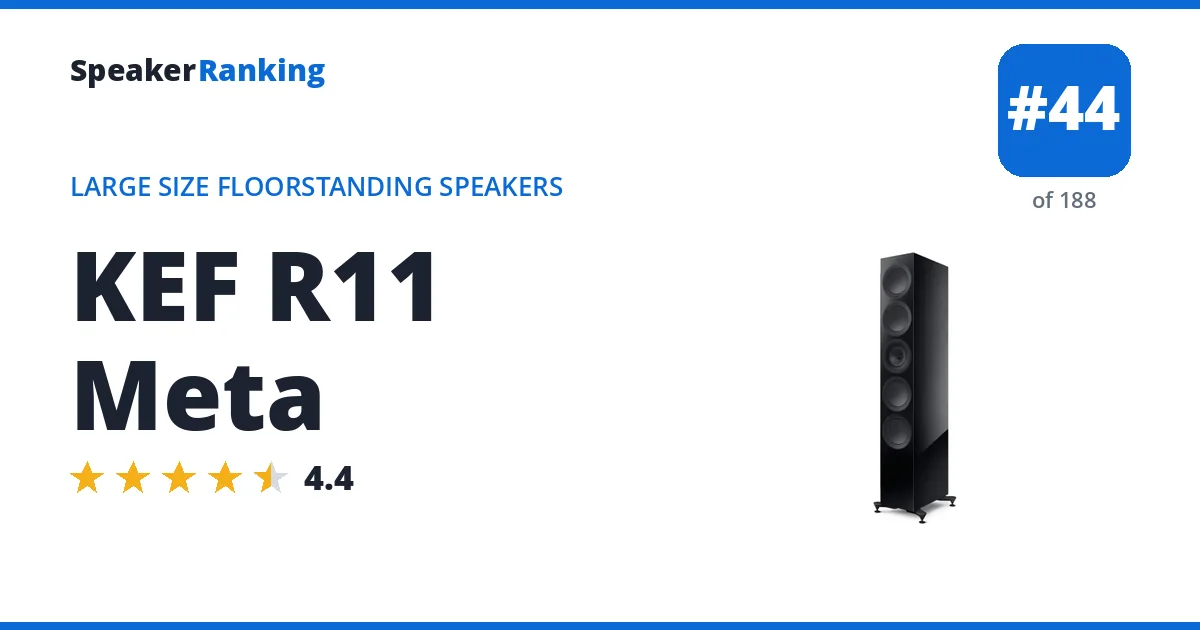
Older model: the KEF R11 (ranked lower, estimated 4.3/5).
Same family: the KEF R3 Meta (bookshelf, rated 4.6/5), the KEF R5 Meta (smaller floorstanding, ranked higher, rated 4.6/5), the KEF R7 Meta (smaller floorstanding, ranked higher, estimated 4.6/5), the KEF R2 Meta (smaller center, rated 4.3/5) and the KEF R6 Meta (larger center, rated 4.2/5).
Pros: CEA2034 spinorama shows a generally flat on-axis response with good directivity and very deep bass extension (F10 of 30Hz). Predicted in-room response is very smooth aside from the small 1-1.5kHz dip. The coaxial Uni-Q driver gives excellent, symmetric vertical directivity, unusual for a tower speaker. Distortion is incredibly low even down to 30Hz at 86dB SPL/1m, and stays low even at 96dB and 102dB SPL/1m: the reviewer found essentially no audible tonality change across that whole output range. Measured bass extension of 64Hz (-3dB).
Cons: A dip around 1-1.2kHz on-axis is attributed to a diffraction effect, and shows up as a smaller dip in the predicted in-room response. Horizontal beamwidth of about ±40 degrees is on the narrower side, though the transition from wide to constant directivity is smooth. Minimum impedance dips to 3.2 ohms around 580Hz, calling for an amplifier comfortable with a demanding load. 4-ohm nominal impedance overall.
Full KEF R11 Meta review and specifications →
| Bass Extension (-10dB) | 31Hz (measured, Audio Science Review) |
|---|---|
| Bass Extension (-3dB) | 64Hz (measured, Audio Science Review) |
| DIY Kit | No |
| Dimensions | 51”H x 12.2”W x 15.1”D (1295.4 x 309.9 x 383.5 mm) |
| Drivers | 4 x 165 mm (6.5 in.) hybrid aluminium cone woofers, 125 mm (5 in.) aluminium cone midrange, 25 mm (1 in.) vented aluminium dome with MAT tweeter |
| Impedance | 4 ohms |
| Sensitivity | 89.5dB |
| Spinorama Preference Score | 5.91 |
| Spinorama Preference Score with Perfect Sub | 7.32 |
| Weight | 80.5 lbs (36.5 kg) each |
| Woofer Cabinet | ported, rear |
- Links
- Reviews, Comparisons and Sound Samples
- Head-to-Head Comparisons
 Infinity Reference 253: $400 per pair used Discontinued eBay
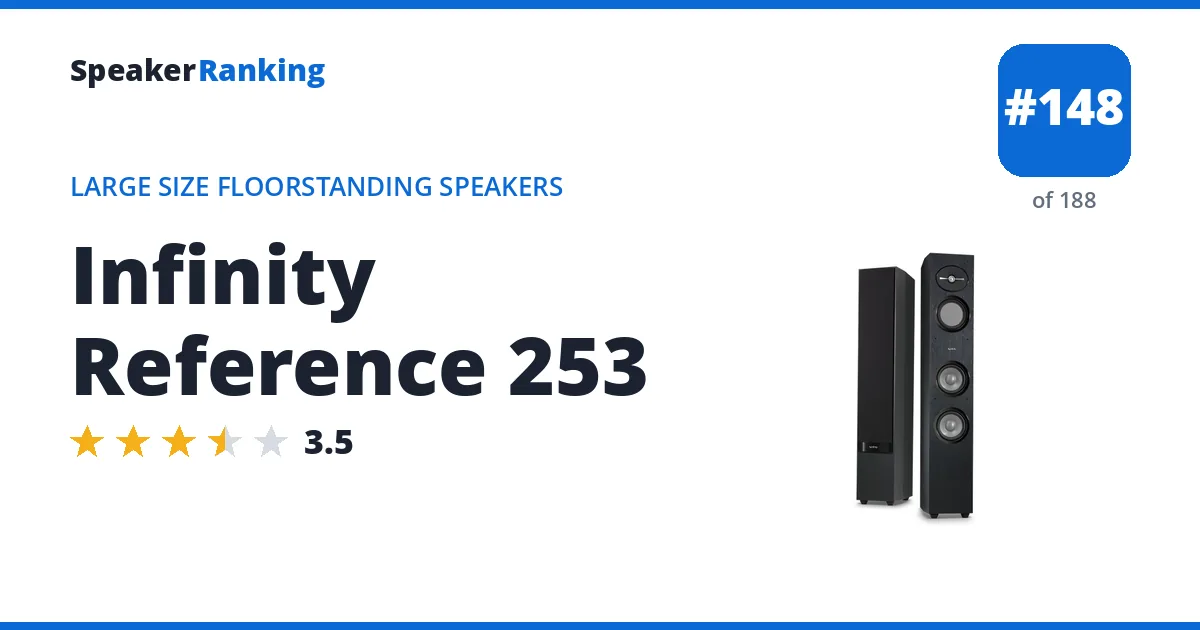
Same family: the Infinity Reference R152 (smaller bookshelf, rated 3.8/5), the Infinity Reference R162 (larger bookshelf, rated 3.8/5), the Infinity Reference R263 (larger floorstanding, ranked higher, rated 4.4/5), the Infinity Reference RC252 (smaller center, rated 4.4/5) and the Infinity Reference RC263 (larger center, rated 4.2/5).
Pros: Horizontal beamwidth of about ±60 degrees is fairly smooth and well controlled. Really amazing value for the performance. Measured bass extension of 78Hz (-3dB), with a measured sensitivity of 86.9dB.
Cons: CEA2034 spinorama and predicted in-room response both show elevated treble above 4kHz (“too hot”), a dip around 2kHz, and bass shelved down relative to the midrange. Vertical directivity requires staying at or below the tweeter axis for accurate tonal balance. Distortion at 96dB SPL/1m is broadly elevated above the reviewer’s audibility threshold across much of the midrange. Minimum impedance dips to 4.2 ohms. Discontinued.
Full Infinity Reference 253 review and specifications →
| Bass Extension (-10dB) | 38Hz (measured, Audio Science Review) |
|---|---|
| Bass Extension (-3dB) | 78Hz (measured, Audio Science Review) |
| DIY Kit | No |
| Dimensions | 40.3”H x 6.8”W x 12.4”D (1023.6 x 172.7 x 315 mm) |
| Drivers | Dual 5.25” (130mm) CMMD™ woofers, 5.25” (130mm) flat-piston CMMD™ midrange, 1” (25mm) CMMD™ tweeter |
| Impedance | 6 ohms |
| Sensitivity | 86.9dB (measured by Audio Science Review; 88dB manufacturer specified) |
| Spinorama Preference Score | 5.43 (spinorama.org) |
| Spinorama Preference Score with Perfect Sub | 7.31 (spinorama.org) |
| Weight | 39.2 lbs (17.8 kg) each |
| Woofer Cabinet | ported, rear |
- Links
- Reviews, Comparisons and Sound Samples
- Head-to-Head Comparisons
- Infinity Reference 253 vs Magnepan LRS+
- Infinity Reference 253 vs Polk Signature Elite ES60
- Infinity Reference 253 vs JBL Stage 2 280F
- Infinity Reference 253 vs Focal Aria Evo X N°2
- Infinity Reference 253 vs Polk T50
- Infinity Reference 253 vs SVS Ultra Evolution Pinnacle
- Infinity Reference 253 vs Definitive Technology BP-9020
- Infinity Reference 253 vs Sony SS-CS3
- See all 34 comparisons