Short answer: the KEF Q6 Meta if sound quality matters most, the Klipsch RP-504C II if price matters most. The KEF Q6 Meta ranks #31 of 98 center channel speakers, rated 3.9/5, at $849.99. The Klipsch RP-504C II ranks #35, rated 3.8/5, at $499.99, $350 cheaper.
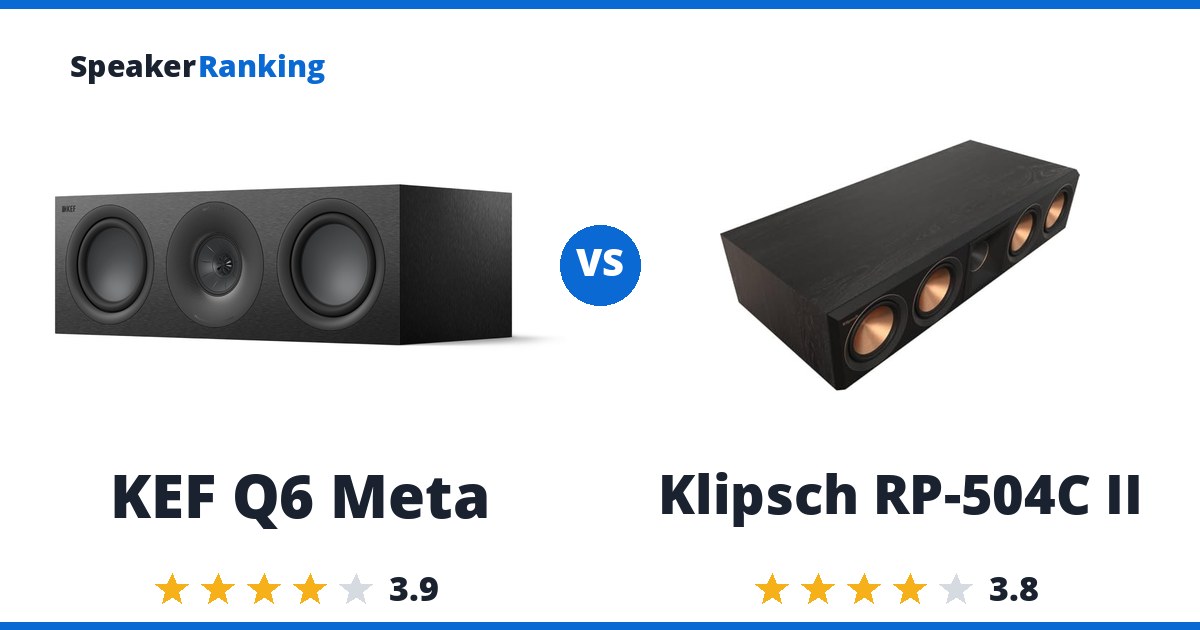
The KEF Q6 Meta is the deeper-bass choice. A true three-way center with a Uni-Q coaxial driver (0.75” vented aluminium tweeter with MAT inside a 4” midrange) between two 6.5” bass drivers, replacing the two-way Q650c at about the same price. Its bass reaches about 60.7Hz before falling 3dB, against 71.8Hz for the Klipsch RP-504C II. Watch for: The only measurements are KEF’s own, and spinorama.org computes no preference score for them, so the ranking is an estimate.
What the Klipsch RP-504C II does well: The largest Reference Premiere center puts four 5.25” Cerametallic woofers around a 1” titanium tweeter in a Tractrix horn, for a very high 96dB sensitivity. The catch: On-axis response is the least even of the Klipsch centers (1.13dB average deviation), and directivity varies strongly with frequency (4.27dB directivity index deviation), so the tone changes for off-center seats and in reflective rooms.
Buy the KEF Q6 Meta if sound quality is the priority over the price, or the Klipsch RP-504C II if the price is the priority over sound quality.
Still deciding? The full Passive Home rankings cover every ranked option.
Specifications Side By Side
| KEF Q6 Meta | Klipsch RP-504C II | |
|---|---|---|
| Price | $849.99 each | $499.99 each |
| Ranked | #31 of 98 in Center Channel Speakers | #35 of 98 in Center Channel Speakers |
| Drivers | Uni-Q: 19mm (0.75”) vented aluminium dome tweeter with MAT, 100mm (4”) aluminium midrange; 2x 165mm (6.5”) hybrid aluminium bass units | 1” titanium LTS vented tweeter with Tractrix horn, 4x 5.25” Cerametallic woofers |
| Frequency Response | 63Hz-20kHz ±3dB (manufacturer specified) | 50Hz-25kHz ±3dB (manufacturer specified) |
| Sensitivity | 86dB (2.83V/1m, manufacturer specified) | 96dB (2.83V/1m, manufacturer specified) |
| Impedance | 4 ohms nominal, 3.2 ohms minimum (manufacturer specified) | 8 ohms nominal (manufacturer specified) |
| Maximum SPL | 109dB (manufacturer specified) | - |
| Woofer Cabinet | sealed | ported (rear Tractrix ports) |
| Dimensions | 8.3”H x 24.8”W x 11.9”D (210 x 629 x 303 mm) | 6.9”H x 32”W x 15.1”D (174 x 814 x 383 mm) |
| Weight | 31.1 lbs (14.1 kg) | 36.4 lbs (16.5 kg) |
| Bass Extension (-3dB) | 60.7Hz (measured, manufacturer data via spinorama.org) | 71.8Hz (measured, Erin’s Audio Corner) |
| Bass Extension (-10dB) | about 39.6Hz (measured, manufacturer data via spinorama.org) | about 43.4Hz (measured, Erin’s Audio Corner) |
| DIY Kit | No | No |
| Spinorama Preference Score | - | 4.58 |
| Spinorama Preference Score with Perfect Sub | - | 6.83 |
Related Speaker Comparisons
More worthwhile head-to-heads for KEF Q6 Meta:
- KEF R2 Meta vs KEF Q6 Meta
- Monitor Audio Silver C250 7G vs KEF Q6 Meta
- SVS Ultra Evolution Center vs KEF Q6 Meta
- Revel Performa4 C245 vs KEF Q6 Meta
- Wharfedale EVO4.C vs KEF Q6 Meta
Prices on this page were last checked October 5, 2026 at 10:21 PM UTC. Product prices and availability are accurate as of that date/time and are subject to change; the price and availability shown on Amazon at the time of purchase will apply to the purchase of this product.
As an eBay Partner, we may be compensated if you make a purchase.
The Two Speakers In Full
 KEF Q6 Meta: $849.99 each Amazon eBay
Older models: the KEF Q250c (ranked lower, rated 3.9/5) and the KEF Q650c (ranked lower, rated 3.7/5).
Pros: A true three-way center with a Uni-Q coaxial driver (0.75” vented aluminium tweeter with MAT inside a 4” midrange) between two 6.5” bass drivers, replacing the two-way Q650c at about the same price. KEF’s Spinorama data shows the most consistent directivity of any center here (2.78dB directivity index deviation), so reflected sound matches the direct sound closely, with the listening window within 2.1dB from 300Hz to 5kHz. Bass reaches 60.7Hz (-3dB) and about 40Hz (-10dB), deep for a center at $850.
Cons: The only measurements are KEF’s own, and spinorama.org computes no preference score for them, so the ranking is an estimate. Sensitivity is a low 86dB and the impedance dips to 3.2 ohms, so it wants a receiver with some power in reserve. Maximum output is rated at 109dB.
Full KEF Q6 Meta review and specifications →
| Bass Extension (-10dB) | about 39.6Hz (measured, manufacturer data via spinorama.org) |
|---|---|
| Bass Extension (-3dB) | 60.7Hz (measured, manufacturer data via spinorama.org) |
| DIY Kit | No |
| Dimensions | 8.3”H x 24.8”W x 11.9”D (210 x 629 x 303 mm) |
| Drivers | Uni-Q: 19mm (0.75”) vented aluminium dome tweeter with MAT, 100mm (4”) aluminium midrange; 2x 165mm (6.5”) hybrid aluminium bass units |
| Frequency Response | 63Hz-20kHz ±3dB (manufacturer specified) |
| Impedance | 4 ohms nominal, 3.2 ohms minimum (manufacturer specified) |
| Maximum SPL | 109dB (manufacturer specified) |
| Sensitivity | 86dB (2.83V/1m, manufacturer specified) |
| Weight | 31.1 lbs (14.1 kg) |
| Woofer Cabinet | sealed |
- Links
- Reviews, Comparisons and Sound Samples
- Head-to-Head Comparisons
- KEF Q6 Meta vs Wharfedale EVO4.C
- KEF Q6 Meta vs Revel Performa4 C245
- KEF Q6 Meta vs SVS Ultra Evolution Center
- KEF Q6 Meta vs Monitor Audio Silver C250 7G
- KEF Q6 Meta vs MartinLogan Motion C10
- KEF Q6 Meta vs Focal Aria Evo X Center
- KEF Q6 Meta vs Q Acoustics 5090
- KEF Q6 Meta vs KEF R2 Meta
- See all 14 comparisons
 Klipsch RP-504C II: $499.99 each Amazon eBay
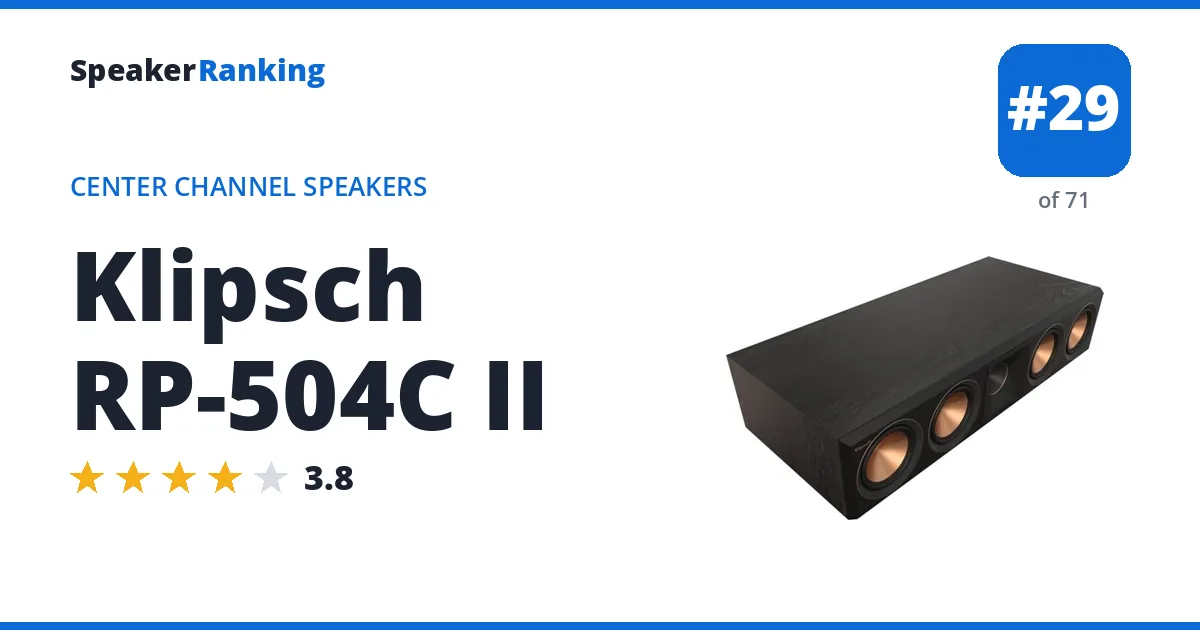
Pros: The largest Reference Premiere center puts four 5.25” Cerametallic woofers around a 1” titanium tweeter in a Tractrix horn, for a very high 96dB sensitivity. Erin’s Audio Corner measured the deepest bass of the Klipsch centers here, 71.8Hz (-3dB) and about 43Hz (-10dB), and a preference score of 4.58 without a subwoofer. Measured bass extension of 71.8Hz (-3dB).
Cons: On-axis response is the least even of the Klipsch centers (1.13dB average deviation), and directivity varies strongly with frequency (4.27dB directivity index deviation), so the tone changes for off-center seats and in reflective rooms. It is 814mm wide and 383mm deep, so check shelf depth before buying.
Full Klipsch RP-504C II review and specifications →
| Bass Extension (-10dB) | about 43.4Hz (measured, Erin’s Audio Corner) |
|---|---|
| Bass Extension (-3dB) | 71.8Hz (measured, Erin’s Audio Corner) |
| DIY Kit | No |
| Dimensions | 6.9”H x 32”W x 15.1”D (174 x 814 x 383 mm) |
| Drivers | 1” titanium LTS vented tweeter with Tractrix horn, 4x 5.25” Cerametallic woofers |
| Frequency Response | 50Hz-25kHz ±3dB (manufacturer specified) |
| Impedance | 8 ohms nominal (manufacturer specified) |
| Sensitivity | 96dB (2.83V/1m, manufacturer specified) |
| Spinorama Preference Score | 4.58 |
| Spinorama Preference Score with Perfect Sub | 6.83 |
| Weight | 36.4 lbs (16.5 kg) |
| Woofer Cabinet | ported (rear Tractrix ports) |
- Links
- Reviews, Comparisons and Sound Samples
- Head-to-Head Comparisons
- Klipsch RP-504C II vs Polk Audio Reserve R400
- Klipsch RP-504C II vs Klipsch RP-500C II
- Klipsch RP-504C II vs Polk Audio Reserve R350
- Klipsch RP-504C II vs Dynaudio Emit 25C
- Klipsch RP-504C II vs DALI Sonik Cinema
- Klipsch RP-504C II vs Focal Theva Center
- Klipsch RP-504C II vs SVS Prime Center
- Klipsch RP-504C II vs Emotiva Airmotiv XC2