Short answer: the KEF Q350 is the better pick for imaging and consistent off-axis sound, while the Triangle Borea BR03 is the stronger budget option for bass extension. Each has audible response issues, but KEF’s coaxial layout makes its room behavior easier to predict.
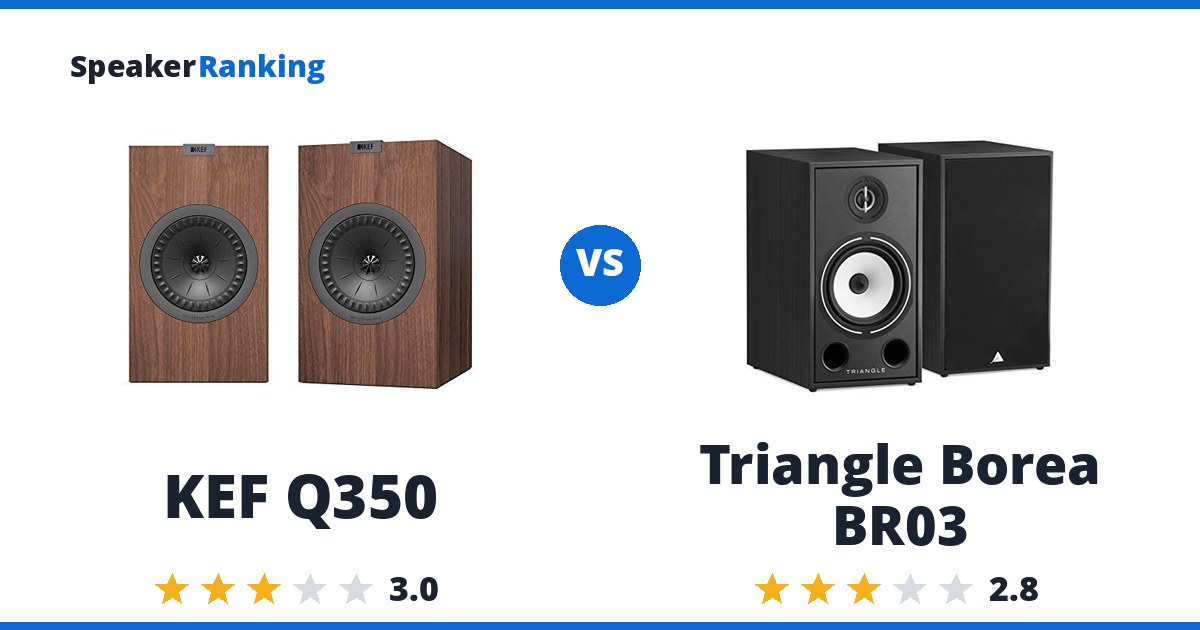
The Q350’s Uni-Q driver gives excellent directivity and a generally even on-axis response, but it has resonances near 700Hz and 1.2kHz plus an upper-bass lift. The BR03 reaches about 57Hz at -3dB and 42Hz at -10dB, yet its upper-midrange suckout is a more obvious tonal compromise.
Buy the KEF Q350 for a coherent soundstage and more stable sound across the listening area.
Buy the Triangle Borea BR03 for useful bass extension at a budget price if you can accept its recessed mids.
Want more options? Browse the full Passive Home rankings.
Specifications Side By Side
| KEF Q350 | Triangle Borea BR03 | |
|---|---|---|
| Price | $699.00 per pair Discontinued | $398.00 per pair |
| Ranked | #109 of 134 in Large Size Bookshelf Speakers | #113 of 134 in Large Size Bookshelf Speakers |
| Bass Extension (-10dB) | 38Hz (measured, Audio Science Review) | 42Hz (measured, Erin’s Audio Corner) |
| Bass Extension (-3dB) | 70Hz (measured, Audio Science Review) | 57Hz (measured, Erin’s Audio Corner) |
| Impedance | 4 ohms | 8 ohms nominal (manufacturer spec), 4.2 ohms minimum (measured, Erin’s Audio Corner) |
| Sensitivity | 86dB (measured, Audio Science Review) | 87.5dB (measured at 2.83V/1m, Erin’s Audio Corner) |
| Drivers | 25mm tweeter + 165mm woofer | 6.5” natural cellulose midwoofer, 1” (25mm) EFS silk dome tweeter |
| Weight | 29.5 lbs (13.4 kg) | 13.2 lbs (6 kg) each |
| Dimensions | 14.1”H x 8.3”W x 12”D (358.0 x 210.0 x 306.0 mm) | 14.96”H x 8.11”W x 12.36”D |
| Woofer Cabinet | ported, rear | ported, dual front ports |
| Spinorama Preference Score | 5.25 (spinorama.org) | 4.03 |
| Spinorama Preference Score with Perfect Sub | 7.12 (spinorama.org) | 6.38 |
| DIY Kit | No | No |
| Crossover Frequency | - | 3600Hz |
| Recommended Power | - | 100W |
Related Speaker Comparisons
More worthwhile head-to-heads for KEF Q350:
- KEF Q350 vs AsciLab C6B
- KEF Q350 vs KEF R3 Meta
- KEF Q Concerto Meta vs KEF Q350
- KEF Q350 vs MoFi SourcePoint 8
- Wharfedale Linton 85 vs KEF Q350
Prices on this page were last checked October 2, 2026 at 10:18 PM UTC. Product prices and availability are accurate as of that date/time and are subject to change; the price and availability shown on Amazon at the time of purchase will apply to the purchase of this product.
As an eBay Partner, we may be compensated if you make a purchase.
The Two Speakers In Full
 KEF Q350: $699.00 per pair Discontinued Amazon eBay
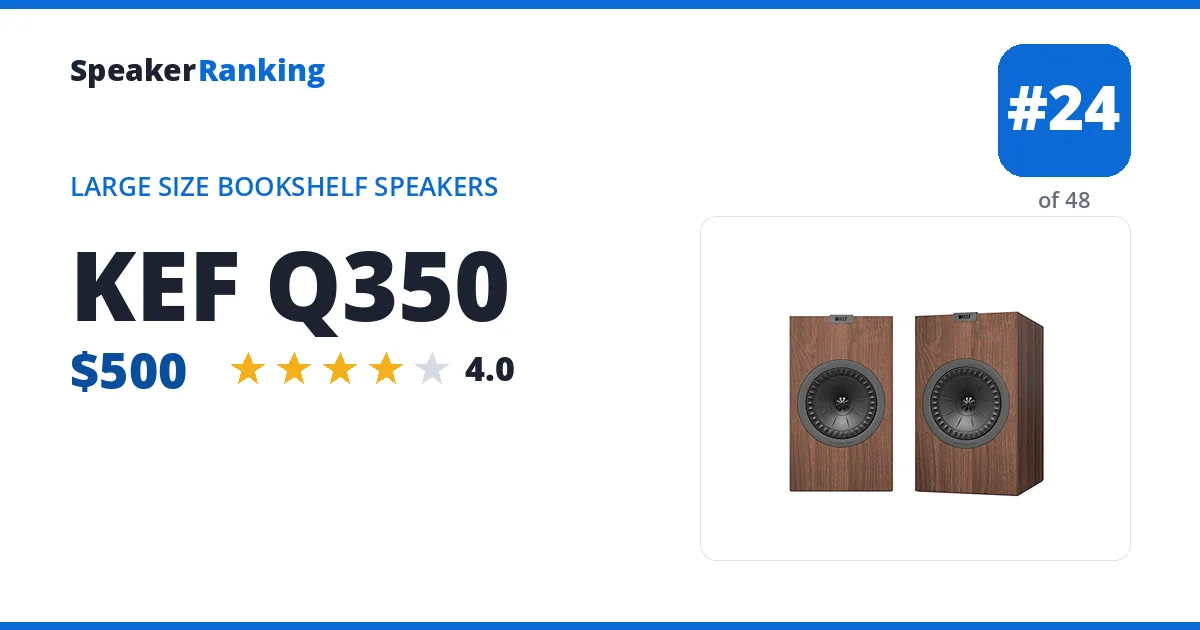
Newer model: the KEF Q3 Meta, ranked higher, rated 3.4/5.
Pros: CEA2034 spinorama shows a reasonably flat on-axis response with excellent directivity, aided by the coaxial Uni-Q driver. Vertical directivity is better than most non-coaxial two-way speakers, another benefit of the concentric design. Measured bass extension of 70Hz (-3dB), with a measured sensitivity of 86dB.
Cons: Two resonances at 700Hz and 1.2kHz show up on-axis, alongside an upper-bass boost. Predicted in-room response looks a bit boomy as a result. Distortion climbs substantially in the 100Hz-1kHz range at 96dB SPL/1m, with a distinct resonance-driven peak around 900Hz-1kHz at both test levels. Discontinued.
Full KEF Q350 review and specifications →
| Bass Extension (-10dB) | 38Hz (measured, Audio Science Review) |
|---|---|
| Bass Extension (-3dB) | 70Hz (measured, Audio Science Review) |
| DIY Kit | No |
| Dimensions | 14.1”H x 8.3”W x 12”D (358.0 x 210.0 x 306.0 mm) |
| Drivers | 25mm tweeter + 165mm woofer |
| Impedance | 4 ohms |
| Sensitivity | 86dB (measured, Audio Science Review) |
| Spinorama Preference Score | 5.25 (spinorama.org) |
| Spinorama Preference Score with Perfect Sub | 7.12 (spinorama.org) |
| Weight | 29.5 lbs (13.4 kg) |
| Woofer Cabinet | ported, rear |
- Links
- Reviews, Comparisons and Sound Samples
- Head-to-Head Comparisons
 Triangle Borea BR03: $398.00 per pair Amazon eBay
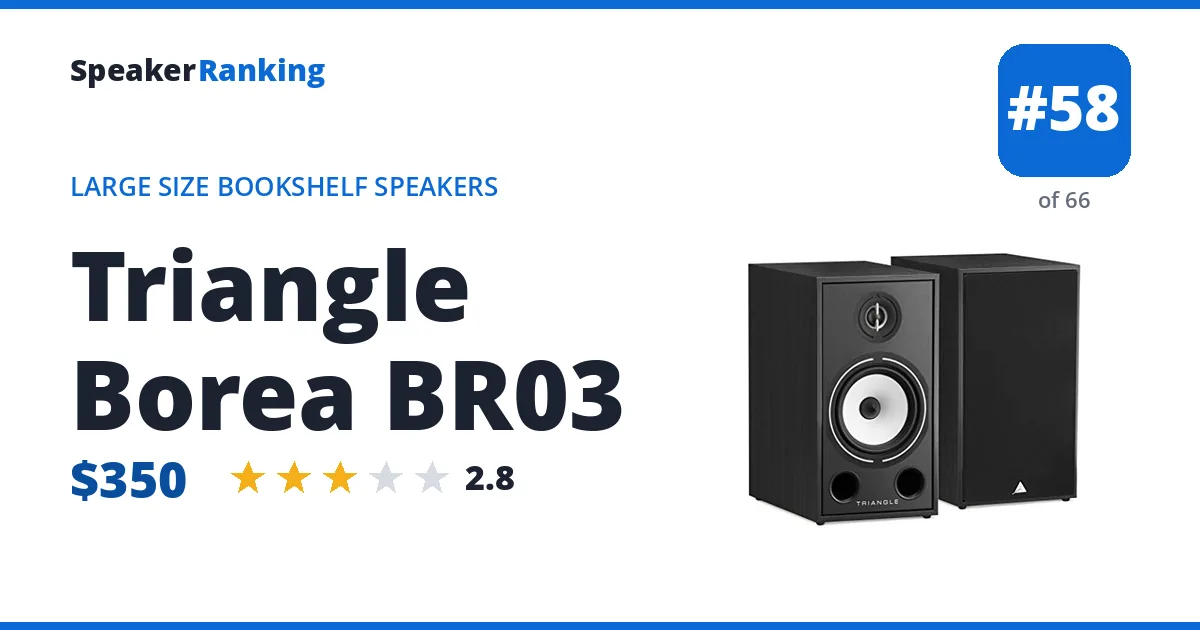
Pros: Bass output is genuinely decent for the price: measured extension reaches F3 57Hz/F10 42Hz, which the reviewer had no real complaints about. Dual front-firing ports and a well-stuffed, well-braced cabinet. Solid build quality overall. Measured bass extension of 57Hz (-3dB), with a measured sensitivity of 87.5dB.
Cons: A noticeable mid-range suckout, most pronounced in the upper mid-range/lower treble, that the reviewer attributes to cabinet resonances and driver breakup rather than a deliberate voicing choice: it makes vocals and instruments sound recessed and thin rather than warm. Sibilance in the 4-8kHz region shows up on every track the reviewer tried. Measured minimum impedance dips to about 4.2 ohms (with an even lower EPDR), despite the speaker and its own rear panel being labeled 8 ohms: worth knowing if you’re planning to drive these with a receiver/AVR that assumes an 8-ohm nominal load. The reviewer is upfront that this speaker has a devoted following among other reviewers, but says he specifically doesn’t hear what they hear and wants people who own it to trust their own ears rather than assume something’s wrong with their hearing if they don’t love it either.
Full Triangle Borea BR03 review and specifications →
| Bass Extension (-10dB) | 42Hz (measured, Erin’s Audio Corner) |
|---|---|
| Bass Extension (-3dB) | 57Hz (measured, Erin’s Audio Corner) |
| Crossover Frequency | 3600Hz |
| DIY Kit | No |
| Dimensions | 14.96”H x 8.11”W x 12.36”D |
| Drivers | 6.5” natural cellulose midwoofer, 1” (25mm) EFS silk dome tweeter |
| Impedance | 8 ohms nominal (manufacturer spec), 4.2 ohms minimum (measured, Erin’s Audio Corner) |
| Recommended Power | 100W |
| Sensitivity | 87.5dB (measured at 2.83V/1m, Erin’s Audio Corner) |
| Spinorama Preference Score | 4.03 |
| Spinorama Preference Score with Perfect Sub | 6.38 |
| Weight | 13.2 lbs (6 kg) each |
| Woofer Cabinet | ported, dual front ports |
- Links
- Reviews, Comparisons and Sound Samples
- Head-to-Head Comparisons
- Triangle Borea BR03 vs B&W 805S
- Triangle Borea BR03 vs Wharfedale Diamond 9.1
- Triangle Borea BR03 vs Klipsch RP-600M
- Triangle Borea BR03 vs Sonus Faber Lumina II Amator
- Triangle Borea BR03 vs Aperion Audio Verus V8B
- Triangle Borea BR03 vs Emotiva Airmotiv B2+
- Triangle Borea BR03 vs Sonus Faber Sonetto II G2
- Triangle Borea BR03 vs ATC SCM19
- See all 51 comparisons