Short answer: the Fosi Audio SP601, if you are buying new. The KEF Q350 ranks higher than it (#106 vs #113 of 131 bookshelf speakers, 3.0/5 vs 2.7/5) but is discontinued, so only consider it used; the Fosi Audio SP601 is still sold new at $339.99.
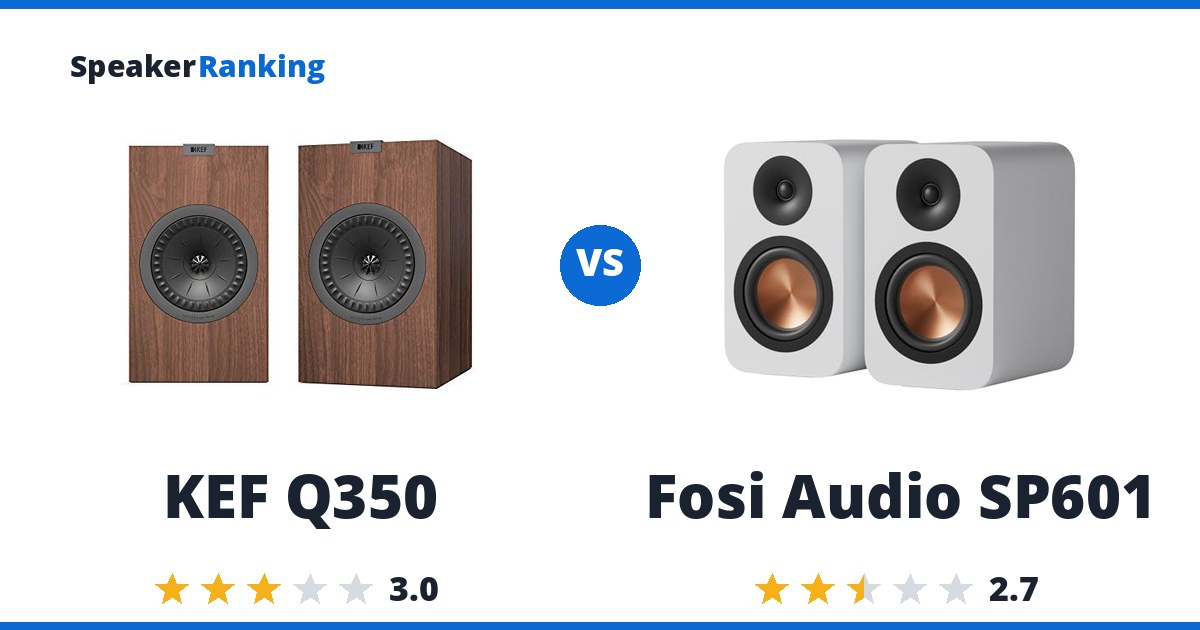
Why pick the KEF Q350: CEA2034 spinorama shows a reasonably flat on-axis response with excellent directivity, aided by the coaxial Uni-Q driver. Watch for: Two resonances at 700Hz and 1.2kHz show up on-axis, alongside an upper-bass boost.
What the Fosi Audio SP601 does well: Two-way bookshelf design with a 6.5” paper/aluminum-alloy composite cone woofer and 1.5” silk dome tweeter. The catch: An unusually erratic, up-and-down frequency response (a scooped midrange followed by an upper-mid bump, a dip, another small bump, then a strong 3-4dB peak around 4-7kHz) makes the speaker’s overall character genuinely hard to characterize: the reviewer compared the experience to a similarly disliked model, the Triangle Borea BR03, which has a comparably inconsistent response.
Buy the Fosi Audio SP601 new; the KEF Q350 is no longer sold new, so it only makes sense as a used find.
Still deciding? The full Passive Home rankings cover every ranked option.
Specifications Side By Side
| KEF Q350 | Fosi Audio SP601 | |
|---|---|---|
| Price | $699.00 per pair Discontinued | $339.99 per pair |
| Ranked | #106 of 131 in Large Size Bookshelf Speakers | #113 of 131 in Large Size Bookshelf Speakers |
| Bass Extension (-10dB) | 38Hz (measured, Audio Science Review) | 40Hz (measured, Erin’s Audio Corner) |
| Bass Extension (-3dB) | 70Hz (measured, Audio Science Review) | 59Hz (measured, Erin’s Audio Corner) |
| Impedance | 4 ohms | 4 ohms nominal, 4.1 ohms minimum (measured, Erin’s Audio Corner) |
| Sensitivity | 86dB (measured, Audio Science Review) | 85.4dB (measured, Erin’s Audio Corner) |
| Drivers | 25mm tweeter + 165mm woofer | 6.5” woofer, 1.5” Silk Dome Tweeters |
| Weight | 29.5 lbs (13.4 kg) | 11.5 lbs (5.2 kg) |
| Dimensions | 14.1”H x 8.3”W x 12”D (358.0 x 210.0 x 306.0 mm) | 14.5”H x 9.1”W x 14”D (368.3 x 231.1 x 355.6 mm) |
| Woofer Cabinet | ported, rear | ported, rear |
| Spinorama Preference Score | 5.25 (spinorama.org) | - |
| Spinorama Preference Score with Perfect Sub | 7.12 (spinorama.org) | - |
| DIY Kit | No | No |
| App | - | No |
| EQ | - | No |
| DSP | - | No |
| Power Handling | - | 80w RMS Per Speaker |
Related Speaker Comparisons
More top alternatives to KEF Q350:
- KEF Q350 vs AsciLab C6B
- KEF Q350 vs KEF R3 Meta
- KEF Q Concerto Meta vs KEF Q350
- KEF Q350 vs MoFi SourcePoint 8
- Wharfedale Linton 85 vs KEF Q350
Prices on this page were last checked September 29, 2026 at 3:43 PM UTC. Product prices and availability are accurate as of that date/time and are subject to change; the price and availability shown on Amazon at the time of purchase will apply to the purchase of this product.
As an eBay Partner, we may be compensated if you make a purchase.
The Two Speakers In Full
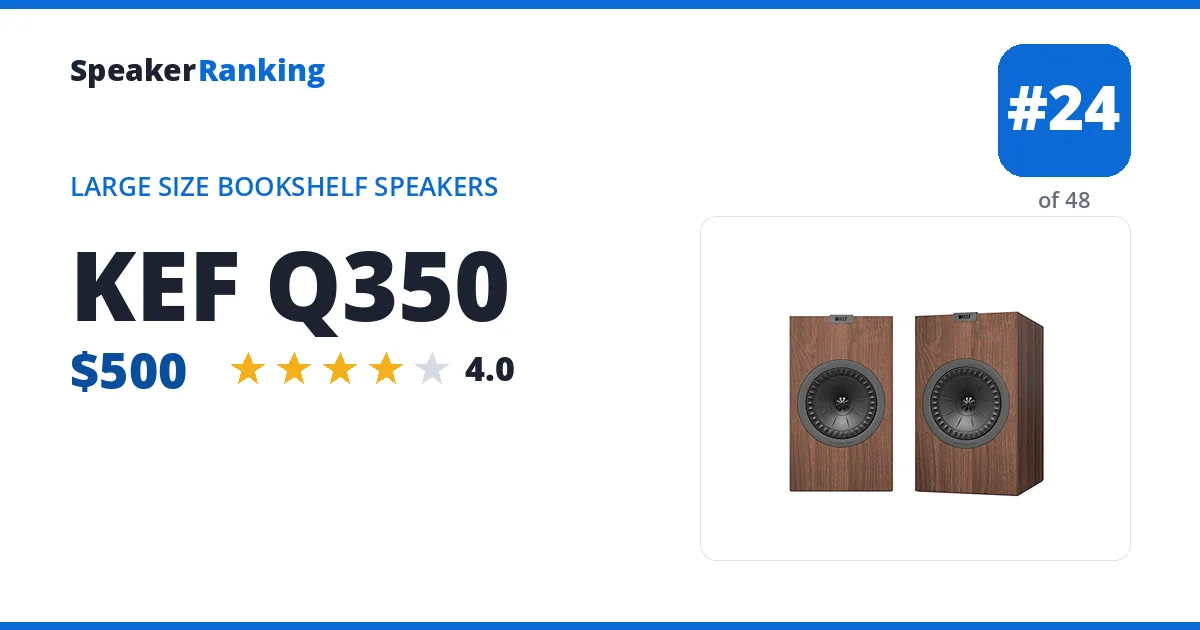
 KEF Q350: $699.00 per pair Discontinued Amazon eBay
Newer model: the KEF Q3 Meta, ranked higher, rated 3.4/5.
Pros: CEA2034 spinorama shows a reasonably flat on-axis response with excellent directivity, aided by the coaxial Uni-Q driver. Vertical directivity is better than most non-coaxial two-way speakers, another benefit of the concentric design. Measured bass extension of 70Hz (-3dB), with a measured sensitivity of 86dB.
Cons: Two resonances at 700Hz and 1.2kHz show up on-axis, alongside an upper-bass boost. Predicted in-room response looks a bit boomy as a result. Distortion climbs substantially in the 100Hz-1kHz range at 96dB SPL/1m, with a distinct resonance-driven peak around 900Hz-1kHz at both test levels. Discontinued.
Full KEF Q350 review and specifications →
| Bass Extension (-10dB) | 38Hz (measured, Audio Science Review) |
|---|---|
| Bass Extension (-3dB) | 70Hz (measured, Audio Science Review) |
| DIY Kit | No |
| Dimensions | 14.1”H x 8.3”W x 12”D (358.0 x 210.0 x 306.0 mm) |
| Drivers | 25mm tweeter + 165mm woofer |
| Impedance | 4 ohms |
| Sensitivity | 86dB (measured, Audio Science Review) |
| Spinorama Preference Score | 5.25 (spinorama.org) |
| Spinorama Preference Score with Perfect Sub | 7.12 (spinorama.org) |
| Weight | 29.5 lbs (13.4 kg) |
| Woofer Cabinet | ported, rear |
- Links
- Reviews, Comparisons and Sound Samples
- Head-to-Head Comparisons
 Fosi Audio SP601: $339.99 per pair Amazon Fosiaudio eBay
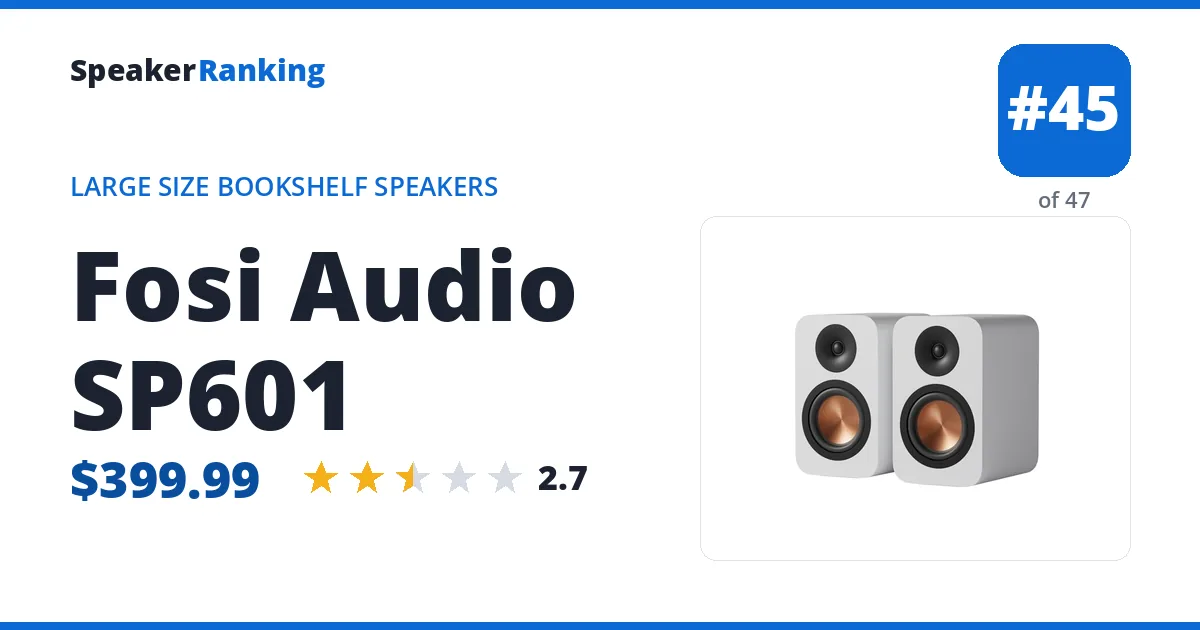
Pros: Two-way bookshelf design with a 6.5” paper/aluminum-alloy composite cone woofer and 1.5” silk dome tweeter. Bass reaches a respectable 60-70Hz in most rooms (F3 59Hz, F10 40Hz) for a budget bookshelf speaker. Distortion at 86dB and 96dB measures reasonably well at face value, and compression issues at extreme output are generally in line with what’s expected for a speaker at this price point. The overall tonal character can be substantially improved with basic EQ: the reviewer found a boost around 400Hz plus a cut around 4kHz brought it to an acceptable baseline. Measured bass extension of 59Hz (-3dB), with a measured sensitivity of 85.4dB.
Cons: An unusually erratic, up-and-down frequency response (a scooped midrange followed by an upper-mid bump, a dip, another small bump, then a strong 3-4dB peak around 4-7kHz) makes the speaker’s overall character genuinely hard to characterize: the reviewer compared the experience to a similarly disliked model, the Triangle Borea BR03, which has a comparably inconsistent response. The 4-7kHz peak gives a sharp, sibilant edge to S and T sounds in vocals. A strong diffraction dip around 4kHz followed by a peak can’t be fully corrected with EQ; the reviewer recommends sidewall absorption panels instead, since off-axis energy in the 2-7kHz range actually exceeds the direct sound reaching the listener. Multitone distortion becomes more noticeable and grainy at higher volumes, concentrated in the upper-midrange where hearing is most sensitive. A peaking distortion issue right at the crossover region suggests a possible combination of tweeter distortion and midwoofer/crossover-component strain. The enclosure sounds notably hollow when tapped, and a flashlight inspection suggested a lack of internal damping material, along with likely insufficient bracing. Vertical listening position is fairly tightly constrained around the tweeter axis. Still requires a subwoofer for real kick-drum impact and bass authority.
Full Fosi Audio SP601 review and specifications →
| App | No |
|---|---|
| Bass Extension (-10dB) | 40Hz (measured, Erin’s Audio Corner) |
| Bass Extension (-3dB) | 59Hz (measured, Erin’s Audio Corner) |
| DIY Kit | No |
| DSP | No |
| Dimensions | 14.5”H x 9.1”W x 14”D (368.3 x 231.1 x 355.6 mm) |
| Drivers | 6.5” woofer, 1.5” Silk Dome Tweeters |
| EQ | No |
| Impedance | 4 ohms nominal, 4.1 ohms minimum (measured, Erin’s Audio Corner) |
| Power Handling | 80w RMS Per Speaker |
| Sensitivity | 85.4dB (measured, Erin’s Audio Corner) |
| Weight | 11.5 lbs (5.2 kg) |
| Woofer Cabinet | ported, rear |
- Links
- Reviews, Comparisons and Sound Samples
- Head-to-Head Comparisons