Short answer: the KEF Q150. It ranks #26 of 88 bookshelf speakers by sound quality, rated 3.7/5, at $350; the Acoustic Energy AE100 Mk2 ranks #59, rated 2.9/5, and costs $399, which makes this an easy call rather than a real tradeoff.
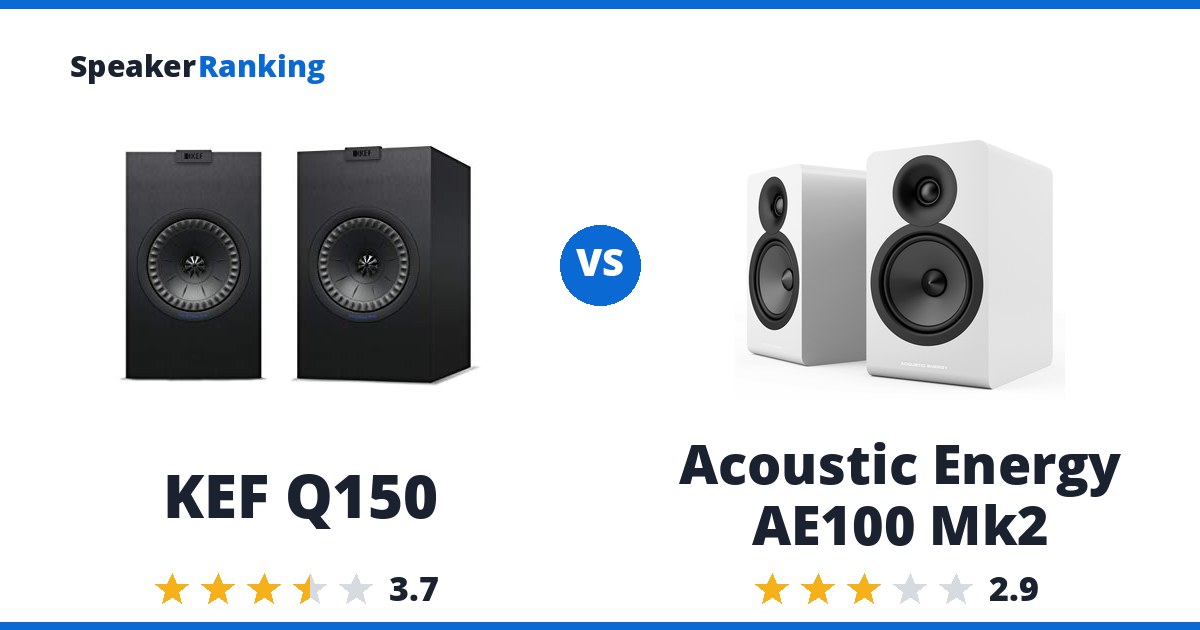
The case for the KEF Q150: Two-way coaxial (Uni-Q) design with a 1” dome tweeter and 5.25” mid-range time-aligned in a single driver assembly, available in ported or sealed configuration. The catch: A high-frequency lift in the estimated in-room response makes it sound noticeably brighter in an untreated room than in a heavily acoustically-treated one: a real preference factor depending on your room’s furnishings.
What the Acoustic Energy AE100 Mk2 does well: Good directivity linearity: on-axis and off-axis response track each other well despite an otherwise uneven overall response, which means the tonal problems can be EQ’d out with reasonably good success. Watch for: High-frequency level runs noticeably too hot regardless of placement: the reviewer tried four different setups (near/far from wall, on-axis, 30° off-axis) at two listening distances and couldn’t get it to sound right at any of them.
Worth knowing: the KEF Q150 is discontinued, though it still ranks #26 of 88 bookshelf speakers by sound quality, so a used unit beats most of what is still sold new.
Buy the KEF Q150. It is rated higher for sound quality than the Acoustic Energy AE100 Mk2 and costs less, so only choose the other one for a particular feature it does better.
Looking for alternatives? See the complete Passive Home rankings.
Specifications Side By Side
| KEF Q150 | Acoustic Energy AE100 Mk2 | |
|---|---|---|
| Price | $350 per pair Discontinued | $399 per pair Discontinued |
| Ranked | #26 of 88 in Medium Size Bookshelf Speakers | #59 of 88 in Medium Size Bookshelf Speakers |
| Bass Extension (-10dB) | 44Hz (measured, Erin’s Audio Corner) | 42Hz (measured, Erin’s Audio Corner) |
| Bass Extension (-3dB) | 51Hz (measured, Erin’s Audio Corner) | 63Hz (measured, Erin’s Audio Corner) |
| Dimensions | 11.9”H x 7.1”W x 10.9”D (303 x 180 x 278 mm) | 11.4”H x 6.5”W x 9.8”D (290 x 165 x 250 mm) |
| Impedance | 8 ohms nominal, about 4.7 ohms minimum (measured, Erin’s Audio Corner) | 6 ohms nominal, 4.7 ohms minimum (measured, Erin’s Audio Corner) |
| Sensitivity | ~85dB (300Hz-3kHz on-axis, measured, Erin’s Audio Corner) | 84dB (measured average, Erin’s Audio Corner) |
| Drivers | 130mm (5.25”) aluminium Uni-Q woofer, 25mm (1”) vented aluminium dome tweeter | 5.25” midwoofer, 1” soft fabric dome tweeter with waveguide |
| Weight | 12.3 lbs (5.6 kg) each | 20.1 lbs (9.1 kg) each |
| Woofer Cabinet | ported, rear | ported, rear slot port |
| Spinorama Preference Score | 4.86 | 4.96 |
| Spinorama Preference Score with Perfect Sub | 7.06 | 7.18 |
| DIY Kit | No | No |
| Crossover Frequency | - | 2.9kHz |
Related Speaker Comparisons
More top alternatives to KEF Q150:
- KEF Q150 vs Audio First Fidelia
- KEF Q150 vs Philharmonic Ceramic Mini
- Ascend Sierra 1 v2 vs KEF Q150
- KEF LS50 Meta vs KEF Q150
- KEF Q150 vs Ascend Acoustics Luna V2 Mini-Monitor Ribbon
Prices on this page were last checked September 29, 2026 at 3:43 PM UTC. Product prices and availability are accurate as of that date/time and are subject to change; the price and availability shown on Amazon at the time of purchase will apply to the purchase of this product.
As an eBay Partner, we may be compensated if you make a purchase.
The Two Speakers In Full
 KEF Q150: $350 per pair Discontinued Amazon eBay
Newer model: the KEF Q1 Meta, ranked lower, rated 3.6/5.
Pros: Two-way coaxial (Uni-Q) design with a 1” dome tweeter and 5.25” mid-range time-aligned in a single driver assembly, available in ported or sealed configuration. Exceptional soundstage depth, a hallmark of KEF’s coaxial designs that the reviewer says few other speakers match. Bass extension reaches into kick-drum territory, respectable for a compact bookshelf speaker. Resonances present in measurements are consistent across on- and off-axis readings, meaning they can be effectively corrected with EQ. Distortion profile is essentially the same whether run sealed or ported, since a subwoofer crossover point sits above where the differences would matter anyway. At its sale price (around $300, sometimes seen at $400), the reviewer considers it a clear step up from his previous budget favorite in this range, the Emotiva B1+, mainly due to the superior soundstage depth. Measured bass extension of 51Hz (-3dB), with a measured sensitivity of 85dB.
Cons: A high-frequency lift in the estimated in-room response makes it sound noticeably brighter in an untreated room than in a heavily acoustically-treated one: a real preference factor depending on your room’s furnishings. A mild dip in the 1-2kHz region reduces vocal fullness somewhat. Unexplained resonances appear in measurements and persist in both sealed and ported configurations, pointing to enclosure or panel vibration rather than the port. Horizontal radiation is narrower than the reviewer generally prefers from KEF’s lineup, with directivity that widens somewhat around 1.2kHz (near a resonance) and again above about 5kHz. Compression testing at high output (102dB) shows significant nonlinearity, especially at lower frequencies: noticeably worse than a comparable Arendal bookshelf speaker costing over twice as much, which held up better until 80Hz. Not intended for loud listening without a subwoofer: the woofer will over-exert itself without a high-pass filter, and the reviewer recommends crossing over at 80-120Hz. At full retail price (around $600/pair), the value proposition is far less certain than at sale pricing. Discontinued.
Full KEF Q150 review and specifications →
| Bass Extension (-10dB) | 44Hz (measured, Erin’s Audio Corner) |
|---|---|
| Bass Extension (-3dB) | 51Hz (measured, Erin’s Audio Corner) |
| DIY Kit | No |
| Dimensions | 11.9”H x 7.1”W x 10.9”D (303 x 180 x 278 mm) |
| Drivers | 130mm (5.25”) aluminium Uni-Q woofer, 25mm (1”) vented aluminium dome tweeter |
| Impedance | 8 ohms nominal, about 4.7 ohms minimum (measured, Erin’s Audio Corner) |
| Sensitivity | ~85dB (300Hz-3kHz on-axis, measured, Erin’s Audio Corner) |
| Spinorama Preference Score | 4.86 |
| Spinorama Preference Score with Perfect Sub | 7.06 |
| Weight | 12.3 lbs (5.6 kg) each |
| Woofer Cabinet | ported, rear |
- Links
- Reviews, Comparisons and Sound Samples
- Erin’s Audio Corner: Kef’s Cheapest Bookshelf. Is the Q150 worth your money? More from Erin’s Audio Corner →
- Erin’s Audio Corner Website KEF Q150
- GR-Research: KEF Q150… can it get any BETTER? More from GR-Research →
- Erin’s Audio Corner: 5 AWESOME SPEAKERS Under $1000 You Won’t Regret
- Erin’s Audio Corner: Budget Stereo Systems You Will Love
- Erin’s Audio Corner Measurements (spinorama.org)
- Head-to-Head Comparisons
 Acoustic Energy AE100 Mk2: $399 per pair Discontinued Amazon eBay
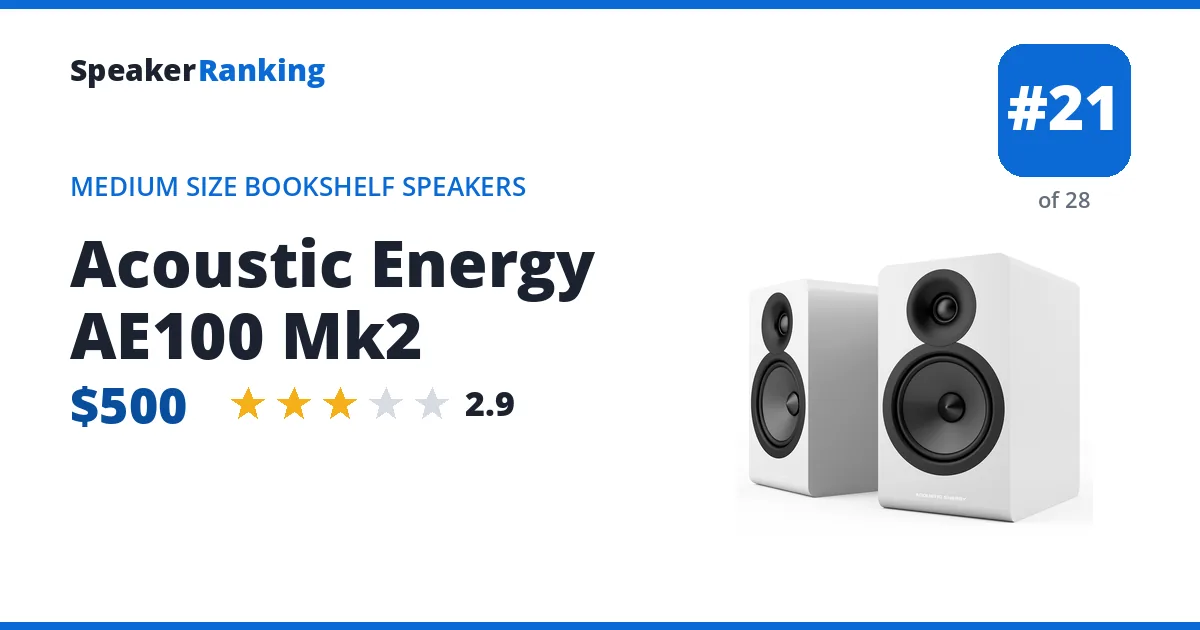
Pros: Good directivity linearity: on-axis and off-axis response track each other well despite an otherwise uneven overall response, which means the tonal problems can be EQ’d out with reasonably good success. Wide horizontal radiation, about ±50°. Nicely finished cabinet: the reviewer specifically called out the fit and finish as a genuine positive. Both units of the review pair measured closely matched to each other. Measured bass extension of 63Hz (-3dB), with a measured sensitivity of 84dB.
Cons: High-frequency level runs noticeably too hot regardless of placement: the reviewer tried four different setups (near/far from wall, on-axis, 30° off-axis) at two listening distances and couldn’t get it to sound right at any of them. A mid-range dip that the reviewer attributes to internal cabinet resonance rather than intentional baffle-step compensation, reinforced by an internal inspection showing no cross-bracing and a slot port that may itself be resonating when tapped. Small tweeter waveguide magnet suggests limited power handling headroom. At this price and radiation pattern, the reviewer would pick the ELAC DBR62 (more neutral, similar ±60° pattern) or, for less money, the ELAC Debut 2.0 B6.2 over this speaker; the KEF Q150 and SVS Prime Bookshelf are also called out as more linear alternatives nearby in price. Discontinued.
Full Acoustic Energy AE100 Mk2 review and specifications →
| Bass Extension (-10dB) | 42Hz (measured, Erin’s Audio Corner) |
|---|---|
| Bass Extension (-3dB) | 63Hz (measured, Erin’s Audio Corner) |
| Crossover Frequency | 2.9kHz |
| DIY Kit | No |
| Dimensions | 11.4”H x 6.5”W x 9.8”D (290 x 165 x 250 mm) |
| Drivers | 5.25” midwoofer, 1” soft fabric dome tweeter with waveguide |
| Impedance | 6 ohms nominal, 4.7 ohms minimum (measured, Erin’s Audio Corner) |
| Sensitivity | 84dB (measured average, Erin’s Audio Corner) |
| Spinorama Preference Score | 4.96 |
| Spinorama Preference Score with Perfect Sub | 7.18 |
| Weight | 20.1 lbs (9.1 kg) each |
| Woofer Cabinet | ported, rear slot port |
- Links
- Reviews, Comparisons and Sound Samples
- Head-to-Head Comparisons