Short answer: a tie on sound quality. Both are rated 3.6/5 (#40 and #38 of 89 bookshelf speakers) at nearly the same price ($699.99 vs $699), so choose on features and fit.
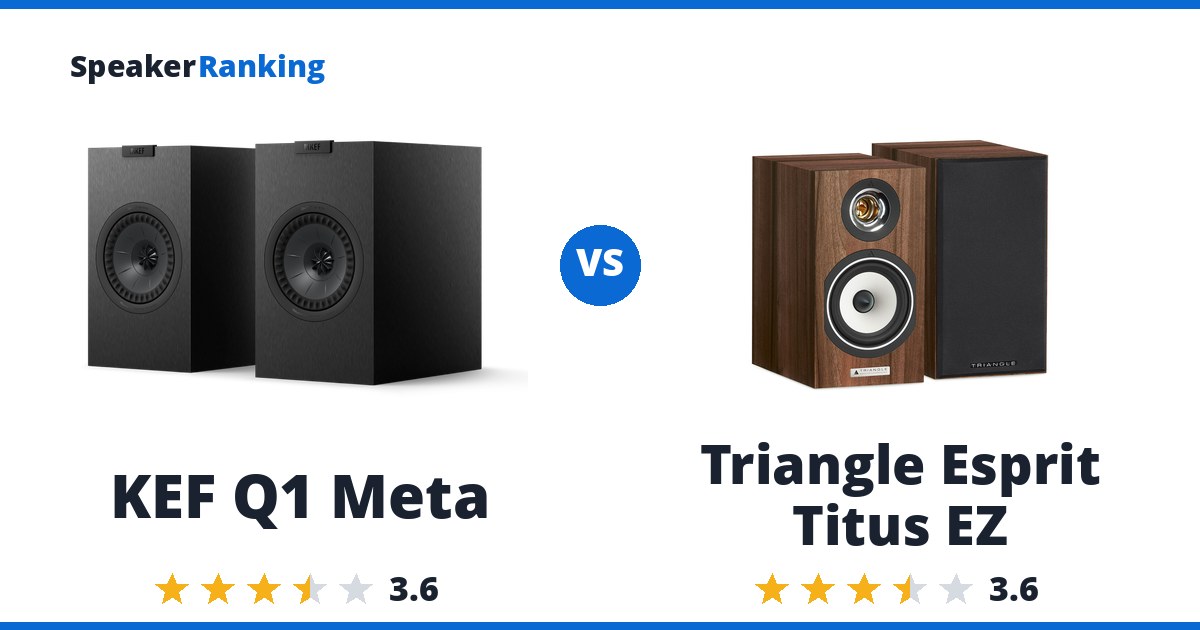
The case for the KEF Q1 Meta: 12th generation Uni-Q coaxial driver places the 1” vented aluminium dome tweeter at the centre of the 5.25” aluminium woofer, with KEF’s Metamaterial Absorption Technology behind the tweeter. The tradeoff: The only measurements are KEF’s own, not independently verified, and spinorama.org computes no preference score for them because the data is truncated at low frequencies.
What the Triangle Esprit Titus EZ does well: High 90dB specified sensitivity, a lively horn-loaded titanium tweeter and compact real hi-fi cabinetry. The catch: The 62Hz measured extension still calls for a subwoofer, while the 3.8-ohm minimum impedance demands a competent amplifier.
Buy the KEF Q1 Meta or the Triangle Esprit Titus EZ on features: they are rated the same for sound quality at close to the same price.
Want more options? Browse the full Passive Home rankings.
Specifications Side By Side
| KEF Q1 Meta | Triangle Esprit Titus EZ | |
|---|---|---|
| Price | $699.99 per pair | $699 per pair |
| Ranked | #40 of 89 in Medium Size Bookshelf Speakers | #38 of 89 in Medium Size Bookshelf Speakers |
| Drivers | Uni-Q: 130mm (5.25”) aluminium cone woofer, 25mm (1”) vented aluminium dome tweeter with MAT | 1-inch titanium horn tweeter, 5-inch paper midwoofer |
| Frequency Response | 51Hz-20kHz ±3dB (manufacturer specified) | 55Hz-22kHz |
| Sensitivity | 86dB (2.83V/1m, manufacturer specified) | 90dB |
| Impedance | 4 ohms nominal, 3.2 ohms minimum (manufacturer specified) | 8 ohms nominal, 3.8 ohms minimum |
| Recommended Power | 10-150W | - |
| Maximum SPL | 108dB (manufacturer specified) | - |
| Crossover Frequency | 2.1kHz | - |
| Woofer Cabinet | ported | - |
| Dimensions | 11.9”H x 7.1”W x 10.9”D (302 x 180 x 277 mm) | 12H x 6.6W x 10.5D in |
| Weight | 13.4 lbs (6.1 kg) each | 13 lbs (5.9 kg) each |
| Cabinet Color | Satin Black, Satin White, Walnut | - |
| Bass Extension (-3dB) | 65.1Hz (measured, KEF vendor data via spinorama.org) | 73.4Hz (measured, spinorama.org) |
| Bass Extension (-10dB) | about 43.4Hz (measured, KEF vendor data via spinorama.org) | 56.0Hz (derived, log-interpolated between spinorama.org -9dB/-12dB points) |
| Enclosure | - | 2-way rear-ported |
| Spinorama Preference Score | - | 4.24 |
| Spinorama Preference Score with Perfect Sub | - | 6.98 |
| DIY Kit | - | No |
Related Speaker Comparisons
More worthwhile head-to-heads for Triangle Esprit Titus EZ:
- KEF LS50 Meta vs Triangle Esprit Titus EZ
- KEF Q150 vs Triangle Esprit Titus EZ
- KEF Q1 Meta vs PSB Alpha P5
- KEF Q1 Meta vs MartinLogan Motion B10
- KEF LS50 Meta vs Micca MB42X G2
Prices on this page were last checked September 26, 2026 at 11:14 PM UTC. Product prices and availability are accurate as of that date/time and are subject to change; the price and availability shown on Amazon at the time of purchase will apply to the purchase of this product.
As an eBay Partner, we may be compensated if you make a purchase.
The Two Speakers In Full
 KEF Q1 Meta: $699.99 per pair Amazon eBay
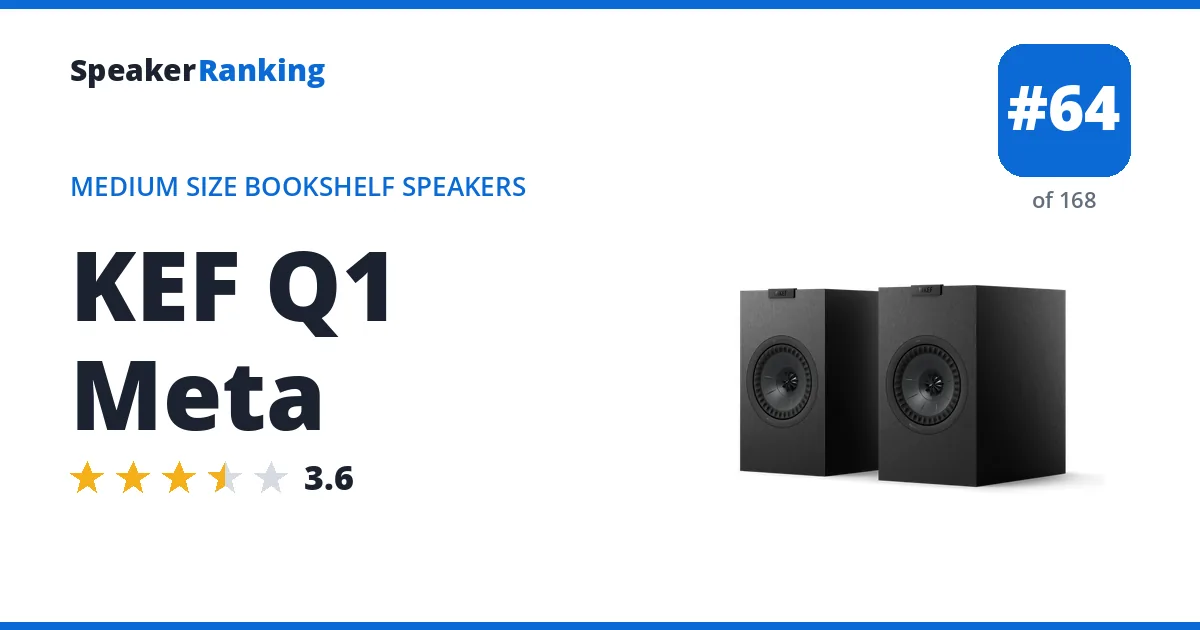
Older models: the KEF Q150 (rated 3.7/5) and the KEF Q100 (rated 2.4/5).
Pros: 12th generation Uni-Q coaxial driver places the 1” vented aluminium dome tweeter at the centre of the 5.25” aluminium woofer, with KEF’s Metamaterial Absorption Technology behind the tweeter. KEF’s own Spinorama measurements, published on spinorama.org, hold the 300Hz to 5kHz response within 2.3dB with a flat on-axis trend, so the tonal balance is even. Measured bass reaches 65Hz (-3dB) and about 43Hz (-10dB), respectable for a compact bookshelf. Same cabinet size as the Q150 it replaces. Measured bass extension of 65.1Hz (-3dB).
Cons: The only measurements are KEF’s own, not independently verified, and spinorama.org computes no preference score for them because the data is truncated at low frequencies. Sound power directivity is less even than the best in this class (3.16dB index deviation), so off-axis listeners and room reflections shift the balance more. Minimum impedance of 3.2 ohms is a harder load than the Q150’s, and rated maximum output is a modest 108dB, so plan on a subwoofer for loud listening.
Full KEF Q1 Meta review and specifications →
| Bass Extension (-10dB) | about 43.4Hz (measured, KEF vendor data via spinorama.org) |
|---|---|
| Bass Extension (-3dB) | 65.1Hz (measured, KEF vendor data via spinorama.org) |
| Cabinet Color | Satin Black, Satin White, Walnut |
| Crossover Frequency | 2.1kHz |
| Dimensions | 11.9”H x 7.1”W x 10.9”D (302 x 180 x 277 mm) |
| Drivers | Uni-Q: 130mm (5.25”) aluminium cone woofer, 25mm (1”) vented aluminium dome tweeter with MAT |
| Frequency Response | 51Hz-20kHz ±3dB (manufacturer specified) |
| Impedance | 4 ohms nominal, 3.2 ohms minimum (manufacturer specified) |
| Maximum SPL | 108dB (manufacturer specified) |
| Recommended Power | 10-150W |
| Sensitivity | 86dB (2.83V/1m, manufacturer specified) |
| Weight | 13.4 lbs (6.1 kg) each |
| Woofer Cabinet | ported |
- Links
- Reviews, Comparisons and Sound Samples
- Head-to-Head Comparisons
 Triangle Esprit Titus EZ: $699 per pair Triangle Hi-Fi eBay
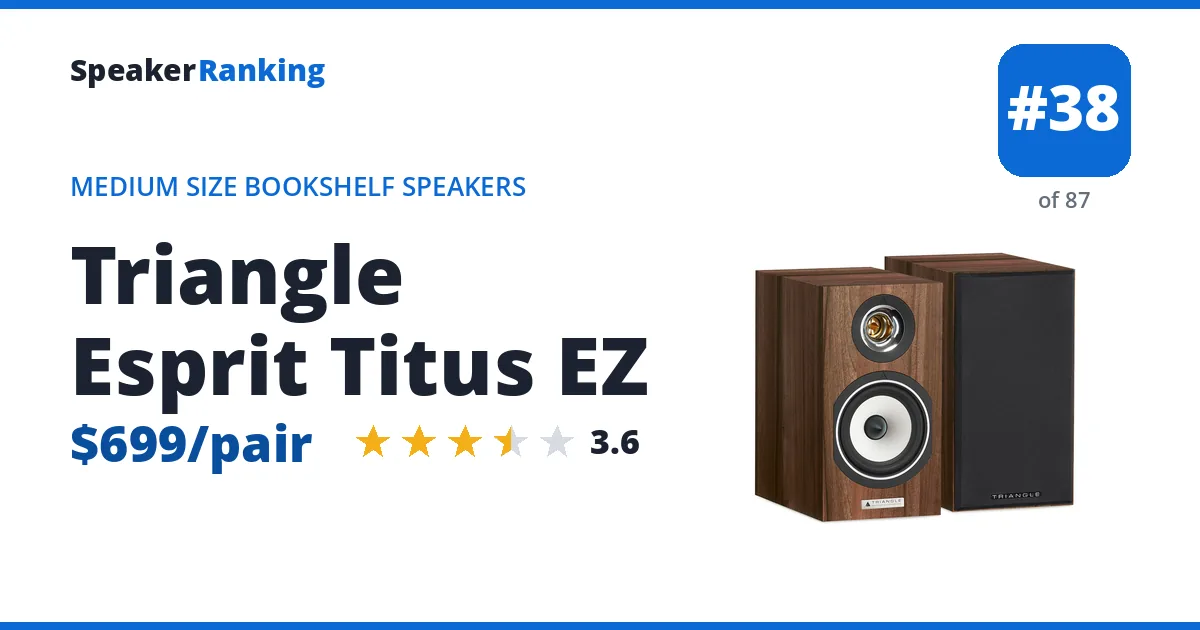
Pros: High 90dB specified sensitivity, a lively horn-loaded titanium tweeter and compact real hi-fi cabinetry. Its local Spinorama scores are 4.24 raw and 6.98 with a subwoofer, supporting a capable small-room system. Measured bass extension of 73.4Hz (-3dB).
Cons: The 62Hz measured extension still calls for a subwoofer, while the 3.8-ohm minimum impedance demands a competent amplifier. Horn/directivity behavior makes setup and toe-in more consequential.
Full Triangle Esprit Titus EZ review and specifications →
| Bass Extension (-10dB) | 56.0Hz (derived, log-interpolated between spinorama.org -9dB/-12dB points) |
|---|---|
| Bass Extension (-3dB) | 73.4Hz (measured, spinorama.org) |
| DIY Kit | No |
| Dimensions | 12H x 6.6W x 10.5D in |
| Drivers | 1-inch titanium horn tweeter, 5-inch paper midwoofer |
| Enclosure | 2-way rear-ported |
| Frequency Response | 55Hz-22kHz |
| Impedance | 8 ohms nominal, 3.8 ohms minimum |
| Sensitivity | 90dB |
| Spinorama Preference Score | 4.24 |
| Spinorama Preference Score with Perfect Sub | 6.98 |
| Weight | 13 lbs (5.9 kg) each |
- Links
- Reviews, Comparisons and Sound Samples
- Head-to-Head Comparisons