Short answer: the KEF LS50 Meta on measured sound quality, the Jamo S7-15B on price. The KEF LS50 Meta ranks #4 of 87 bookshelf speakers at $1599. The Jamo S7-15B ranks #31 at $299, $1300 cheaper.
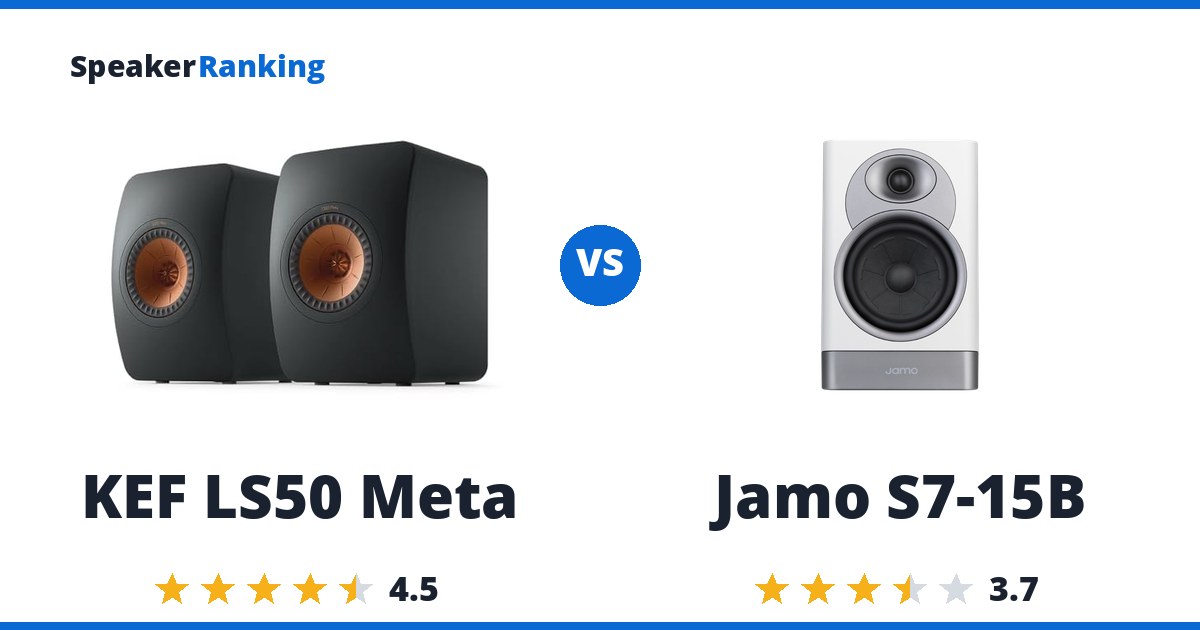
What the KEF LS50 Meta offers: Uni-Q concentric driver mounts a 1” vented aluminum dome tweeter at the center of a 5.25” aluminum cone woofer, rated 79Hz-20kHz+. Speaker-to-speaker matching measured tight at roughly 0.5dB deviation between the pair tested, versus 2-3dB seen on some other speakers - likely why imaging stayed so precise. Imaging stays tight and focused even toed out, unlike most coincident designs where toe-out typically diffuses the image, giving more of an oval-shaped soundstage than a hard rectangular boundary. Horizontal and vertical directivity both hold to about ±50° at the -6dB point, so tonality stays consistent across roughly a 100° listening cone. The extended bass shelf is deliberately tuned for near-wall/boundary placement rather than the usual “pull it 3 feet into the room” advice, playing lower without excess boominess when placed close to a wall. At $1,000 (a frequent sale price versus $1,600 list), called a no-brainer for a compact stand-mount speaker. Independent ASR Klippel measurements corroborate this: very good directivity with the on- and off-axis curves tracking closely, and a predicted in-room response the reviewer called “very close to ideal.” Watch for: F3 of 67Hz and F10 of 42Hz mean it doesn’t get much below 50Hz in-room; a subwoofer is recommended for real bass. A 2-3dB scoop around 2-4kHz shows up in both the listening window and sound power measurements, matching a subjectively noticed lack of attack and vocal clarity that the reviewer wanted to correct with about 2dB of EQ. An on-axis diffraction dip around 8kHz smooths out with about 15° of toe-out (typical for concentric designs, but still present at 0°). Distortion is elevated at low frequencies since the single 5.25” cone shares surface area with the tweeter housing, reducing effective radiating area; multitone distortion crosses the 3% threshold at 96dB/1m, making roughly 88dB or below the safer output ceiling. Moderate sensitivity (~83dB average) needed 2-3dB more amplifier gain than typical in testing. Adding a subwoofer at an 80Hz crossover only helps lower-midrange distortion, not the elevated distortion in the 1-2kHz and above-5kHz regions. ASR’s own Klippel testing found the same pattern in starker terms: THD is very good at 86dB SPL/1m but climbs past 100% in the bass at 96dB SPL/1m, confirming this is not a near-field speaker for high-output bass-heavy material. Cumulative spectral decay (waterfall) also shows a couple of resonances lingering in the 1-2kHz region.
What the Jamo S7-15B offers: Distinctive 7-degree tilted cabinetry, fabric-dome tweeter and a solid 3.74 raw local Spinorama score. With a subwoofer it reaches 5.88, while the compact format and magnetic grilles suit living-room use. Watch for: Despite the 45Hz snapshot extension metric, Jamo specifies a conservative 71Hz +/-3dB bandwidth, so deep bass needs support. The four-ohm load and modest 86.3dB sensitivity require a capable amplifier.
Buy the KEF LS50 Meta if sound quality matters more than the price. Buy the Jamo S7-15B if the price matters more than sound quality.
Looking for alternatives? See the complete Passive Home rankings.
Specifications Side By Side
| KEF LS50 Meta | Jamo S7-15B | |
|---|---|---|
| Price | $1,599.00 per pair | $299.00 per pair |
| Ranked | #4 of 87 in Medium Size Bookshelf Speakers | #31 of 87 in Medium Size Bookshelf Speakers |
| Bass Extension (-10dB) | 43Hz (measured, Erin's Audio Corner) | - |
| Bass Extension (-3dB) | 68Hz (measured, Erin's Audio Corner) | - |
| Dimensions | 11.9"H x 7.9"W x 11"D (302 x 200 x 280.5 mm) | 12.6H x 7.9W x 13.4D in |
| Impedance | 8 ohms nominal (3.7 ohms minimum above 80Hz, measured by Erin's Audio Corner) | 4 ohms |
| Sensitivity | 83dB (measured average, Erin's Audio Corner; 85dB manufacturer specified) | 86.3dB |
| Drivers | 130 mm (5.25 in.) aluminium cone woofer, 25 mm (1 in.) vented aluminium dome with Metamaterial Absorption tweeter | 1-inch fabric tweeter, 5.5-inch paper woofer |
| Weight | 17.2 lbs (7.8 kg) each | 13 lbs (5.9 kg) each |
| Woofer Cabinet | ported, rear | - |
| Spinorama Preference Score | 4.88 | 3.74 |
| Spinorama Preference Score with Perfect Sub | 7.02 | 5.88 |
| Enclosure | - | 2-way bass reflex |
| Frequency Response | - | 71Hz-22kHz +/-3dB |
Related Speaker Comparisons
More worthwhile head-to-heads for KEF LS50 Meta:
- KEF LS50 Meta vs Audio First Fidelia
- KEF LS50 Meta vs Philharmonic Ceramic Mini
- Ascend Sierra 1 v2 vs KEF LS50 Meta
- Ascend Acoustics Luna V2 Mini-Monitor Ribbon vs KEF LS50 Meta
- KEF LS50 Meta vs XMechanik Mechano23 DIY
Prices on this page were last checked September 16, 2026 at 12:41 AM UTC. Product prices and availability are accurate as of that date/time and are subject to change; the price and availability shown on Amazon at the time of purchase will apply to the purchase of this product.
As an eBay Partner, we may be compensated if you make a purchase.
The Two Speakers In Full
 KEF LS50 Meta: $1,599.00 per pair Amazon Crutchfield eBay
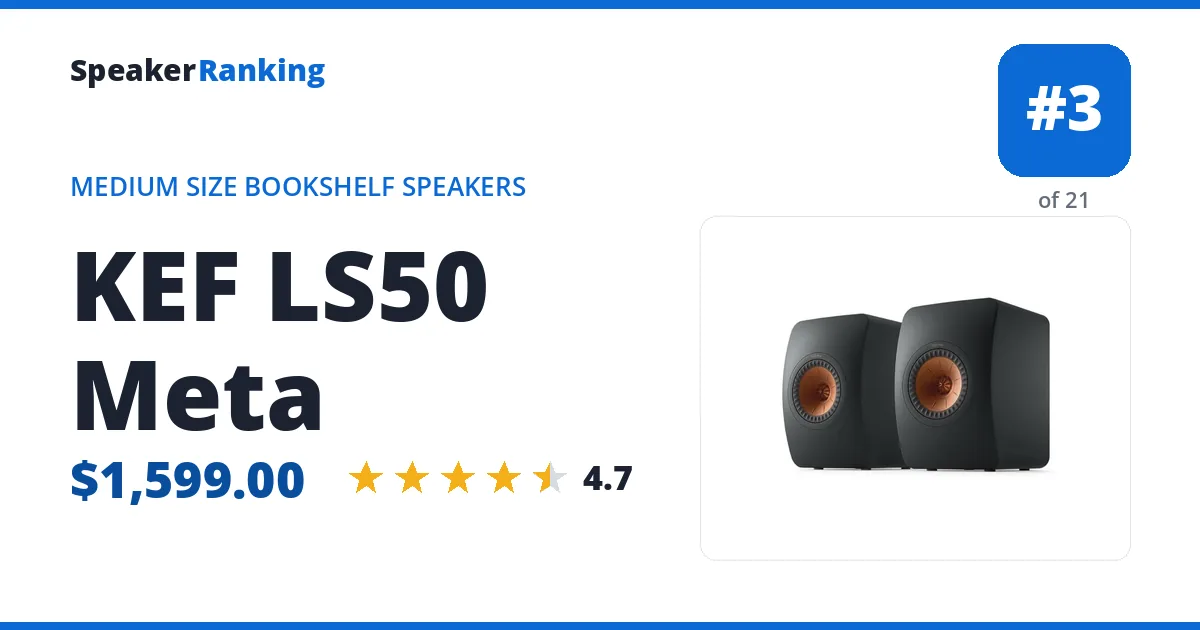
Pros: Uni-Q concentric driver mounts a 1” vented aluminum dome tweeter at the center of a 5.25” aluminum cone woofer, rated 79Hz-20kHz+. Speaker-to-speaker matching measured tight at roughly 0.5dB deviation between the pair tested, versus 2-3dB seen on some other speakers - likely why imaging stayed so precise. Imaging stays tight and focused even toed out, unlike most coincident designs where toe-out typically diffuses the image, giving more of an oval-shaped soundstage than a hard rectangular boundary. Horizontal and vertical directivity both hold to about ±50° at the -6dB point, so tonality stays consistent across roughly a 100° listening cone. The extended bass shelf is deliberately tuned for near-wall/boundary placement rather than the usual “pull it 3 feet into the room” advice, playing lower without excess boominess when placed close to a wall. At $1,000 (a frequent sale price versus $1,600 list), called a no-brainer for a compact stand-mount speaker. Independent ASR Klippel measurements corroborate this: very good directivity with the on- and off-axis curves tracking closely, and a predicted in-room response the reviewer called “very close to ideal.”. Measured bass extension of 68Hz (-3dB), with a measured sensitivity of 83dB.
Cons: F3 of 67Hz and F10 of 42Hz mean it doesn’t get much below 50Hz in-room; a subwoofer is recommended for real bass. A 2-3dB scoop around 2-4kHz shows up in both the listening window and sound power measurements, matching a subjectively noticed lack of attack and vocal clarity that the reviewer wanted to correct with about 2dB of EQ. An on-axis diffraction dip around 8kHz smooths out with about 15° of toe-out (typical for concentric designs, but still present at 0°). Distortion is elevated at low frequencies since the single 5.25” cone shares surface area with the tweeter housing, reducing effective radiating area; multitone distortion crosses the 3% threshold at 96dB/1m, making roughly 88dB or below the safer output ceiling. Moderate sensitivity (~83dB average) needed 2-3dB more amplifier gain than typical in testing. Adding a subwoofer at an 80Hz crossover only helps lower-midrange distortion, not the elevated distortion in the 1-2kHz and above-5kHz regions. ASR’s own Klippel testing found the same pattern in starker terms: THD is very good at 86dB SPL/1m but climbs past 100% in the bass at 96dB SPL/1m, confirming this is not a near-field speaker for high-output bass-heavy material. Cumulative spectral decay (waterfall) also shows a couple of resonances lingering in the 1-2kHz region.
Full KEF LS50 Meta review and specifications →
| Bass Extension (-10dB) | 43Hz (measured, Erin's Audio Corner) |
|---|---|
| Bass Extension (-3dB) | 68Hz (measured, Erin's Audio Corner) |
| Dimensions | 11.9"H x 7.9"W x 11"D (302 x 200 x 280.5 mm) |
| Drivers | 130 mm (5.25 in.) aluminium cone woofer, 25 mm (1 in.) vented aluminium dome with Metamaterial Absorption tweeter |
| Impedance | 8 ohms nominal (3.7 ohms minimum above 80Hz, measured by Erin's Audio Corner) |
| Sensitivity | 83dB (measured average, Erin's Audio Corner; 85dB manufacturer specified) |
| Spinorama Preference Score | 4.88 |
| Spinorama Preference Score with Perfect Sub | 7.02 |
| Weight | 17.2 lbs (7.8 kg) each |
| Woofer Cabinet | ported, rear |
- Links
- Reviews, Comparisons and Sound Samples
- Erin’s Audio Corner: Unveiling the KEF LS50 Meta: The Truth Behind the Hype More from Erin’s Audio Corner →
- Erin’s Audio Corner Website KEF LS50 Meta
- Audio Science Review KEF LS50 Meta More from Audio Science Review →
- GR-Research: KEF LS50 Meta! Worthy of HYPE? More from GR-Research →
- Erin’s Audio Corner: My Top Picks of 2023: Must-Haves Under $3000
- Erin’s Audio Corner Measurements (spinorama.org)
- Head-to-Head Comparisons
- KEF LS50 Meta vs Ascend Sierra 1 v2
- KEF LS50 Meta vs Ascend Acoustics Luna V2 Mini-Monitor Ribbon
- KEF LS50 Meta vs Philharmonic Ceramic Mini
- KEF LS50 Meta vs XMechanik Mechano23 DIY
- KEF LS50 Meta vs Audio First Fidelia
- KEF LS50 Meta vs Ascend Acoustics HTM-200SE2
- KEF LS50 Meta vs Arendal 1961 Monitor
- KEF LS50 Meta vs SunAudio Purified 4
- See all 85 comparisons
 Jamo S7-15B: $299.00 per pair Amazon eBay
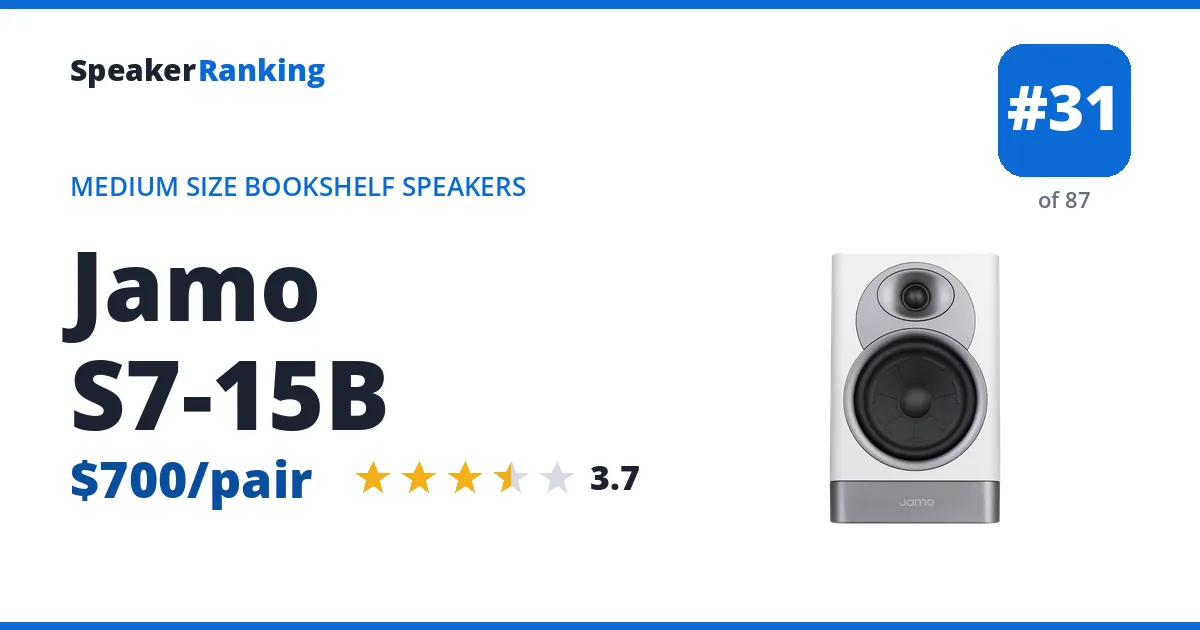
Pros: Distinctive 7-degree tilted cabinetry, fabric-dome tweeter and a solid 3.74 raw local Spinorama score. With a subwoofer it reaches 5.88, while the compact format and magnetic grilles suit living-room use.
Cons: Despite the 45Hz snapshot extension metric, Jamo specifies a conservative 71Hz +/-3dB bandwidth, so deep bass needs support. The four-ohm load and modest 86.3dB sensitivity require a capable amplifier.
Full Jamo S7-15B review and specifications →
| Dimensions | 12.6H x 7.9W x 13.4D in |
|---|---|
| Drivers | 1-inch fabric tweeter, 5.5-inch paper woofer |
| Enclosure | 2-way bass reflex |
| Frequency Response | 71Hz-22kHz +/-3dB |
| Impedance | 4 ohms |
| Sensitivity | 86.3dB |
| Spinorama Preference Score | 3.74 |
| Spinorama Preference Score with Perfect Sub | 5.88 |
| Weight | 13 lbs (5.9 kg) each |
- Links
- Reviews, Comparisons and Sound Samples
- Head-to-Head Comparisons