Short answer: the Airpulse A100. It ranks #25 of 67 powered bookshelf speakers by sound quality, rated 4.0/5, at $999.99. The Kanto Tuk G2 ranks #32, rated 3.9/5, at $899.99, $100 cheaper, which does not close the gap in sound quality.
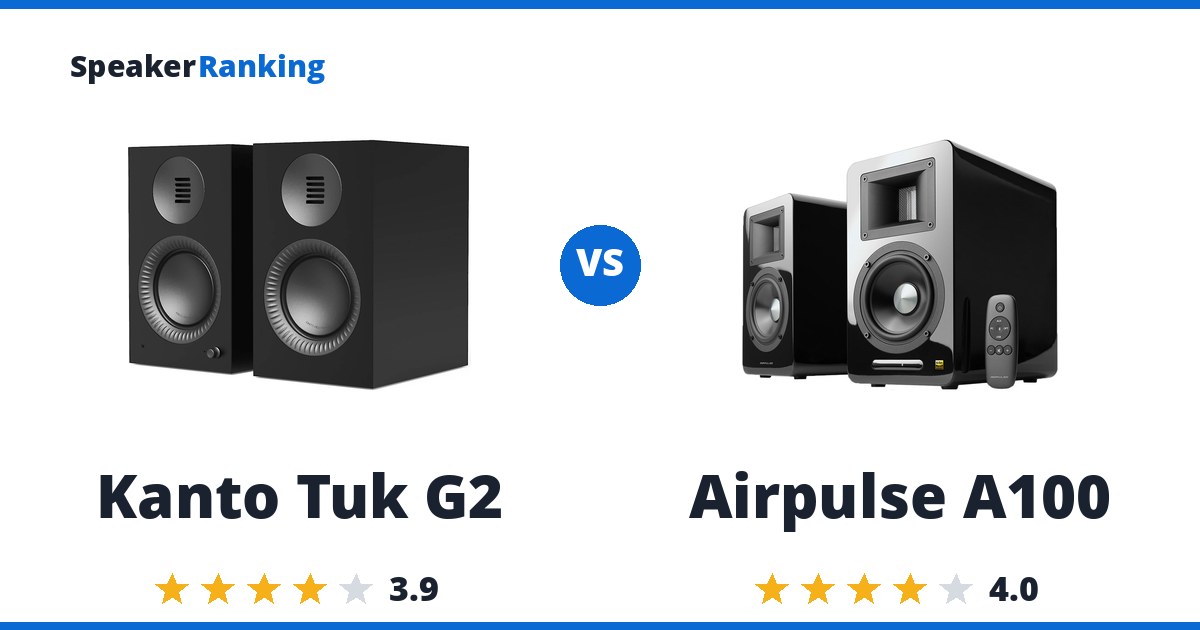
Why pick the Kanto Tuk G2: Bass reaches about 52Hz at -3dB and 42Hz at -10dB in Erin’s measurements, legitimate extension from a 5.25-inch woofer. Watch for: On-axis response is uneven, with elevated upper bass around 80 to 100Hz, a forward midrange near 800Hz to 1.5kHz and further ripples through the treble.
What the Airpulse A100 does well: ASR’s Klippel data gives a 2.9dB midrange span and scores of 4.56 standalone and 7.08 with an ideal subwoofer. The catch: Bass reaches -3dB around 63Hz, so lower notes need a subwoofer for full weight.
Buy the Airpulse A100. It is rated higher for sound quality, and the $100 saving on the Kanto Tuk G2 is not enough to make up the difference.
Looking for alternatives? See the complete Powered Home rankings.
Specifications Side By Side
| Kanto Tuk G2 | Airpulse A100 | |
|---|---|---|
| Price | $899.99 per pair | $999.99 per pair |
| Ranked | #32 of 67 in Medium Size Powered Bookshelf Speakers | #25 of 67 in Medium Size Powered Bookshelf Speakers |
| Dimensions | 7.2"W x 12"H x 10"D (183 x 305 x 254 mm) | 6.3" x 11.1" x 10" (160 x 283 x 255 mm) each |
| Frequency Response | 50Hz-22kHz (Manufacturer specified) | 52Hz - 40kHz |
| Inputs | Optical, 2x RCA, USB-C, Bluetooth | RCA (aux), USB, optical, coaxial, Bluetooth aptX |
| Outputs | Subwoofer RCA (80Hz low-pass), USB-A charging (5V/2A) | - |
| Weight | 12.3 lbs (5.6 kg) (active), 11.5 lbs (5.2 kg) (passive) | 24.3 lbs (11 kg) each |
| Drivers | 5.25-inch aluminum woofer + AMT folded ribbon tweeter (each), bass reflex | Horn-loaded ribbon tweeter, 5" hard-anodized aluminum cone woofer |
| Bluetooth Version | 5.4 | - |
| Bluetooth Codecs | aptX Adaptive, SBC | SBC, aptX |
| DSP | Yes | - |
| Amplifier Power | 130W Class D total (Manufacturer specified) | 100W total (40W+40W woofer, 10W+10W tweeter) |
| Bass Extension (-3dB) | 52Hz (measured, Erin's Audio Corner) | 63.0Hz (measured, spinorama.org) |
| Bass Extension (-10dB) | 42Hz (measured, Erin's Audio Corner) | 53.2Hz (measured, spinorama.org) |
| Spinorama Preference Score | 4.61 (calculated from Erin's Audio Corner CEA2034 data) | 4.56 |
| Spinorama Preference Score with Perfect Sub | 6.73 (calculated from Erin's Audio Corner CEA2034 data) | 7.08 |
| Measurement Source | Erin's Audio Corner | - |
| Subwoofer Output | Yes | - |
| Headphone Output | No | - |
| XLR Input | No | No |
| RCA Input | Yes | Yes |
| TRS Input | No | No |
| Optical Input | Yes | Yes |
| Coaxial Input | No | Yes |
| USB Input | Yes | Yes |
| HDMI Input | No | No |
| AES Input | No | No |
| Aux Input | No | Yes |
| Bluetooth | Yes, 5.4 | Yes (SBC, aptX) |
| App | - | None (physical bass/treble knobs, IR remote) |
| EQ | - | Yes, rear-panel bass/treble trim knobs |
Related Speaker Comparisons
More worthwhile head-to-heads for Airpulse A100:
- Airpulse A100 vs Genelec 8331A
- Neumann KH120 MKII vs Airpulse A100
- Genelec 8030C vs Airpulse A100
- Neumann KH80 DSP vs Airpulse A100
- Dynaudio LYD 5 vs Airpulse A100
Prices on this page were last checked September 23, 2026 at 11:24 PM UTC. Product prices and availability are accurate as of that date/time and are subject to change; the price and availability shown on Amazon at the time of purchase will apply to the purchase of this product.
As an eBay Partner, we may be compensated if you make a purchase.
The Two Speakers In Full
 Kanto Tuk G2: $899.99 per pair eBay
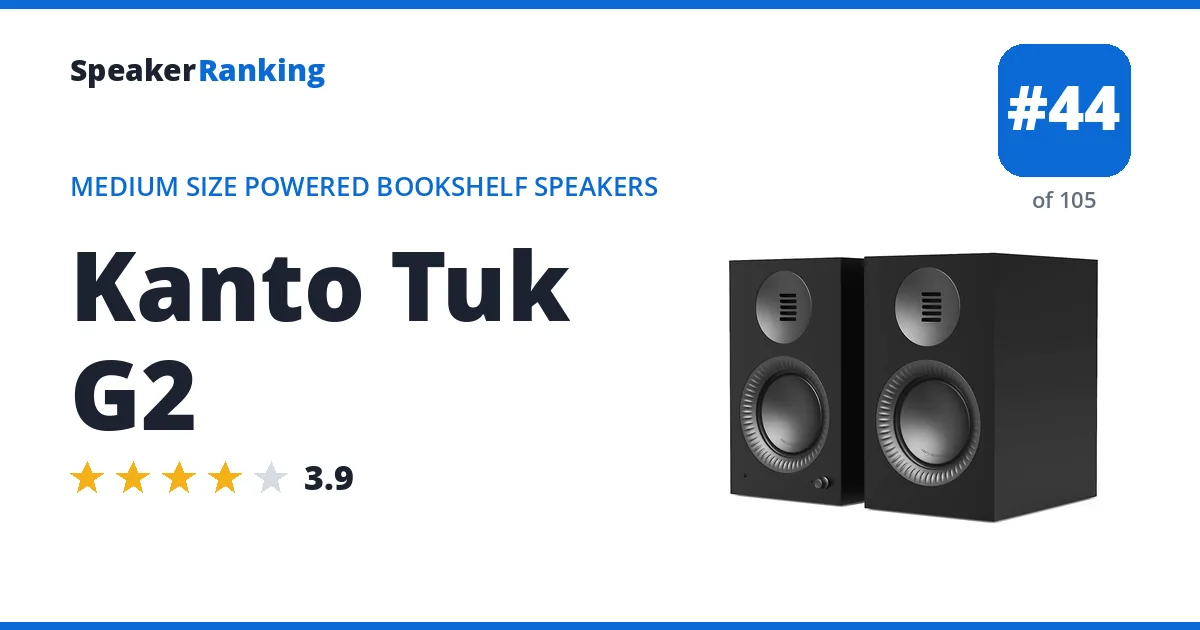
Pros: Bass reaches about 52Hz at -3dB and 42Hz at -10dB in Erin’s measurements, legitimate extension from a 5.25-inch woofer. The predicted in-room response is fairly even from the upper bass through the treble, which lifts its preference score to about 4.6 on its own and 6.7 with an ideal subwoofer. Connections cover most desk and living room sources: optical, two RCA inputs, USB-C from a computer and Bluetooth 5.4 with aptX Adaptive, plus a subwoofer output with an 80Hz low-pass, a remote and a USB charging port. Measured bass extension of 52Hz (-3dB).
Cons: On-axis response is uneven, with elevated upper bass around 80 to 100Hz, a forward midrange near 800Hz to 1.5kHz and further ripples through the treble. Horizontal dispersion widens abruptly around 2 to 2.5kHz before narrowing again, and the vertical listening window is narrow, so keep the AMT tweeter near ear height. Compression grows at 96dB and becomes severe near 102dB, with distortion rising sharply at high levels, so it sounds best as a nearfield or small room speaker at moderate volume.
Full Kanto Tuk G2 review and specifications →
| AES Input | No |
|---|---|
| Amplifier Power | 130W Class D total (Manufacturer specified) |
| Aux Input | No |
| Bass Extension (-10dB) | 42Hz (measured, Erin's Audio Corner) |
| Bass Extension (-3dB) | 52Hz (measured, Erin's Audio Corner) |
| Bluetooth | Yes, 5.4 |
| Bluetooth Codecs | aptX Adaptive, SBC |
| Bluetooth Version | 5.4 |
| Coaxial Input | No |
| DSP | Yes |
| Dimensions | 7.2"W x 12"H x 10"D (183 x 305 x 254 mm) |
| Drivers | 5.25-inch aluminum woofer + AMT folded ribbon tweeter (each), bass reflex |
| Frequency Response | 50Hz-22kHz (Manufacturer specified) |
| HDMI Input | No |
| Headphone Output | No |
| Inputs | Optical, 2x RCA, USB-C, Bluetooth |
| Measurement Source | Erin's Audio Corner |
| Optical Input | Yes |
| Outputs | Subwoofer RCA (80Hz low-pass), USB-A charging (5V/2A) |
| RCA Input | Yes |
| Spinorama Preference Score | 4.61 (calculated from Erin's Audio Corner CEA2034 data) |
| Spinorama Preference Score with Perfect Sub | 6.73 (calculated from Erin's Audio Corner CEA2034 data) |
| Subwoofer Output | Yes |
| TRS Input | No |
| USB Input | Yes |
| Weight | 12.3 lbs (5.6 kg) (active), 11.5 lbs (5.2 kg) (passive) |
| XLR Input | No |
- Links
- Reviews, Comparisons and Sound Samples
- Head-to-Head Comparisons
 Airpulse A100: $999.99 per pair Amazon B&H Photo Video eBay
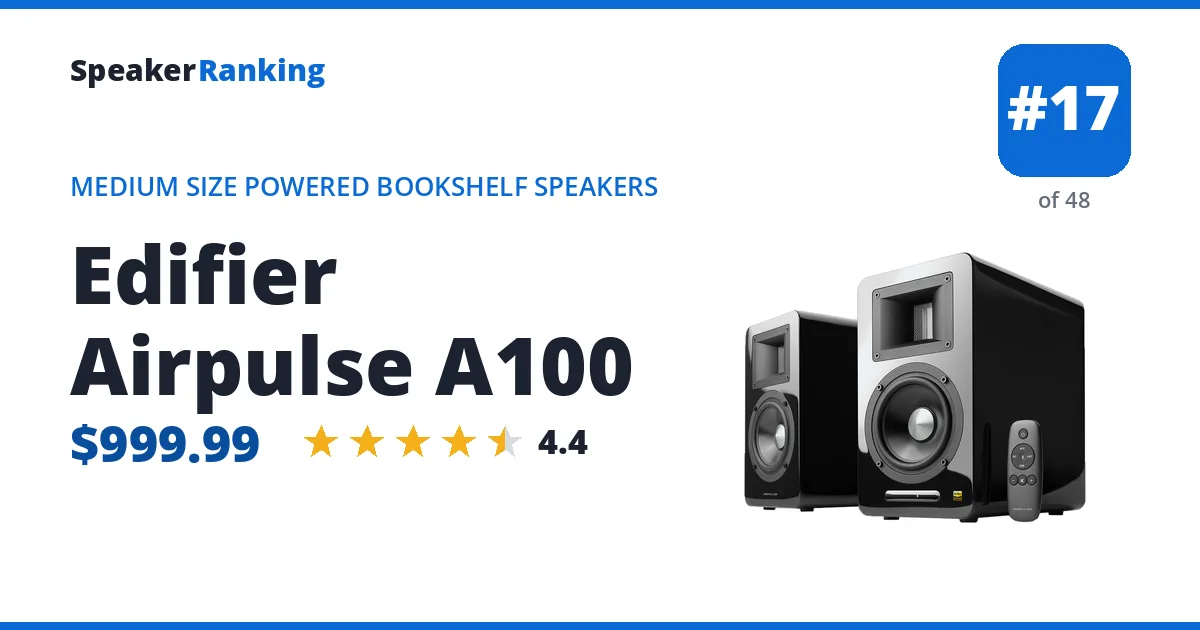
Pros: ASR’s Klippel data gives a 2.9dB midrange span and scores of 4.56 standalone and 7.08 with an ideal subwoofer. The ribbon tweeter and five-inch woofer provide a distinctive compact powered system, with remote control and a subwoofer output simplifying everyday use. Measured bass extension of 63.0Hz (-3dB).
Cons: Bass reaches -3dB around 63Hz, so lower notes need a subwoofer for full weight. Listening-window narrow-band deviation of 0.419 shows more local tonal variation than the leading monitors. Rear tone controls are less flexible than parametric EQ or room correction. Neither the ribbon tweeter nor a directivity-index summary establishes uniquely wide or perfectly controlled dispersion.
Full Airpulse A100 review and specifications →
| AES Input | No |
|---|---|
| Amplifier Power | 100W total (40W+40W woofer, 10W+10W tweeter) |
| App | None (physical bass/treble knobs, IR remote) |
| Aux Input | Yes |
| Bass Extension (-10dB) | 53.2Hz (measured, spinorama.org) |
| Bass Extension (-3dB) | 63.0Hz (measured, spinorama.org) |
| Bluetooth | Yes (SBC, aptX) |
| Bluetooth Codecs | SBC, aptX |
| Coaxial Input | Yes |
| Dimensions | 6.3" x 11.1" x 10" (160 x 283 x 255 mm) each |
| Drivers | Horn-loaded ribbon tweeter, 5" hard-anodized aluminum cone woofer |
| EQ | Yes, rear-panel bass/treble trim knobs |
| Frequency Response | 52Hz - 40kHz |
| HDMI Input | No |
| Inputs | RCA (aux), USB, optical, coaxial, Bluetooth aptX |
| Optical Input | Yes |
| RCA Input | Yes |
| Spinorama Preference Score | 4.56 |
| Spinorama Preference Score with Perfect Sub | 7.08 |
| TRS Input | No |
| USB Input | Yes |
| Weight | 24.3 lbs (11 kg) each |
| XLR Input | No |
- Links
- Reviews, Comparisons and Sound Samples
- Head-to-Head Comparisons