Short answer: the Kali IN-UNF for a coherent nearfield system. Its desk-mounted bass module and time-aligned coincident satellites make it a specialized but ingenious ultra-nearfield setup. The NHT Pro M-00 has a cast aluminum-zinc enclosure that doubles as an amplifier heatsink plus RCA and XLR/TRS inputs, but Amir identified a sudden upper-bass suck-out that affects many commonly-used notes.
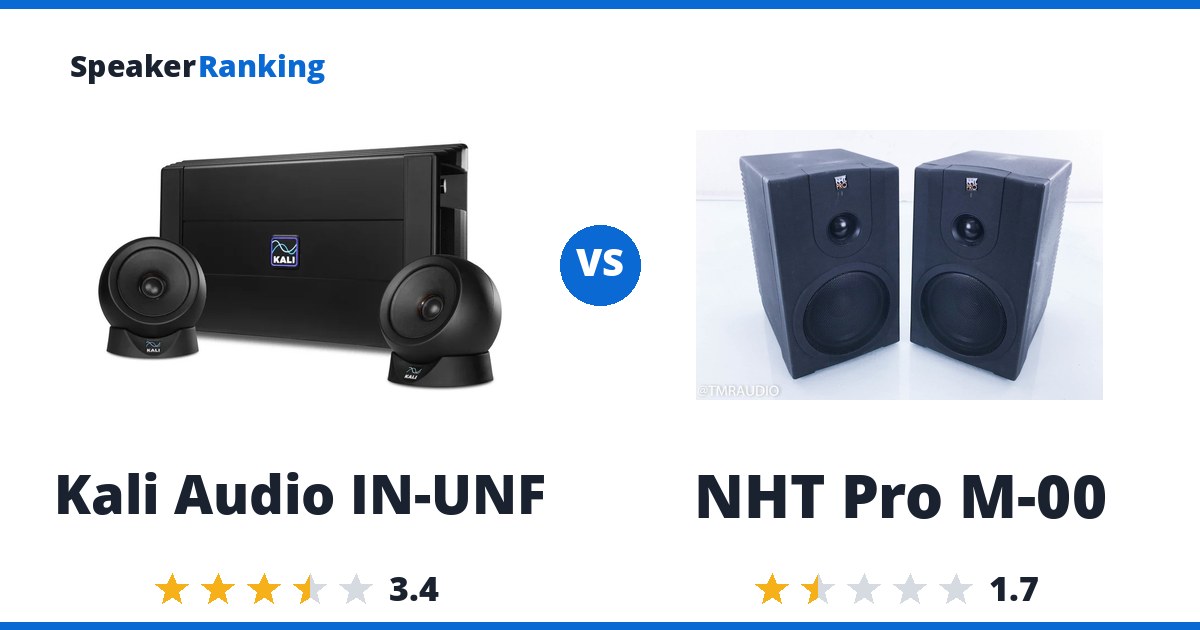
On the Kali Audio IN-UNF side: Ingenious ultra-nearfield system: a desk-mounted bass module uses two opposed 4.5-inch woofers below 280Hz, while the satellites use time-aligned 4-inch/1-inch coincident drivers. Set against that: This is a very specialized system rather than a general desktop-speaker recommendation.
Buy the Kali Audio IN-UNF. It is rated higher for sound quality, and the NHT Pro M-00 is discontinued, so it is only available used.
Still deciding? The full Powered Home rankings cover every ranked option.
Specifications Side By Side
| Kali Audio IN-UNF | NHT Pro M-00 | |
|---|---|---|
| Price | $699 per pair | $498 per pair (used market; originally $249 each), Discontinued |
| Ranked | #58 of 68 in Medium Size Powered Bookshelf Speakers | #67 of 68 in Medium Size Powered Bookshelf Speakers |
| Drivers | Bass module: two opposed 4.5” woofers; satellites: 4” coincident midrange with 1” textile-dome tweeter | 1” ferrofluid-cooled fabric dome tweeter, 4.5” treated paper-cone woofer |
| Amplifier Power | 100W LF + 60W mid/HF per channel (continuous) | 75W RMS continuous, 150W peak (per speaker) |
| Inputs | USB-C, optical, 3.5mm, balanced TRS | RCA, XLR/TRS |
| Bass Extension (-3dB) | 47Hz (manufacturer specified; Erin did not publish an anechoic F3) | 83.3Hz (measured, Audio Science Review) |
| Bass Extension (-10dB) | 39Hz (manufacturer specified; Erin did not publish an anechoic F10) | 59.7Hz (measured, Audio Science Review) |
| Frequency Response | 47Hz - 21kHz +/-3dB (manufacturer specified) | 98Hz - 20kHz (Manufacturer specified) |
| Crossover Frequency | 280Hz LF-to-midrange; 2.8kHz midrange-to-HF | - |
| Dimensions | Bass module: 11.6”H x 19.4”W x 5.25”D; satellites: 6.25” diameter | 9H x 5.7W x 7.3D in |
| DSP | Yes (placement/boundary and tonal trims) | No |
| Bluetooth | No | No |
| Maximum SPL | 103dB peak at 1m (manufacturer specified) | - |
| XLR Input | No | Yes |
| RCA Input | No | Yes |
| TRS Input | Yes | Yes |
| Optical Input | Yes | No |
| Coaxial Input | No | No |
| USB Input | Yes | No |
| HDMI Input | No | No |
| AES Input | No | No |
| Aux Input | Yes | No |
| Weight | 24.7 lbs (11.2 kg) | 14 lbs (6.35 kg) each |
| App | - | No |
Related Speaker Comparisons
More top alternatives to Kali Audio IN-UNF:
- Kali Audio IN-UNF vs Genelec 8331A
- Neumann KH120 MKII vs Kali Audio IN-UNF
- Genelec 8030C vs Kali Audio IN-UNF
- Neumann KH80 DSP vs Kali Audio IN-UNF
- Dynaudio LYD 5 vs Kali Audio IN-UNF
Prices on this page were last checked October 2, 2026 at 10:18 PM UTC. Product prices and availability are accurate as of that date/time and are subject to change; the price and availability shown on Amazon at the time of purchase will apply to the purchase of this product.
As an eBay Partner, we may be compensated if you make a purchase.
The Two Speakers In Full
 Kali Audio IN-UNF: $699 per pair Kali Audio eBay
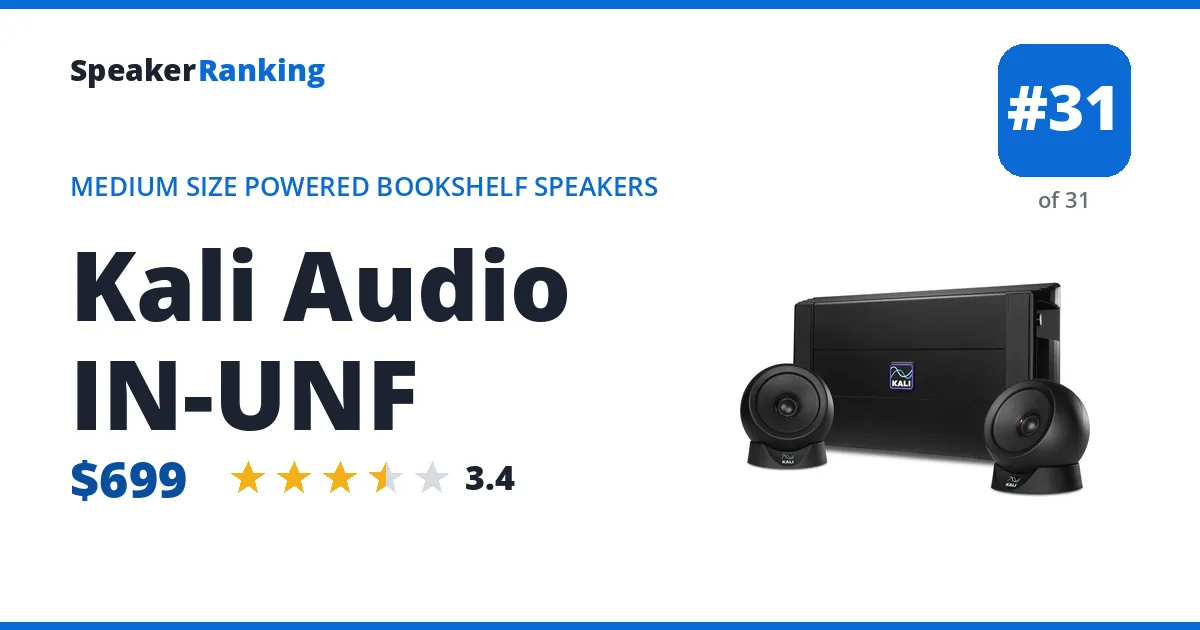
Pros: A specialized ultra-nearfield system with coaxial satellites and an opposed-woofer bass module designed to sit on the desk. Erin found it worked much better when positioned using Kali’s placement template, with useful agreement between the intended response and close-range moving-microphone measurements. DSP placement controls and varied inputs make it a thoughtful solution for the right desk.
Cons: The intended desk geometry is part of the acoustic design. The bass module and prescribed spacing occupy considerable desk space and may conflict with large monitors. It is not designed for arbitrary room placement.
Full Kali Audio IN-UNF review and specifications →
| AES Input | No |
|---|---|
| Amplifier Power | 100W LF + 60W mid/HF per channel (continuous) |
| Aux Input | Yes |
| Bass Extension (-10dB) | 39Hz (manufacturer specified; Erin did not publish an anechoic F10) |
| Bass Extension (-3dB) | 47Hz (manufacturer specified; Erin did not publish an anechoic F3) |
| Bluetooth | No |
| Coaxial Input | No |
| Crossover Frequency | 280Hz LF-to-midrange; 2.8kHz midrange-to-HF |
| DSP | Yes (placement/boundary and tonal trims) |
| Dimensions | Bass module: 11.6”H x 19.4”W x 5.25”D; satellites: 6.25” diameter |
| Drivers | Bass module: two opposed 4.5” woofers; satellites: 4” coincident midrange with 1” textile-dome tweeter |
| Frequency Response | 47Hz - 21kHz +/-3dB (manufacturer specified) |
| HDMI Input | No |
| Inputs | USB-C, optical, 3.5mm, balanced TRS |
| Maximum SPL | 103dB peak at 1m (manufacturer specified) |
| Optical Input | Yes |
| RCA Input | No |
| TRS Input | Yes |
| USB Input | Yes |
| Weight | 24.7 lbs (11.2 kg) |
| XLR Input | No |
- Links
- Reviews, Comparisons and Sound Samples
- Head-to-Head Comparisons
- Kali Audio IN-UNF vs Edifier S1000MKII
- Kali Audio IN-UNF vs Audioengine HD4
- Kali Audio IN-UNF vs Edifier S1000W
- Kali Audio IN-UNF vs Edifier R1700BT
- Kali Audio IN-UNF vs Edifier R2000DB
- Kali Audio IN-UNF vs Edifier R1280DB
- Kali Audio IN-UNF vs Audioengine HD6
- Kali Audio IN-UNF vs Edifier R1280T
- See all 52 comparisons
 NHT Pro M-00: $498 per pair (used market; originally $249 each) Discontinued eBay
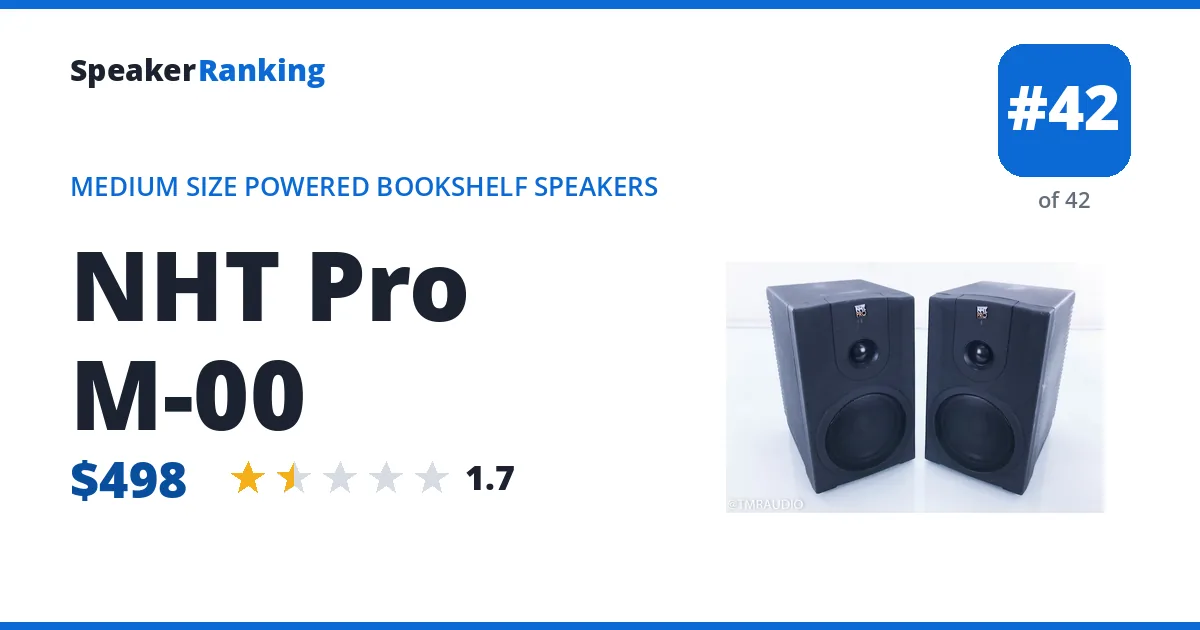
Pros: A sturdy metal enclosure, analog studio/consumer connections and selectable nearfield/farfield voicing give it practical features as an older powered monitor. Measured bass extension of 83.3Hz (-3dB).
Cons: The review identifies a pronounced upper-bass cancellation, treble peaks and problematic vertical response, and strongly prefers the JBL 305P MKII in direct listening. Discontinued.
Full NHT Pro M-00 review and specifications →
| AES Input | No |
|---|---|
| Amplifier Power | 75W RMS continuous, 150W peak (per speaker) |
| App | No |
| Aux Input | No |
| Bass Extension (-10dB) | 59.7Hz (measured, Audio Science Review) |
| Bass Extension (-3dB) | 83.3Hz (measured, Audio Science Review) |
| Bluetooth | No |
| Coaxial Input | No |
| DSP | No |
| Dimensions | 9H x 5.7W x 7.3D in |
| Drivers | 1” ferrofluid-cooled fabric dome tweeter, 4.5” treated paper-cone woofer |
| Frequency Response | 98Hz - 20kHz (Manufacturer specified) |
| HDMI Input | No |
| Inputs | RCA, XLR/TRS |
| Optical Input | No |
| RCA Input | Yes |
| TRS Input | Yes |
| USB Input | No |
| Weight | 14 lbs (6.35 kg) each |
| XLR Input | Yes |
- Reviews, Comparisons and Sound Samples
- Head-to-Head Comparisons