Short answer: the Neumann KH 310 A is the more trustworthy reference monitor, while the Kali Audio IN-8 V2 offers an appealing coaxial three-way architecture for less money if you can address its forward upper mids. Accuracy versus value is the real split here.
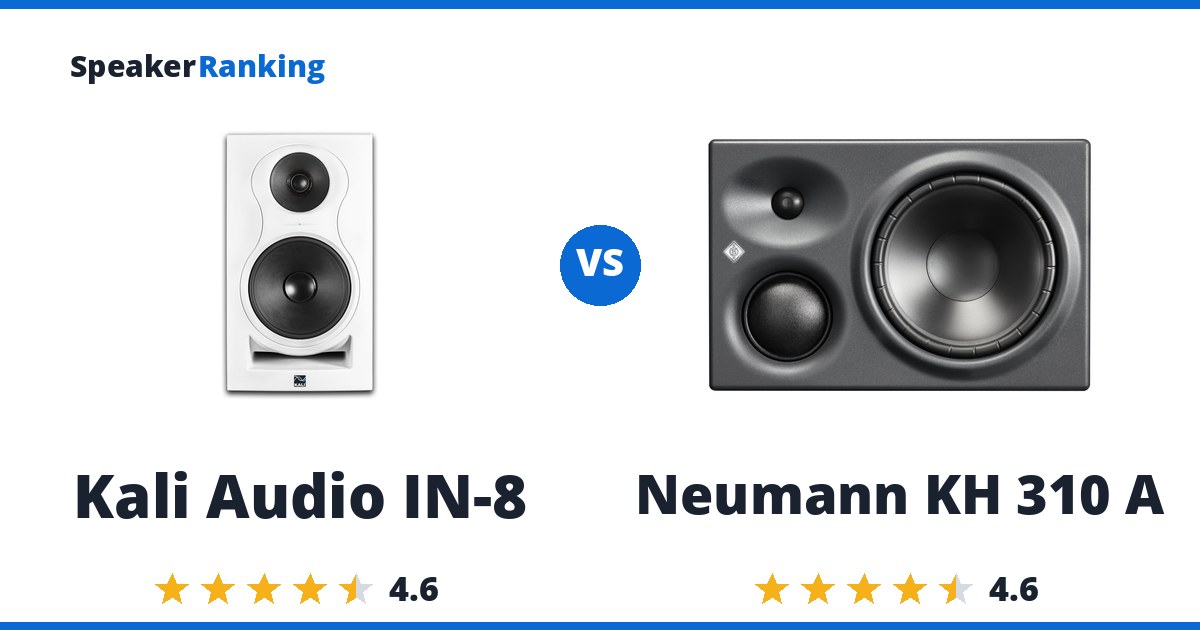
The case for the Neumann KH 310 A: CEA2034 spinorama shows a near-perfect on-axis response with superb directivity control and minimal off-axis variation. The tradeoff: An unidentified dip around 80Hz shows up in the measurements, which Neumann was asked to investigate.
The KH 310 A measures near-perfectly on-axis with excellent directivity control, although its 80Hz measurement dip and price deserve attention. The IN-8 V2 offers front porting, placement switches, and coherent geometry, but its 4-5kHz forwardness benefits from toe-out and EQ, and it is not built for high-output farfield use.
Buy the Neumann KH 310 A for reference-grade tonality and directivity in a serious monitoring chain.
Buy the Kali Audio IN-8 V2 for a more affordable coaxial three-way with flexible placement controls.
Looking for alternatives? See the complete Powered Home rankings.
Specifications Side By Side
| Kali Audio IN-8 V2 | Neumann KH 310 A | |
|---|---|---|
| Price | $998 per pair | $4,998 per pair |
| Ranked | #26 of 68 in Large Size Powered Bookshelf Speakers | #17 of 68 in Large Size Powered Bookshelf Speakers |
| Bass Extension (-10dB) | 36Hz (measured, Erin’s Audio Corner) | 28.3Hz (derived, log-interpolated between spinorama.org -9dB/-12dB points) |
| Bass Extension (-3dB) | 44Hz (measured, Erin’s Audio Corner) | 35.2Hz (measured, Audio Science Review) |
| Dimensions | 17.8”H x 10”W x 11.3”D (452.1 x 254 x 287 mm) | 10” x 15.1” x 11.5” (253 x 383 x 292 mm) (H x W x D) |
| Inputs | XLR, RCA | XLR (balanced analog) |
| Weight | 22.9 lbs (10.4 kg) each | 28.7 lbs (13.0 kg) |
| Drivers | 8” (203mm) woofer | 8.25” woofer, 3” midrange, 1” tweeter |
| App | No | No |
| Bluetooth | No | No |
| EQ | Yes (Room adjustment) | No |
| DSP | No | No |
| Amplifier Power | 140w Per Speaker | 290W total (150W woofer, 70W mid, 70W tweeter) |
| Sensitivity | 89dB (measured at 0.3V/1m, Erin’s Audio Corner) | - |
| Spinorama Preference Score | 5.36 | 6.21 |
| Spinorama Preference Score with Perfect Sub | 7.30 | 7.70 |
| XLR Input | Yes | Yes |
| RCA Input | Yes | No |
| TRS Input | No | No |
| Optical Input | No | No |
| Coaxial Input | No | No |
| USB Input | No | No |
| HDMI Input | No | No |
| AES Input | No | No |
| Aux Input | No | No |
| Frequency Response | 45Hz - 21kHz (±3dB) (Manufacturer specified) | 34Hz - 21kHz (+/-3dB) (Manufacturer specified) |
Related Speaker Comparisons
More worthwhile head-to-heads for Neumann KH 310 A:
- AsciLab C8C vs Neumann KH 310 A
- Neumann KH 310 A vs Mesanovic CDM65
- Genelec 8351B vs Neumann KH 310 A
- Neumann KH420 vs Neumann KH 310 A
- Genelec 8361A vs Neumann KH 310 A
Prices on this page were last checked October 2, 2026 at 10:18 PM UTC. Product prices and availability are accurate as of that date/time and are subject to change; the price and availability shown on Amazon at the time of purchase will apply to the purchase of this product.
As an eBay Partner, we may be compensated if you make a purchase.
The Two Speakers In Full
 Kali Audio IN-8 V2: $998 per pair Amazon eBay
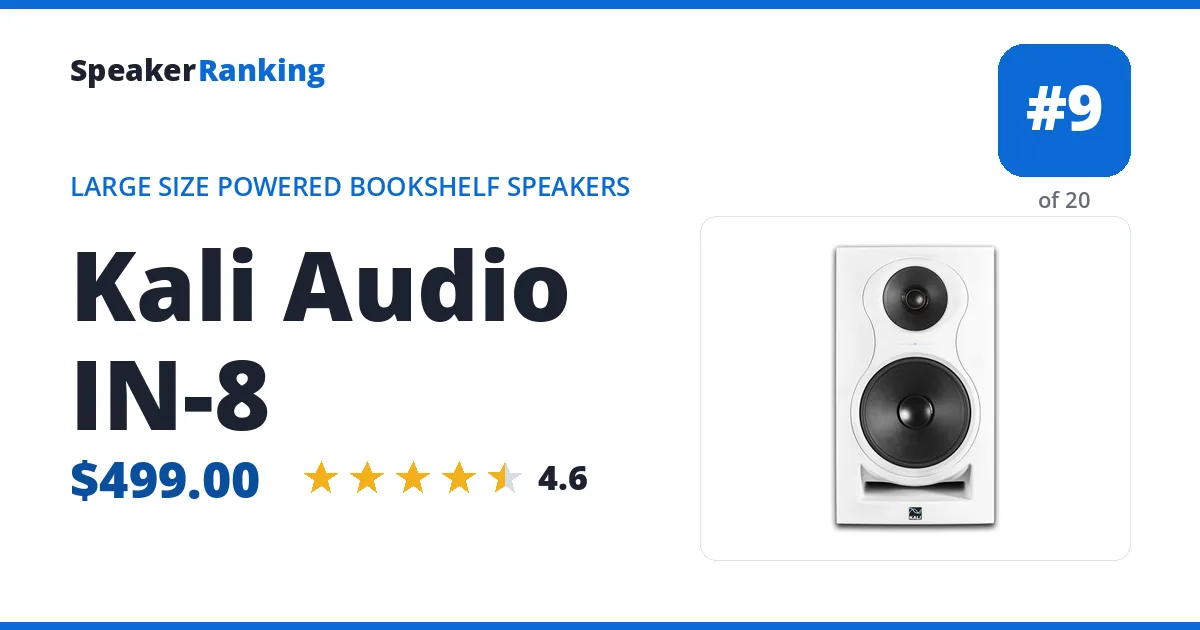
Pros: The IN-8 V2’s coaxial midrange/tweeter supports coherent imaging, and low distortion at ordinary levels complements its 7.30 ideal-subwoofer score. Measured -3dB extension of 45.4Hz provides useful bass; boundary settings assist placement. The front port allows placement near a wall without port noise problems. Measured bass extension of 44Hz (-3dB), with a measured sensitivity of 89dB.
Cons: The measured 3.0dB response span from 300Hz to 5kHz includes unevenness that can make some vocals sound forward. Bass and limiter behavior constrain high-level playback. These measurements apply to the V2, not the first-generation IN-8. On-axis, the 4 to 5kHz range sounds forward; Kali recommends about 10° of toe-out, and some EQ helps.
Full Kali Audio IN-8 V2 review and specifications →
| AES Input | No |
|---|---|
| Amplifier Power | 140w Per Speaker |
| App | No |
| Aux Input | No |
| Bass Extension (-10dB) | 36Hz (measured, Erin’s Audio Corner) |
| Bass Extension (-3dB) | 44Hz (measured, Erin’s Audio Corner) |
| Bluetooth | No |
| Coaxial Input | No |
| DSP | No |
| Dimensions | 17.8”H x 10”W x 11.3”D (452.1 x 254 x 287 mm) |
| Drivers | 8” (203mm) woofer |
| EQ | Yes (Room adjustment) |
| Frequency Response | 45Hz - 21kHz (±3dB) (Manufacturer specified) |
| HDMI Input | No |
| Inputs | XLR, RCA |
| Optical Input | No |
| RCA Input | Yes |
| Sensitivity | 89dB (measured at 0.3V/1m, Erin’s Audio Corner) |
| Spinorama Preference Score | 5.36 |
| Spinorama Preference Score with Perfect Sub | 7.30 |
| TRS Input | No |
| USB Input | No |
| Weight | 22.9 lbs (10.4 kg) each |
| XLR Input | Yes |
- Links
- Reviews, Comparisons and Sound Samples
- Head-to-Head Comparisons
- Kali Audio IN-8 V2 vs Genelec 8050B
- Kali Audio IN-8 V2 vs Kali Audio LP-6 V2
- Kali Audio IN-8 V2 vs Yamaha HS8
- Kali Audio IN-8 V2 vs JBL 4305P
- Kali Audio IN-8 V2 vs JBL 308P MKII
- Kali Audio IN-8 V2 vs Focal Solo6 ST6
- Kali Audio IN-8 V2 vs Kali Audio LP-6
- Kali Audio IN-8 V2 vs Genelec S360
- See all 39 comparisons
 Neumann KH 310 A: $4,998 per pair B&H Photo Video eBay
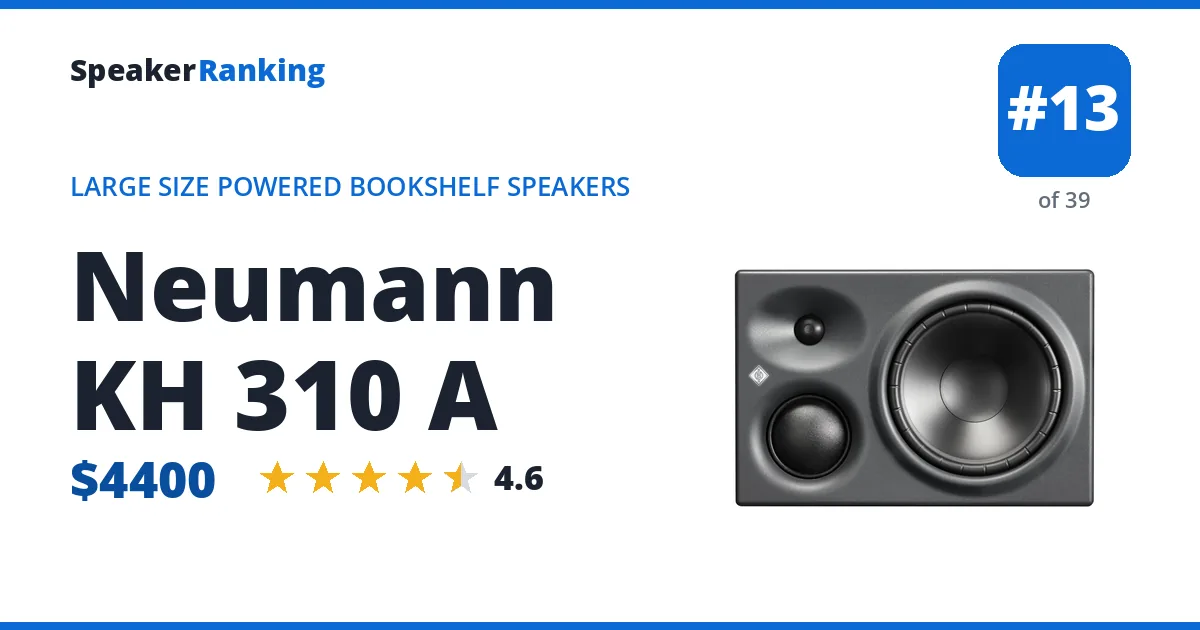
Pros: The sealed three-way design combines 35.2Hz measured -3dB extension with low distortion in the review’s demanding playback tests. Its 2.2dB response span from 300Hz to 5kHz and 7.70 ideal-subwoofer score support balanced monitoring with useful full-range capability. Measured bass extension of 35.2Hz (-3dB).
Cons: Its measured tonal balance is not as even as the KH 150 or the best coaxial alternatives. Correct orientation and listening height matter for the separated drivers. The analog system lacks the integrated calibration workflow of newer DSP models, so room correction requires additional equipment. An unexplained dip around 80Hz shows in the measurements.
Full Neumann KH 310 A review and specifications →
| AES Input | No |
|---|---|
| Amplifier Power | 290W total (150W woofer, 70W mid, 70W tweeter) |
| App | No |
| Aux Input | No |
| Bass Extension (-10dB) | 28.3Hz (derived, log-interpolated between spinorama.org -9dB/-12dB points) |
| Bass Extension (-3dB) | 35.2Hz (measured, Audio Science Review) |
| Bluetooth | No |
| Coaxial Input | No |
| DSP | No |
| Dimensions | 10” x 15.1” x 11.5” (253 x 383 x 292 mm) (H x W x D) |
| Drivers | 8.25” woofer, 3” midrange, 1” tweeter |
| EQ | No |
| Frequency Response | 34Hz - 21kHz (+/-3dB) (Manufacturer specified) |
| HDMI Input | No |
| Inputs | XLR (balanced analog) |
| Optical Input | No |
| RCA Input | No |
| Spinorama Preference Score | 6.21 |
| Spinorama Preference Score with Perfect Sub | 7.70 |
| TRS Input | No |
| USB Input | No |
| Weight | 28.7 lbs (13.0 kg) |
| XLR Input | Yes |
- Links
- Reviews, Comparisons and Sound Samples
- Head-to-Head Comparisons
- Neumann KH 310 A vs HEDD Type 20 MK2
- Neumann KH 310 A vs Genelec S360
- Neumann KH 310 A vs LOGProfessional Alpha
- Neumann KH 310 A vs Adam Audio S2V
- Neumann KH 310 A vs JBL 308P MKII
- Neumann KH 310 A vs Buchardt A10
- Neumann KH 310 A vs Yamaha HS8
- Neumann KH 310 A vs Kali Audio LP-6 V2
- See all 37 comparisons