Short answer: the JTR Noesis 210HT. It ranks #40 of 131 bookshelf speakers by sound quality, rated 4.3/5, at $3,998; the McIntosh XR50 ranks #88, rated 3.4/5, and costs $4,000, so there is little reason to consider the other one.
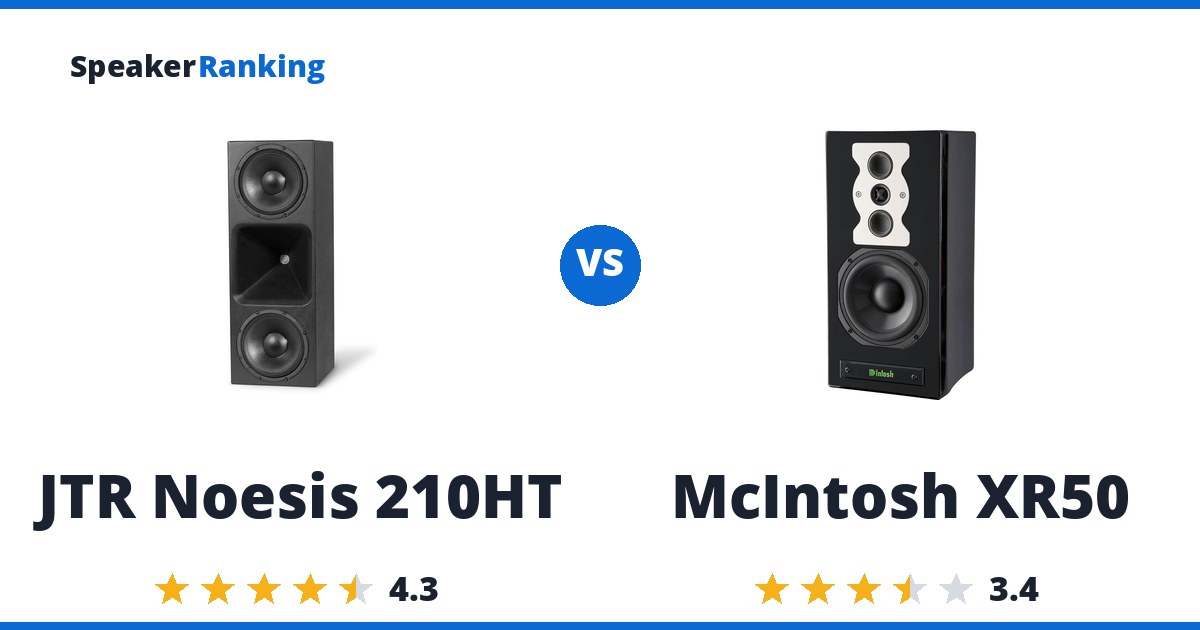
What the JTR Noesis 210HT does well: Exceptionally high-output sealed loudspeaker: Erin measured 92.5dB/2.83V/1m sensitivity, less than 3% distortion at both 86dB and 96dB test levels, and excellent compression behavior. The tradeoff: Erin measured F3 at 76Hz and F10 at 43Hz, so the 210HT is designed to hand bass duties to subwoofers rather than operate full-range.
What the McIntosh XR50 does well: The compact XR50 produces unexpectedly authoritative bass: Erin measured F3 at 43Hz and praised its low-end weight. The tradeoff: Erin measured roughly 80-81dB sensitivity, making the XR50 exceptionally power hungry despite its nominal eight-ohm rating.
Buy the JTR Noesis 210HT. It is rated higher for sound quality than the McIntosh XR50 and costs less, so it is the default pick unless a specific strength of the other one matters more to you.
Want more options? Browse the full Passive Home rankings.
Specifications Side By Side
| JTR Noesis 210HT | McIntosh XR50 | |
|---|---|---|
| Price | $3,998 per pair | $4,000 per pair |
| Ranked | #40 of 131 in Large Size Bookshelf Speakers | #88 of 131 in Large Size Bookshelf Speakers |
| Bass Extension (-3dB) | 76Hz (measured, Erin’s Audio Corner) | 43Hz (measured, Erin’s Audio Corner) |
| Bass Extension (-10dB) | 43Hz (measured, Erin’s Audio Corner) | 35.6Hz (measured, Erin’s Audio Corner) |
| Sensitivity | 92.5dB/2.83V/1m (measured, Erin’s Audio Corner) | ~81dB/2.83V/1m (measured, Erin’s Audio Corner) |
| Impedance | Approximately 3 ohms minimum at 100-200Hz (measured, Erin’s Audio Corner) | 8 ohms nominal |
| Drivers | Dual 10” woofers; coaxial compression driver on 60° x 60° horn | 6-inch woofer; dual 2-inch inverted-dome mids; 0.75-inch titanium dome |
| Crossover Frequency | Approximately 850Hz | - |
| Dimensions | 34”H x 12.25”W x 14”D | 17H x 8W x 11.75D inches |
| Weight | 85.1 lbs (38.6 kg) each | 19.4 lbs (8.8 kg) each |
| Woofer Cabinet | sealed | - |
| Spinorama Preference Score | 2.66 | 4.99 |
| Spinorama Preference Score with Perfect Sub | 5.41 | 6.80 |
| DIY Kit | No | No |
Related Speaker Comparisons
More worthwhile head-to-heads for JTR Noesis 210HT:
- Selah Audio Purezza vs JTR Noesis 210HT
- Revel M126Be vs JTR Noesis 210HT
- ELAC VELA BS 403 vs JTR Noesis 210HT
- ELAC Debut 3.0 DB63 vs JTR Noesis 210HT
- JTR Noesis 210HT vs Yamaha NS-800A
Prices on this page were last checked September 29, 2026 at 3:43 PM UTC. Product prices and availability are accurate as of that date/time and are subject to change; the price and availability shown on Amazon at the time of purchase will apply to the purchase of this product.
As an eBay Partner, we may be compensated if you make a purchase.
The Two Speakers In Full
 JTR Noesis 210HT: $3,998 per pair JTR Speakers eBay
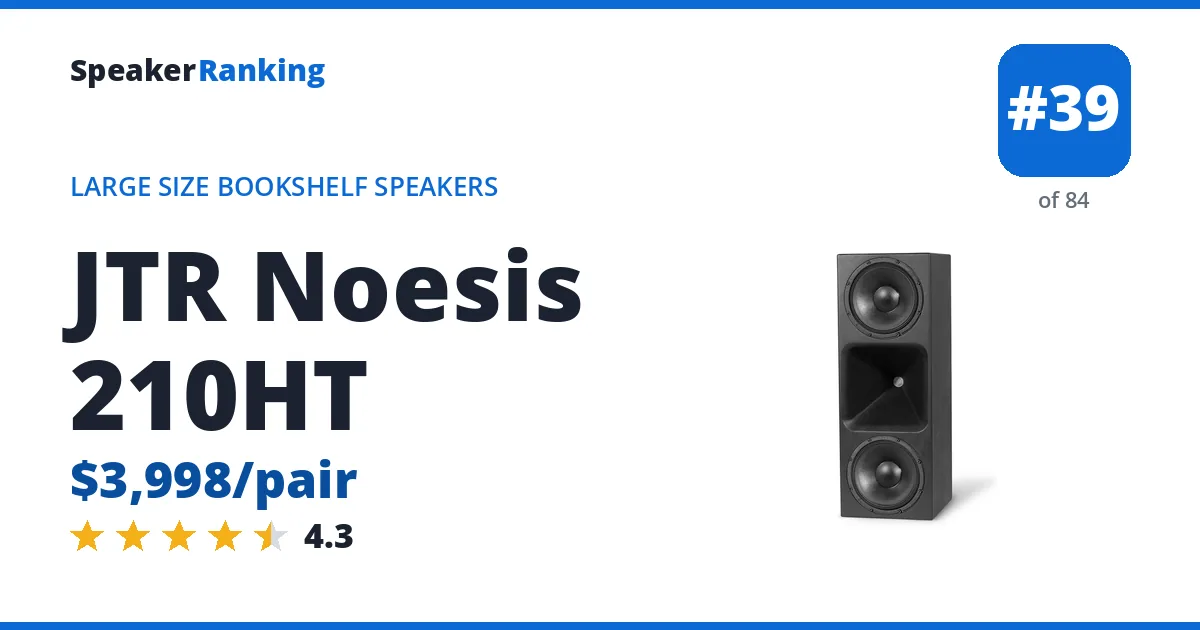
Pros: Exceptionally high-output sealed loudspeaker: Erin measured 92.5dB/2.83V/1m sensitivity, less than 3% distortion at both 86dB and 96dB test levels, and excellent compression behavior. The coaxial compression driver and dual 10-inch woofers cross at roughly 850Hz into a nominal 60° x 60° pattern, keeping radiation controlled enough that broad response errors remain amenable to EQ. Its sealed 12dB/octave bass roll-off simplifies subwoofer integration, while Baltic-birch construction and professional-grade drivers suit reference-level cinema use. Measured bass extension of 76Hz (-3dB), with a measured sensitivity of 92.5dB.
Cons: Erin measured F3 at 76Hz and F10 at 43Hz, so the 210HT is designed to hand bass duties to subwoofers rather than operate full-range. The impedance falls to approximately 3 ohms through 100-200Hz (Erin), making a stable separate amplifier preferable. Midrange resonances and the horn-to-woofer directivity transition raise the predicted in-room treble balance; careful toe-in, room treatment and DSP are advisable. Each enclosure is unusually large and heavy for a stand-mount, and the narrow coverage is less forgiving across a wide seating area.
Full JTR Noesis 210HT review and specifications →
| Bass Extension (-10dB) | 43Hz (measured, Erin’s Audio Corner) |
|---|---|
| Bass Extension (-3dB) | 76Hz (measured, Erin’s Audio Corner) |
| Crossover Frequency | Approximately 850Hz |
| DIY Kit | No |
| Dimensions | 34”H x 12.25”W x 14”D |
| Drivers | Dual 10” woofers; coaxial compression driver on 60° x 60° horn |
| Impedance | Approximately 3 ohms minimum at 100-200Hz (measured, Erin’s Audio Corner) |
| Sensitivity | 92.5dB/2.83V/1m (measured, Erin’s Audio Corner) |
| Spinorama Preference Score | 2.66 |
| Spinorama Preference Score with Perfect Sub | 5.41 |
| Weight | 85.1 lbs (38.6 kg) each |
| Woofer Cabinet | sealed |
- Links
- Reviews, Comparisons and Sound Samples
- Head-to-Head Comparisons
 McIntosh XR50: $4,000 per pair Crutchfield eBay
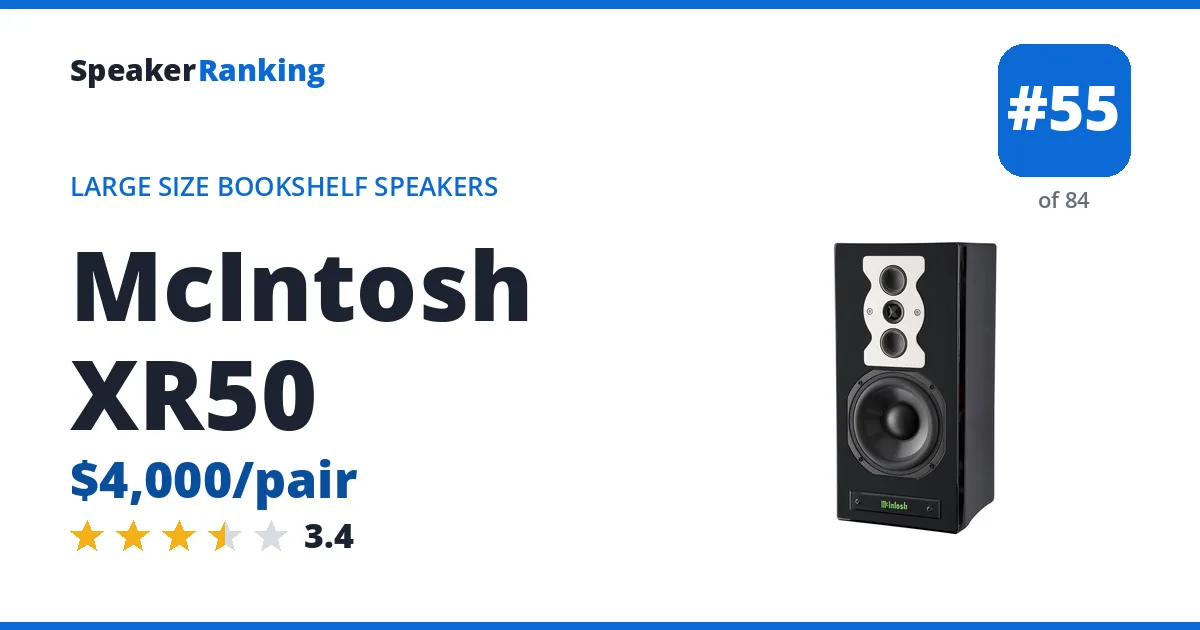
Pros: The compact XR50 produces unexpectedly authoritative bass: Erin measured F3 at 43Hz and praised its low-end weight. Horizontal radiation is exceptionally wide, and the four-driver three-way layout holds distortion and compression together reasonably well through the midband. The sealed-back 2-inch inverted-dome midranges isolate vocals from woofer pressure, while the heavily braced nonparallel cabinet, premium terminals and five-year warranty are genuinely high-grade. Measured bass extension of 43Hz (-3dB), with a measured sensitivity of 81dB.
Cons: Erin measured roughly 80-81dB sensitivity, making the XR50 exceptionally power hungry despite its nominal eight-ohm rating. A broad treble excess sounds bright and sibilant on-axis; at least 20° toe-out or EQ is needed, but toe-out increases reflected energy and trades away image focus. Direct and reflected responses diverge through parts of the treble, limiting perfect EQ correction. At $2000/pair, its tonal flaws and low efficiency are hard to excuse as merely the cost of premium construction.
Full McIntosh XR50 review and specifications →
| Bass Extension (-10dB) | 35.6Hz (measured, Erin’s Audio Corner) |
|---|---|
| Bass Extension (-3dB) | 43Hz (measured, Erin’s Audio Corner) |
| DIY Kit | No |
| Dimensions | 17H x 8W x 11.75D inches |
| Drivers | 6-inch woofer; dual 2-inch inverted-dome mids; 0.75-inch titanium dome |
| Impedance | 8 ohms nominal |
| Sensitivity | ~81dB/2.83V/1m (measured, Erin’s Audio Corner) |
| Spinorama Preference Score | 4.99 |
| Spinorama Preference Score with Perfect Sub | 6.80 |
| Weight | 19.4 lbs (8.8 kg) each |
- Links
- Reviews, Comparisons and Sound Samples
- Head-to-Head Comparisons