Short answer: the Polk Reserve R100, if you are buying new. The JBL Studio 630 ranks higher than it (#123 vs #146 of 203 bookshelf speakers, 3.6/5 vs 3.4/5) but is discontinued, so only consider it used; the Polk Reserve R100 is still sold new at $559.
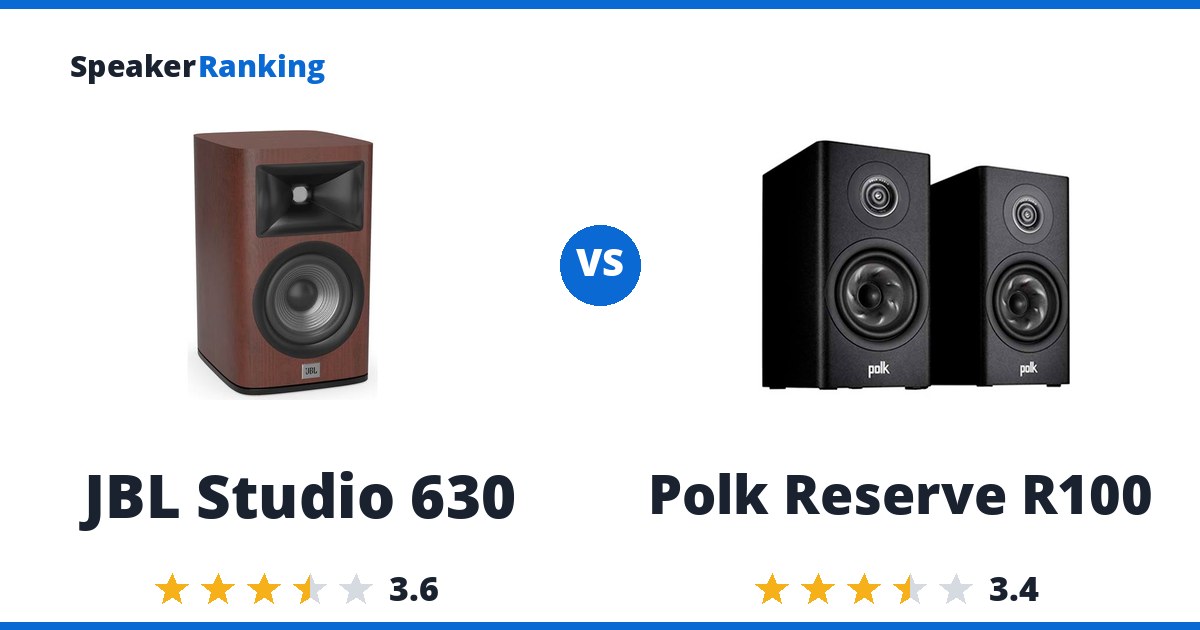
The Studio 630 is a discontinued horn speaker with excellent imaging. Its compression driver in a waveguide keeps directivity very even, so instruments stay locked in place, and its bass reaches 54.2Hz before falling 3dB with a controlled punch. Its midrange is scooped relative to the treble, so it needs EQ to sound its best, and its sensitivity is about 83dB.
The Reserve R100 is the compact, current alternative. A ring-radiator tweeter and 5.25-inch Turbine woofer give good detail at moderate levels and useful bass for the size, reaching 68Hz before falling 3dB. Its treble runs about 3dB hot and turns aggressive above about 85dB, and its impedance dips to 3.6 ohms.
Buy the Polk Reserve R100 new; the JBL Studio 630 is no longer sold new, so it only makes sense as a used find.
Still deciding? The full Passive Home rankings cover every ranked option.
Specifications Side By Side
| JBL Studio 630 | Polk Reserve R100 | |
|---|---|---|
| Price | $699 per pair Discontinued | $559.00 per pair |
| Ranked | #123 of 203 in Large Size Bookshelf Speakers | #146 of 203 in Large Size Bookshelf Speakers |
| Drivers | 6.5” PolyPlas cone woofer, 1” compression driver (2414H-1) with waveguide | 1” Pinnacle ring-radiator tweeter; 5.25” Turbine Cone midwoofer |
| Dimensions | 14-13/16”H x 9”W x 11-5/16”D | 12.8”H x 6.5”W x 10.2”D |
| Weight | 19.8 lbs (9 kg) each | 12.1 lbs (5.5 kg) each |
| Impedance | 6 ohms nominal, 4.7 ohms minimum (measured, Erin’s Audio Corner) | 3.6 ohms minimum (measured, Erin’s Audio Corner) |
| Sensitivity | 83.2dB (measured, Erin’s Audio Corner; 85dB manufacturer specified) | 85dB/2.83V/1m (measured, Erin’s Audio Corner) |
| Frequency Response | 45Hz - 40,000Hz (manufacturer specified) | - |
| Bass Extension (-3dB) | 54.2Hz (measured, Erin’s Audio Corner) | 68Hz (measured, Erin’s Audio Corner) |
| Bass Extension (-10dB) | 37.0Hz (measured, Erin’s Audio Corner) | 49Hz (measured, Erin’s Audio Corner) |
| Power Handling | up to 150W | - |
| Spinorama Preference Score | 3.67 | 5.46 |
| Spinorama Preference Score with Perfect Sub | 5.68 | 7.93 |
| DIY Kit | No | No |
| Woofer Cabinet | - | ported, rear X-Port |
Related Speaker Comparisons
How JBL Studio 630 compares with other leading options:
- JBL Studio 630 vs AsciLab C6B
- JBL Studio 630 vs KEF R3 Meta
- JBL Studio 630 vs KEF Q Concerto Meta
- AsciLab F6B vs JBL Studio 630
- JBL Studio 630 vs MoFi SourcePoint 8
Prices on this page were last checked October 7, 2026 at 9:25 PM UTC. Product prices and availability are accurate as of that date/time and are subject to change; the price and availability shown on Amazon at the time of purchase will apply to the purchase of this product.
As an eBay Partner, we may be compensated if you make a purchase.
The Two Speakers In Full
 JBL Studio 630: $699 per pair Discontinued eBay
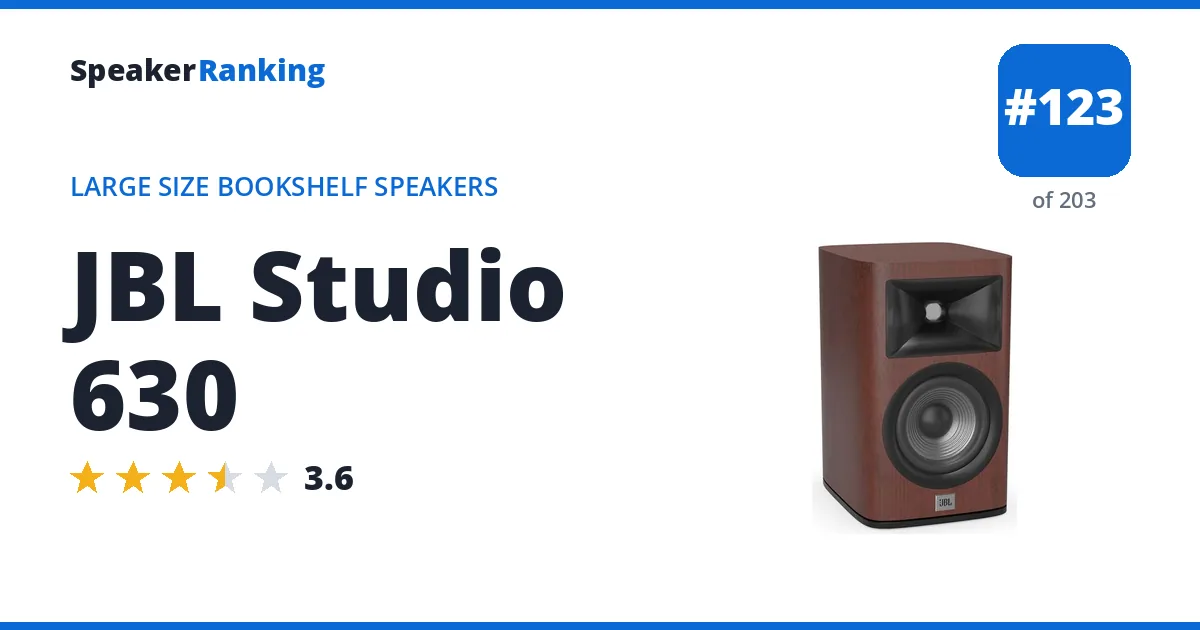
Same family: the JBL Studio 698 (floorstanding, rated 4.3/5).
Pros: Excellent directivity linearity: harmonics of the same instrument stay collocated in the soundstage instead of drifting between positions, giving precise, stable imaging that holds up well into higher frequencies where many speakers start to beam and narrow. Good compression behavior: mid-bass stays taut and controlled from low to high volume without the sound falling apart or distorting as you turn it up. A pleasant, controlled mid-bass bump in the 60-100 Hz range adds punch to kick drums without bleeding into an uncontrolled boom on bass guitar. Horizontal radiation holds steady off-axis (about ±60°), so toe-in isn’t fussy. Compared directly to its predecessor, the JBL Studio 530, the reviewer would pick the 630 (smoother trend line through the upper mids and treble, and likely more dynamic headroom) as long as you’re willing to EQ. Measured bass extension of 54.2Hz (-3dB), with a measured sensitivity of 83.2dB.
Cons: Noticeable mid-range dip/scoop relative to the higher frequencies: not dramatic, but audibly “missing” something by the second or third track. Some tracks read as forward or aggressive around 2 kHz, like the upper frequencies are jumping out at you rather than sitting in stage depth. Needs EQ to bring the mid-range back up to be fully recommendable; without EQ available, the reviewer says he’d look at a different speaker entirely. Measured sensitivity (about 83.2dB) runs noticeably below the 85dB manufacturer spec, likely a byproduct of the mid-range dip skewing the average downward. Discontinued and no longer sold new.
Full JBL Studio 630 review and specifications →
| Bass Extension (-10dB) | 37.0Hz (measured, Erin’s Audio Corner) |
|---|---|
| Bass Extension (-3dB) | 54.2Hz (measured, Erin’s Audio Corner) |
| DIY Kit | No |
| Dimensions | 14-13/16”H x 9”W x 11-5/16”D |
| Drivers | 6.5” PolyPlas cone woofer, 1” compression driver (2414H-1) with waveguide |
| Frequency Response | 45Hz - 40,000Hz (manufacturer specified) |
| Impedance | 6 ohms nominal, 4.7 ohms minimum (measured, Erin’s Audio Corner) |
| Power Handling | up to 150W |
| Sensitivity | 83.2dB (measured, Erin’s Audio Corner; 85dB manufacturer specified) |
| Spinorama Preference Score | 3.67 |
| Spinorama Preference Score with Perfect Sub | 5.68 |
| Weight | 19.8 lbs (9 kg) each |
- Links
- Reviews, Comparisons and Sound Samples
- Head-to-Head Comparisons
- JBL Studio 630 vs Behringer B2030P
- JBL Studio 630 vs Dynaudio Emit 20
- JBL Studio 630 vs Klipsch RP-600M II
- JBL Studio 630 vs Infinity IL10
- JBL Studio 630 vs Dynaudio Special Forty
- JBL Studio 630 vs ELAC Debut 2.0 B6.2
- JBL Studio 630 vs SVS Prime Bookshelf
- JBL Studio 630 vs Infinity Reference R162
- See all 38 comparisons
 Polk Reserve R100: $559.00 per pair Amazon Polk Audio eBay
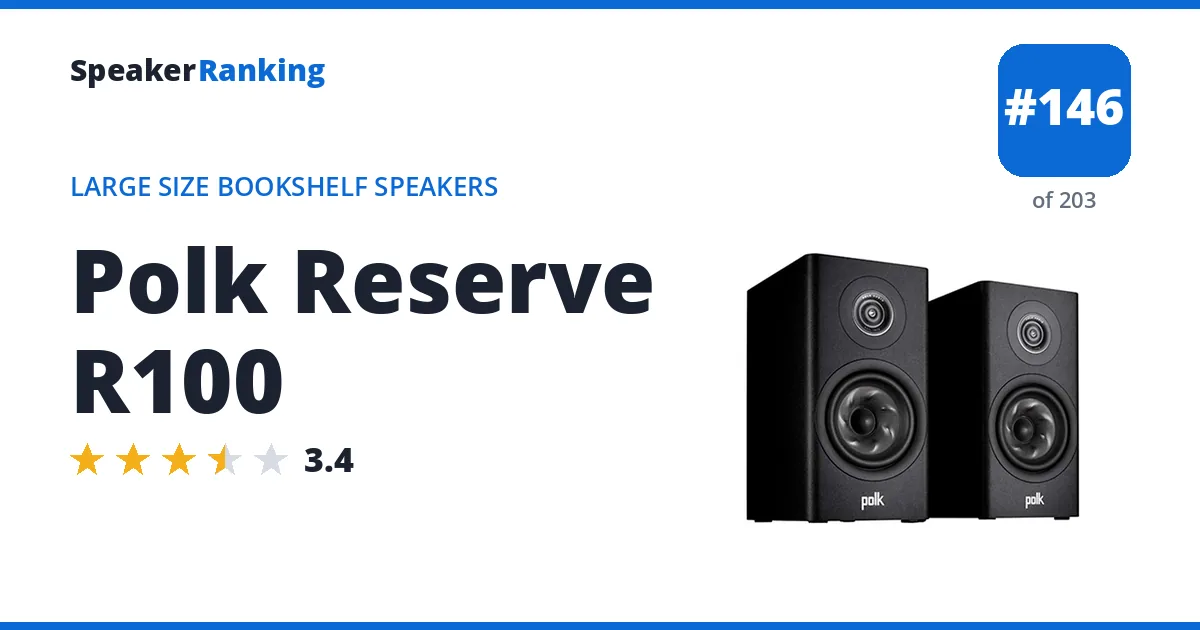
Same family: the Polk R200 (larger bookshelf, ranked lower, rated 3.2/5), the Polk Reserve R500 (smallest floorstanding, rated 4.2/5), the Polk Reserve R600 (floorstanding, estimated 4.2/5), the Polk Audio Reserve R700 (largest floorstanding, rated 4.3/5), the Polk Audio Reserve R300 (smallest center, estimated 3.6/5), the Polk Audio Reserve R350 (center, rated 3.7/5) and the Polk Audio Reserve R400 (largest center, estimated 3.8/5).
Pros: Compact cabinet, unusually useful bass for its size and well-controlled woofer breakup. Erin measured F3/F10 points of 68Hz/49Hz, and the X-Port vent avoids much of the chuffing and pipe resonance common to budget rear ports. The 5.25-inch Turbine Cone woofer and 1-inch Pinnacle ring-radiator tweeter produce good detail at moderate levels, while listening roughly 20° off-axis reduces part of the elevated top octave. Measured bass extension of 68Hz (-3dB), with a measured sensitivity of 85dB.
Cons: Erin measured only about 85dB sensitivity and the impedance reaches 3.6 ohms, so it is neither efficient nor an entirely benign AVR load. The treble runs roughly 3dB above the midrange and becomes aggressive above about 85dB SPL. A directivity discontinuity through the woofer/tweeter crossover means EQ cannot fully repair the power response, and a 400Hz impedance feature plus 500Hz-1kHz response irregularity suggests a cabinet or system resonance. Substantial low-frequency compression at higher playback levels limits clean dynamics.
Full Polk Reserve R100 review and specifications →
| Bass Extension (-10dB) | 49Hz (measured, Erin’s Audio Corner) |
|---|---|
| Bass Extension (-3dB) | 68Hz (measured, Erin’s Audio Corner) |
| DIY Kit | No |
| Dimensions | 12.8”H x 6.5”W x 10.2”D |
| Drivers | 1” Pinnacle ring-radiator tweeter; 5.25” Turbine Cone midwoofer |
| Impedance | 3.6 ohms minimum (measured, Erin’s Audio Corner) |
| Sensitivity | 85dB/2.83V/1m (measured, Erin’s Audio Corner) |
| Spinorama Preference Score | 5.46 |
| Spinorama Preference Score with Perfect Sub | 7.93 |
| Weight | 12.1 lbs (5.5 kg) each |
| Woofer Cabinet | ported, rear X-Port |
- Links
- Reviews, Comparisons and Sound Samples
- Head-to-Head Comparisons
- Polk Reserve R100 vs Sonus Faber Lumina II
- Polk Reserve R100 vs Polk Monitor XT20
- Polk Reserve R100 vs KEF Q3 Meta
- Polk Reserve R100 vs Focal Aria 906
- Polk Reserve R100 vs Revel Performa M22
- Polk Reserve R100 vs HSU Research MFL-6
- Polk Reserve R100 vs SVS Prime Bookshelf
- Polk Reserve R100 vs ELAC Debut 2.0 B6.2
- See all 30 comparisons