Short answer: the JBL L52 Classic, though neither ranks well in its class. It ranks #65 of 88 bookshelf speakers by sound quality, rated 2.6/5, at $999; the Q Acoustics 5020 ranks #74, rated 2.2/5, and costs $1,199, which makes this an easy call rather than a real tradeoff. Both are rated below 3.0/5 among the 88 bookshelf speakers, and the Philharmonic Ceramic Mini, ranked #2 at $900, is a better place to start if sound quality matters.
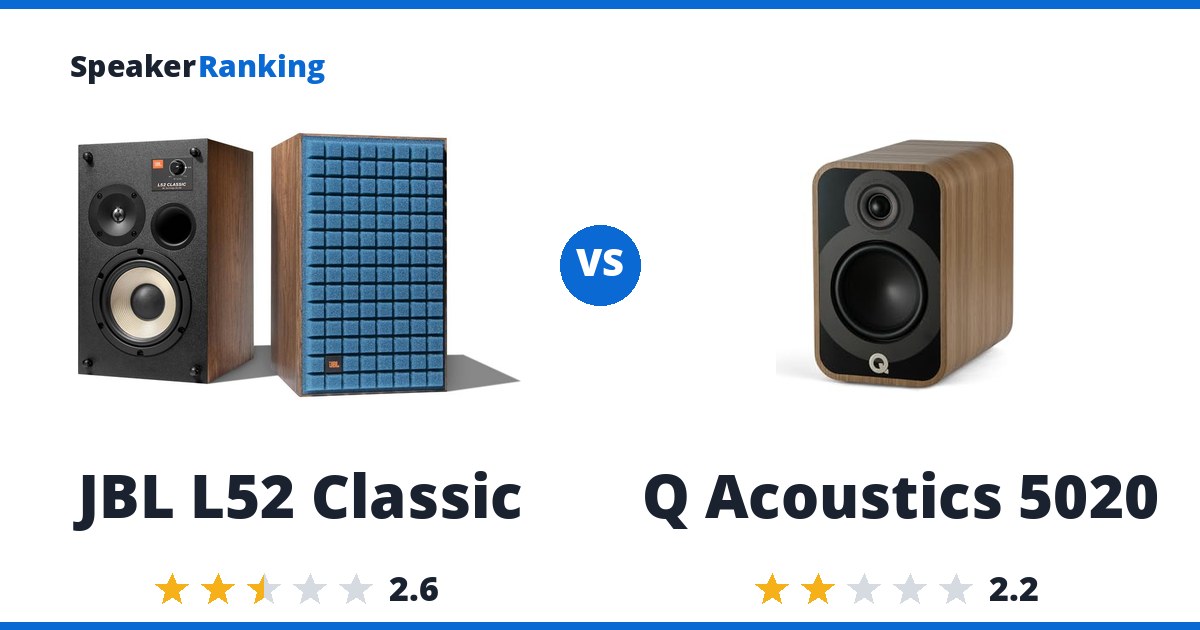
What the JBL L52 Classic does well: Genuine walnut wood veneer cabinet with a retro Quadrex foam grille (black, orange, or dark blue) reviving JBL’s classic L-series look. The tradeoff: Measured compression and distortion behavior from about 1-5 kHz was inconsistent (“wonky”) across output levels, and didn’t clean up even at lower volume; adding a subwoofer high-pass didn’t fix the high-frequency distortion either.
What the Q Acoustics 5020 does well: Attractively finished compact standmount with a 5-inch Continuous Curved Cone woofer and carefully engineered cabinet details. The tradeoff: Erin found the tonal balance distinctly too crisp, forward and treble-heavy: the top end is roughly 3-5dB elevated while the 1-3kHz region is recessed, so vocals change level unnaturally as they move through their range.
Buy the JBL L52 Classic. It is rated higher for sound quality than the Q Acoustics 5020 and costs less, which makes it the one to get unless you need something the other one does better.
Looking for alternatives? See the complete Passive Home rankings.
Specifications Side By Side
| JBL L52 Classic | Q Acoustics 5020 | |
|---|---|---|
| Price | $999.00 per pair | $1,199.00 per pair |
| Ranked | #65 of 88 in Medium Size Bookshelf Speakers | #74 of 88 in Medium Size Bookshelf Speakers |
| Drivers | 5.25” pure pulp cone woofer, 0.75” titanium dome tweeter with waveguide | 5” (125mm) C3 mid/bass driver, 1” (25mm) tweeter |
| Dimensions | 13-1/16”H x 7-13/16”W x 8-11/16”D | 11.2”H x 7.1”W x 11.5”D |
| Weight | 11 lbs (5 kg) each | 15.4 lbs (7.0 kg) each |
| Impedance | 4 ohms nominal, 3.7 ohms minimum (measured, Erin’s Audio Corner) | 6 ohms nominal, 3.3 ohms minimum (manufacturer specified) |
| Sensitivity | 85dB (measured average, Erin’s Audio Corner) | 87.1dB (2.83V/1m, measured, Erin’s Audio Corner; 87.9dB manufacturer specified) |
| Frequency Response | 47Hz - 24kHz (-6dB, manufacturer specified) | 53Hz - 30kHz (-6dB, manufacturer specified) |
| Power Handling | 10-75W RMS | - |
| Bass Extension (-3dB) | 62Hz (measured average, Erin’s Audio Corner) | 103Hz (measured, Erin’s Audio Corner) |
| Bass Extension (-10dB) | 45Hz (measured average, Erin’s Audio Corner) | 48Hz (measured, Erin’s Audio Corner) |
| Crossover Frequency | 2.8kHz | 2.5kHz (manufacturer specified) |
| Spinorama Preference Score | 4.54 | 3.63 |
| Spinorama Preference Score with Perfect Sub | 6.96 | 6.55 |
| DIY Kit | No | No |
| Recommended Power | - | 25W - 100W (manufacturer specified) |
| Woofer Cabinet | - | rear-ported |
Related Speaker Comparisons
More top alternatives to JBL L52 Classic:
- Ascend Sierra 1 v2 vs JBL L52 Classic
- KEF LS50 Meta vs JBL L52 Classic
- JBL L52 Classic vs Arendal 1961 Monitor
- JBL L52 Classic vs Revel M105
- JBL L52 Classic vs Klipsch RP-500M II
Prices on this page were last checked September 30, 2026 at 2:57 PM UTC. Product prices and availability are accurate as of that date/time and are subject to change; the price and availability shown on Amazon at the time of purchase will apply to the purchase of this product.
As an eBay Partner, we may be compensated if you make a purchase.
The Two Speakers In Full
 JBL L52 Classic: $999.00 per pair Amazon eBay
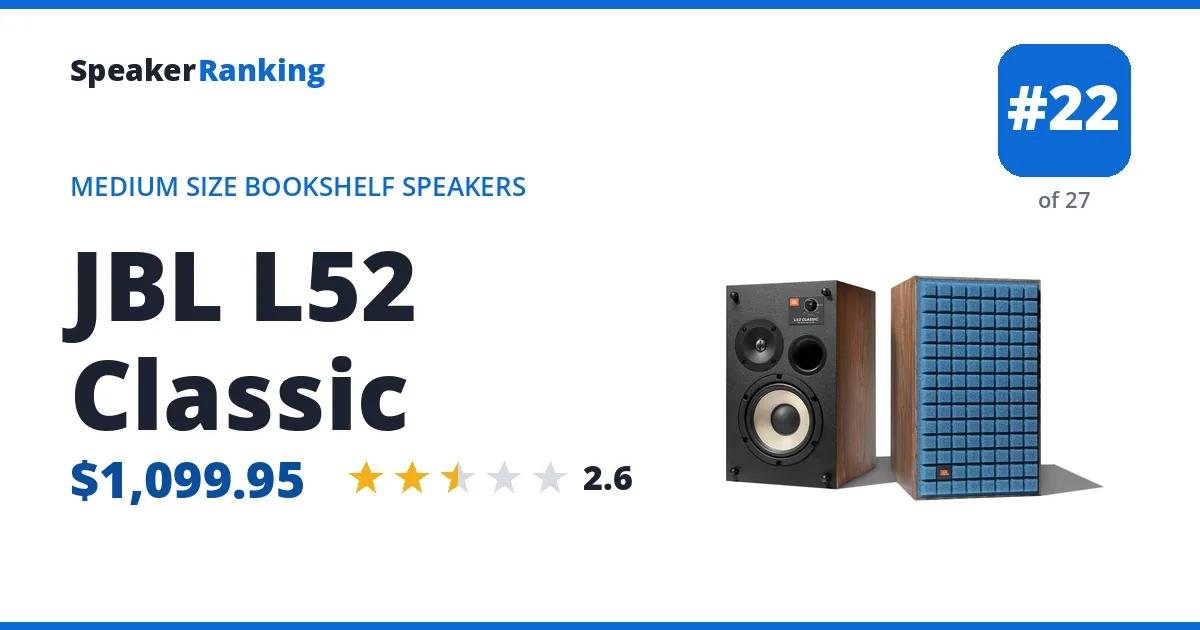
Pros: Genuine walnut wood veneer cabinet with a retro Quadrex foam grille (black, orange, or dark blue) reviving JBL’s classic L-series look. 5.25” pure pulp cone woofer and 0.75” titanium dome tweeter on a waveguide, front-firing bass reflex port, in a compact stand-mount cabinet. A pronounced upper-bass bump around 100 Hz gives kick drums a punchy, textured character. Measured bass extension of 62Hz (-3dB), with a measured sensitivity of 85dB.
Cons: Measured compression and distortion behavior from about 1-5 kHz was inconsistent (“wonky”) across output levels, and didn’t clean up even at lower volume; adding a subwoofer high-pass didn’t fix the high-frequency distortion either. Response rolls off quickly above the upper-bass bump, so there’s punch and impact but not real low-end rumble or fundamental weight below about 60 Hz without a subwoofer. Soundstage width was inconsistent track to track, with imaging not staying locked to where instruments should be. Vocals could sound hot and slightly grainy in the 2.5-5 kHz region; pointing the speakers off-axis reduced that sharpness but also killed high-frequency air.
Full JBL L52 Classic review and specifications →
| Bass Extension (-10dB) | 45Hz (measured average, Erin’s Audio Corner) |
|---|---|
| Bass Extension (-3dB) | 62Hz (measured average, Erin’s Audio Corner) |
| Crossover Frequency | 2.8kHz |
| DIY Kit | No |
| Dimensions | 13-1/16”H x 7-13/16”W x 8-11/16”D |
| Drivers | 5.25” pure pulp cone woofer, 0.75” titanium dome tweeter with waveguide |
| Frequency Response | 47Hz - 24kHz (-6dB, manufacturer specified) |
| Impedance | 4 ohms nominal, 3.7 ohms minimum (measured, Erin’s Audio Corner) |
| Power Handling | 10-75W RMS |
| Sensitivity | 85dB (measured average, Erin’s Audio Corner) |
| Spinorama Preference Score | 4.54 |
| Spinorama Preference Score with Perfect Sub | 6.96 |
| Weight | 11 lbs (5 kg) each |
- Links
- Reviews, Comparisons and Sound Samples
- Head-to-Head Comparisons
- JBL L52 Classic vs JBL Stage A120
- JBL L52 Classic vs ELAC Uni-Fi 2.0 UB52
- JBL L52 Classic vs Pioneer SP-BS22-LR (Philharmonic AAM Mod)
- JBL L52 Classic vs KEF Q100
- JBL L52 Classic vs Dynaudio X14
- JBL L52 Classic vs Q Acoustics 3020i
- JBL L52 Classic vs ELAC BS U5
- JBL L52 Classic vs Dynaudio Emit M10
- See all 34 comparisons
 Q Acoustics 5020: $1,199.00 per pair Amazon eBay
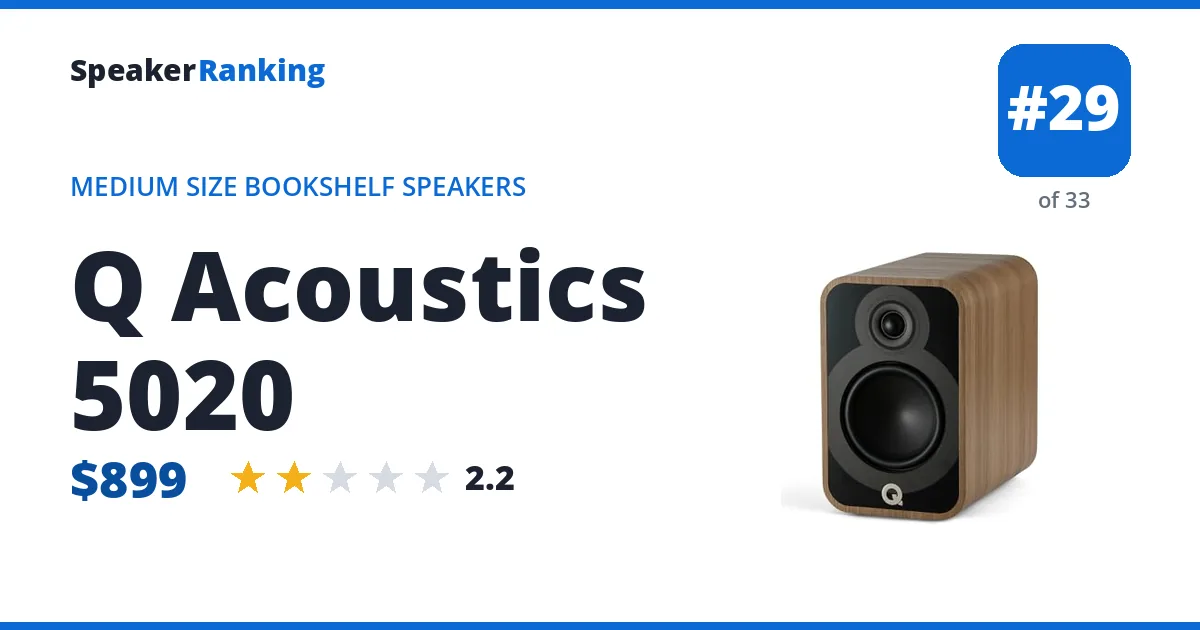
Pros: Attractively finished compact standmount with a 5-inch Continuous Curved Cone woofer and carefully engineered cabinet details. Erin found distortion well controlled at normal levels: below 1% down to about 50Hz at 86dB/1m. Its 87dB measured sensitivity is unremarkable rather than hard to drive, and it maintains acceptable output for typical 80-85dB listening. The rear port can be plugged for placement flexibility. Measured bass extension of 103Hz (-3dB), with a measured sensitivity of 87.1dB.
Cons: Erin found the tonal balance distinctly too crisp, forward and treble-heavy: the top end is roughly 3-5dB elevated while the 1-3kHz region is recessed, so vocals change level unnaturally as they move through their range. The shallow woofer crossover and steeper tweeter slope contribute to the off-axis discontinuity, while the port has a strong 1kHz resonance. Bass is limited: Erin measured F3 103Hz and F10 48Hz; at 96dB distortion reaches about 3% by 100Hz, and he bottomed the woofer when pushed hard. He preferred the less-expensive 3020i’s linearity and did not recommend the 5020 for neutral listening without EQ.
Full Q Acoustics 5020 review and specifications →
| Bass Extension (-10dB) | 48Hz (measured, Erin’s Audio Corner) |
|---|---|
| Bass Extension (-3dB) | 103Hz (measured, Erin’s Audio Corner) |
| Crossover Frequency | 2.5kHz (manufacturer specified) |
| DIY Kit | No |
| Dimensions | 11.2”H x 7.1”W x 11.5”D |
| Drivers | 5” (125mm) C3 mid/bass driver, 1” (25mm) tweeter |
| Frequency Response | 53Hz - 30kHz (-6dB, manufacturer specified) |
| Impedance | 6 ohms nominal, 3.3 ohms minimum (manufacturer specified) |
| Recommended Power | 25W - 100W (manufacturer specified) |
| Sensitivity | 87.1dB (2.83V/1m, measured, Erin’s Audio Corner; 87.9dB manufacturer specified) |
| Spinorama Preference Score | 3.63 |
| Spinorama Preference Score with Perfect Sub | 6.55 |
| Weight | 15.4 lbs (7.0 kg) each |
| Woofer Cabinet | rear-ported |
- Links
- Reviews, Comparisons and Sound Samples
- Head-to-Head Comparisons
- Q Acoustics 5020 vs Micca RB42
- Q Acoustics 5020 vs Verdant Audio Bambusa AL-1
- Q Acoustics 5020 vs JBL Stage A130
- Q Acoustics 5020 vs Fluance Signature HFS
- Q Acoustics 5020 vs Q Acoustics 3020i
- Q Acoustics 5020 vs JBL Control 1 Pro
- Q Acoustics 5020 vs KEF Q100
- Q Acoustics 5020 vs Polk T15
- See all 42 comparisons