Short answer: the JBL 708P for off-axis consistency, the Adam Audio T8V for a neutral nearfield tone. The T8V is quite balanced and neutral, very close to the Yamaha HS8, but a crossover-region notch around 4.6kHz and a hole in the vertical response below the tweeter axis mean the tweeter belongs at or above ear height. The 708P’s spinorama is extremely good on and off axis, with a port resonance adding a mild rise around 600-900Hz.
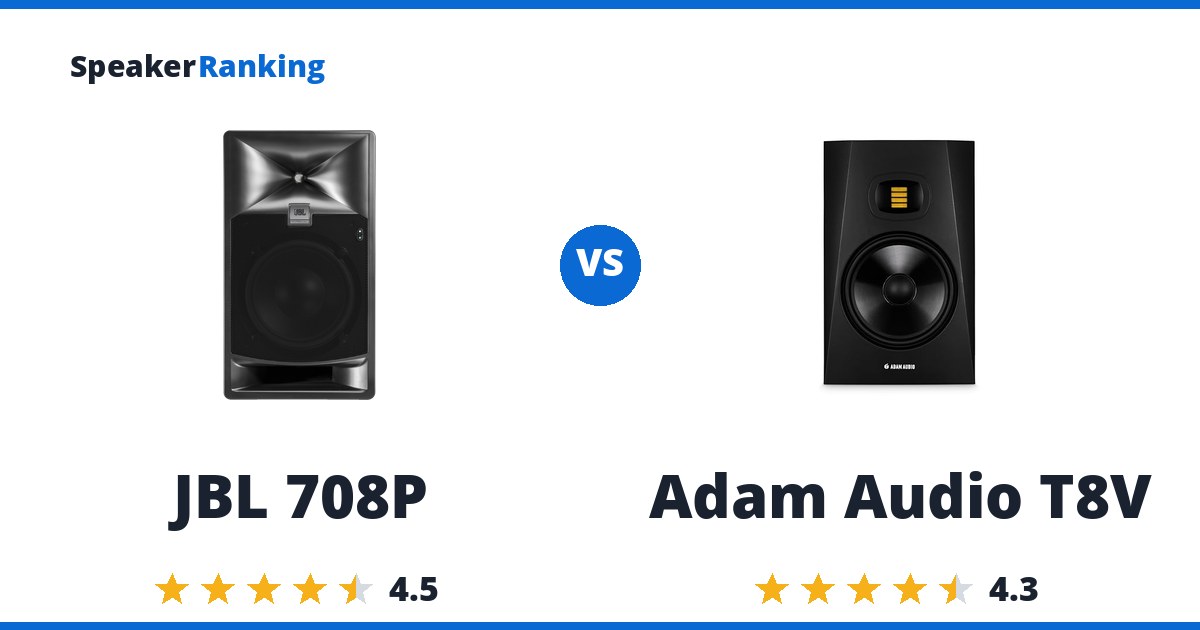
On the JBL 708P side: CEA2034 spinorama shows extremely good frequency response both on- and off-axis, with excellent horizontal directivity. Set against that: A port resonance creates a mild rise around 600-900Hz.
Buy the JBL 708P when sound quality outweighs the price for you, and the Adam Audio T8V when the price outweighs sound quality instead.
Still deciding? The full Powered Home rankings cover every ranked option.
Specifications Side By Side
| JBL 708P | Adam Audio T8V | |
|---|---|---|
| Price | $4000 per pair | $719.98 per pair |
| Ranked | #39 of 68 in Large Size Powered Bookshelf Speakers | #54 of 68 in Large Size Powered Bookshelf Speakers |
| Bass Extension (-3dB) | 43.9Hz (measured, Erin’s Audio Corner) | 39.6Hz (measured, Audio Science Review) |
| Bass Extension (-10dB) | 35.6Hz (derived, log-interpolated between spinorama.org -9dB/-12dB points) | 33.2Hz (derived, log-interpolated between spinorama.org -9dB/-12dB points) |
| Dimensions | 17.2”H x 9.8”W x 11.5”D (438 x 248 x 292 mm) | 15.8”H x 9.8”W x 13.2”D (401.3 x 248.9 x 335.3 mm) |
| Frequency Response | 41Hz - 25kHz (+/-3dB) (Manufacturer specified) | 33Hz - 25kHz (-6dB) (Manufacturer specified) |
| Weight | 25.1 lbs (11.4 kg) each | 21.6 lbs (9.8 kg) |
| Drivers | 8” woofer, 2409H 1” compression driver | 8” (203mm) woofer |
| App | No | No |
| EQ | No | Yes (Room adjustment) |
| DSP | No | No |
| Amplifier Power | 500W total (250W woofer, 250W tweeter) | 90w Per Speaker |
| Spinorama Preference Score | 5.03 | 4.65 |
| Spinorama Preference Score with Perfect Sub | 6.91 | 6.31 |
| Inputs | XLR/TRS combo (analog), XLR AES3 (digital) | XLR, RCA |
| XLR Input | Yes | Yes |
| RCA Input | No | Yes |
| TRS Input | Yes | No |
| Optical Input | No | No |
| Coaxial Input | No | No |
| USB Input | No | No |
| HDMI Input | No | No |
| AES Input | Yes | No |
| Aux Input | No | No |
| Bluetooth | No | No |
Related Speaker Comparisons
More top alternatives to JBL 708P:
- Genelec 8351B vs JBL 708P
- JBL 708P vs Neumann KH420
- Genelec 8361A vs JBL 708P
- JBL 708P vs Genelec 8341A
- Neumann KH 150 vs JBL 708P
Prices on this page were last checked October 2, 2026 at 10:18 PM UTC. Product prices and availability are accurate as of that date/time and are subject to change; the price and availability shown on Amazon at the time of purchase will apply to the purchase of this product.
As an eBay Partner, we may be compensated if you make a purchase.
The Two Speakers In Full
 JBL 708P: $4000 per pair B&H Photo Video eBay
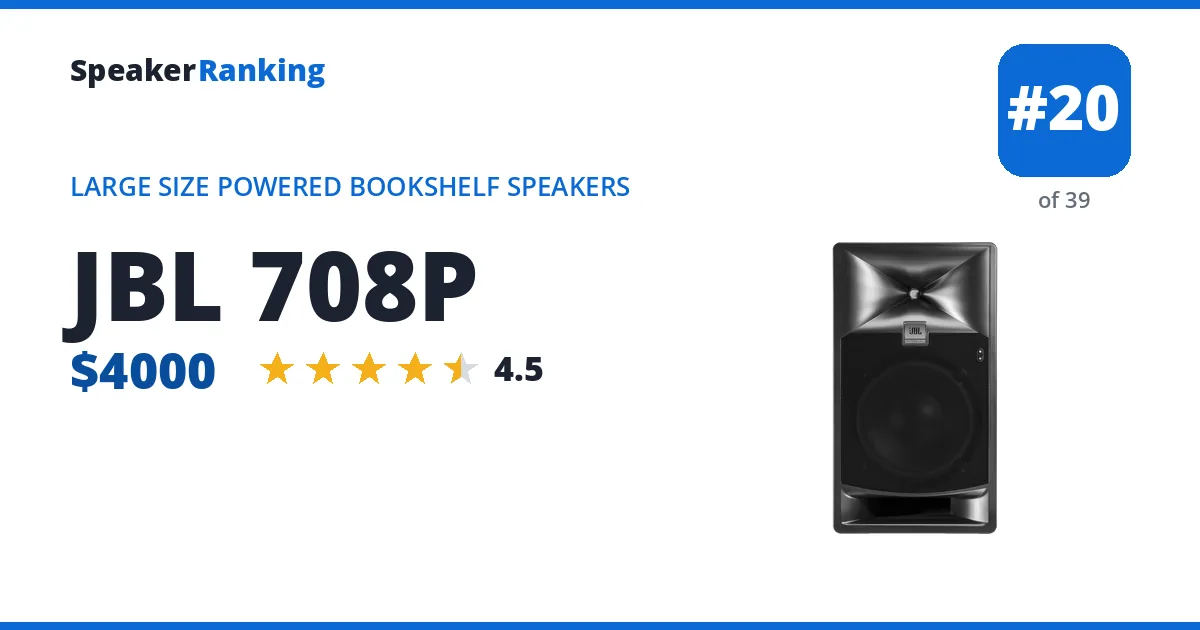
Pros: Erin’s measurements give 43.9Hz -3dB extension and a 6.91 ideal-subwoofer score, with useful bass from a professional active monitor. The waveguide and onboard processing make it a practical choice for a carefully installed studio system. Measured bass extension of 43.9Hz (-3dB).
Cons: The 2.6dB response span from 300Hz to 5kHz includes audible-relevance irregularities, with port-region features and vertical crossover sensitivity. High-level distortion remains a constraint. Its professional positioning and amplifier power do not make it automatically more neutral than the cheaper 308P MKII. A port resonance adds a mild rise around 600 to 900Hz, and vertical dispersion is narrower than horizontal, so stay within a few degrees of the tweeter axis.
Full JBL 708P review and specifications →
| AES Input | Yes |
|---|---|
| Amplifier Power | 500W total (250W woofer, 250W tweeter) |
| App | No |
| Aux Input | No |
| Bass Extension (-10dB) | 35.6Hz (derived, log-interpolated between spinorama.org -9dB/-12dB points) |
| Bass Extension (-3dB) | 43.9Hz (measured, Erin’s Audio Corner) |
| Bluetooth | No |
| Coaxial Input | No |
| DSP | No |
| Dimensions | 17.2”H x 9.8”W x 11.5”D (438 x 248 x 292 mm) |
| Drivers | 8” woofer, 2409H 1” compression driver |
| EQ | No |
| Frequency Response | 41Hz - 25kHz (+/-3dB) (Manufacturer specified) |
| HDMI Input | No |
| Inputs | XLR/TRS combo (analog), XLR AES3 (digital) |
| Optical Input | No |
| RCA Input | No |
| Spinorama Preference Score | 5.03 |
| Spinorama Preference Score with Perfect Sub | 6.91 |
| TRS Input | Yes |
| USB Input | No |
| Weight | 25.1 lbs (11.4 kg) each |
| XLR Input | Yes |
- Links
- Reviews, Comparisons and Sound Samples
- Head-to-Head Comparisons
 Adam Audio T8V: $719.98 per pair Amazon eBay
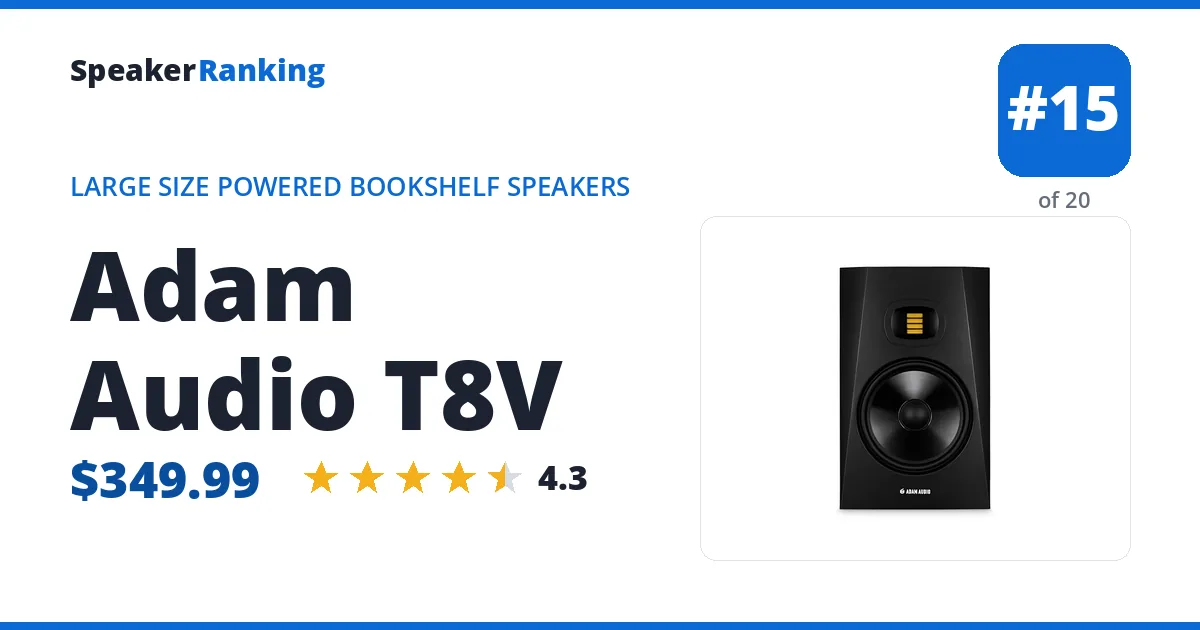
Pros: Measured -3dB extension of 39.6Hz gives useful bass depth for an affordable large monitor. Analog inputs and basic shelf controls offer uncomplicated studio integration. Measured bass extension of 39.6Hz (-3dB).
Cons: The 6.31 ideal-subwoofer score and 3.0dB response span from 300Hz to 5kHz show less even tonal balance than stronger budget alternatives. Treble emphasis and crossover-region vertical cancellation make listening height important. Deep bass and an AMT tweeter do not by themselves imply accurate sound. A notch around 4.6kHz, where tweeter and woofer interact, and a hole below the tweeter axis mean the tweeter should sit at or above ear height.
Full Adam Audio T8V review and specifications →
| AES Input | No |
|---|---|
| Amplifier Power | 90w Per Speaker |
| App | No |
| Aux Input | No |
| Bass Extension (-10dB) | 33.2Hz (derived, log-interpolated between spinorama.org -9dB/-12dB points) |
| Bass Extension (-3dB) | 39.6Hz (measured, Audio Science Review) |
| Bluetooth | No |
| Coaxial Input | No |
| DSP | No |
| Dimensions | 15.8”H x 9.8”W x 13.2”D (401.3 x 248.9 x 335.3 mm) |
| Drivers | 8” (203mm) woofer |
| EQ | Yes (Room adjustment) |
| Frequency Response | 33Hz - 25kHz (-6dB) (Manufacturer specified) |
| HDMI Input | No |
| Inputs | XLR, RCA |
| Optical Input | No |
| RCA Input | Yes |
| Spinorama Preference Score | 4.65 |
| Spinorama Preference Score with Perfect Sub | 6.31 |
| TRS Input | No |
| USB Input | No |
| Weight | 21.6 lbs (9.8 kg) |
| XLR Input | Yes |
- Links
- Reviews, Comparisons and Sound Samples
- Audio Science Review Measurements More from Audio Science Review →
- Sercan Solmaz: Adam Audio T8V vs Yamaha HS8 vs KRK Rokit 8 (STUDIO SPEAKER SOUND TEST)
- DSAUDIO.review: Adam Audio T8V vs KRK Rokit 8 G4 Sound & Frequency Response Comparison More from DSAUDIOreview →
- Audio Science Review Measurements (spinorama.org)
- Head-to-Head Comparisons