Short answer: the HEDD Type 20 MK2. It ranks #26 of 113 powered bookshelf speakers by sound quality (rated 4.5/5) at $4,798 and is still sold new; the JBL 4329P ranks #71 (rated 4.1/5) and is discontinued, so it is only an option used.
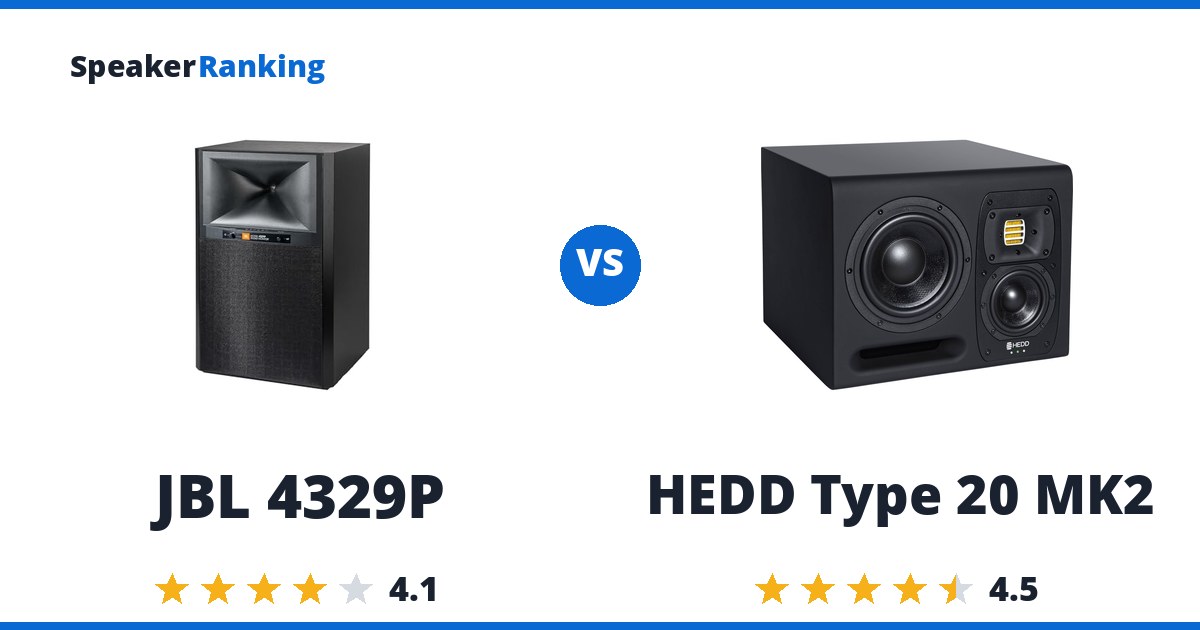
What the JBL 4329P does well: Measured -3dB extension of 32.2Hz provides deeper native bass than the smaller 4305P. It keeps a wired aux input, which the HEDD Type 20 MK2 lacks. The catch: The measured 4.5dB response span from 300Hz to 5kHz includes a notable midrange dip, so it is not as neutral as its size and price might suggest.
The HEDD Type 20 MK2 is the more accurate choice. The measured ported configuration reaches 35.2Hz at -3dB and scores 7.69 with an ideal subwoofer. Its measured preference score, a predictor of how neutral it sounds, is 6.11 against 5.40 for the JBL 4329P. The catch: These results are for ported operation, not every bass or phase setting.
Buy the HEDD Type 20 MK2. It is rated higher for sound quality; the JBL 4329P is no longer sold new.
Still deciding? The full Powered Home rankings cover every ranked option.
Specifications Side By Side
| JBL 4329P | HEDD Type 20 MK2 | |
|---|---|---|
| Price | $4,500 per pair Discontinued | $4,798 per pair |
| Ranked | #71 of 113 in Large Size Powered Bookshelf Speakers | #26 of 113 in Large Size Powered Bookshelf Speakers |
| Drivers | 8” midwoofer, 1” compression driver with JBL High-Definition Imaging horn | 7” honeycomb composite woofer, 4” honeycomb composite midrange, HEDD AMT (Air Motion Transformer) tweeter |
| Dimensions | 20.3”H x 12.6”W x 12.7”D | 14.1”H x 11”W x 13.3”D (358.1 x 279.4 x 337.8 mm) |
| Weight | 34.4 lbs (15.6 kg) (primary), 34.4 lbs (15.6 kg) (secondary) | 34 lbs (15.4 kg) each |
| Sensitivity | 102.2dB (measured at 0.3V/1m, Erin’s Audio Corner) | - |
| Bass Extension (-3dB) | 31Hz (measured, Erin’s Audio Corner) | 32Hz (measured, Audio Science Review) |
| Bass Extension (-10dB) | 27Hz (measured, Erin’s Audio Corner) | 26Hz (measured, Audio Science Review) |
| Frequency Response | 30Hz - 20kHz (anechoic, manufacturer specified) | 32Hz - 40kHz (Manufacturer specified) |
| Inputs | USB, Optical, Bluetooth, Analog, 3.5mm, AirPlay 2 | XLR (Analog/AES) |
| Bluetooth Codecs | SBC, aptX Adaptive | - |
| Woofer Cabinet | ported | - |
| Spinorama Preference Score | 5.40 | 6.11 |
| Spinorama Preference Score with Perfect Sub | 6.72 | 7.69 |
| XLR Input | No | Yes |
| RCA Input | No | No |
| TRS Input | No | No |
| Optical Input | Yes | No |
| Coaxial Input | No | No |
| USB Input | Yes | No |
| HDMI Input | No | No |
| AES Input | No | Yes |
| Aux Input | Yes | No |
| Amplifier Power | 300W RMS per speaker (600W total system power) | 900W (3x300W) |
| Bluetooth | Yes | No |
| Bluetooth Version | 5.3 | - |
| App | - | Yes (HEDD CTRL) |
| DSP | - | Yes (96kHz/32-bit) |
| EQ | - | Yes (Desk filter, shelf filters) |
| Outputs | - | XLR (AES pass-through) |
| Maximum SPL | - | 120dB @ 1m (per pair) (manufacturer specified) |
Related Speaker Comparisons
More worthwhile head-to-heads for HEDD Type 20 MK2:
- AsciLab C8C vs HEDD Type 20 MK2
- Mesanovic CDM65 vs HEDD Type 20 MK2
- Genelec 8351B vs HEDD Type 20 MK2
- Genelec 8361A vs HEDD Type 20 MK2
- Neumann KH 150 vs HEDD Type 20 MK2
Prices on this page were last checked October 7, 2026 at 9:25 PM UTC. Product prices and availability are accurate as of that date/time and are subject to change; the price and availability shown on Amazon at the time of purchase will apply to the purchase of this product.
As an eBay Partner, we may be compensated if you make a purchase.
The Two Speakers In Full
 JBL 4329P: $4,500 per pair Discontinued eBay
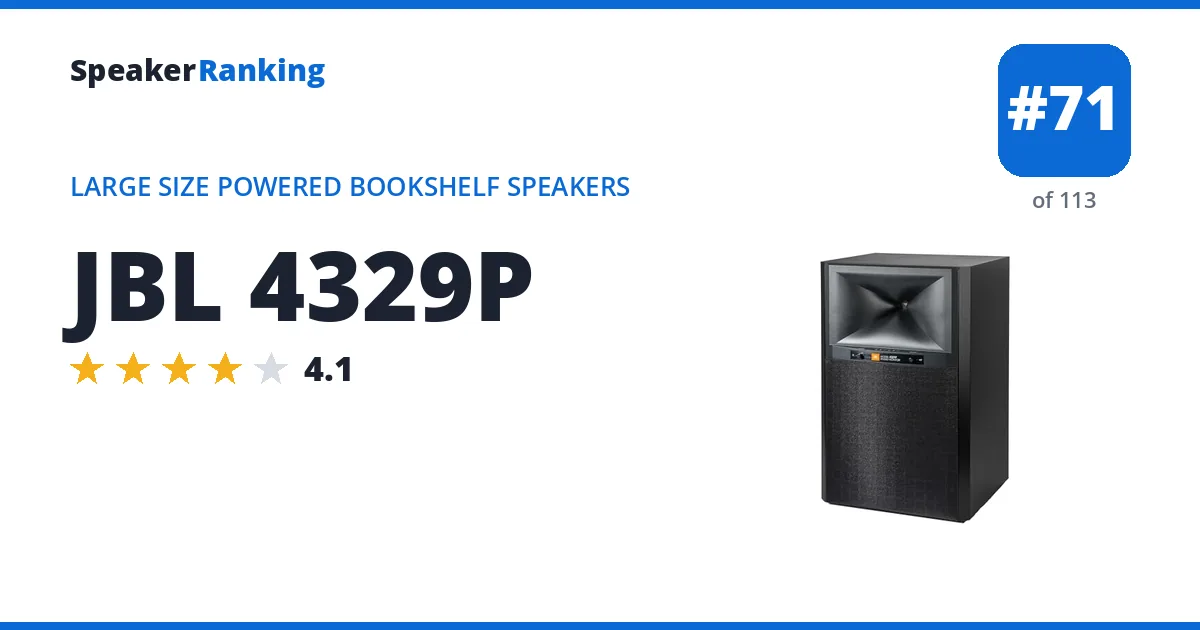
Pros: Measured -3dB extension of 32.2Hz provides deeper native bass than the smaller 4305P. Integrated amplification and streaming make it convenient for a full-range living-room system, and its larger format is useful when scale matters. Measured bass extension of 31Hz (-3dB), with a measured sensitivity of 102.2dB.
Cons: The measured 4.5dB response span from 300Hz to 5kHz includes a notable midrange dip, so it is not as neutral as its size and price might suggest. Its 6.72 ideal-subwoofer score trails the 4305P. There is no HDMI connection for the simplest TV hookup. Discontinued.
Full JBL 4329P review and specifications →
| AES Input | No |
|---|---|
| Amplifier Power | 300W RMS per speaker (600W total system power) |
| Aux Input | Yes |
| Bass Extension (-10dB) | 27Hz (measured, Erin’s Audio Corner) |
| Bass Extension (-3dB) | 31Hz (measured, Erin’s Audio Corner) |
| Bluetooth | Yes |
| Bluetooth Codecs | SBC, aptX Adaptive |
| Bluetooth Version | 5.3 |
| Coaxial Input | No |
| Dimensions | 20.3”H x 12.6”W x 12.7”D |
| Drivers | 8” midwoofer, 1” compression driver with JBL High-Definition Imaging horn |
| Frequency Response | 30Hz - 20kHz (anechoic, manufacturer specified) |
| HDMI Input | No |
| Inputs | USB, Optical, Bluetooth, Analog, 3.5mm, AirPlay 2 |
| Optical Input | Yes |
| RCA Input | No |
| Sensitivity | 102.2dB (measured at 0.3V/1m, Erin’s Audio Corner) |
| Spinorama Preference Score | 5.40 |
| Spinorama Preference Score with Perfect Sub | 6.72 |
| TRS Input | No |
| USB Input | Yes |
| Weight | 34.4 lbs (15.6 kg) (primary), 34.4 lbs (15.6 kg) (secondary) |
| Woofer Cabinet | ported |
| XLR Input | No |
- Links
- Reviews, Comparisons and Sound Samples
- Head-to-Head Comparisons
 HEDD Type 20 MK2: $4,798 per pair B&H Photo Video eBay
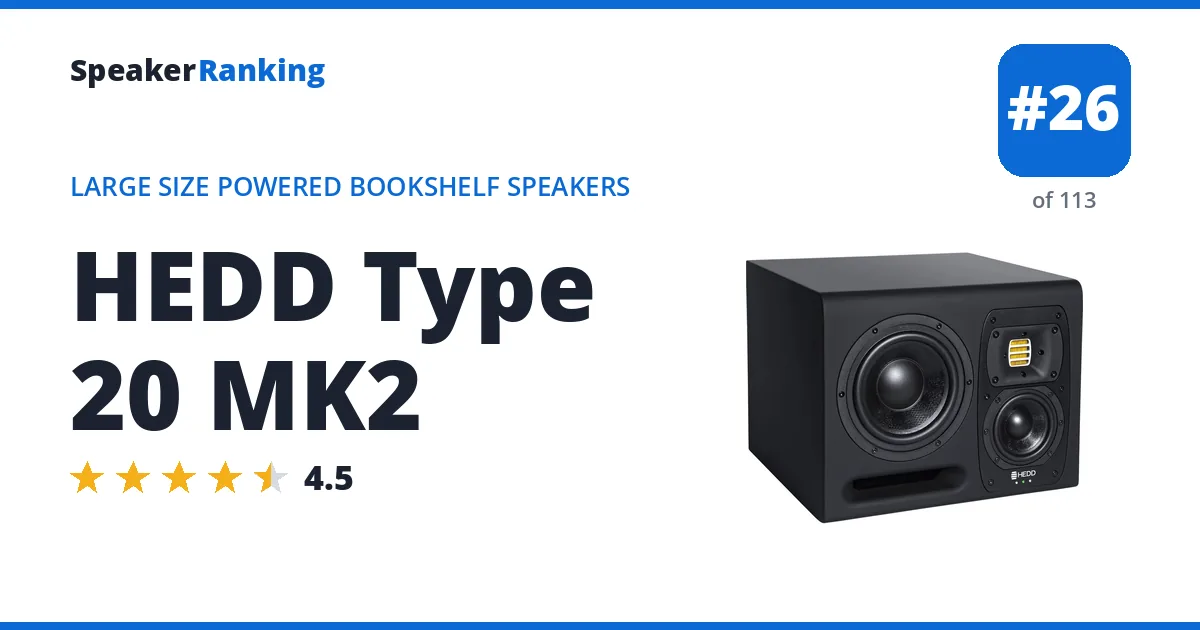
Pros: The measured ported configuration reaches 35.2Hz at -3dB and scores 7.69 with an ideal subwoofer. A 2.4dB response span from 300Hz to 5kHz supports broadly balanced mids, while ported operation reduces deep-bass strain compared with the sealed setting in the review. Measured bass extension of 32Hz (-3dB).
Cons: These results are for ported operation, not every bass or phase setting. Horizontal asymmetry and vertical crossover behavior make orientation and listening position important. Distortion rises at higher output, and linear-phase processing can add latency for live monitoring.
Full HEDD Type 20 MK2 review and specifications →
| AES Input | Yes |
|---|---|
| Amplifier Power | 900W (3x300W) |
| App | Yes (HEDD CTRL) |
| Aux Input | No |
| Bass Extension (-10dB) | 26Hz (measured, Audio Science Review) |
| Bass Extension (-3dB) | 32Hz (measured, Audio Science Review) |
| Bluetooth | No |
| Coaxial Input | No |
| DSP | Yes (96kHz/32-bit) |
| Dimensions | 14.1”H x 11”W x 13.3”D (358.1 x 279.4 x 337.8 mm) |
| Drivers | 7” honeycomb composite woofer, 4” honeycomb composite midrange, HEDD AMT (Air Motion Transformer) tweeter |
| EQ | Yes (Desk filter, shelf filters) |
| Frequency Response | 32Hz - 40kHz (Manufacturer specified) |
| HDMI Input | No |
| Inputs | XLR (Analog/AES) |
| Maximum SPL | 120dB @ 1m (per pair) (manufacturer specified) |
| Optical Input | No |
| Outputs | XLR (AES pass-through) |
| RCA Input | No |
| Spinorama Preference Score | 6.11 |
| Spinorama Preference Score with Perfect Sub | 7.69 |
| TRS Input | No |
| USB Input | No |
| Weight | 34 lbs (15.4 kg) each |
| XLR Input | Yes |
- Links
- Reviews, Comparisons and Sound Samples
- Head-to-Head Comparisons
- HEDD Type 20 MK2 vs Neumann KH 310 A
- HEDD Type 20 MK2 vs Buchardt A500
- HEDD Type 20 MK2 vs JBL 308P MKII
- HEDD Type 20 MK2 vs Yamaha HS8
- HEDD Type 20 MK2 vs Kali Audio LP-6 V2
- HEDD Type 20 MK2 vs Kali Audio IN-8 V2
- HEDD Type 20 MK2 vs Genelec 8050B
- HEDD Type 20 MK2 vs JBL 4305P
- See all 24 comparisons