Short answer: the JBL 305P MKII. It ranks #17 of 100 powered bookshelf speakers by sound quality, rated 4.3/5, at $289; the Pioneer DJ VM-50 ranks #33, rated 4.0/5, and costs $418, so there is not much of a tradeoff to weigh.
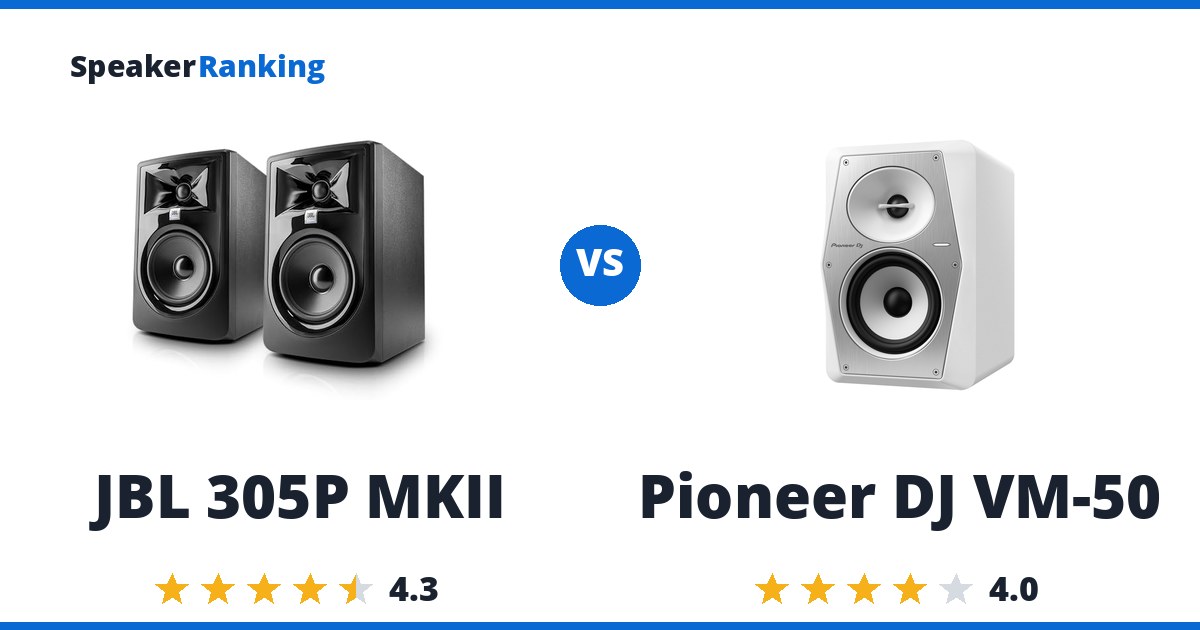
305P MKII’s Klippel data gives 5.38 standalone and 7.52 with an ideal subwoofer, with bass reaching -3dB around 51Hz and effective limiting that keeps compression in check. A 3.3dB midrange span and some excess treble mean the treble-trim switch is worth using.
VM-50 scores 4.64 standalone and 7.00 with an ideal subwoofer, with bass extension around 60Hz at -3dB. Separate bass and treble voicing switches plus balanced inputs make it straightforward to adjust, though EQ-switch selection and aiming both matter for its default balance.
Buy the JBL 305P MKII for the stronger measured performance and deeper bass extension. Buy the Pioneer DJ VM-50 if the adjustable bass/treble voicings and balanced inputs matter more for your setup.
Looking for alternatives? See the complete Powered Home rankings.
Specifications Side By Side
| JBL 305P MKII | Pioneer DJ VM-50 | |
|---|---|---|
| Price | $289.00 per pair | $418 per pair |
| Ranked | #17 of 100 in Medium Size Powered Bookshelf Speakers | #33 of 100 in Medium Size Powered Bookshelf Speakers |
| Dimensions | 11.7”H x 7.3”W x 9.1”D (297.2 x 185.4 x 231.1 mm) | 7.8” x 11.8” x 10.1” (198 x 300 x 256 mm) (W x H x D) |
| Frequency Response | 49 Hz - 20 kHz (+-3 dB) (Manufacturer specified) | 40Hz - 36kHz (Manufacturer specified) |
| Bass Extension (-3dB) | 50Hz (measured, Erin’s Audio Corner) | 61Hz (measured, Erin’s Audio Corner) |
| Bass Extension (-10dB) | 43Hz (measured, Erin’s Audio Corner) | 47.3Hz (measured, Erin’s Audio Corner) |
| Inputs | XLR, TRS | XLR/TRS combo and RCA |
| Weight | 10.4 lbs (4.7 kg) each | 12.1 lbs (5.5 kg) |
| Drivers | 5” (127mm) woofer | 1” tweeter in horn; 5.25” aramid-fiber woofer |
| App | No | - |
| Bluetooth | No | No |
| EQ | Yes (Room adjustment) | - |
| Amplifier Power | 81w Per Speaker | 30W LF + 30W HF; Class D |
| Sensitivity | 91.1dB (measured at 0.3V/1m, Erin’s Audio Corner) | - |
| Spinorama Preference Score | 5.38 | 4.64 |
| Spinorama Preference Score with Perfect Sub | 7.52 | 7.00 |
| XLR Input | Yes | Yes |
| RCA Input | No | Yes |
| TRS Input | Yes | Yes |
| Optical Input | No | No |
| Coaxial Input | No | No |
| USB Input | No | No |
| HDMI Input | No | No |
| AES Input | No | No |
| Aux Input | No | No |
| DSP | - | Four LF and four HF EQ settings |
Related Speaker Comparisons
How JBL 305P MKII compares with other leading options:
- Genelec 8331A vs JBL 305P MKII
- JBL 305P MKII vs Neumann KH120 MKII
- Genelec 8030C vs JBL 305P MKII
- JBL 305P MKII vs Neumann KH80 DSP
- JBL 305P MKII vs Reflector Audio Square Two
Prices on this page were last checked October 7, 2026 at 9:25 PM UTC. Product prices and availability are accurate as of that date/time and are subject to change; the price and availability shown on Amazon at the time of purchase will apply to the purchase of this product.
As an eBay Partner, we may be compensated if you make a purchase.
The Two Speakers In Full
 JBL 305P MKII: $289.00 per pair Amazon eBay
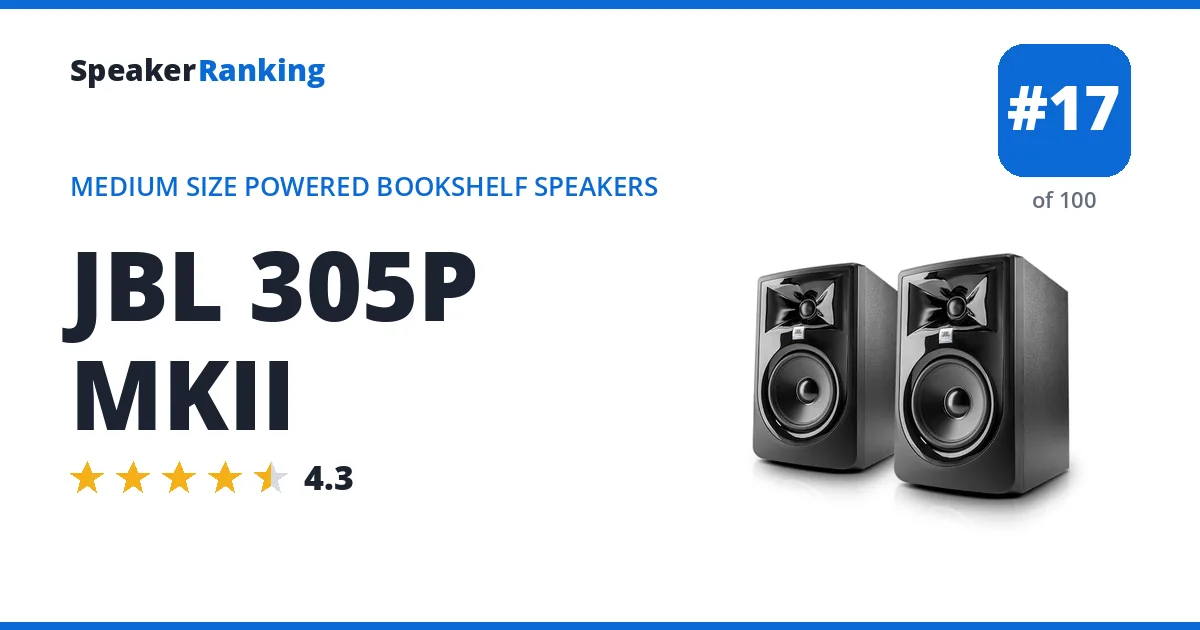
Older model: the JBL LSR305 (ranked lower, rated 4.2/5).
Same family: the JBL 306P MKII (larger bookshelf, rated 4.1/5) and the JBL 308P MKII (larger bookshelf, rated 4.4/5).
Pros: Erin’s Klippel data gives 5.38 standalone and 7.52 with an ideal subwoofer, with bass reaching -3dB around 51Hz. Broad horizontal coverage and reasonably smooth reflected sound support stable imaging across a desk. The existing review reports effective limiting and little sustained thermal compression, making it a strong budget-monitor option rather than just a speaker with a promising frequency curve. Measured bass extension of 50Hz (-3dB), with a measured sensitivity of 91.1dB.
Cons: The 3.3dB midrange span and rising response show it is not perfectly neutral. A port-related feature around 1.6kHz and some excess treble can be audible; the review recommends the treble-trim switch. Vertical crossover interference makes ear height important. Amplifier hiss may matter in very quiet nearfield use, and rear-port placement needs room-boundary adjustment.
Full JBL 305P MKII review and specifications →
| AES Input | No |
|---|---|
| Amplifier Power | 81w Per Speaker |
| App | No |
| Aux Input | No |
| Bass Extension (-10dB) | 43Hz (measured, Erin’s Audio Corner) |
| Bass Extension (-3dB) | 50Hz (measured, Erin’s Audio Corner) |
| Bluetooth | No |
| Coaxial Input | No |
| Dimensions | 11.7”H x 7.3”W x 9.1”D (297.2 x 185.4 x 231.1 mm) |
| Drivers | 5” (127mm) woofer |
| EQ | Yes (Room adjustment) |
| Frequency Response | 49 Hz - 20 kHz (+-3 dB) (Manufacturer specified) |
| HDMI Input | No |
| Inputs | XLR, TRS |
| Optical Input | No |
| RCA Input | No |
| Sensitivity | 91.1dB (measured at 0.3V/1m, Erin’s Audio Corner) |
| Spinorama Preference Score | 5.38 |
| Spinorama Preference Score with Perfect Sub | 7.52 |
| TRS Input | Yes |
| USB Input | No |
| Weight | 10.4 lbs (4.7 kg) each |
| XLR Input | Yes |
- Links
- Reviews, Comparisons and Sound Samples
- Erin’s Audio Corner Review Measurements More from Erin’s Audio Corner →
- Audio Science Review Measurements More from Audio Science Review →
- Erin’s Audio Corner: LIVE! JBL 305P MkII Powered Studio Monitor Review
- DSAUDIO.review: DSAUDIO.review Focal Alpha 50 EVO vs JBL 305P MKII sound.DEMO More from DSAUDIOreview →
- DSAUDIO.review: JBL 305P MKII vs Yamaha HS5 6-Track Comparison
- DSAUDIO.review: DSAUDIO.review JBL 305P MKII vs KRK Classic 5 CL5G3 sound.DEMO
- DSAUDIO.review: JBL 305P MKII vs Adam Audio T5V 6-Track Comparison
- DSAUDIO.review: DSAUDIO.review Adam Audio A5X vs JBL 305P MKII sound.DEMO
- DSAUDIO.review: DSAUDIO.review Kali Audio LP-6 V2 (2nd Wave) vs JBL 305P MKII sound.DEMO
- DSAUDIO.review: DSAUDIO.review Edifier MR4 vs JBL 305P MKII sound.DEMO
- DSAUDIO.review: Kali Audio IN-5 vs JBL 305P MKII Sound & Frequency Response Comparison
- DSAUDIO.review: JBL 308P MKII vs JBL 305P MKII Sound & Frequency Response Comparison
- DSAUDIO.review: Neumann KH80 DSP vs JBL 305P MKII Sound & Frquency Response Comparison
- DSAUDIO.review: JBL 305P MKII vs PreSonus Eris E5 6-Track Comparison
- Erin’s Audio Corner Measurements (spinorama.org)
- Jasper Tech: Best Desktop Computer Speakers for Every Budget – 2026 More from Jasper Tech →
- Jasper Tech: Best Powered Bookshelf Speakers for Every Budget - 2025
- Jasper Tech: Are the iLoud Micro Monitor Pro the Best Studio Monitor Speakers for your Home Studio?
- Head-to-Head Comparisons
- JBL 305P MKII vs KEF LS50 Wireless II
- JBL 305P MKII vs Klipsch The Fives
- JBL 305P MKII vs Vanatoo Transparent One Encore Plus
- JBL 305P MKII vs Genelec 8020D
- JBL 305P MKII vs IK Multimedia iLoud MTM MKII
- JBL 305P MKII vs Topping MA4
- JBL 305P MKII vs Sigberg Audio SBS Gen 2
- JBL 305P MKII vs HEDD Type 05 A-CORE
- See all 66 comparisons
 Pioneer DJ VM-50: $418 per pair Amazon B&H Photo Video eBay
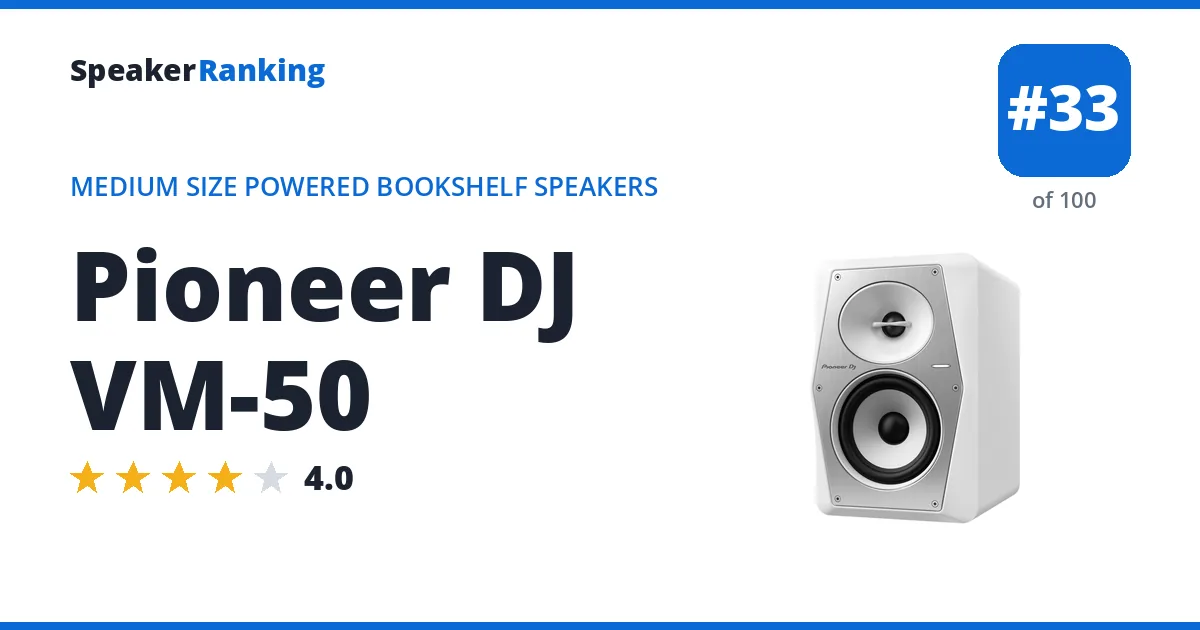
Same family: the Pioneer DJ VM-70 (larger bookshelf, estimated 4/5) and the Pioneer DJ VM-80 (larger bookshelf, estimated 4/5).
Pros: Erin’s Klippel measurements give scores of 4.64 standalone and 7.00 with an ideal subwoofer, with a -3dB point around 60Hz. The existing review reports low distortion and little sustained compression, supporting practical clean playback beyond what the tonal score alone captures. Separate bass and treble voicings and balanced inputs make adjustment straightforward. Measured bass extension of 61Hz (-3dB).
Cons: The default response spans 3.5dB from 300Hz to 5kHz, and the upper-midrange/treble balance varies with angle. EQ-switch selection and aiming therefore matter. Bass below about 50Hz is reduced, so it is not a full-range substitute for a monitor-and-subwoofer system. Its output evidence supports nearfield use, not unrestricted home-theater levels.
Full Pioneer DJ VM-50 review and specifications →
| AES Input | No |
|---|---|
| Amplifier Power | 30W LF + 30W HF; Class D |
| Aux Input | No |
| Bass Extension (-10dB) | 47.3Hz (measured, Erin’s Audio Corner) |
| Bass Extension (-3dB) | 61Hz (measured, Erin’s Audio Corner) |
| Bluetooth | No |
| Coaxial Input | No |
| DSP | Four LF and four HF EQ settings |
| Dimensions | 7.8” x 11.8” x 10.1” (198 x 300 x 256 mm) (W x H x D) |
| Drivers | 1” tweeter in horn; 5.25” aramid-fiber woofer |
| Frequency Response | 40Hz - 36kHz (Manufacturer specified) |
| HDMI Input | No |
| Inputs | XLR/TRS combo and RCA |
| Optical Input | No |
| RCA Input | Yes |
| Spinorama Preference Score | 4.64 |
| Spinorama Preference Score with Perfect Sub | 7.00 |
| TRS Input | Yes |
| USB Input | No |
| Weight | 12.1 lbs (5.5 kg) |
| XLR Input | Yes |
- Links
- Reviews, Comparisons and Sound Samples
- Head-to-Head Comparisons
- Pioneer DJ VM-50 vs Airpulse A100
- Pioneer DJ VM-50 vs KEF LSX II LT
- Pioneer DJ VM-50 vs Audioengine A5+ Classic
- Pioneer DJ VM-50 vs IK Multimedia iLoud MTM
- Pioneer DJ VM-50 vs Adam Audio T5V
- Pioneer DJ VM-50 vs Kali Audio IN-5
- Pioneer DJ VM-50 vs Kanto YU6
- Pioneer DJ VM-50 vs Kali Audio SM-5
- See all 53 comparisons