Short answer: the HEDD Type 20 MK2 if sound quality matters most, the JBL 4305P if price matters most. The HEDD Type 20 MK2 ranks #18 of 68 powered bookshelf speakers, rated 4.5/5, at $4,800. The JBL 4305P ranks #28, rated 4.4/5, at $1,499.99, $3,300.01 cheaper.
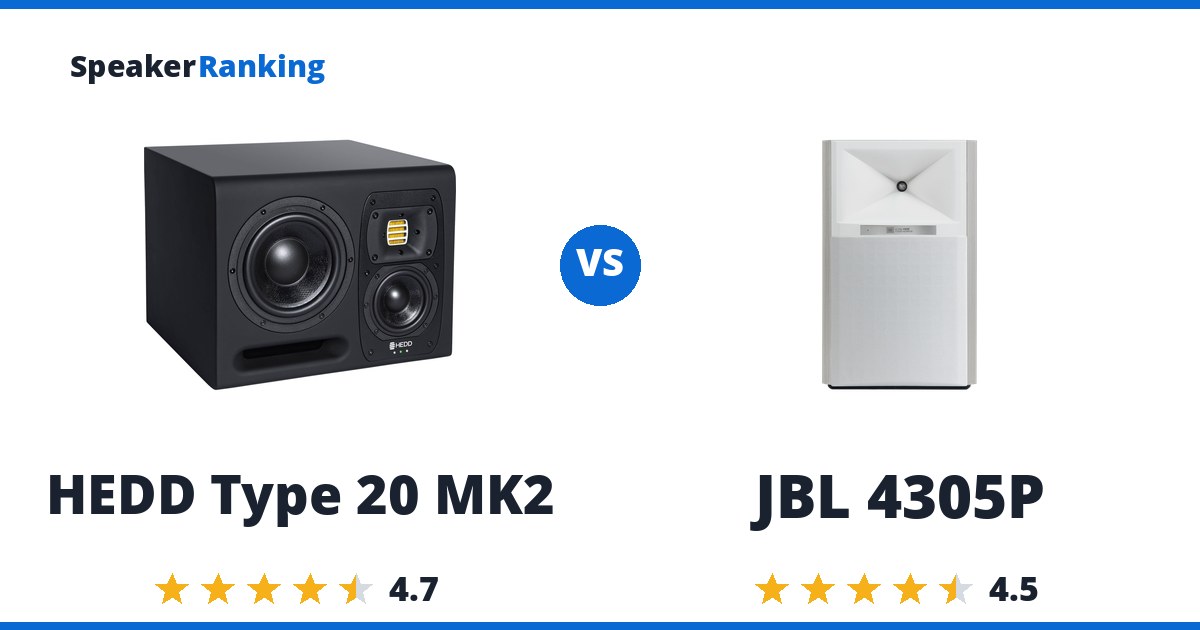
Why pick the HEDD Type 20 MK2: The measured ported configuration reaches 35.2Hz at -3dB and scores 7.69 with an ideal subwoofer. The tradeoff: These results are for ported operation, not every bass or phase setting.
The case for the JBL 4305P: The measured 1.5dB response span from 300Hz to 5kHz supports even mids, with a 7.45 ideal-subwoofer score and 45.4Hz -3dB bass extension. The catch: Crossover-region directivity changes mean the narrow on-axis span does not describe every listening angle.
Buy the HEDD Type 20 MK2 if sound quality matters more than the price. Buy the JBL 4305P if the price matters more than sound quality.
Want more options? Browse the full Powered Home rankings.
Specifications Side By Side
| HEDD Type 20 MK2 | JBL 4305P | |
|---|---|---|
| Price | $4800 per pair | $1,499.99 per pair |
| Ranked | #18 of 68 in Large Size Powered Bookshelf Speakers | #28 of 68 in Large Size Powered Bookshelf Speakers |
| App | Yes (HEDD CTRL) | - |
| Bass Extension (-10dB) | 26Hz (measured, Audio Science Review) | 40.5Hz (measured, Erin’s Audio Corner) |
| Bass Extension (-3dB) | 32Hz (measured, Audio Science Review) | 45Hz (measured, Erin’s Audio Corner) |
| Bluetooth | No | Yes, 5.1 |
| Dimensions | 14.1”H x 11”W x 13.3”D (358.1 x 279.4 x 337.8 mm) | 13.2H x 8.3W x 8.8D inches |
| DSP | Yes (96kHz/32-bit) | - |
| EQ | Yes (Desk filter, shelf filters) | - |
| Frequency Response | 32Hz - 40kHz (Manufacturer specified) | 45Hz - 25kHz (-6dB) (Manufacturer specified) |
| Inputs | XLR (Analog/AES) | XLR/TRS combo, 3.5mm Aux, Optical, USB-B, Ethernet |
| Drivers | 7” honeycomb composite woofer, 4” honeycomb composite midrange, HEDD AMT (Air Motion Transformer) tweeter | 5.25-inch pulp woofer; 1-inch annular compression driver |
| Outputs | XLR (AES pass-through) | - |
| Weight | 34 lbs (15.4 kg) each | Primary 14.6 lbs (6.6 kg), Secondary 14.1 lbs (6.4 kg) |
| Amplifier Power | 900W (3x300W) | 300W system: 125W LF + 25W HF per speaker |
| Maximum SPL | 120dB @ 1m (per pair) (manufacturer specified) | ~93dB at 2m in-room before limiting (measured, Erin’s Audio Corner) |
| Spinorama Preference Score | 6.11 | 5.44 |
| Spinorama Preference Score with Perfect Sub | 7.69 | 7.45 |
| XLR Input | Yes | Yes |
| RCA Input | No | No |
| TRS Input | No | Yes |
| Optical Input | No | Yes |
| Coaxial Input | No | No |
| USB Input | No | Yes |
| HDMI Input | No | No |
| AES Input | Yes | No |
| Aux Input | No | Yes |
Related Speaker Comparisons
More worthwhile head-to-heads for HEDD Type 20 MK2:
- AsciLab C8C vs HEDD Type 20 MK2
- Mesanovic CDM65 vs HEDD Type 20 MK2
- Genelec 8351B vs HEDD Type 20 MK2
- Genelec 8361A vs HEDD Type 20 MK2
- Neumann KH 150 vs HEDD Type 20 MK2
Prices on this page were last checked September 30, 2026 at 2:57 PM UTC. Product prices and availability are accurate as of that date/time and are subject to change; the price and availability shown on Amazon at the time of purchase will apply to the purchase of this product.
As an eBay Partner, we may be compensated if you make a purchase.
The Two Speakers In Full
 HEDD Type 20 MK2: $4800 per pair B&H Photo Video eBay
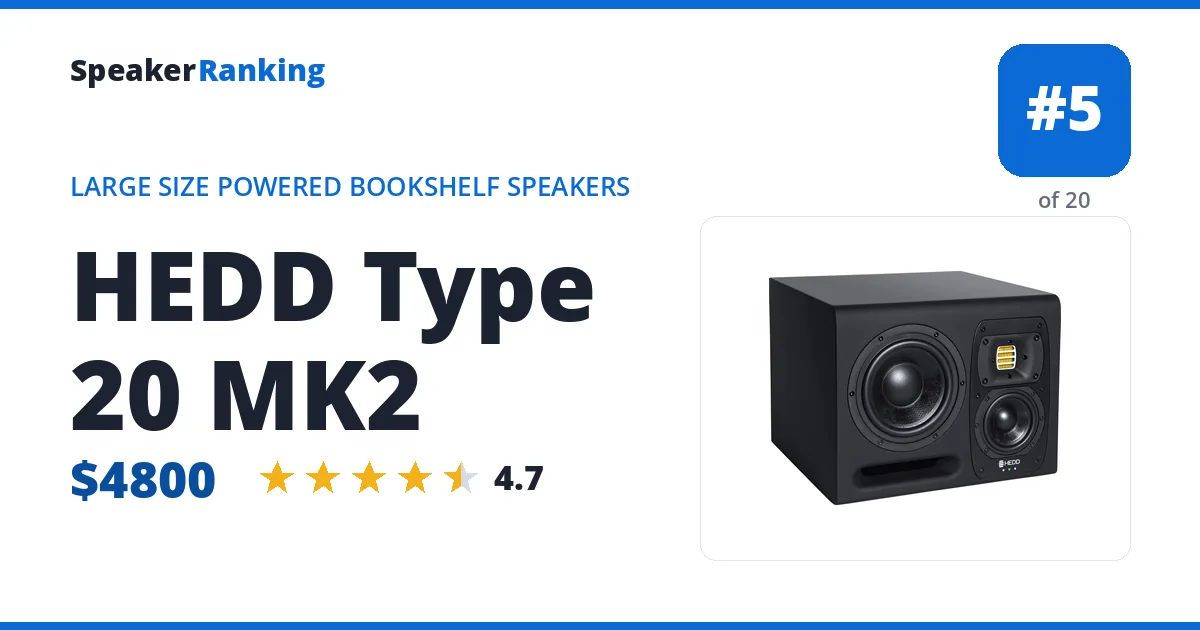
Pros: The measured ported configuration reaches 35.2Hz at -3dB and scores 7.69 with an ideal subwoofer. A 2.4dB response span from 300Hz to 5kHz supports broadly balanced mids, while ported operation reduces deep-bass strain compared with the sealed setting in the review. Measured bass extension of 32Hz (-3dB).
Cons: These results are for ported operation, not every bass or phase setting. Horizontal asymmetry and vertical crossover behavior make orientation and listening position important. Distortion rises at higher output, and linear-phase processing can add latency for live monitoring.
Full HEDD Type 20 MK2 review and specifications →
| AES Input | Yes |
|---|---|
| Amplifier Power | 900W (3x300W) |
| App | Yes (HEDD CTRL) |
| Aux Input | No |
| Bass Extension (-10dB) | 26Hz (measured, Audio Science Review) |
| Bass Extension (-3dB) | 32Hz (measured, Audio Science Review) |
| Bluetooth | No |
| Coaxial Input | No |
| DSP | Yes (96kHz/32-bit) |
| Dimensions | 14.1”H x 11”W x 13.3”D (358.1 x 279.4 x 337.8 mm) |
| Drivers | 7” honeycomb composite woofer, 4” honeycomb composite midrange, HEDD AMT (Air Motion Transformer) tweeter |
| EQ | Yes (Desk filter, shelf filters) |
| Frequency Response | 32Hz - 40kHz (Manufacturer specified) |
| HDMI Input | No |
| Inputs | XLR (Analog/AES) |
| Maximum SPL | 120dB @ 1m (per pair) (manufacturer specified) |
| Optical Input | No |
| Outputs | XLR (AES pass-through) |
| RCA Input | No |
| Spinorama Preference Score | 6.11 |
| Spinorama Preference Score with Perfect Sub | 7.69 |
| TRS Input | No |
| USB Input | No |
| Weight | 34 lbs (15.4 kg) each |
| XLR Input | Yes |
- Links
- Reviews, Comparisons and Sound Samples
- Head-to-Head Comparisons
- HEDD Type 20 MK2 vs Neumann KH 310 A
- HEDD Type 20 MK2 vs Buchardt A500
- HEDD Type 20 MK2 vs JBL 308P MKII
- HEDD Type 20 MK2 vs Yamaha HS8
- HEDD Type 20 MK2 vs Buchardt A10
- HEDD Type 20 MK2 vs Kali Audio LP-6 V2
- HEDD Type 20 MK2 vs Kali Audio IN-8 V2
- HEDD Type 20 MK2 vs Genelec 8050B
- See all 24 comparisons
 JBL 4305P: $1,499.99 per pair Amazon JBL eBay
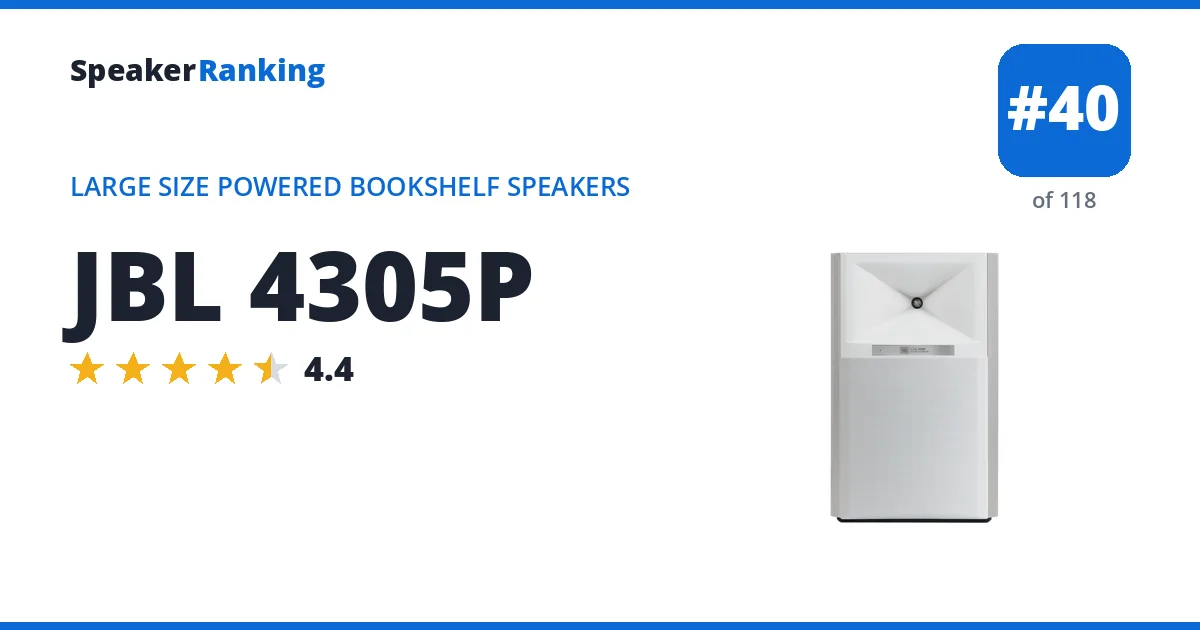
Pros: The measured 1.5dB response span from 300Hz to 5kHz supports even mids, with a 7.45 ideal-subwoofer score and 45.4Hz -3dB bass extension. Integrated consumer connectivity makes this a more convenient living-room system than many studio monitors. Measured bass extension of 45Hz (-3dB).
Cons: Crossover-region directivity changes mean the narrow on-axis span does not describe every listening angle. Limiting becomes relevant at high output, particularly with bass-heavy music. It suits near- to midfield listening better than the largest high-output systems here. Erin measured about 8dB lost near 50Hz at the highest drive level and reached roughly 93dB unweighted at 2m in-room.
Full JBL 4305P review and specifications →
| AES Input | No |
|---|---|
| Amplifier Power | 300W system: 125W LF + 25W HF per speaker |
| Aux Input | Yes |
| Bass Extension (-10dB) | 40.5Hz (measured, Erin’s Audio Corner) |
| Bass Extension (-3dB) | 45Hz (measured, Erin’s Audio Corner) |
| Bluetooth | Yes, 5.1 |
| Coaxial Input | No |
| Dimensions | 13.2H x 8.3W x 8.8D inches |
| Drivers | 5.25-inch pulp woofer; 1-inch annular compression driver |
| Frequency Response | 45Hz - 25kHz (-6dB) (Manufacturer specified) |
| HDMI Input | No |
| Inputs | XLR/TRS combo, 3.5mm Aux, Optical, USB-B, Ethernet |
| Maximum SPL | ~93dB at 2m in-room before limiting (measured, Erin’s Audio Corner) |
| Optical Input | Yes |
| RCA Input | No |
| Spinorama Preference Score | 5.44 |
| Spinorama Preference Score with Perfect Sub | 7.45 |
| TRS Input | Yes |
| USB Input | Yes |
| Weight | Primary 14.6 lbs (6.6 kg), Secondary 14.1 lbs (6.4 kg) |
| XLR Input | Yes |
- Links
- Reviews, Comparisons and Sound Samples
- Head-to-Head Comparisons