Short answer: the Perlisten R5m is the proven choice, measured and ranked among bookshelf speakers, while the newer Harbeth M30.3 XD2 has no independent measurements yet and can only be compared on specs.
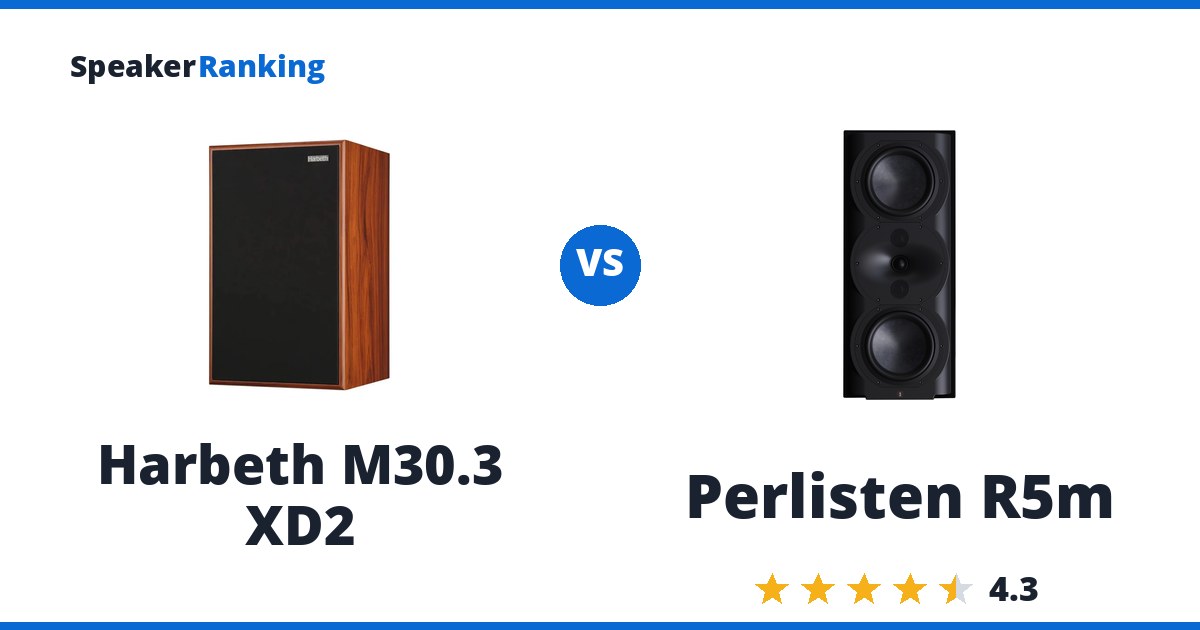
What the Harbeth M30.3 XD2 offers: The current version of Harbeth’s Monitor 30, with an 8” (200mm) RADIAL4 mid/bass driver made by Harbeth and a 1” ferrofluid cooled tweeter in a compact front ported cabinet.
What the Perlisten R5m brings: The standmount version of Perlisten’s DPC-Array platform (three silk-dome drivers plus dual 6.5” woofers), reaching a measured -6dB point of 50.5Hz.
On paper: The Perlisten R5m is more sensitive, 89.2dB against 85dB, so it needs less amplifier power to play loud.
Price: the Harbeth M30.3 XD2 lists at $6,290 and the Perlisten R5m at $6,590.
Buy the Perlisten R5m if you want a speaker whose sound quality has been measured and ranked. It also has higher sensitivity.
Buy the Harbeth M30.3 XD2 if you prefer its design or features, and you can wait for measurements to confirm how it sounds.
Looking for alternatives? See the complete Passive Home rankings.
Specifications Side By Side
| Harbeth M30.3 XD2 | Perlisten R5m | |
|---|---|---|
| Price | $6,290 per pair | $6,590 per pair |
| Ranked | - | #39 of 131 in Large Size Bookshelf Speakers |
| DIY Kit | No | No |
| Dimensions | 460H x 277W x 275D mm | 21.5”H x 9.1”W x 13.2”D (546 x 230 x 336 mm) |
| Drivers | 1” (25mm) ferrofluid cooled tweeter, 8” (200mm) RADIAL4 mid/bass driver | 3x 26mm silk dome (tweeter + 2 midrange), 2x 165mm (6.5”) HPF woofers |
| Frequency Response | 50Hz - 20kHz (+/-3dB, free space, manufacturer specified) | - |
| Impedance | 6 ohms | 4 ohms nominal, 2.7 ohms minimum |
| Power Handling | 150W programme | - |
| Recommended Power | 25W per channel or more (manufacturer suggested) | - |
| Sensitivity | 85dB (2.83V/1m, manufacturer specified) | 89.2dB @ 2.83V/1m |
| Weight | 11.6 kg each | 38.6 lbs (17.5 kg) each |
| Woofer Cabinet | ported, front | - |
| Enclosure | - | 3-way, sealed / bass-reflex convertible |
| Country | - | Designed in the United States (Verona, Wisconsin) |
| Spinorama Preference Score | - | 5.47 |
| Spinorama Preference Score with Perfect Sub | - | 8.06 |
| Bass Extension (-3dB) | - | 61.7Hz (measured, spinorama.org) |
| Bass Extension (-10dB) | - | 41.1Hz (measured, spinorama.org; matches manufacturer-specified 40Hz -10dB point in bass reflex mode) |
Prices on this page were last checked September 29, 2026 at 3:43 PM UTC. Product prices and availability are accurate as of that date/time and are subject to change; the price and availability shown on Amazon at the time of purchase will apply to the purchase of this product.
As an eBay Partner, we may be compensated if you make a purchase.
The Two Speakers In Full
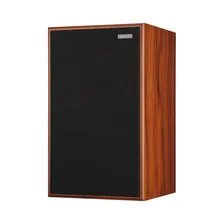 Harbeth M30.3 XD2: $6,290 per pair House of Stereo eBay
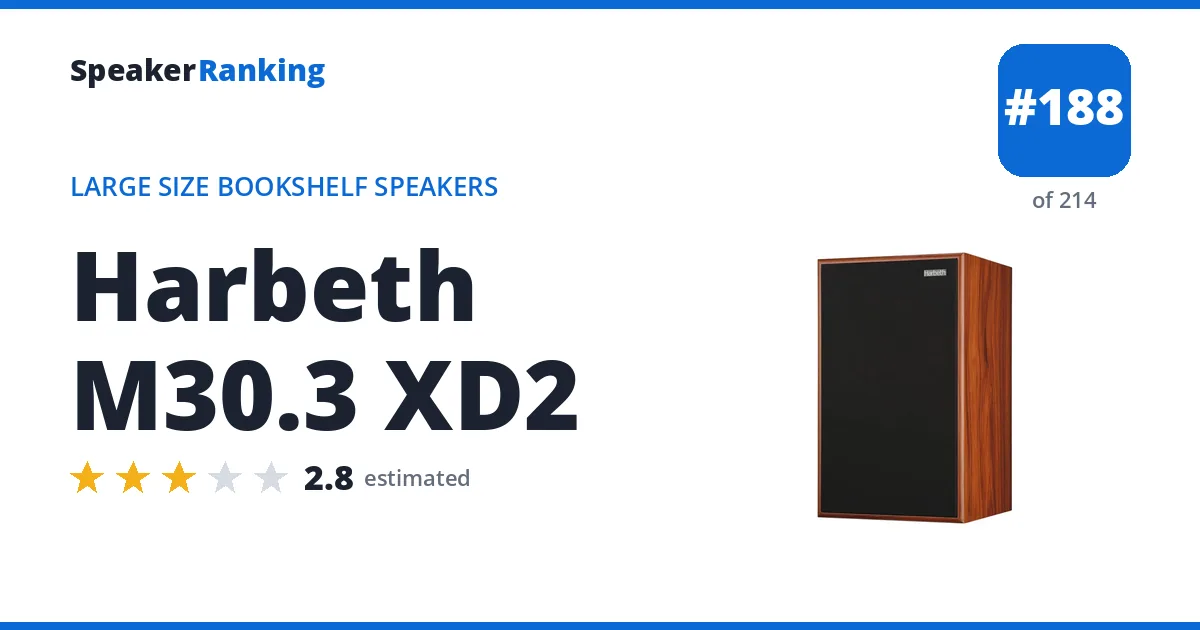
Older model: the Harbeth Monitor 30 (rated 2.5/5).
Pros: The current version of Harbeth’s Monitor 30, with an 8” (200mm) RADIAL4 mid/bass driver made by Harbeth and a 1” ferrofluid cooled tweeter in a compact front ported cabinet. Harbeth rates it at 50Hz to 20kHz within 3dB in free space with the grille on, and a 6 ohm load that it describes as easy to drive, with amplifiers from 25W per channel suggested. Handmade in England and offered in five real wood veneer finishes.
Cons: No independent measurements have been published for this version, so its linearity, directivity and real bass extension are unknown. The older Monitor 30 measured with a deep on axis dip around the crossover region, and it isn’t known whether this revision changes that. Sensitivity is a modest 85dB at 2.83V, and the 50Hz lower limit means most rooms will want a subwoofer for deep bass. Harbeth tunes it for placement away from walls, and it costs far more than most 2 way standmounts.
Full Harbeth M30.3 XD2 review and specifications →
| DIY Kit | No |
|---|---|
| Dimensions | 460H x 277W x 275D mm |
| Drivers | 1” (25mm) ferrofluid cooled tweeter, 8” (200mm) RADIAL4 mid/bass driver |
| Frequency Response | 50Hz - 20kHz (+/-3dB, free space, manufacturer specified) |
| Impedance | 6 ohms |
| Power Handling | 150W programme |
| Recommended Power | 25W per channel or more (manufacturer suggested) |
| Sensitivity | 85dB (2.83V/1m, manufacturer specified) |
| Weight | 11.6 kg each |
| Woofer Cabinet | ported, front |
- Links
- Reviews, Comparisons and Sound Samples
- These figures are manufacturer-specified rather than independently measured.
- Head-to-Head Comparisons
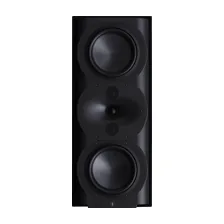 Perlisten R5m: $6,590 per pair Audio Advice eBay
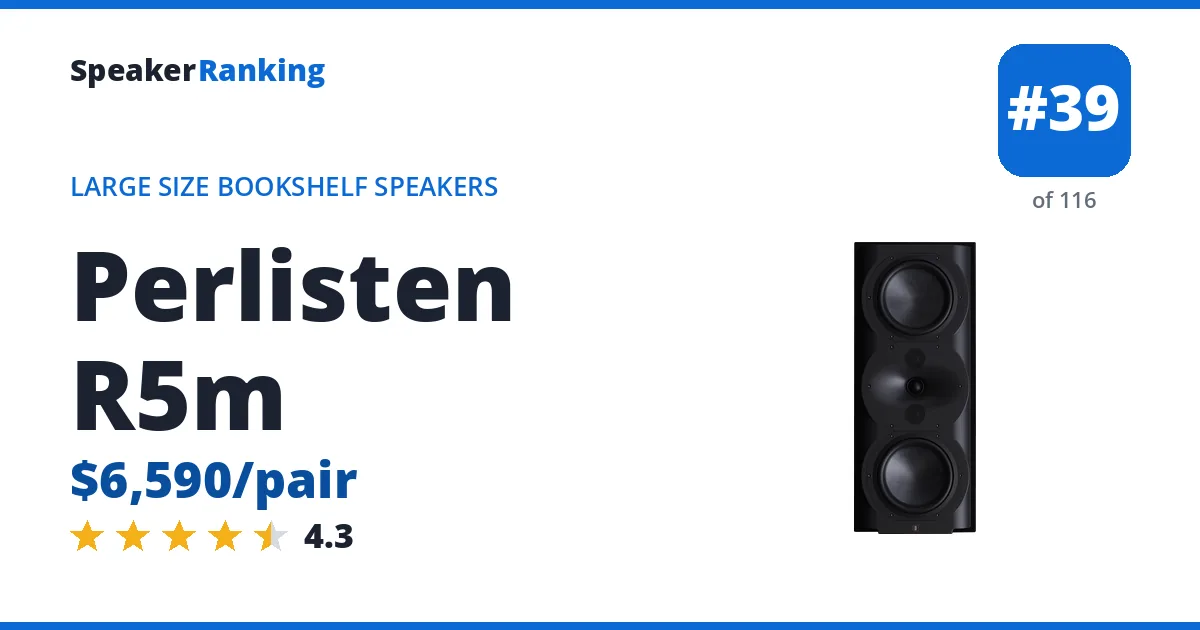
Pros: The standmount version of Perlisten’s DPC-Array platform (three silk-dome drivers plus dual 6.5” woofers), reaching a measured -6dB point of 50.5Hz. A directivity-index standard deviation of 3.01 is tight for a standmount this size. THX-adjacent R-series build quality at a lower price than Perlisten’s S-series. Measured bass extension of 61.7Hz (-3dB).
Cons: On-axis deviation of 0.264dB and sound-power smoothness of 0.511 are middling, with a fairly pronounced -0.29dB per octave downward tonal tilt and a bass-alignment Q of 2.40 pointing to a somewhat resonant low end. Like the rest of the R-series it’s sold only through specialty AV dealers with per-unit pricing.
Full Perlisten R5m review and specifications →
| Bass Extension (-10dB) | 41.1Hz (measured, spinorama.org; matches manufacturer-specified 40Hz -10dB point in bass reflex mode) |
|---|---|
| Bass Extension (-3dB) | 61.7Hz (measured, spinorama.org) |
| Country | Designed in the United States (Verona, Wisconsin) |
| DIY Kit | No |
| Dimensions | 21.5”H x 9.1”W x 13.2”D (546 x 230 x 336 mm) |
| Drivers | 3x 26mm silk dome (tweeter + 2 midrange), 2x 165mm (6.5”) HPF woofers |
| Enclosure | 3-way, sealed / bass-reflex convertible |
| Impedance | 4 ohms nominal, 2.7 ohms minimum |
| Sensitivity | 89.2dB @ 2.83V/1m |
| Spinorama Preference Score | 5.47 |
| Spinorama Preference Score with Perfect Sub | 8.06 |
| Weight | 38.6 lbs (17.5 kg) each |
- Links
- Reviews, Comparisons and Sound Samples
- Head-to-Head Comparisons