Short answer: the Genelec 8331A wins on imaging, the Adam Audio T5V on vocal detail and low end. The 8331A’s coaxial mid/tweeter and concealed opposed woofers give exceptionally uniform directivity and pinpoint imaging, but it is expensive and its protection circuit mutes near its limit. The T5V betters the HS5 for vocal detail and bass, though its AMT tweeter leaves an elevated, slightly uneven top end that the rear treble trim only tilts.
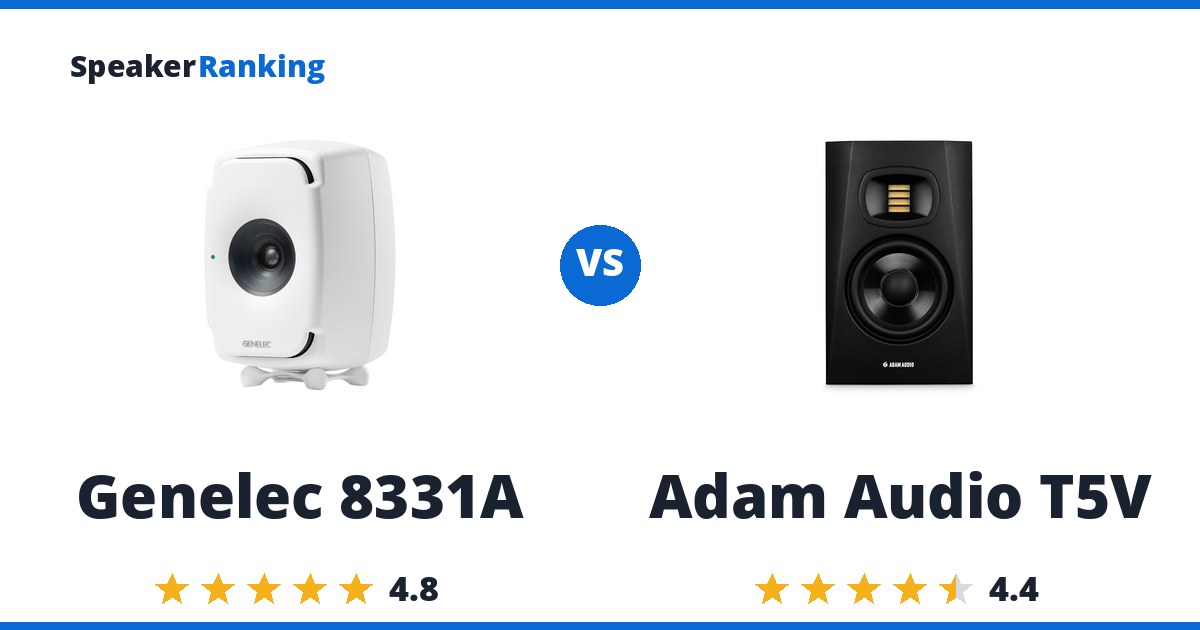
Buy the Genelec 8331A if sound quality is the priority over the price, or the Adam Audio T5V if the price is the priority over sound quality.
Want more options? Browse the full Powered Home rankings.
Specifications Side By Side
| Genelec 8331A | Adam Audio T5V | |
|---|---|---|
| Price | $5750 per pair | $464 per pair |
| Ranked | #1 of 68 in Medium Size Powered Bookshelf Speakers | #29 of 68 in Medium Size Powered Bookshelf Speakers |
| Bass Extension (-3dB) | 49Hz (measured, Erin’s Audio Corner) | 58.6Hz (measured, Audio Science Review) |
| Bass Extension (-10dB) | 39Hz (measured, Erin’s Audio Corner) | 45.9Hz (derived, log-interpolated between spinorama.org -9dB/-12dB points) |
| Maximum SPL | 100dB at 3m before protection (measured, Erin’s Audio Corner) | - |
| Amplifier Power | 72W LF + 36W MF + 36W HF | 70w Per Speaker |
| Drivers | Dual 130x65mm woofers; 90mm coaxial mid; 19mm tweeter | 5” (127mm) woofer |
| Dimensions | 12”H x 7.4”W x 8.3”D (305 x 189 x 212 mm) | 11.7”H x 7”W x 11.7”D (297.2 x 177.8 x 297.2 mm) |
| Weight | 14.8 lbs (6.7kg) each | 12.6 lbs (5.7 kg) each |
| Spinorama Preference Score | 6.57 | 4.65 |
| Spinorama Preference Score with Perfect Sub | 8.51 | 7.02 |
| Inputs | XLR, AES/EBU | XLR, RCA |
| XLR Input | Yes | Yes |
| RCA Input | No | Yes |
| TRS Input | No | No |
| Optical Input | No | No |
| Coaxial Input | No | No |
| USB Input | No | No |
| HDMI Input | No | No |
| AES Input | Yes | No |
| Aux Input | No | No |
| Bluetooth | No | No |
| Frequency Response | 45Hz - 37kHz (-6dB) (Manufacturer specified) | 58Hz - 24kHz (-3dB) (Manufacturer specified) |
| App | - | No |
| EQ | - | Yes (Room adjustment) |
Related Speaker Comparisons
More worthwhile head-to-heads for Genelec 8331A:
- Genelec 8331A vs Neumann KH120 MKII
- Genelec 8331A vs Genelec 8030C
- Genelec 8331A vs Neumann KH80 DSP
- Dynaudio LYD 5 vs Genelec 8331A
- Genelec 8331A vs Genelec 8330A
Prices on this page were last checked October 2, 2026 at 10:18 PM UTC. Product prices and availability are accurate as of that date/time and are subject to change; the price and availability shown on Amazon at the time of purchase will apply to the purchase of this product.
As an eBay Partner, we may be compensated if you make a purchase.
The Two Speakers In Full
 Genelec 8331A: $5750 per pair B&H Photo Video eBay
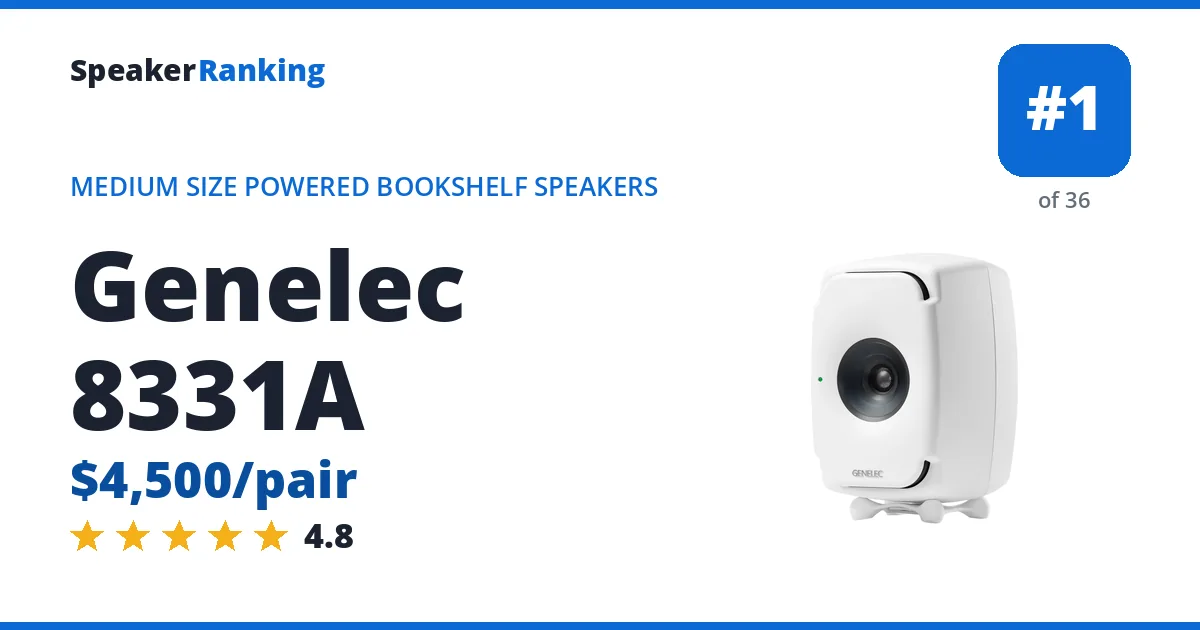
Pros: Erin’s Klippel measurements support its reference-monitor credentials: a 1.4dB response span from 300Hz to 5kHz, low listening-window and predicted-room irregularity, and preference scores of 6.57 standalone and 8.51 with an ideal subwoofer. The coaxial mid/tweeter and concealed woofers maintain coherent radiation as listening position changes. Bass reaches -3dB around 48Hz, and GLM adds level, delay and room-response calibration. Measured bass extension of 49Hz (-3dB).
Cons: Expensive, with studio-oriented XLR connectivity rather than consumer streaming. The compact woofers still limit deep-bass output, and the review reports protection muting when pushed beyond its operating range. GLM calibration hardware is an additional purchase. Its excellent tonal score does not remove the need for a subwoofer or larger monitor at demanding levels.
Full Genelec 8331A review and specifications →
| AES Input | Yes |
|---|---|
| Amplifier Power | 72W LF + 36W MF + 36W HF |
| Aux Input | No |
| Bass Extension (-10dB) | 39Hz (measured, Erin’s Audio Corner) |
| Bass Extension (-3dB) | 49Hz (measured, Erin’s Audio Corner) |
| Bluetooth | No |
| Coaxial Input | No |
| Dimensions | 12”H x 7.4”W x 8.3”D (305 x 189 x 212 mm) |
| Drivers | Dual 130x65mm woofers; 90mm coaxial mid; 19mm tweeter |
| Frequency Response | 45Hz - 37kHz (-6dB) (Manufacturer specified) |
| HDMI Input | No |
| Inputs | XLR, AES/EBU |
| Maximum SPL | 100dB at 3m before protection (measured, Erin’s Audio Corner) |
| Optical Input | No |
| RCA Input | No |
| Spinorama Preference Score | 6.57 |
| Spinorama Preference Score with Perfect Sub | 8.51 |
| TRS Input | No |
| USB Input | No |
| Weight | 14.8 lbs (6.7kg) each |
| XLR Input | Yes |
- Links
- Reviews, Comparisons and Sound Samples
- Head-to-Head Comparisons
 Adam Audio T5V: $464 per pair Amazon eBay
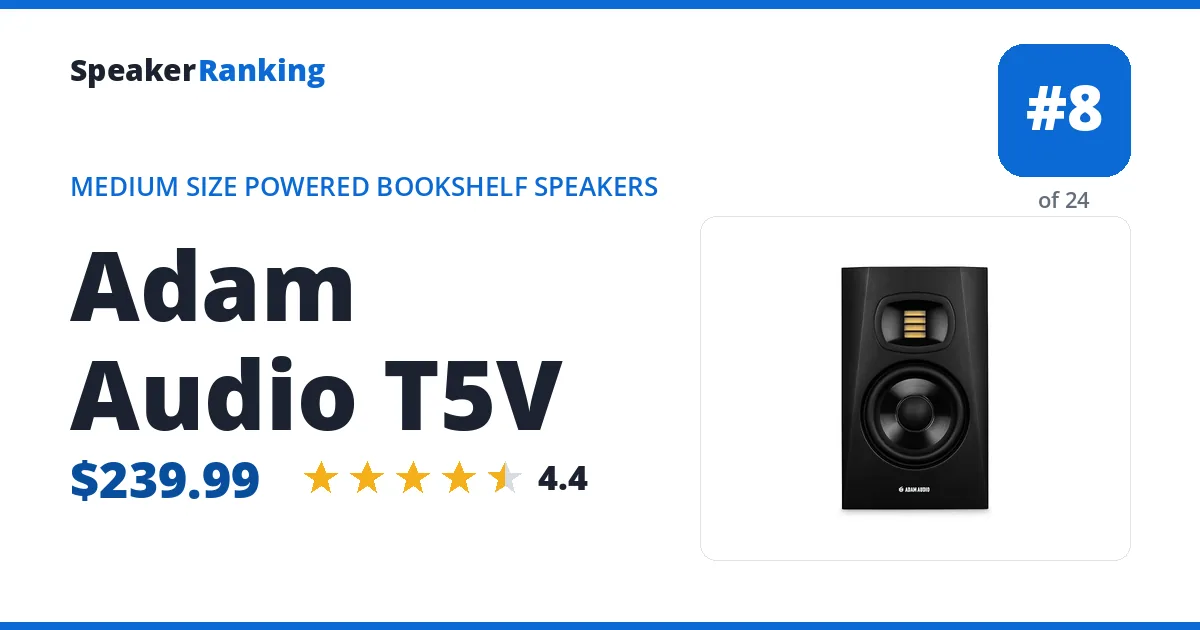
Pros: ASR’s data shows a small 2.0dB span from 300Hz to 5kHz, a -3dB point around 59Hz, and scores of 4.65 standalone and 7.02 with an ideal subwoofer. It offers useful bass and midrange performance for an affordable studio monitor. Rear tonal trims allow broad placement adjustment. Measured bass extension of 58.6Hz (-3dB).
Cons: The response rises toward the treble by about 0.56dB per octave, so the small midrange span should not be mistaken for flat full-band response. Upper-frequency unevenness remains, and a shelving control cannot precisely remove every peak. The existing review finds distortion reasonable for the price rather than reference-class; deeper bass and demanding levels still call for more capable hardware.
Full Adam Audio T5V review and specifications →
| AES Input | No |
|---|---|
| Amplifier Power | 70w Per Speaker |
| App | No |
| Aux Input | No |
| Bass Extension (-10dB) | 45.9Hz (derived, log-interpolated between spinorama.org -9dB/-12dB points) |
| Bass Extension (-3dB) | 58.6Hz (measured, Audio Science Review) |
| Bluetooth | No |
| Coaxial Input | No |
| Dimensions | 11.7”H x 7”W x 11.7”D (297.2 x 177.8 x 297.2 mm) |
| Drivers | 5” (127mm) woofer |
| EQ | Yes (Room adjustment) |
| Frequency Response | 58Hz - 24kHz (-3dB) (Manufacturer specified) |
| HDMI Input | No |
| Inputs | XLR, RCA |
| Optical Input | No |
| RCA Input | Yes |
| Spinorama Preference Score | 4.65 |
| Spinorama Preference Score with Perfect Sub | 7.02 |
| TRS Input | No |
| USB Input | No |
| Weight | 12.6 lbs (5.7 kg) each |
| XLR Input | Yes |
- Links
- Reviews, Comparisons and Sound Samples
- Audio Science Review Measurements More from Audio Science Review →
- DSAUDIO.review: JBL 305P MKII vs Adam Audio T5V 6-Track Comparison More from DSAUDIOreview →
- DSAUDIO.review: Kali LP-6 vs Adam Audio T5V Sound & Frequency Response Comparison
- DSAUDIO.review: Adam Audio T5V vs Yamaha HS5 5 Track Comparison
- DSAUDIO.review: DSAUDIO.review Adam Audio A5X vs Adam Audio T5V sound.DEMO
- DSAUDIO.review: DSAUDIO.review Focal Alpha 50 EVO vs Adam Audio T5V sound.DEMO
- DSAUDIO.review: Adam Audio T5V vs Presonus Eris E5 5 Track Comparison
- DSAUDIO.review: KRK Rokit 5 G4 RP5G4 vs Adam Audio T5V Sound & Frequency Response Comparison
- DSAUDIO.review: Bright and brighter. PreSonus E5 XT takes on Adam Audio T5V SOUND & FREQUENCY RESPONSE COMPARISON
- DSAUDIO.review: Adam Audio T5V vs Adam Audio T7V Sound & Frequency Response Comparison
- Audio Science Review Measurements (spinorama.org)
- Jasper Tech: Best Desktop Computer Speakers for Every Budget – 2026 More from Jasper Tech →
- Jasper Tech: Are the iLoud Micro Monitor Pro the Best Studio Monitor Speakers for your Home Studio?
- Head-to-Head Comparisons