Short answer: the Genelec 8030C. It ranks #3 of 67 powered bookshelf speakers by sound quality, rated 4.6/5, at $1,750. The HEDD Type 05 A-CORE ranks #18, rated 4.2/5, at $1,398, $352 cheaper, which does not close the gap in sound quality.
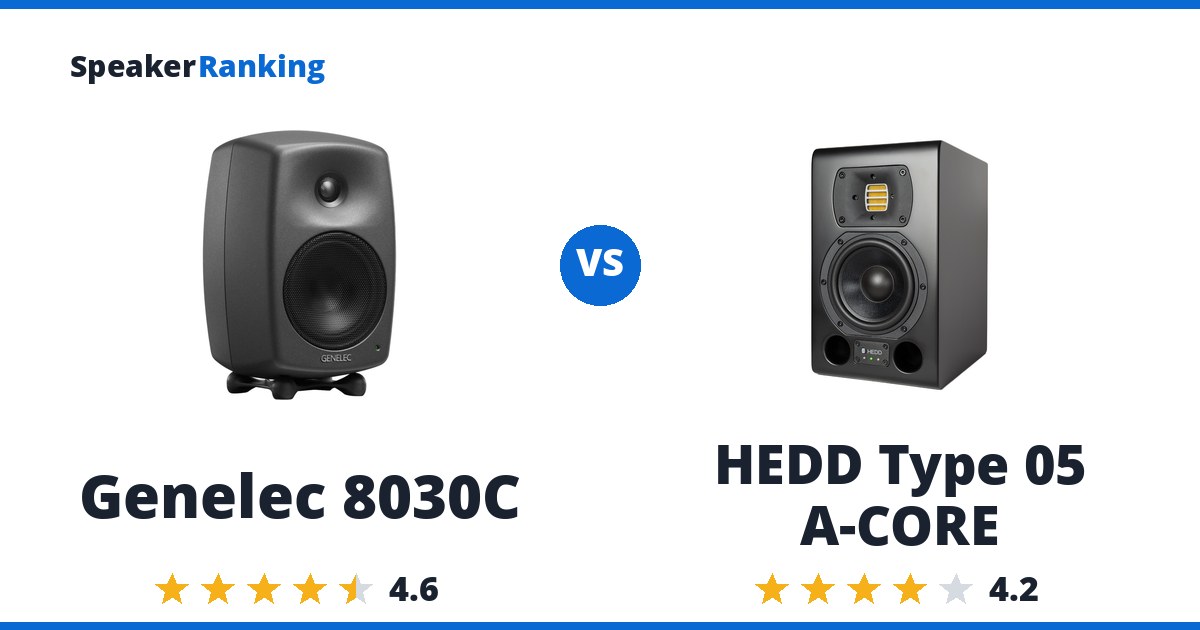
Why pick the Genelec 8030C: ASR’s Klippel measurements show a 1.9dB response span from 300Hz to 5kHz and smooth listening-window behavior. The catch: A dip around 2-3kHz remains, and vertical placement is less forgiving than the horizontal coverage suggests.
The case for the HEDD Type 05 A-CORE: ASR’s Klippel data shows useful bass reach for this size, with -3dB around 44Hz. Watch for: The 2.7dB midrange span and listening-window narrow-band deviation of 0.404 trail the most linear monitors here.
Buy the Genelec 8030C. It is rated higher for sound quality, and saving $352 with the HEDD Type 05 A-CORE does not make up for the sound-quality gap.
Looking for alternatives? See the complete Powered Home rankings.
Specifications Side By Side
| Genelec 8030C | HEDD Type 05 A-CORE | |
|---|---|---|
| Price | $1,750 per pair | $1,398 per pair |
| Ranked | #3 of 67 in Medium Size Powered Bookshelf Speakers | #18 of 67 in Medium Size Powered Bookshelf Speakers |
| Bass Extension (-10dB) | 47Hz (measured, Audio Science Review) | 37.1Hz (measured, spinorama.org) |
| Bass Extension (-3dB) | 59Hz (measured, Audio Science Review) | 43.9Hz (measured, spinorama.org) |
| Dimensions | 11.7”H x 7.4”W x 7”D (297.2 x 188 x 177.8 mm) | 12.1” x 7.1” x 9.6” (308 x 180 x 245 mm) each |
| Inputs | XLR | RCA unbalanced, XLR/TRS combo balanced |
| Weight | 11 lbs (5 kg) each | 13.7 lbs (6.2 kg) each |
| Drivers | 5.1” woofer, 0.75” metal dome tweeter | AMT (Air Motion Transformer) tweeter, 5” Honeycomb-compound woofer |
| App | No | None (analog-only, no DSP) |
| Bluetooth | No | No |
| EQ | Yes (Bass tilt, treble tilt, room response) | Yes, analog High/Low shelving, ±6dB continuous |
| Frequency Response | 54Hz - 20kHz (±2.5dB) (Manufacturer specified) | 43Hz - 50kHz |
| Amplifier Power | 100W (50W woofer + 50W tweeter) | 200W total, bi-amped (2x100W ICEpower Class D) |
| Maximum SPL | 110dB @ 1m (manufacturer specified) | 112dB per pair at 1m (manufacturer specified) |
| XLR Input | Yes | Yes |
| RCA Input | No | Yes |
| TRS Input | No | Yes |
| Optical Input | No | No |
| Coaxial Input | No | No |
| USB Input | No | No |
| HDMI Input | No | No |
| AES Input | No | No |
| Aux Input | No | No |
| Spinorama Preference Score | - | 5.35 |
| Spinorama Preference Score with Perfect Sub | - | 7.23 |
Related Speaker Comparisons
How Genelec 8030C compares with other leading options:
- Genelec 8331A vs Genelec 8030C
- Genelec 8030C vs Neumann KH120 MKII
- Genelec 8030C vs Neumann KH80 DSP
- Genelec 8030C vs Dynaudio LYD 5
- Genelec 8030C vs Genelec 8330A
Prices on this page were last checked September 26, 2026 at 11:14 PM UTC. Product prices and availability are accurate as of that date/time and are subject to change; the price and availability shown on Amazon at the time of purchase will apply to the purchase of this product.
As an eBay Partner, we may be compensated if you make a purchase.
The Two Speakers In Full
 Genelec 8030C: $1,750 per pair B&H Photo Video eBay
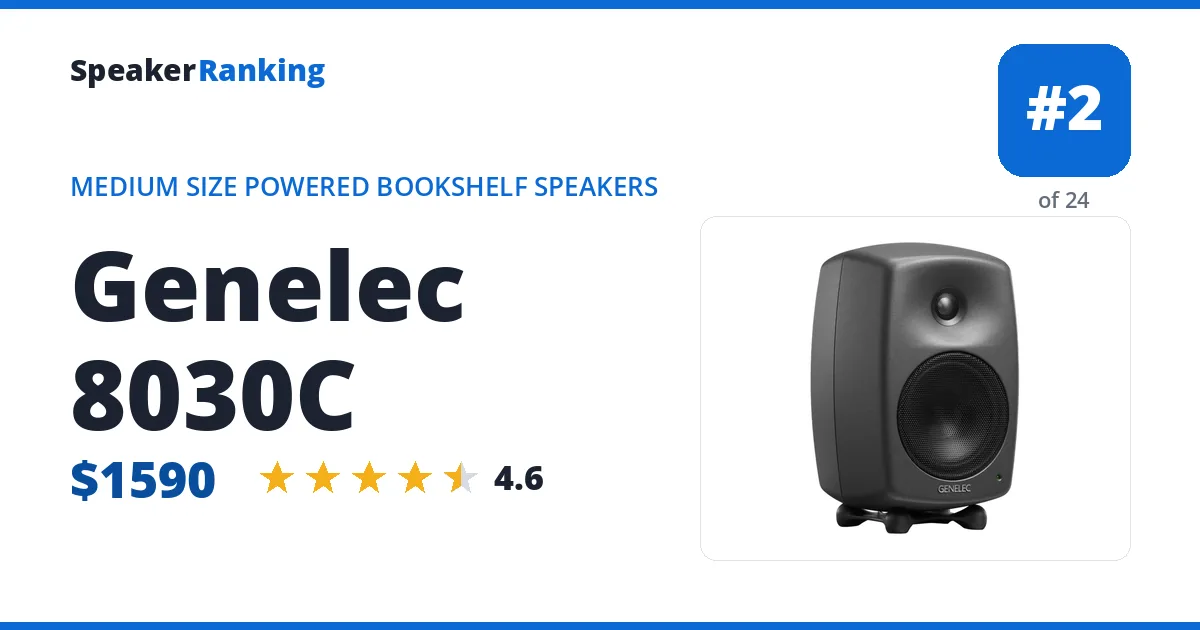
Pros: ASR’s Klippel measurements show a 1.9dB response span from 300Hz to 5kHz and smooth listening-window behavior. Predicted preference scores of 5.35 standalone and 7.60 with an ideal subwoofer support its high position for tonal accuracy. Broad, controlled horizontal radiation makes the balance relatively stable across a desk, and bass reaches -3dB around 56Hz. Measured bass extension of 59Hz (-3dB).
Cons: A dip around 2-3kHz remains, and vertical placement is less forgiving than the horizontal coverage suggests. Deep-bass headroom is limited; isolated high-output measurements at higher frequencies do not describe full-band loudness. The review found demanding bass material could cause audible distress beyond moderate levels. A subwoofer is useful for full-range monitoring.
Full Genelec 8030C review and specifications →
| AES Input | No |
|---|---|
| Amplifier Power | 100W (50W woofer + 50W tweeter) |
| App | No |
| Aux Input | No |
| Bass Extension (-10dB) | 47Hz (measured, Audio Science Review) |
| Bass Extension (-3dB) | 59Hz (measured, Audio Science Review) |
| Bluetooth | No |
| Coaxial Input | No |
| Dimensions | 11.7”H x 7.4”W x 7”D (297.2 x 188 x 177.8 mm) |
| Drivers | 5.1” woofer, 0.75” metal dome tweeter |
| EQ | Yes (Bass tilt, treble tilt, room response) |
| Frequency Response | 54Hz - 20kHz (±2.5dB) (Manufacturer specified) |
| HDMI Input | No |
| Inputs | XLR |
| Maximum SPL | 110dB @ 1m (manufacturer specified) |
| Optical Input | No |
| RCA Input | No |
| TRS Input | No |
| USB Input | No |
| Weight | 11 lbs (5 kg) each |
| XLR Input | Yes |
- Links
- Reviews, Comparisons and Sound Samples
- Head-to-Head Comparisons
 HEDD Type 05 A-CORE: $1,398 per pair B&H Photo Video eBay
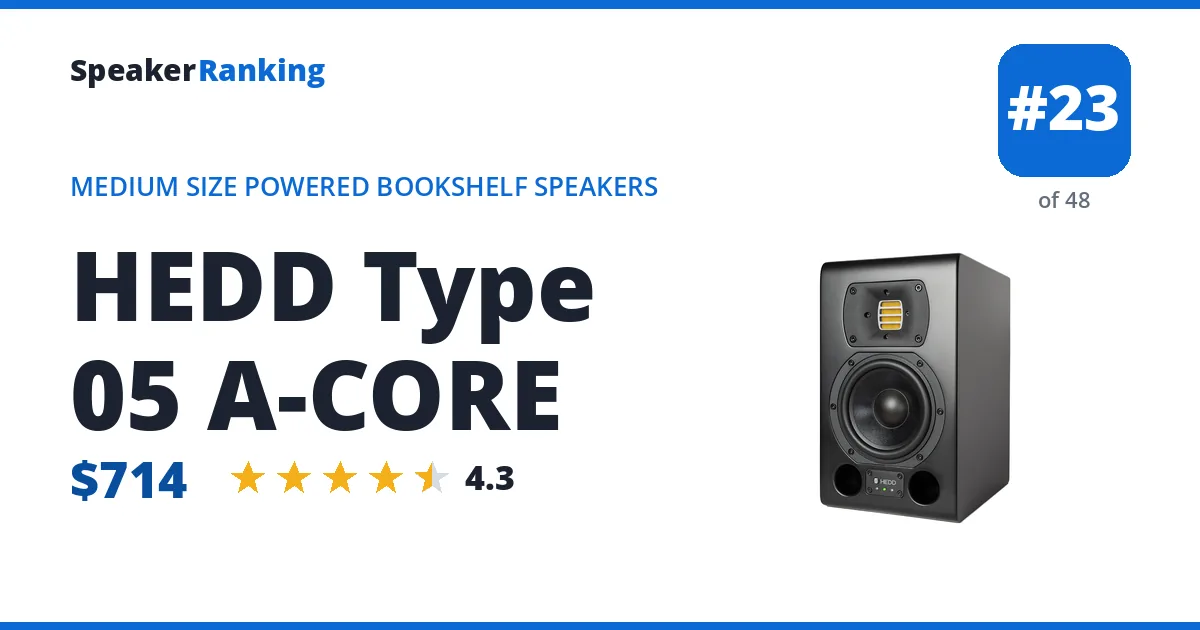
Pros: ASR’s Klippel data shows useful bass reach for this size, with -3dB around 44Hz. Preference scores of 5.35 standalone and 7.23 with an ideal subwoofer support it as a balanced all-round option. The AMT tweeter and analog signal path appeal to users who want a studio monitor without digital conversion or firmware dependence. Measured bass extension of 43.9Hz (-3dB).
Cons: The 2.7dB midrange span and listening-window narrow-band deviation of 0.404 trail the most linear monitors here. The response rises modestly toward the treble. The analog-only design does not provide built-in room correction or digital inputs, and published amplification power should not be read as a measured clean-output rating.
Full HEDD Type 05 A-CORE review and specifications →
| AES Input | No |
|---|---|
| Amplifier Power | 200W total, bi-amped (2x100W ICEpower Class D) |
| App | None (analog-only, no DSP) |
| Aux Input | No |
| Bass Extension (-10dB) | 37.1Hz (measured, spinorama.org) |
| Bass Extension (-3dB) | 43.9Hz (measured, spinorama.org) |
| Bluetooth | No |
| Coaxial Input | No |
| Dimensions | 12.1” x 7.1” x 9.6” (308 x 180 x 245 mm) each |
| Drivers | AMT (Air Motion Transformer) tweeter, 5” Honeycomb-compound woofer |
| EQ | Yes, analog High/Low shelving, ±6dB continuous |
| Frequency Response | 43Hz - 50kHz |
| HDMI Input | No |
| Inputs | RCA unbalanced, XLR/TRS combo balanced |
| Maximum SPL | 112dB per pair at 1m (manufacturer specified) |
| Optical Input | No |
| RCA Input | Yes |
| Spinorama Preference Score | 5.35 |
| Spinorama Preference Score with Perfect Sub | 7.23 |
| TRS Input | Yes |
| USB Input | No |
| Weight | 13.7 lbs (6.2 kg) each |
| XLR Input | Yes |
- Links
- Reviews, Comparisons and Sound Samples
- Head-to-Head Comparisons
- HEDD Type 05 A-CORE vs IK Multimedia iLoud MTM MKII
- HEDD Type 05 A-CORE vs Kali Audio IN-5
- HEDD Type 05 A-CORE vs IK Multimedia iLoud MTM
- HEDD Type 05 A-CORE vs JBL 305P MKII
- HEDD Type 05 A-CORE vs Klipsch The Fives
- HEDD Type 05 A-CORE vs KEF LSX II LT
- HEDD Type 05 A-CORE vs Audioengine A5+ Classic
- HEDD Type 05 A-CORE vs Adam Audio T5V
- See all 19 comparisons