Short answer: the Fosi Audio SP601 for better sound quality, the Dayton Audio MK602X for the lower price, though neither ranks well in its class. The Fosi Audio SP601 ranks #113 of 131 bookshelf speakers, rated 2.7/5, at $339.99. The Dayton Audio MK602X ranks #122, rated 2.4/5, at $149, $190.99 cheaper. Both are rated below 3.0/5 among the 131 bookshelf speakers; for better sound, the Monolith Encore B6 ranks #63 at $360.
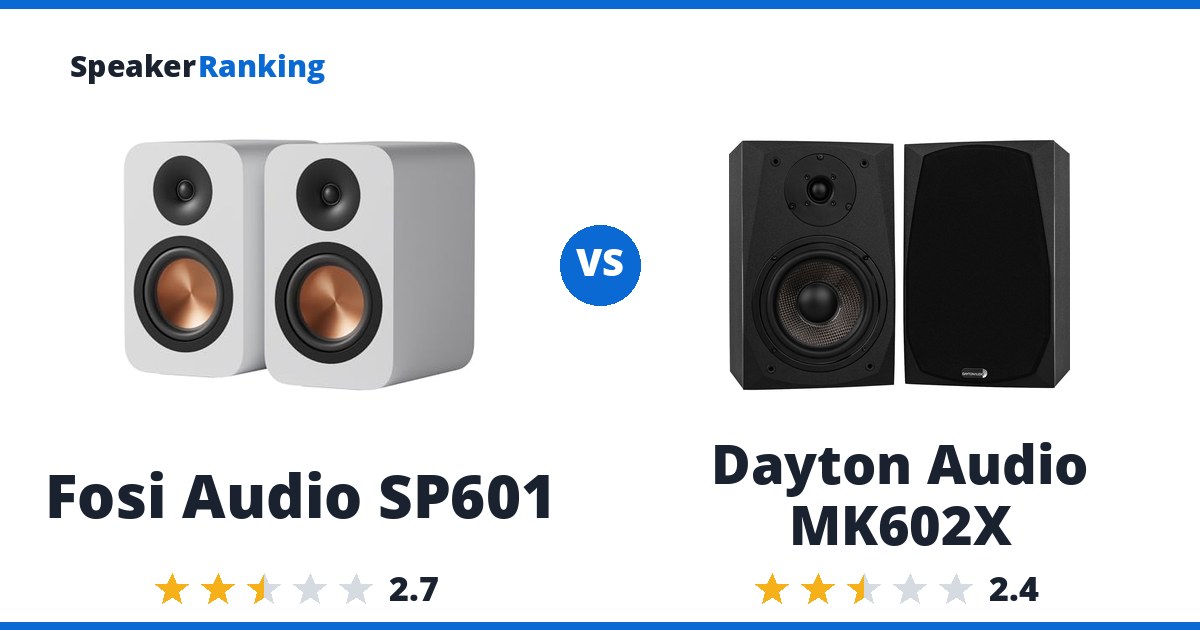
The case for the Fosi Audio SP601: Two-way bookshelf design with a 6.5” paper/aluminum-alloy composite cone woofer and 1.5” silk dome tweeter. Watch for: An unusually erratic, up-and-down frequency response (a scooped midrange followed by an upper-mid bump, a dip, another small bump, then a strong 3-4dB peak around 4-7kHz) makes the speaker’s overall character genuinely hard to characterize: the reviewer compared the experience to a similarly disliked model, the Triangle Borea BR03, which has a comparably inconsistent response.
The case for the Dayton Audio MK602X: Inexpensive, compact two-way with a 6.5-inch glass-fiber woofer and 1-inch silk dome. The tradeoff: The top end sits roughly 5dB above the midband, producing brightness that can masquerade as detail.
One note: the Dayton Audio MK602X is discontinued and no longer widely available new.
Buy the Fosi Audio SP601 if sound quality matters more than the price. Buy the Dayton Audio MK602X if the price matters more than sound quality.
Want more options? Browse the full Passive Home rankings.
Specifications Side By Side
| Fosi Audio SP601 | Dayton Audio MK602X | |
|---|---|---|
| Price | $339.99 per pair | $149 per pair Discontinued |
| Ranked | #113 of 131 in Large Size Bookshelf Speakers | #122 of 131 in Large Size Bookshelf Speakers |
| Drivers | 6.5” woofer, 1.5” Silk Dome Tweeters | 1” silk-dome tweeter; 6.5” glass-fiber midwoofer |
| Weight | 11.5 lbs (5.2 kg) | - |
| Dimensions | 14.5”H x 9.1”W x 14”D (368.3 x 231.1 x 355.6 mm) | 15.1”H x 8.6”W x 11.8”D |
| App | No | - |
| EQ | No | - |
| DSP | No | - |
| Power Handling | 80w RMS Per Speaker | - |
| Sensitivity | 85.4dB (measured, Erin’s Audio Corner) | Approximately 85dB/2.83V/1m (measured, Erin’s Audio Corner) |
| Impedance | 4 ohms nominal, 4.1 ohms minimum (measured, Erin’s Audio Corner) | 4 ohms nominal (manufacturer specified; Erin’s impedance measurement confirms a low-impedance load) |
| Woofer Cabinet | ported, rear | ported, rear |
| Bass Extension (-10dB) | 40Hz (measured, Erin’s Audio Corner) | 43Hz (measured, Erin’s Audio Corner) |
| Bass Extension (-3dB) | 59Hz (measured, Erin’s Audio Corner) | 72Hz (measured, Erin’s Audio Corner) |
| DIY Kit | No | No |
| Spinorama Preference Score | - | 4.39 |
| Spinorama Preference Score with Perfect Sub | - | 6.91 |
Related Speaker Comparisons
More top alternatives to Fosi Audio SP601:
- DIYSG HTM-12 v2 vs Fosi Audio SP601
- ELAC Debut 3.0 DB63 vs Fosi Audio SP601
- Klipsch RP-600M II vs Fosi Audio SP601
- KEF Q350 vs Fosi Audio SP601
- Tannoy System 600 vs Dayton Audio MK602X
Prices on this page were last checked September 29, 2026 at 3:43 PM UTC. Product prices and availability are accurate as of that date/time and are subject to change; the price and availability shown on Amazon at the time of purchase will apply to the purchase of this product.
As an eBay Partner, we may be compensated if you make a purchase.
The Two Speakers In Full
 Fosi Audio SP601: $339.99 per pair Amazon Fosiaudio eBay
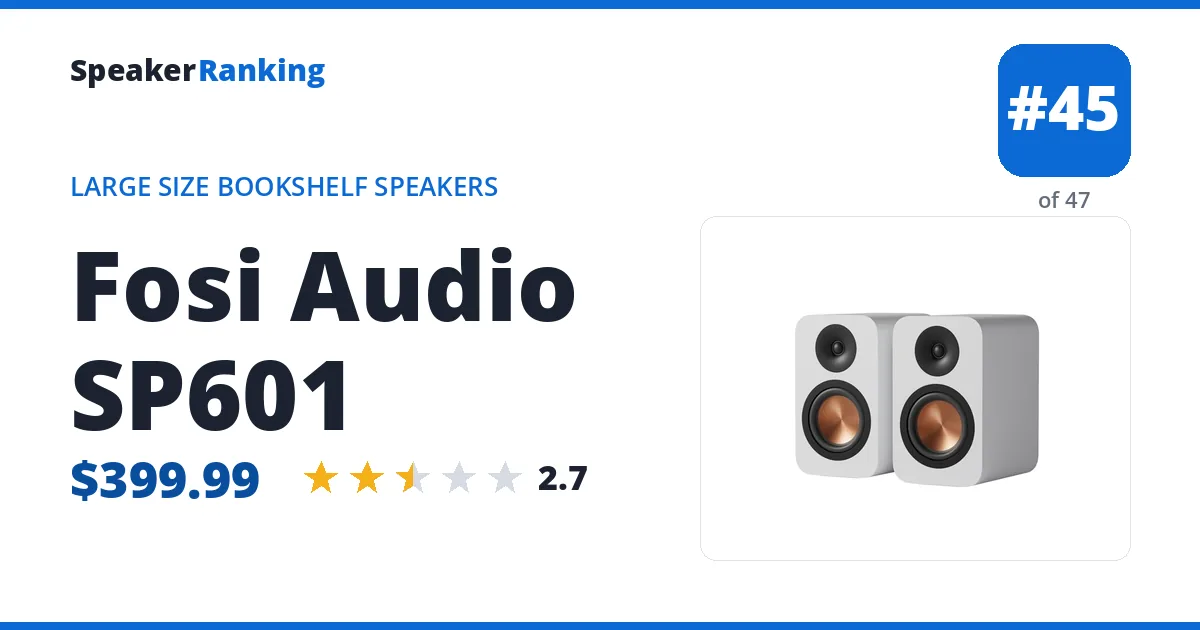
Pros: Two-way bookshelf design with a 6.5” paper/aluminum-alloy composite cone woofer and 1.5” silk dome tweeter. Bass reaches a respectable 60-70Hz in most rooms (F3 59Hz, F10 40Hz) for a budget bookshelf speaker. Distortion at 86dB and 96dB measures reasonably well at face value, and compression issues at extreme output are generally in line with what’s expected for a speaker at this price point. The overall tonal character can be substantially improved with basic EQ: the reviewer found a boost around 400Hz plus a cut around 4kHz brought it to an acceptable baseline. Measured bass extension of 59Hz (-3dB), with a measured sensitivity of 85.4dB.
Cons: An unusually erratic, up-and-down frequency response (a scooped midrange followed by an upper-mid bump, a dip, another small bump, then a strong 3-4dB peak around 4-7kHz) makes the speaker’s overall character genuinely hard to characterize: the reviewer compared the experience to a similarly disliked model, the Triangle Borea BR03, which has a comparably inconsistent response. The 4-7kHz peak gives a sharp, sibilant edge to S and T sounds in vocals. A strong diffraction dip around 4kHz followed by a peak can’t be fully corrected with EQ; the reviewer recommends sidewall absorption panels instead, since off-axis energy in the 2-7kHz range actually exceeds the direct sound reaching the listener. Multitone distortion becomes more noticeable and grainy at higher volumes, concentrated in the upper-midrange where hearing is most sensitive. A peaking distortion issue right at the crossover region suggests a possible combination of tweeter distortion and midwoofer/crossover-component strain. The enclosure sounds notably hollow when tapped, and a flashlight inspection suggested a lack of internal damping material, along with likely insufficient bracing. Vertical listening position is fairly tightly constrained around the tweeter axis. Still requires a subwoofer for real kick-drum impact and bass authority.
Full Fosi Audio SP601 review and specifications →
| App | No |
|---|---|
| Bass Extension (-10dB) | 40Hz (measured, Erin’s Audio Corner) |
| Bass Extension (-3dB) | 59Hz (measured, Erin’s Audio Corner) |
| DIY Kit | No |
| DSP | No |
| Dimensions | 14.5”H x 9.1”W x 14”D (368.3 x 231.1 x 355.6 mm) |
| Drivers | 6.5” woofer, 1.5” Silk Dome Tweeters |
| EQ | No |
| Impedance | 4 ohms nominal, 4.1 ohms minimum (measured, Erin’s Audio Corner) |
| Power Handling | 80w RMS Per Speaker |
| Sensitivity | 85.4dB (measured, Erin’s Audio Corner) |
| Weight | 11.5 lbs (5.2 kg) |
| Woofer Cabinet | ported, rear |
- Links
- Reviews, Comparisons and Sound Samples
- Head-to-Head Comparisons
 Dayton Audio MK602X: $149 per pair Discontinued eBay
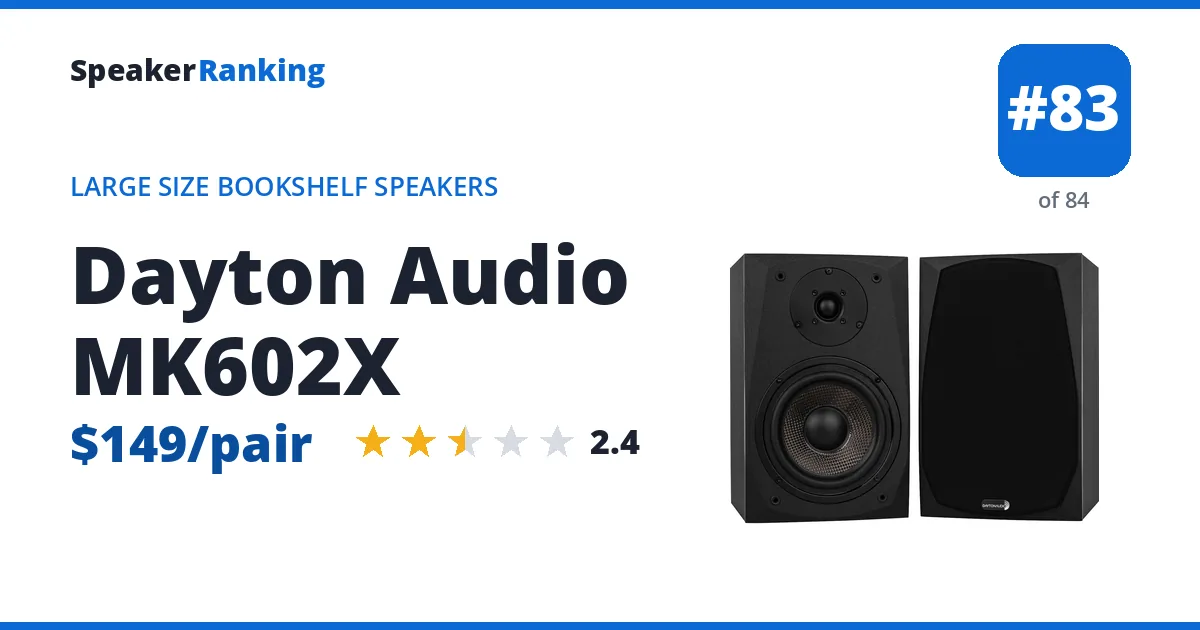
Pros: Inexpensive, compact two-way with a 6.5-inch glass-fiber woofer and 1-inch silk dome. Erin measured respectable small-box extension (72Hz F3 and 43Hz F10) and roughly 85dB sensitivity. The cabinet and removable grille are tidy for the price, and the response can be made less bright with broad treble EQ when listening close to the reference axis. Measured bass extension of 72Hz (-3dB), with a measured sensitivity of 85dB.
Cons: The top end sits roughly 5dB above the midband, producing brightness that can masquerade as detail. More seriously, the low-order woofer filter creates a 4-5dB directivity discontinuity around 2kHz; because the reflected sound differs from the direct sound, equalization cannot fully fix it. Erin also found multiple resonances around 900Hz and rising distortion/compression from the woofer at higher levels. Its 4-ohm nominal load and modest 85dB measured sensitivity demand more amplifier current than the price suggests, while the 72Hz F3 makes a subwoofer advisable despite the relatively low F10. Discontinued.
Full Dayton Audio MK602X review and specifications →
| Bass Extension (-10dB) | 43Hz (measured, Erin’s Audio Corner) |
|---|---|
| Bass Extension (-3dB) | 72Hz (measured, Erin’s Audio Corner) |
| DIY Kit | No |
| Dimensions | 15.1”H x 8.6”W x 11.8”D |
| Drivers | 1” silk-dome tweeter; 6.5” glass-fiber midwoofer |
| Impedance | 4 ohms nominal (manufacturer specified; Erin’s impedance measurement confirms a low-impedance load) |
| Sensitivity | Approximately 85dB/2.83V/1m (measured, Erin’s Audio Corner) |
| Spinorama Preference Score | 4.39 |
| Spinorama Preference Score with Perfect Sub | 6.91 |
| Woofer Cabinet | ported, rear |
- Links
- Reviews, Comparisons and Sound Samples
- Head-to-Head Comparisons