Short answer: the Focal Aria Evo X N°2 is the clearly more capable tower, but it still needs careful setup or EQ to tame its bright upper range. Focal offers solid in-room bass, low distortion and better-behaved directivity, whereas Triangle’s response includes multiple resonances, weak bass behavior and severe high-level distortion. The Antal Ez is less expensive and more sensitive, but its measurement evidence does not support it as the better sounding option.
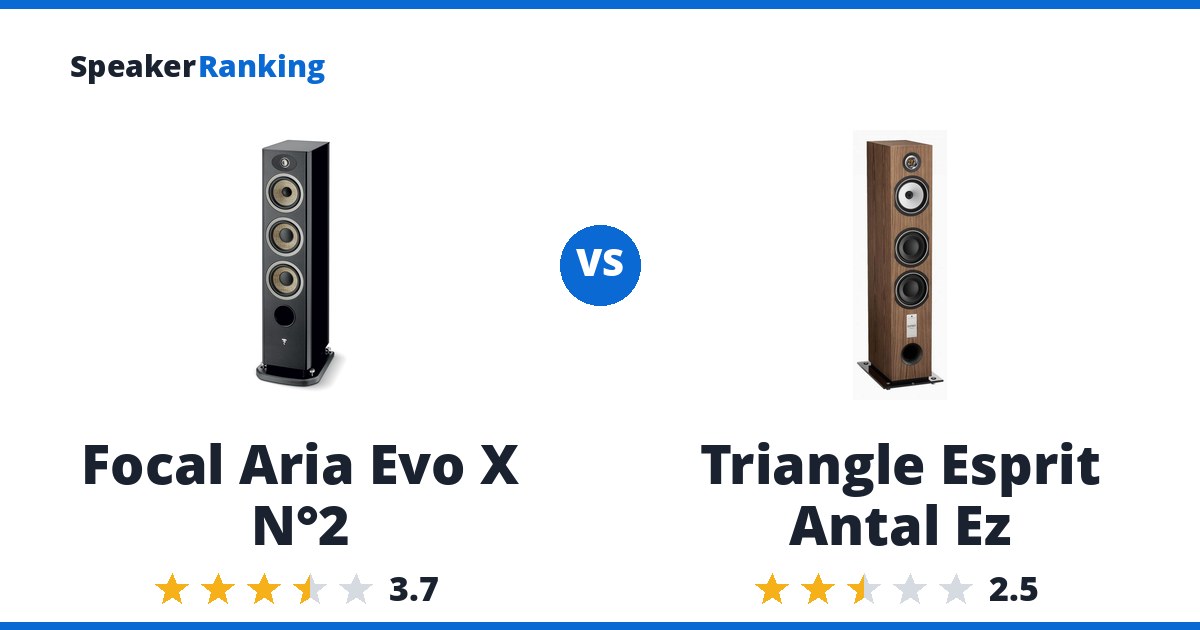
Buy the Focal Aria Evo X N°2 if you have a capable 4-ohm-stable amplifier and can use placement or EQ to balance its bright, recessed-presence tuning.
Buy the Triangle Esprit Antal Ez only if you find it at a steep used discount and understand that its measured resonances and distortion are substantial compromises.
Still deciding? The full Passive Home rankings cover every ranked option.
Specifications Side By Side
| Focal Aria Evo X N°2 | Triangle Esprit Antal Ez | |
|---|---|---|
| Price | $4,798 per pair | $1,799 per pair Discontinued |
| Ranked | #57 of 74 in Large Size Floorstanding Speakers | #71 of 74 in Large Size Floorstanding Speakers |
| Bass Extension (-10dB) | 38Hz (measured, Erin’s Audio Corner) | 62Hz (measured, Audio Science Review) - low confidence - on-axis curve shows an unusual notch/dip around 250-300Hz for this floorstanding tower |
| Bass Extension (-3dB) | 50Hz (measured, Erin’s Audio Corner) | 85Hz (measured, Audio Science Review) - low confidence - on-axis curve shows an unusual notch/dip around 250-300Hz for this floorstanding tower |
| Impedance | 8 ohms nominal (2.9 ohms minimum, Manufacturer specified; 3.4 ohms minimum measured by Erin’s Audio Corner) | 8 ohms nominal (2.7 ohms minimum, measured by Audio Science Review) |
| Sensitivity | 88.2dB (2.83V/1m, measured by Erin’s Audio Corner; 91.5dB Manufacturer specified) | 90.7dB (2.83V/1m, measured by Audio Science Review) |
| Drivers | Aluminum-magnesium inverted dome tweeter with waveguide, 6.5” flax midrange, dual 6.5” flax midbass woofers | 2x 6.5” (160mm) fiberglass cone woofers, 1x 6.5” (160mm) natural cellulose midrange, 1x 1” (25mm) titanium dome tweeter |
| Weight | 55.1 lbs (25 kg) each | 98.5 lbs (44.7 kg) |
| Dimensions | 40.7”H x 14.6”W x 11.6”D (1035 x 371 x 294 mm) | 43.9”H x 11.8”W x 15.7”D (1115.0 x 300.0 x 400.0 mm) |
| Woofer Cabinet | 3-way, bass reflex (bottom-firing port, requires plinth) | ported, front |
| Frequency Response | 45Hz - 30kHz (Manufacturer specified) | - |
| Recommended Power | 40-250W | - |
| Spinorama Preference Score | 4.88 | 2.76 |
| Spinorama Preference Score with Perfect Sub | 6.82 | 5.37 |
| DIY Kit | No | No |
Related Speaker Comparisons
More worthwhile head-to-heads for Focal Aria Evo X N°2:
- Focal Aria Evo X N°2 vs KEF Blade Two Meta
- Focal Aria Evo X N°2 vs MoFi SourcePoint V10 Master Edition
- Focal Aria Evo X N°2 vs MoFi SourcePoint 888
- Revel F328Be vs Focal Aria Evo X N°2
- Focal Aria Evo X N°2 vs KEF R5 Meta
Prices on this page were last checked October 2, 2026 at 10:18 PM UTC. Product prices and availability are accurate as of that date/time and are subject to change; the price and availability shown on Amazon at the time of purchase will apply to the purchase of this product.
As an eBay Partner, we may be compensated if you make a purchase.
The Two Speakers In Full
 Focal Aria Evo X N°2: $4,798 per pair Amazon eBay
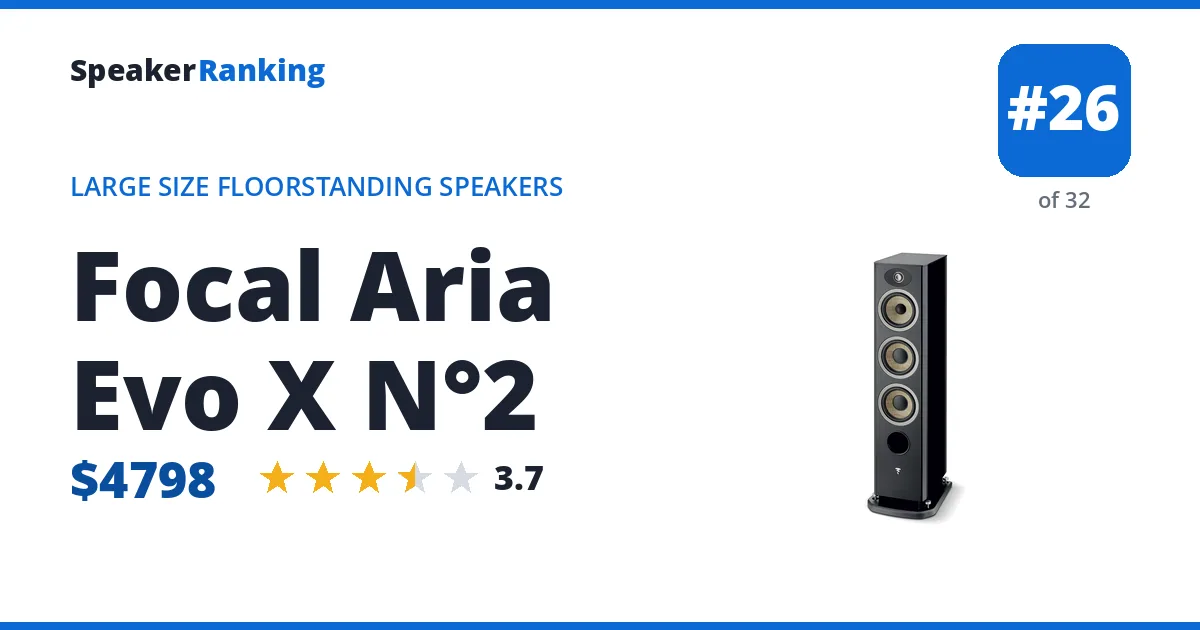
Pros: Solid bass with a deliberate mid-bass bump (80-120Hz) that gives extra thump and weight, extending to about 40-50Hz in-room. High sensitivity (measured 88.2dB) makes it easy to drive, and distortion is low throughout the range even at high output: the reviewer found only a minor compression “glare” around 4.5kHz at very high volumes, not a real concern. Directivity components (mid-range and tweeter) transition smoothly rather than abruptly, and the overall soundstage is wide and enveloping. Measured bass extension of 50Hz (-3dB), with a measured sensitivity of 88.2dB.
Cons: Sounds very bright pointed directly at the listener: the tweeter comes in 5-6dB above the midrange with an unusually wide, roughly two-octave dip (1kHz-4kHz) leading into it, giving a laid-back, low-attack character even after toeing out ~20 degrees. Fixing this properly requires real EQ (a mini DSP or similar), not just toe-out or absorption alone; without EQ, expect it to sound bright for stereo listening. A mild dip around 200Hz makes male vocals sound slightly subdued. Narrow vertical directivity (about +/-15 degrees) means you need to stay close to tweeter-axis height. Impedance dips to 3.4 ohms (EPDR 1.4 ohms), so it wants a 4-ohm-capable amplifier, and requires a plinth for floor clearance since it’s bottom-ported.
Full Focal Aria Evo X N°2 review and specifications →
| Bass Extension (-10dB) | 38Hz (measured, Erin’s Audio Corner) |
|---|---|
| Bass Extension (-3dB) | 50Hz (measured, Erin’s Audio Corner) |
| DIY Kit | No |
| Dimensions | 40.7”H x 14.6”W x 11.6”D (1035 x 371 x 294 mm) |
| Drivers | Aluminum-magnesium inverted dome tweeter with waveguide, 6.5” flax midrange, dual 6.5” flax midbass woofers |
| Frequency Response | 45Hz - 30kHz (Manufacturer specified) |
| Impedance | 8 ohms nominal (2.9 ohms minimum, Manufacturer specified; 3.4 ohms minimum measured by Erin’s Audio Corner) |
| Recommended Power | 40-250W |
| Sensitivity | 88.2dB (2.83V/1m, measured by Erin’s Audio Corner; 91.5dB Manufacturer specified) |
| Spinorama Preference Score | 4.88 |
| Spinorama Preference Score with Perfect Sub | 6.82 |
| Weight | 55.1 lbs (25 kg) each |
| Woofer Cabinet | 3-way, bass reflex (bottom-firing port, requires plinth) |
- Links
- Reviews, Comparisons and Sound Samples
- Head-to-Head Comparisons
- Focal Aria Evo X N°2 vs Polk Audio XT60
- Focal Aria Evo X N°2 vs Polk T50
- Focal Aria Evo X N°2 vs Infinity Reference 253
- Focal Aria Evo X N°2 vs Magnepan LRS+
- Focal Aria Evo X N°2 vs SVS Ultra Evolution Pinnacle
- Focal Aria Evo X N°2 vs Definitive Technology BP-9020
- Focal Aria Evo X N°2 vs Klipsch RP-6000F II
- Focal Aria Evo X N°2 vs JBL Stage 2 280F
- See all 46 comparisons
 Triangle Esprit Antal Ez: $1,799 per pair Discontinued eBay
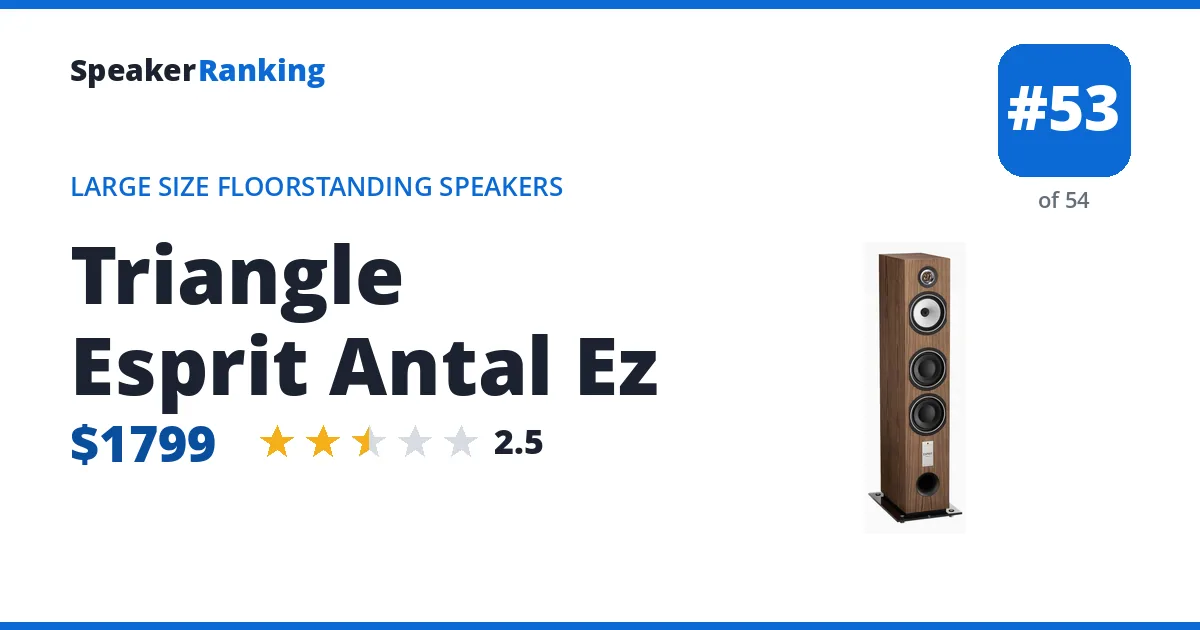
Pros: Predicted in-room response sums rather nicely aside from the resonance and bass issues. Horizontal beamwidth of about ±50 degrees is reasonably controlled. Measured bass extension of 85Hz (-3dB), with a measured sensitivity of 90.7dB.
Cons: Resonance around 260Hz and a number of other resonances show up on-axis, along with a dip in bass response. Two distinct distortion sources (one around 250-300Hz, another around 3-4kHz) already cross the reviewer’s audibility threshold even at moderate output, and get much worse at 96dB SPL/1m, where distortion broadly exceeds 50% relative level across large parts of the spectrum. Directivity is not great overall. The reviewer does not recommend it. Discontinued.
Full Triangle Esprit Antal Ez review and specifications →
| Bass Extension (-10dB) | 62Hz (measured, Audio Science Review) - low confidence - on-axis curve shows an unusual notch/dip around 250-300Hz for this floorstanding tower |
|---|---|
| Bass Extension (-3dB) | 85Hz (measured, Audio Science Review) - low confidence - on-axis curve shows an unusual notch/dip around 250-300Hz for this floorstanding tower |
| DIY Kit | No |
| Dimensions | 43.9”H x 11.8”W x 15.7”D (1115.0 x 300.0 x 400.0 mm) |
| Drivers | 2x 6.5” (160mm) fiberglass cone woofers, 1x 6.5” (160mm) natural cellulose midrange, 1x 1” (25mm) titanium dome tweeter |
| Impedance | 8 ohms nominal (2.7 ohms minimum, measured by Audio Science Review) |
| Sensitivity | 90.7dB (2.83V/1m, measured by Audio Science Review) |
| Spinorama Preference Score | 2.76 |
| Spinorama Preference Score with Perfect Sub | 5.37 |
| Weight | 98.5 lbs (44.7 kg) |
| Woofer Cabinet | ported, front |
- Links
- Reviews, Comparisons and Sound Samples
- Head-to-Head Comparisons
- Triangle Esprit Antal Ez vs JBL Studio 590
- Triangle Esprit Antal Ez vs Rockville RockTower 68B
- Triangle Esprit Antal Ez vs Bose 901 Series V
- Triangle Esprit Antal Ez vs Sony SS-CS3
- Triangle Esprit Antal Ez vs JBL Stage 2 280F
- Triangle Esprit Antal Ez vs Magnepan LRS+
- Triangle Esprit Antal Ez vs Infinity Reference 253
- Triangle Esprit Antal Ez vs Polk T50
- See all 12 comparisons