Short answer: the ELAC Debut 2.0 B6.2. It ranks #136 of 203 bookshelf speakers by sound quality (rated 3.5/5) at $329 and is still sold new; the Emotiva Airmotiv B2+ ranks #169 (rated 3.0/5) and is discontinued, so it is only an option used. The Emotiva Airmotiv B2+’s replacement, the Emotiva Airmotiv XB2, is rated 4.2/5.
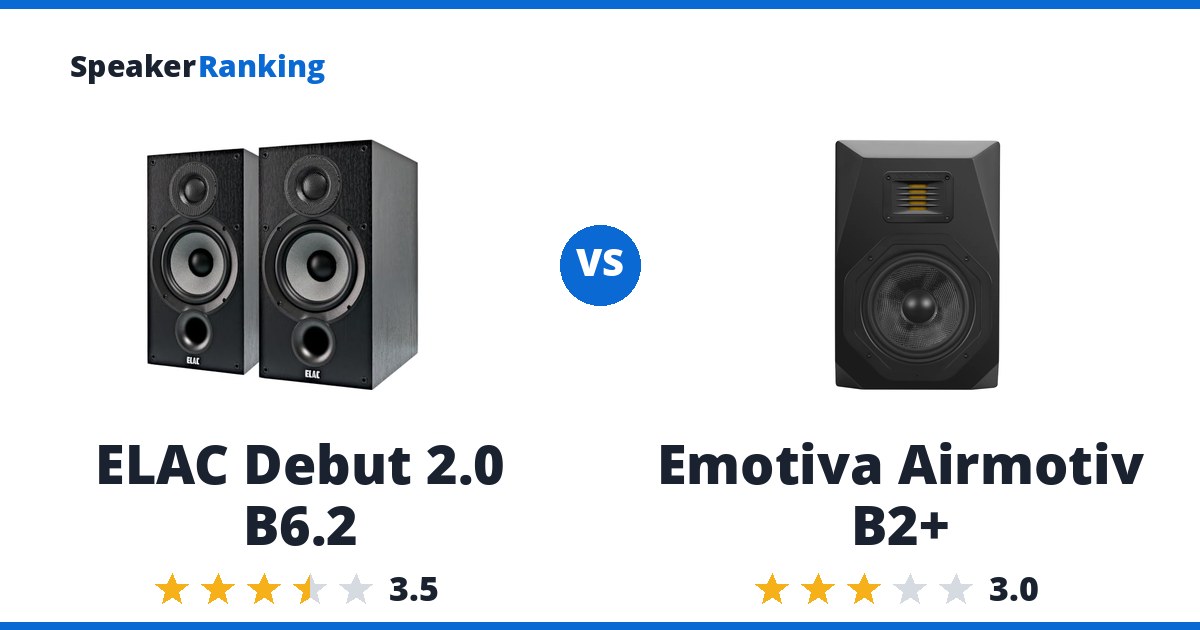
The ELAC Debut 2.0 B6.2 is the better-sounding pick. Reasonably flat on-axis and listening-window response with reasonably even horizontal directivity, holding about ±60° up to roughly 8kHz for consistent stereo width whether aimed directly at the listener or toed out. The tradeoff: A good size resonant peak around 700Hz stands out from an otherwise smooth response and lingers in cumulative spectral decay (waterfall) measurements: in one reviewer’s sighted A/B test, reducing it by about 5dB via EQ made a noticeable but not dramatic difference.
The Emotiva Airmotiv B2+ is the more accurate pick. Erin measured a useful 86dB average sensitivity and strong midbass punch around 120Hz. Its measured preference score, a predictor of how neutral it sounds, is 5.60 against 4.75 for the ELAC Debut 2.0 B6.2. Watch for: The replacement B2+ did not deliver the neutral upgrade Erin expected.
Buy the ELAC Debut 2.0 B6.2. It is rated higher for sound quality and still sold new, while the Emotiva Airmotiv B2+ is discontinued.
Looking for alternatives? See the complete Passive Home rankings.
Specifications Side By Side
| ELAC Debut 2.0 B6.2 | Emotiva Airmotiv B2+ | |
|---|---|---|
| Price | $329.00 per pair | $449 per pair Discontinued |
| Ranked | #136 of 203 in Large Size Bookshelf Speakers | #169 of 203 in Large Size Bookshelf Speakers |
| Bass Extension (-10dB) | 40Hz (measured, Erin’s Audio Corner) | 43Hz (measured, Erin’s Audio Corner) |
| Bass Extension (-3dB) | 64Hz (measured, Erin’s Audio Corner) | 66Hz (measured, Erin’s Audio Corner) |
| Impedance | 6 ohms nominal, 5.2 ohms minimum (measured, Erin’s Audio Corner) | 4 ohms nominal (manufacturer specified) |
| Sensitivity | 86.5dB (measured, Audio Science Review) | 86dB (measured average, Erin’s Audio Corner) |
| Drivers | 25mm tweeter + 165mm woofer | 6.5” woven-fiber woofer, 32 x 25mm folded-ribbon tweeter |
| Weight | 29.1 lbs (13.2 kg) | 15.7 lbs (7.1 kg) each |
| Dimensions | 14.8”H x 7.7”W x 10.6”D (375.0 x 195.0 x 268.0 mm) | 12.8”H x 8.5”W x 11.5”D (324 x 216 x 293 mm) |
| Woofer Cabinet | ported, front | ported, rear |
| Spinorama Preference Score | 4.75 (spinorama.org) | 5.60 |
| Spinorama Preference Score with Perfect Sub | 7.0 (spinorama.org) | 7.96 |
| DIY Kit | No | No |
Related Speaker Comparisons
More top alternatives to ELAC Debut 2.0 B6.2:
- ELAC Debut 2.0 B6.2 vs Perlisten S4b
- ELAC Debut 2.0 B6.2 vs KEF Reference 1 Meta
- ELAC Debut 2.0 B6.2 vs GR-Research NX-Studio
- AsciLab C6B vs ELAC Debut 2.0 B6.2
- ELAC Debut 2.0 B6.2 vs Audio First Cadentia 3
Prices on this page were last checked October 7, 2026 at 9:25 PM UTC. Product prices and availability are accurate as of that date/time and are subject to change; the price and availability shown on Amazon at the time of purchase will apply to the purchase of this product.
As an eBay Partner, we may be compensated if you make a purchase.
The Two Speakers In Full
 ELAC Debut 2.0 B6.2: $329.00 per pair Amazon Crutchfield eBay
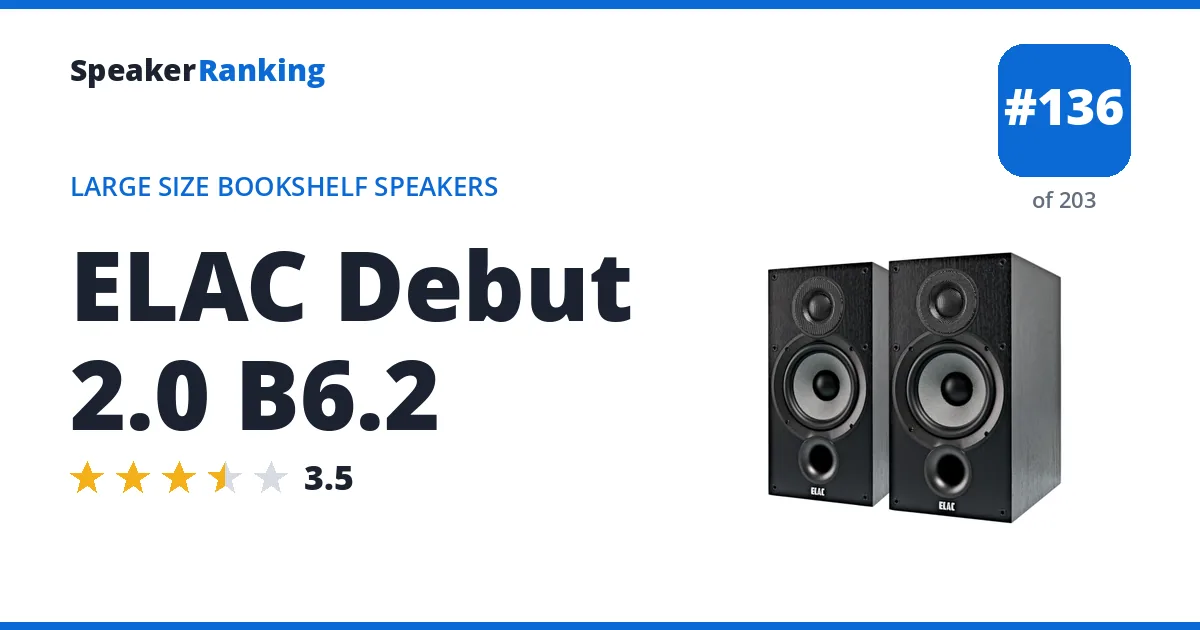
Newer model: the ELAC Debut 3.0 DB63, ranked higher, rated 4.2/5.
Same family: the ELAC Debut 2.0 B5.2 (smaller bookshelf, rated 3.2/5).
Pros: Reasonably flat on-axis and listening-window response with reasonably even horizontal directivity, holding about ±60° up to roughly 8kHz for consistent stereo width whether aimed directly at the listener or toed out. Its larger-than-typical woofer lets it play very loud with minimal distortion, staying under about 1% THD down to 50Hz at 86dB, and minimum impedance stays a comfortable 5-6 ohms. In-room bass extension reaches about 50Hz without much trouble, enough for a solid kick-drum sound. Takes equalization very well: correcting the on-axis response doesn’t cost sensitivity through the midrange, and the underlying directivity behavior (diffraction, vertical mismatch) is mild enough that EQ alone gets most of the way to a well-balanced sound. Vertical tolerance is asymmetric and fairly forgiving: about 10° above the tweeter axis and 20° below it before tonal balance meaningfully shifts. One reviewer called it “a good speaker” with “a good price” rather than just good-for-the-price, and found it fairly neutral overall in-room. Measured bass extension of 64Hz (-3dB), with a measured sensitivity of 86.5dB.
Cons: A good size resonant peak around 700Hz stands out from an otherwise smooth response and lingers in cumulative spectral decay (waterfall) measurements: in one reviewer’s sighted A/B test, reducing it by about 5dB via EQ made a noticeable but not dramatic difference. Directivity error shows up around 3.3kHz, and the upper-midrange around 4-6kHz stood out as edgy and sharp, almost sibilant at times, in casual listening: the predicted in-room response shows a lack of energy between 1-2kHz and a bit too much above that, which one reviewer thought would sound bright. Distortion at 96dB SPL/1m shows two harmonic peaks the reviewer says “should not be there,” one from woofer breakup around 400Hz and another around 7-8kHz from the tweeter, and multitone distortion approaches 10% in the 500-800Hz range at that output level. Real compression shows up even at moderate volume and worsens at 96dB and above, with the woofer clearly giving up around 60-70Hz: a subwoofer is recommended for anyone wanting to listen loud, since running it full-range at high output costs real dynamic range in the midbass and bass. Don’t place it close to a wall: boundary reinforcement adds a midbass bump that undoes the otherwise smooth, linear response. Getting the best out of it takes EQ (taming the 700Hz peak, filling in the 1-2kHz dip, and trimming the highs).
Full ELAC Debut 2.0 B6.2 review and specifications →
| Bass Extension (-10dB) | 40Hz (measured, Erin’s Audio Corner) |
|---|---|
| Bass Extension (-3dB) | 64Hz (measured, Erin’s Audio Corner) |
| DIY Kit | No |
| Dimensions | 14.8”H x 7.7”W x 10.6”D (375.0 x 195.0 x 268.0 mm) |
| Drivers | 25mm tweeter + 165mm woofer |
| Impedance | 6 ohms nominal, 5.2 ohms minimum (measured, Erin’s Audio Corner) |
| Sensitivity | 86.5dB (measured, Audio Science Review) |
| Spinorama Preference Score | 4.75 (spinorama.org) |
| Spinorama Preference Score with Perfect Sub | 7.0 (spinorama.org) |
| Weight | 29.1 lbs (13.2 kg) |
| Woofer Cabinet | ported, front |
- Links
- Reviews, Comparisons and Sound Samples
- Head-to-Head Comparisons
- ELAC Debut 2.0 B6.2 vs SVS Prime Bookshelf
- ELAC Debut 2.0 B6.2 vs Dynaudio Special Forty
- ELAC Debut 2.0 B6.2 vs Infinity IL10
- ELAC Debut 2.0 B6.2 vs GR-Research X-LS Encore
- ELAC Debut 2.0 B6.2 vs KEF Q3 Meta
- ELAC Debut 2.0 B6.2 vs Polk Monitor XT20
- ELAC Debut 2.0 B6.2 vs Parts Express Samba MT
- ELAC Debut 2.0 B6.2 vs Sonus Faber Lumina II
- See all 63 comparisons
 Emotiva Airmotiv B2+: $449 per pair Discontinued eBay
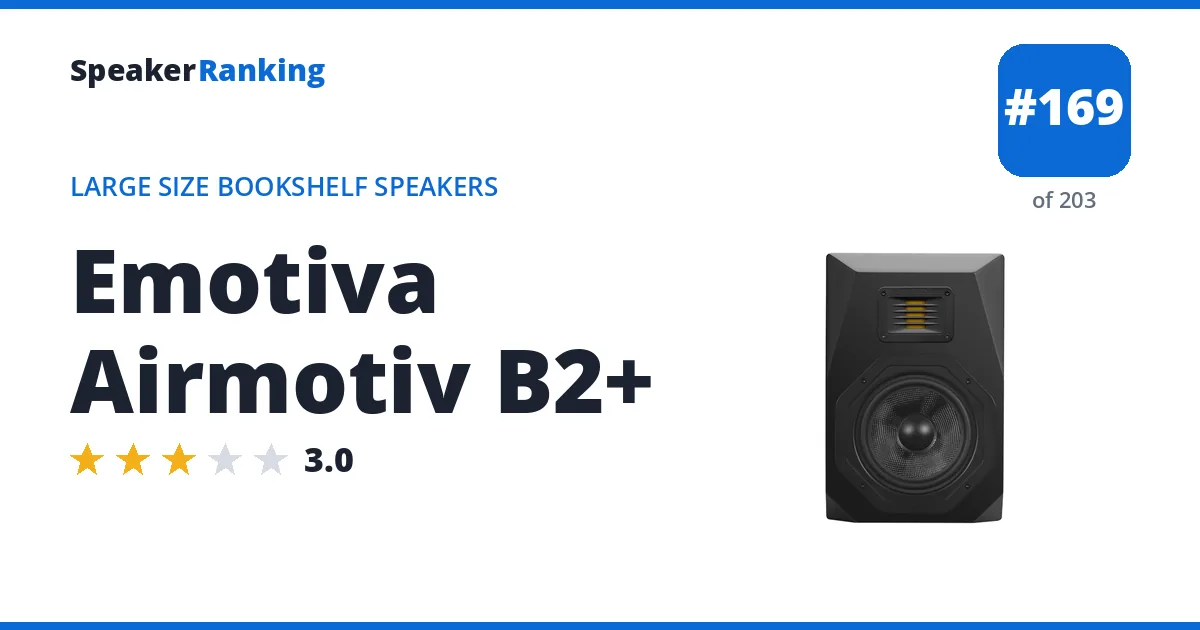
Newer model: the Emotiva Airmotiv XB2, ranked higher, rated 4.2/5.
Same family: the Emotiva Airmotiv T2+ (floorstanding, rated 4.2/5) and the Emotiva Airmotiv C2+ (center, rated 2.9/5).
Pros: Erin measured a useful 86dB average sensitivity and strong midbass punch around 120Hz. The folded-ribbon tweeter provides very broad upper-treble radiation, and the speaker can create a spacious presentation when positioned carefully. Response and directivity remain reasonably orderly below the roughly 2kHz crossover region. The 6.5-inch woofer offers more output capability than compact 5-inch competitors, while F3/F10 of 66/43Hz leave adequate overlap for a conventional 80Hz subwoofer crossover. Horizontal directivity data makes the broad baffle-step trend amenable to partial EQ below the crossover. Measured bass extension of 66Hz (-3dB), with a measured sensitivity of 86dB.
Cons: The replacement B2+ did not deliver the neutral upgrade Erin expected. A baffle-step loss around 500Hz depresses the lower midrange while the AMT’s much wider radiation above crossover injects excess room energy, yielding a bright, forward balance and false impression of cymbal detail. The directivity discontinuity near 2kHz cannot be completely equalized. Erin measured F3 at 66Hz and F10 at 43Hz, so meaningful kick-drum fundamentals and low bass still need a subwoofer. Vertical listening tolerance is roughly +/-10 degrees, with best results between the top of the woofer and tweeter axes. Broad lateral treble energy may require careful toe-out and sidewall absorption. Despite a large cabinet, it offers limited deep-bass advantage and was not Erin’s hoped-for successor to the more linear B1+. Discontinued.
Full Emotiva Airmotiv B2+ review and specifications →
| Bass Extension (-10dB) | 43Hz (measured, Erin’s Audio Corner) |
|---|---|
| Bass Extension (-3dB) | 66Hz (measured, Erin’s Audio Corner) |
| DIY Kit | No |
| Dimensions | 12.8”H x 8.5”W x 11.5”D (324 x 216 x 293 mm) |
| Drivers | 6.5” woven-fiber woofer, 32 x 25mm folded-ribbon tweeter |
| Impedance | 4 ohms nominal (manufacturer specified) |
| Sensitivity | 86dB (measured average, Erin’s Audio Corner) |
| Spinorama Preference Score | 5.60 |
| Spinorama Preference Score with Perfect Sub | 7.96 |
| Weight | 15.7 lbs (7.1 kg) each |
| Woofer Cabinet | ported, rear |
- Reviews, Comparisons and Sound Samples
- Head-to-Head Comparisons
- Emotiva Airmotiv B2+ vs Sonus Faber Sonetto II G2
- Emotiva Airmotiv B2+ vs KEF Q350
- Emotiva Airmotiv B2+ vs JBL XPL-90
- Emotiva Airmotiv B2+ vs Sonus Faber Lumina II Amator
- Emotiva Airmotiv B2+ vs Klipsch RP-600M
- Emotiva Airmotiv B2+ vs Polk R200
- Emotiva Airmotiv B2+ vs Wharfedale Diamond 9.1
- Emotiva Airmotiv B2+ vs Triangle Borea BR03
- See all 27 comparisons