Short answer: the ELAC Debut 3.0 DB63. It ranks #50 of 203 bookshelf speakers by sound quality (rated 4.2/5) at $499 and is still sold new; the Buchardt S400 MKII ranks #103 (rated 3.8/5) and is discontinued, so it is only an option used. The Buchardt S400 MKII’s replacement, the Buchardt S400 MK3, is rated 4.0/5.
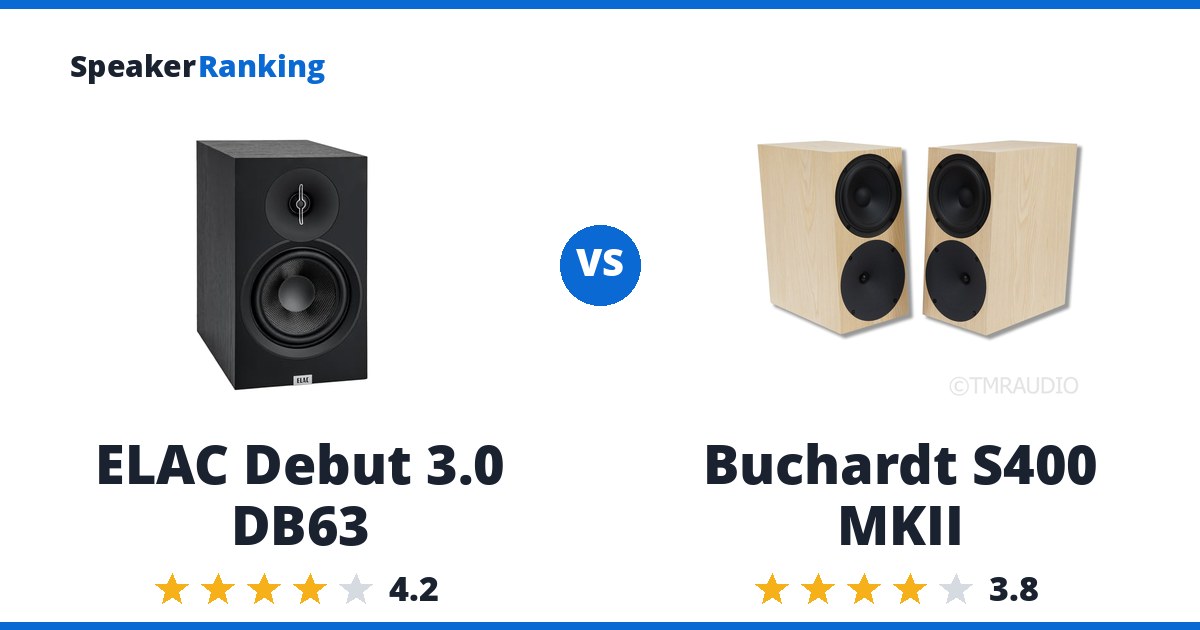
The ELAC Debut 3.0 DB63 is the better-sounding choice. 1” aluminum dome tweeter with a distinctive partial-lens waveguide design paired with a 6.5” third-generation aramid fiber cone woofer, in a robustly built cabinet for the price. The catch: A dip in the lower midrange (300-600Hz, about 1.5dB) reduces vocal warmth and can make voices sound slightly hollow.
The Buchardt S400 MKII is the deeper-bass option. Its bass reaches about 59Hz before falling 3dB, against 76Hz for the ELAC Debut 3.0 DB63. Watch for: Sounds a bit bright and slightly boosted above about 7-8kHz on-axis, even with 30° of toe-out: benefits from about 1 inch of sidewall absorption at the first reflection points to tame it.
Buy the ELAC Debut 3.0 DB63. It is rated higher for sound quality, and the Buchardt S400 MKII is discontinued, so it is only available used.
Want more options? Browse the full Passive Home rankings.
Specifications Side By Side
| ELAC Debut 3.0 DB63 | Buchardt S400 MKII | |
|---|---|---|
| Price | $499.00 per pair | $2400 per pair Discontinued |
| Ranked | #50 of 203 in Large Size Bookshelf Speakers | #103 of 203 in Large Size Bookshelf Speakers |
| Bass Extension (-10dB) | 40Hz (measured, Erin’s Audio Corner) | 40Hz (measured, Erin’s Audio Corner) |
| Bass Extension (-3dB) | 76Hz (measured, Erin’s Audio Corner) | 59Hz (measured, Erin’s Audio Corner) |
| Dimensions | 13.3”H x 7.7”W x 11.7”D (337.8 x 195.6 x 297.2 mm) | 14.4”H x 7”W x 11”D (365.8 x 177.8 x 279.4 mm) |
| Impedance | 6 ohms nominal (4.4 ohms minimum, measured, Erin’s Audio Corner) | 4 ohms nominal, 3 ohms minimum (measured, Erin’s Audio Corner) |
| Sensitivity | 86.2dB (measured, Erin’s Audio Corner) | 84.7dB (measured, Erin’s Audio Corner; 87dB manufacturer specified) |
| Drivers | 6.5” Aramid Fiber woofer, 1” soft dome tweeter | 6.5” aluminum cone woofer, 1” soft dome tweeter |
| Weight | 17.2 lbs (7.8 kg) each | 16.5 lbs (7.5 kg) each |
| Woofer Cabinet | ported, rear | ported |
| DIY Kit | No | No |
| Spinorama Preference Score | - | 5.38 |
| Spinorama Preference Score with Perfect Sub | - | 7.46 |
Related Speaker Comparisons
More worthwhile head-to-heads for ELAC Debut 3.0 DB63:
- ELAC Debut 3.0 DB63 vs TAD Compact Reference One (CR1TX)
- ELAC Debut 3.0 DB63 vs Perlisten S4b
- ELAC Debut 3.0 DB63 vs KEF Reference 1 Meta
- ELAC Debut 3.0 DB63 vs GR-Research NX-Studio
- ELAC Debut 3.0 DB63 vs March Audio Sointuva AWG
Prices on this page were last checked October 9, 2026 at 8:01 AM UTC. Product prices and availability are accurate as of that date/time and are subject to change; the price and availability shown on Amazon at the time of purchase will apply to the purchase of this product.
As an eBay Partner, we may be compensated if you make a purchase.
The Two Speakers In Full
 ELAC Debut 3.0 DB63: $499.00 per pair Amazon Crutchfield eBay
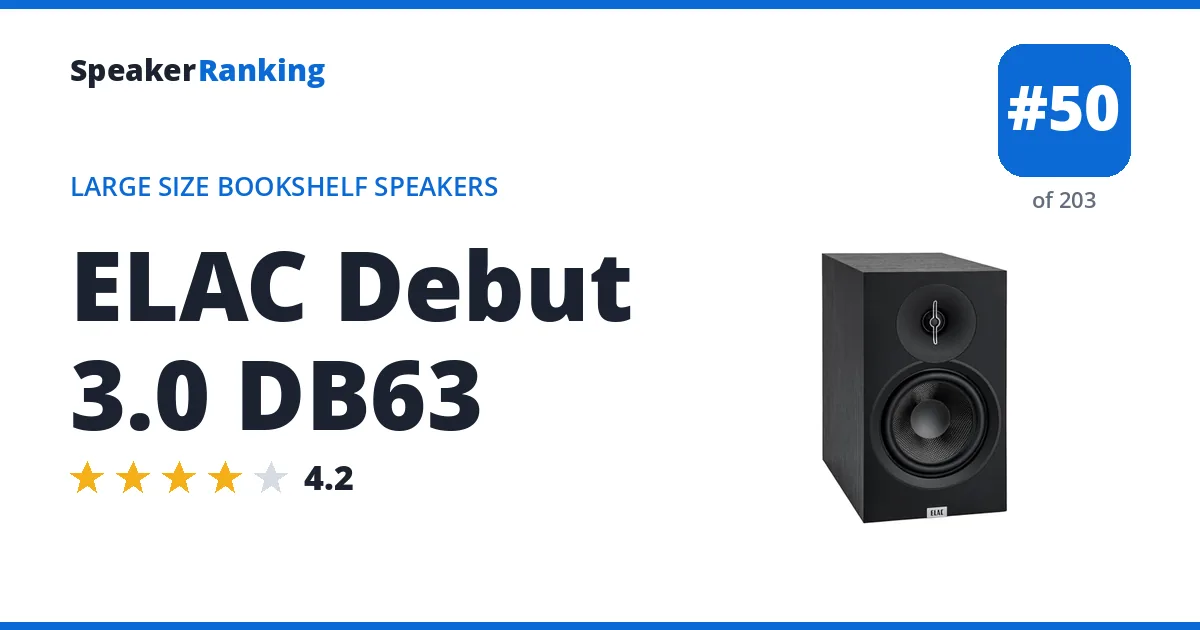
Older model: the ELAC Debut 2.0 B6.2 (ranked lower, rated 3.5/5).
Same family: the ELAC Debut 3.0 DB53 (smaller bookshelf, estimated 3.9/5), the ELAC Debut 3.0 DF53 (smaller floorstanding, estimated 4.2/5), the ELAC Debut 3.0 DF63 (larger floorstanding, rated 4.2/5), the ELAC Debut 3.0 DC53 (smaller center, estimated 3.4/5) and the ELAC Debut 3.0 DC63 (larger center, estimated 3.5/5).
Pros: 1” aluminum dome tweeter with a distinctive partial-lens waveguide design paired with a 6.5” third-generation aramid fiber cone woofer, in a robustly built cabinet for the price. Shallow bass rolloff (F3 76Hz, F10 40Hz) allows placement close to a wall without excessive boominess, useful for smaller living rooms. Solid measured performance for the price: on-axis linearity within about 2.5dB, impedance dipping only to about 4.4 ohms (easily AVR-driven), and roughly 20-26dB of usable dynamic range. A clear improvement over its sibling ELAC DB62, which has a sibilance issue tied to the crossover that can’t be fixed with EQ. Wide horizontal radiation of about ±60°, giving a spacious soundstage. Distortion looks good at a moderate 86dB and still reasonable at 96dB. Takes well to EQ correction: the reviewer provides a specific filter set (a low-shelf boost at 650Hz plus peaking cuts/boosts at 550Hz, 660Hz, and 3kHz) that meaningfully smooths out its known deviations. Measured bass extension of 76Hz (-3dB), with a measured sensitivity of 86.2dB.
Cons: A dip in the lower midrange (300-600Hz, about 1.5dB) reduces vocal warmth and can make voices sound slightly hollow. A high-Q resonance around 650-750Hz shows up clearly in measurements, though the reviewer couldn’t reliably hear it in his own A/B testing. A dip around 2-3kHz (roughly 1-2dB) slightly reduces speech intelligibility and attack in the upper midrange. Directivity droops above about 2kHz as the midwoofer narrows toward its beaming frequency while the tweeter’s pattern behaves differently: an inherent trade-off of physically separated drivers that can’t be fully corrected without introducing other issues. Multitone distortion crosses the reviewer’s 3% threshold in the 200Hz-1kHz range, and adding a subwoofer at an 80Hz crossover only modestly reduces it. Toeing the speaker away from the listener loses noticeable top-end air and cymbal energy, giving a softer upper register. Practical loudness ceiling is around 90dB at typical listening distance before midrange distortion and bass attack begin to degrade. Still needs a subwoofer for extension below about 40Hz.
Full ELAC Debut 3.0 DB63 review and specifications →
| Bass Extension (-10dB) | 40Hz (measured, Erin’s Audio Corner) |
|---|---|
| Bass Extension (-3dB) | 76Hz (measured, Erin’s Audio Corner) |
| DIY Kit | No |
| Dimensions | 13.3”H x 7.7”W x 11.7”D (337.8 x 195.6 x 297.2 mm) |
| Drivers | 6.5” Aramid Fiber woofer, 1” soft dome tweeter |
| Impedance | 6 ohms nominal (4.4 ohms minimum, measured, Erin’s Audio Corner) |
| Sensitivity | 86.2dB (measured, Erin’s Audio Corner) |
| Weight | 17.2 lbs (7.8 kg) each |
| Woofer Cabinet | ported, rear |
- Links
- Reviews, Comparisons and Sound Samples
- Head-to-Head Comparisons
- ELAC Debut 3.0 DB63 vs Emotiva Airmotiv XB2
- ELAC Debut 3.0 DB63 vs Arendal 1723 Bookshelf S THX
- ELAC Debut 3.0 DB63 vs Perlisten A3m
- ELAC Debut 3.0 DB63 vs JBL HDI-1600
- ELAC Debut 3.0 DB63 vs Aalto Speakers Aalto 3 Passive
- ELAC Debut 3.0 DB63 vs JTR Noesis 210HT
- ELAC Debut 3.0 DB63 vs Danley SH50
- ELAC Debut 3.0 DB63 vs Perlisten R5m
- See all 130 comparisons
 Buchardt S400 MKII: $2400 per pair Discontinued Buchardt Audio eBay
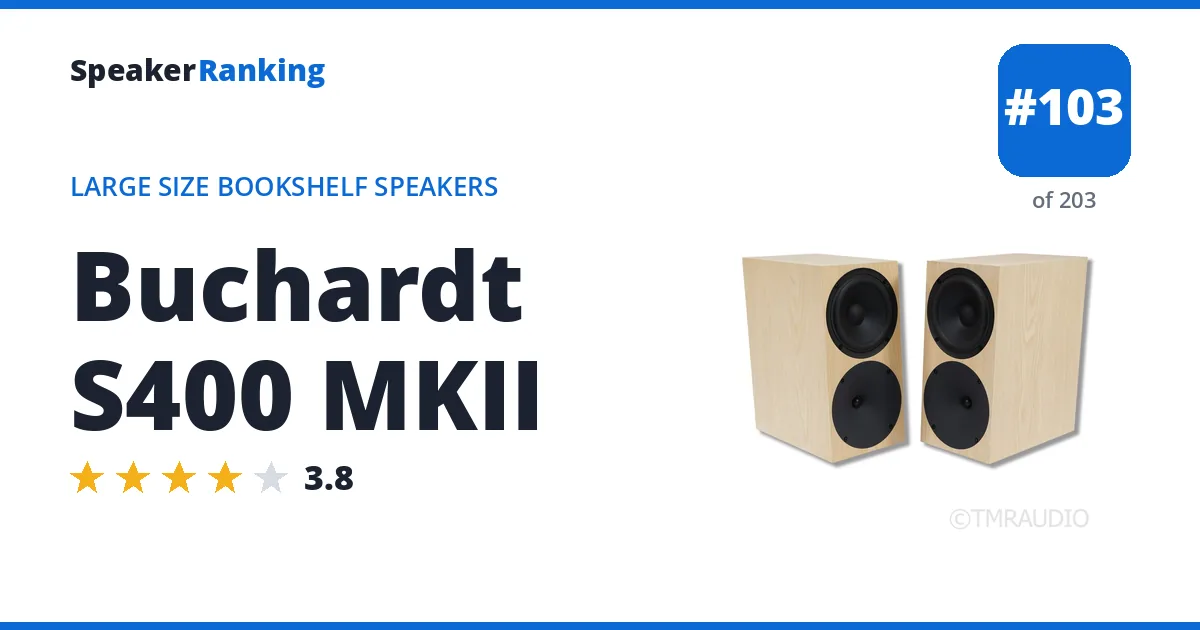
Newer model: the Buchardt S400 MK3, ranked higher, estimated 4/5.
Older model: the Buchardt Audio S400 (ranked higher, rated 4.4/5).
Pros: Two-way design with a 3/4” tweeter on a well-implemented aluminum waveguide (compression-driver style, letting the small tweeter cross unusually low at 1800Hz), a 6” SB Acoustics-style mid-woofer, and a tunable 5x8” passive radiator adjustable via rear weights. Exceptionally flat on-axis linearity, within about ±2dB from 80Hz to 16kHz. Wide horizontal radiation for a waveguided design (about ±45-50°), notably broader than a comparable narrow-waveguide rival like the Klipsch Sevens (~±30°). Well-focused, precise imaging, aided by tight pair matching between the two speakers. Takes very well to EQ correction, letting listeners easily dial in the top end or add midrange fullness to taste. Bass extension reaches a genuine 50Hz in-room from a mellow, well-tuned rolloff rather than an artificially boosted one. Measured bass extension of 59Hz (-3dB), with a measured sensitivity of 84.7dB.
Cons: Sounds a bit bright and slightly boosted above about 7-8kHz on-axis, even with 30° of toe-out: benefits from about 1 inch of sidewall absorption at the first reflection points to tame it. A mild dullness noted especially on male vocals, alongside a small dip around 300-600Hz. Vertical positioning is critical and unusually “temperamental”: sitting even slightly toward the tweeter line causes a suckout, while sitting above it adds too much energy; not well suited to multi-height home theater seating. Distortion is fine at 86dB but runs into real issues by 96dB: not a high-output speaker. Some compression-related enhancement appears around 1.2kHz (crossover-region interaction), and the tweeter shows clear compression at 102dB. The woofer can bottom out at extreme low-frequency content played very loud; crossing to a subwoofer below 60Hz caused output problems at high volume, while 80-100Hz worked well. A subwoofer isn’t strictly required to protect the speaker at moderate listening levels (80-85dB at 3 meters), but is still recommended for genuine low-octave extension. Discontinued.
Full Buchardt S400 MKII review and specifications →
| Bass Extension (-10dB) | 40Hz (measured, Erin’s Audio Corner) |
|---|---|
| Bass Extension (-3dB) | 59Hz (measured, Erin’s Audio Corner) |
| DIY Kit | No |
| Dimensions | 14.4”H x 7”W x 11”D (365.8 x 177.8 x 279.4 mm) |
| Drivers | 6.5” aluminum cone woofer, 1” soft dome tweeter |
| Impedance | 4 ohms nominal, 3 ohms minimum (measured, Erin’s Audio Corner) |
| Sensitivity | 84.7dB (measured, Erin’s Audio Corner; 87dB manufacturer specified) |
| Spinorama Preference Score | 5.38 |
| Spinorama Preference Score with Perfect Sub | 7.46 |
| Weight | 16.5 lbs (7.5 kg) each |
| Woofer Cabinet | ported |
- Links
- Reviews, Comparisons and Sound Samples
- Head-to-Head Comparisons
- Buchardt S400 MKII vs Klipsch RP-600M II
- Buchardt S400 MKII vs Dynaudio Emit 20
- Buchardt S400 MKII vs Philharmonic BMR Monitor
- Buchardt S400 MKII vs ELAC DBR62
- Buchardt S400 MKII vs Buchardt S400 MK3
- Buchardt S400 MKII vs Dynaudio Special Forty
- Buchardt S400 MKII vs KEF Q3 Meta
- Buchardt S400 MKII vs Sonus Faber Lumina II
- See all 18 comparisons