Short answer: the ELAC Debut 3.0 DB63. It ranks #50 of 203 bookshelf speakers by sound quality, rated 4.2/5, at $499; the Aperion Audio Verus V8B ranks #183, rated 2.7/5, and costs $1,499, which makes this an easy call rather than a real tradeoff.
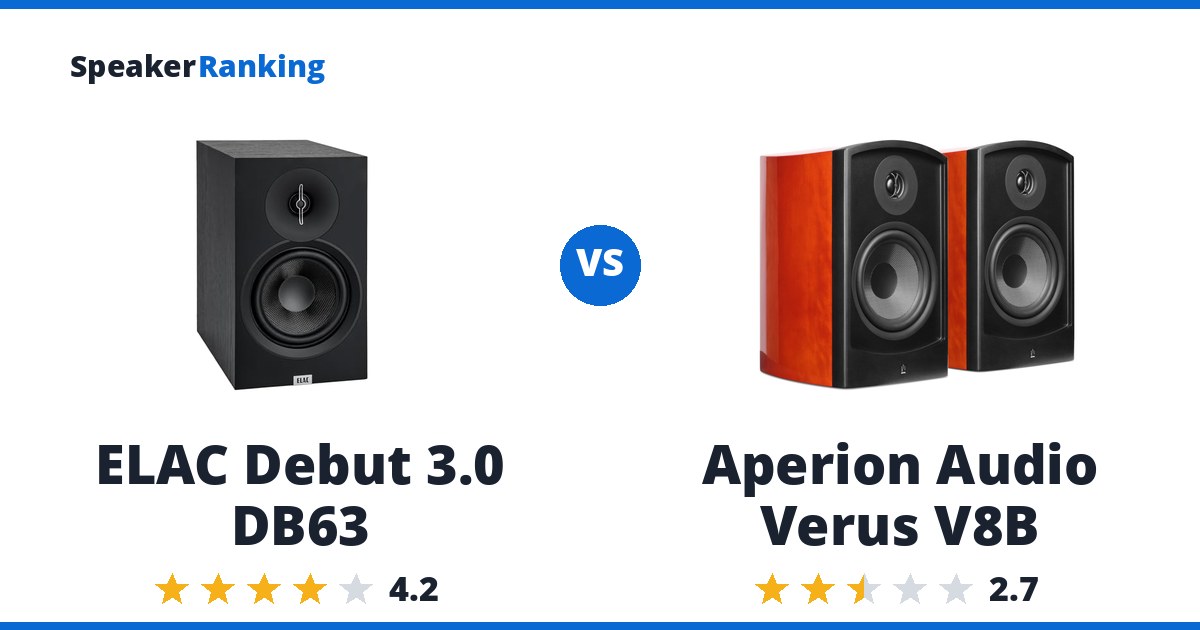
The ELAC Debut 3.0 DB63 is the better-sounding choice. 1” aluminum dome tweeter with a distinctive partial-lens waveguide design paired with a 6.5” third-generation aramid fiber cone woofer, in a robustly built cabinet for the price. The catch: A dip in the lower midrange (300-600Hz, about 1.5dB) reduces vocal warmth and can make voices sound slightly hollow.
The Aperion Audio Verus V8B is the deeper-bass option. Low-distortion bass that reaches a reasonable level for an 8-inch mid-woofer: the reviewer had no complaints about bass cleanliness, just extension. Its bass reaches about 55Hz before falling 3dB, against 76Hz for the ELAC Debut 3.0 DB63. The catch: A large mid-range scoop from about 100Hz-500Hz strips out the “meat” of male and female vocals, giving the speaker an overall dull, subdued character the reviewer specifically didn’t care for.
Buy the ELAC Debut 3.0 DB63. It is rated higher for sound quality than the Aperion Audio Verus V8B and costs less, so it is the default pick unless a specific strength of the other one matters more to you.
Want more options? Browse the full Passive Home rankings.
Specifications Side By Side
| ELAC Debut 3.0 DB63 | Aperion Audio Verus V8B | |
|---|---|---|
| Price | $499.00 per pair | $1,499 per pair |
| Ranked | #50 of 203 in Large Size Bookshelf Speakers | #183 of 203 in Large Size Bookshelf Speakers |
| Bass Extension (-10dB) | 40Hz (measured, Erin’s Audio Corner) | 39Hz (measured, Erin’s Audio Corner) |
| Bass Extension (-3dB) | 76Hz (measured, Erin’s Audio Corner) | 55Hz (measured, Erin’s Audio Corner) |
| Dimensions | 13.3”H x 7.7”W x 11.7”D (337.8 x 195.6 x 297.2 mm) | 17”H x 10.6”W x 13”D |
| Impedance | 6 ohms nominal (4.4 ohms minimum, measured, Erin’s Audio Corner) | 6 ohms nominal (manufacturer spec), 5.7 ohms nominal / ~3 ohms EPDR minimum (measured, Erin’s Audio Corner) |
| Sensitivity | 86.2dB (measured, Erin’s Audio Corner) | 85dB (measured average, Erin’s Audio Corner; 88dB manufacturer specified) |
| Drivers | 6.5” Aramid Fiber woofer, 1” soft dome tweeter | 8” Woven Kevlar long-throw woofer, 1.1” Custom Aperion ASR dome tweeter with ferrofluid |
| Weight | 17.2 lbs (7.8 kg) each | 28 lbs (12.7 kg) each |
| Woofer Cabinet | ported, rear | ported, rear |
| DIY Kit | No | No |
| Frequency Response | - | 30Hz - 35kHz ±3dB (manufacturer specified) |
| Recommended Power | - | 20-150W |
| Spinorama Preference Score | - | 3.65 |
| Spinorama Preference Score with Perfect Sub | - | 5.79 |
Related Speaker Comparisons
How ELAC Debut 3.0 DB63 compares with other leading options:
- ELAC Debut 3.0 DB63 vs TAD Compact Reference One (CR1TX)
- ELAC Debut 3.0 DB63 vs Perlisten S4b
- ELAC Debut 3.0 DB63 vs KEF Reference 1 Meta
- ELAC Debut 3.0 DB63 vs GR-Research NX-Studio
- ELAC Debut 3.0 DB63 vs March Audio Sointuva AWG
Prices on this page were last checked October 7, 2026 at 9:25 PM UTC. Product prices and availability are accurate as of that date/time and are subject to change; the price and availability shown on Amazon at the time of purchase will apply to the purchase of this product.
As an eBay Partner, we may be compensated if you make a purchase.
The Two Speakers In Full
 ELAC Debut 3.0 DB63: $499.00 per pair Amazon Crutchfield eBay
Older model: the ELAC Debut 2.0 B6.2 (ranked lower, rated 3.5/5).
Same family: the ELAC Debut 3.0 DB53 (smaller bookshelf, estimated 3.9/5), the ELAC Debut 3.0 DF53 (smaller floorstanding, estimated 4.2/5), the ELAC Debut 3.0 DF63 (larger floorstanding, rated 4.2/5), the ELAC Debut 3.0 DC53 (smaller center, estimated 3.4/5) and the ELAC Debut 3.0 DC63 (larger center, estimated 3.5/5).
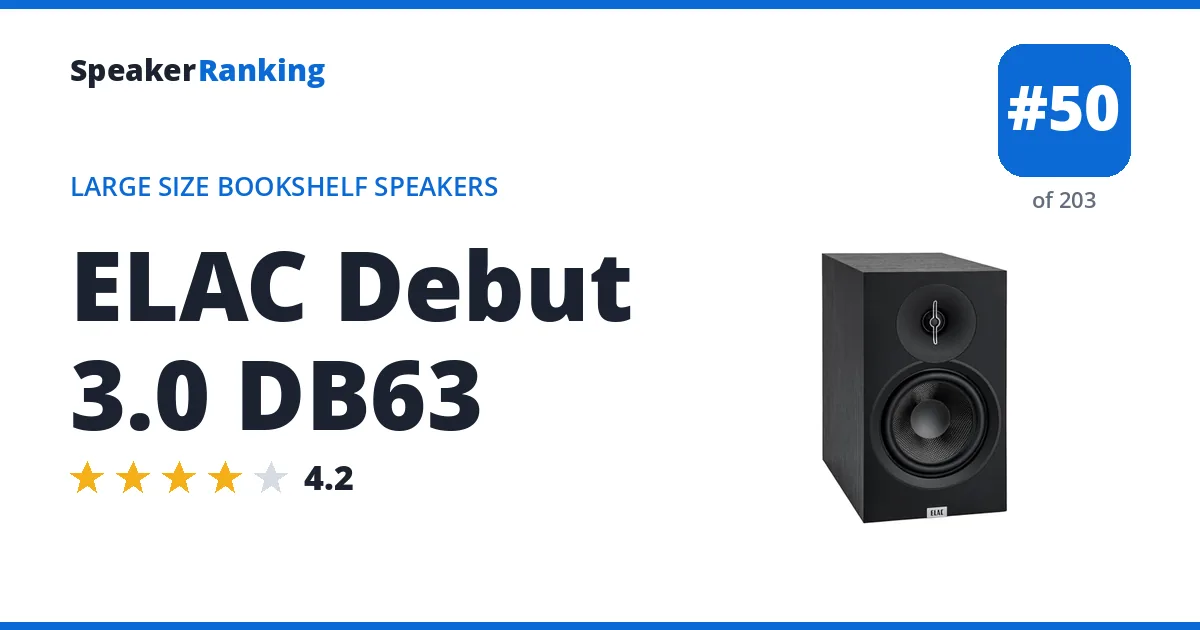
Pros: 1” aluminum dome tweeter with a distinctive partial-lens waveguide design paired with a 6.5” third-generation aramid fiber cone woofer, in a robustly built cabinet for the price. Shallow bass rolloff (F3 76Hz, F10 40Hz) allows placement close to a wall without excessive boominess, useful for smaller living rooms. Solid measured performance for the price: on-axis linearity within about 2.5dB, impedance dipping only to about 4.4 ohms (easily AVR-driven), and roughly 20-26dB of usable dynamic range. A clear improvement over its sibling ELAC DB62, which has a sibilance issue tied to the crossover that can’t be fixed with EQ. Wide horizontal radiation of about ±60°, giving a spacious soundstage. Distortion looks good at a moderate 86dB and still reasonable at 96dB. Takes well to EQ correction: the reviewer provides a specific filter set (a low-shelf boost at 650Hz plus peaking cuts/boosts at 550Hz, 660Hz, and 3kHz) that meaningfully smooths out its known deviations. Measured bass extension of 76Hz (-3dB), with a measured sensitivity of 86.2dB.
Cons: A dip in the lower midrange (300-600Hz, about 1.5dB) reduces vocal warmth and can make voices sound slightly hollow. A high-Q resonance around 650-750Hz shows up clearly in measurements, though the reviewer couldn’t reliably hear it in his own A/B testing. A dip around 2-3kHz (roughly 1-2dB) slightly reduces speech intelligibility and attack in the upper midrange. Directivity droops above about 2kHz as the midwoofer narrows toward its beaming frequency while the tweeter’s pattern behaves differently: an inherent trade-off of physically separated drivers that can’t be fully corrected without introducing other issues. Multitone distortion crosses the reviewer’s 3% threshold in the 200Hz-1kHz range, and adding a subwoofer at an 80Hz crossover only modestly reduces it. Toeing the speaker away from the listener loses noticeable top-end air and cymbal energy, giving a softer upper register. Practical loudness ceiling is around 90dB at typical listening distance before midrange distortion and bass attack begin to degrade. Still needs a subwoofer for extension below about 40Hz.
Full ELAC Debut 3.0 DB63 review and specifications →
| Bass Extension (-10dB) | 40Hz (measured, Erin’s Audio Corner) |
|---|---|
| Bass Extension (-3dB) | 76Hz (measured, Erin’s Audio Corner) |
| DIY Kit | No |
| Dimensions | 13.3”H x 7.7”W x 11.7”D (337.8 x 195.6 x 297.2 mm) |
| Drivers | 6.5” Aramid Fiber woofer, 1” soft dome tweeter |
| Impedance | 6 ohms nominal (4.4 ohms minimum, measured, Erin’s Audio Corner) |
| Sensitivity | 86.2dB (measured, Erin’s Audio Corner) |
| Weight | 17.2 lbs (7.8 kg) each |
| Woofer Cabinet | ported, rear |
- Links
- Reviews, Comparisons and Sound Samples
- Head-to-Head Comparisons
- ELAC Debut 3.0 DB63 vs Emotiva Airmotiv XB2
- ELAC Debut 3.0 DB63 vs Arendal 1723 Bookshelf S THX
- ELAC Debut 3.0 DB63 vs Perlisten A3m
- ELAC Debut 3.0 DB63 vs JBL HDI-1600
- ELAC Debut 3.0 DB63 vs Aalto Speakers Aalto 3 Passive
- ELAC Debut 3.0 DB63 vs JTR Noesis 210HT
- ELAC Debut 3.0 DB63 vs Danley SH50
- ELAC Debut 3.0 DB63 vs Perlisten R5m
- See all 130 comparisons
 Aperion Audio Verus V8B: $1,499 per pair Aperion Audio eBay
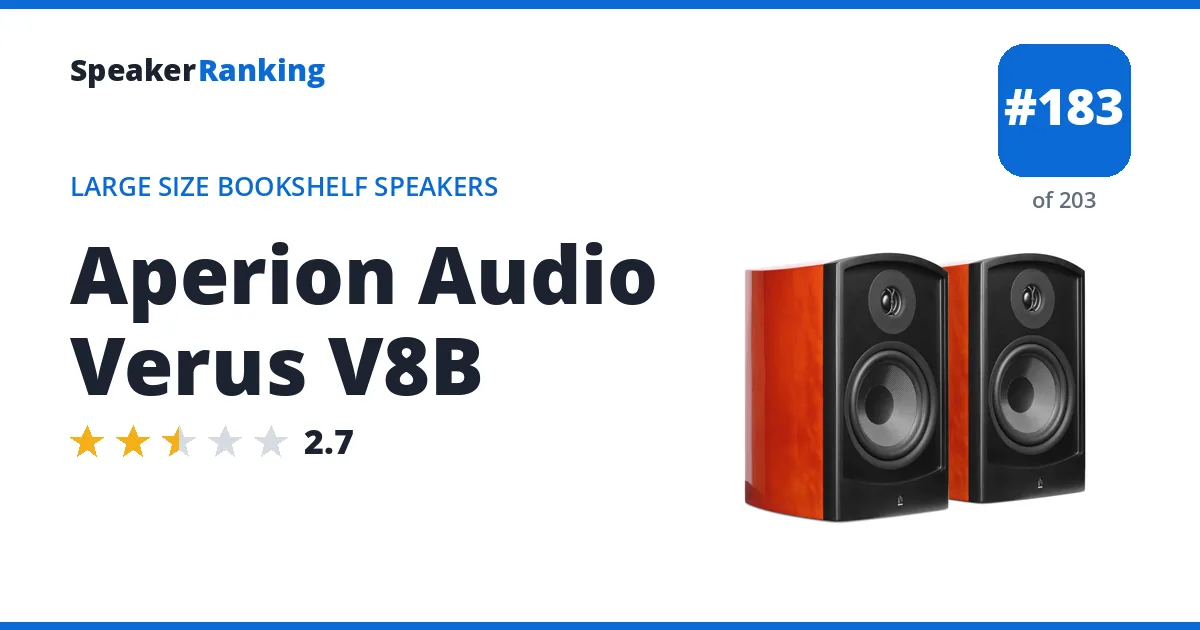
Pros: Low-distortion bass that reaches a reasonable level for an 8-inch mid-woofer: the reviewer had no complaints about bass cleanliness, just extension. Wide-enough horizontal radiation to give some room involvement without being uncomfortably narrow. HDF (high-density fiberboard) cabinet construction instead of the more typical MDF. Nice aesthetic in the gloss cherry finish (also available in black); solidly built at nearly 28 lbs each. Measured bass extension of 55Hz (-3dB), with a measured sensitivity of 85dB.
Cons: A large mid-range scoop from about 100Hz-500Hz strips out the “meat” of male and female vocals, giving the speaker an overall dull, subdued character the reviewer specifically didn’t care for. Two back-to-back resonant peaks (around 4kHz and 10kHz) cause sibilance and an overbearing hi-hat crispness on some tracks; toeing the speakers 30 degrees off-axis helps a little but doesn’t remove the underlying resonances. At $1499/pair, the reviewer felt EQ shouldn’t be necessary to get a satisfying result out of the box. Minimum impedance (EPDR) dips to around 3 ohms despite a 5.7-ohm nominal rating, so a Class AB amplifier needs to be 4-ohm capable. Bass extension is modest for an 8” driver: measured F3 55Hz/F10 39Hz, getting into the mid-40s Hz in-room rather than truly deep bass.
Full Aperion Audio Verus V8B review and specifications →
| Bass Extension (-10dB) | 39Hz (measured, Erin’s Audio Corner) |
|---|---|
| Bass Extension (-3dB) | 55Hz (measured, Erin’s Audio Corner) |
| DIY Kit | No |
| Dimensions | 17”H x 10.6”W x 13”D |
| Drivers | 8” Woven Kevlar long-throw woofer, 1.1” Custom Aperion ASR dome tweeter with ferrofluid |
| Frequency Response | 30Hz - 35kHz ±3dB (manufacturer specified) |
| Impedance | 6 ohms nominal (manufacturer spec), 5.7 ohms nominal / ~3 ohms EPDR minimum (measured, Erin’s Audio Corner) |
| Recommended Power | 20-150W |
| Sensitivity | 85dB (measured average, Erin’s Audio Corner; 88dB manufacturer specified) |
| Spinorama Preference Score | 3.65 |
| Spinorama Preference Score with Perfect Sub | 5.79 |
| Weight | 28 lbs (12.7 kg) each |
| Woofer Cabinet | ported, rear |
- Links
- Reviews, Comparisons and Sound Samples
- Head-to-Head Comparisons
- Aperion Audio Verus V8B vs B&W 805S
- Aperion Audio Verus V8B vs Triangle Borea BR03
- Aperion Audio Verus V8B vs Wharfedale Diamond 9.1
- Aperion Audio Verus V8B vs Klipsch RP-600M
- Aperion Audio Verus V8B vs Sonus Faber Lumina II Amator
- Aperion Audio Verus V8B vs HSU Research CCB-8
- Aperion Audio Verus V8B vs KEF Q350
- Aperion Audio Verus V8B vs Sonus Faber Sonetto II G2
- See all 15 comparisons