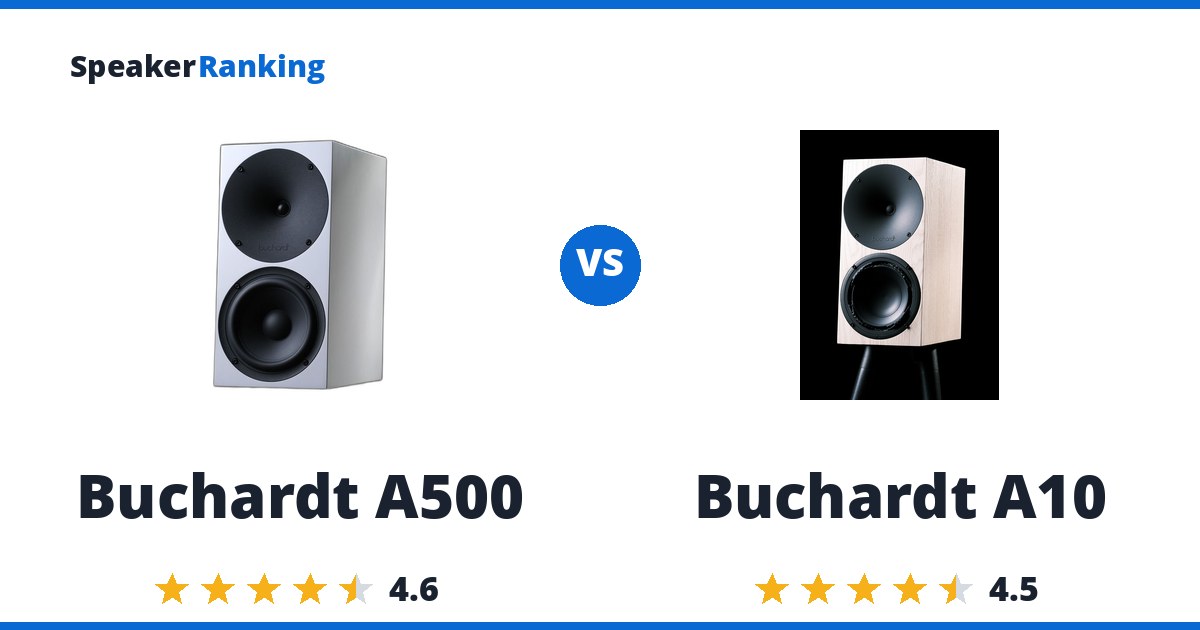
Short answer: the Buchardt A500 is the more elaborate DSP-driven three-way system, while the Buchardt A10 is the simpler sealed active monitor with a very specific placement requirement. A500 supplies 450W and DSP per cabinet, with its rear six-inch driver working as a cardioid and low-bass element rather than a passive radiator.
Its performance is defined by the selected DSP master, so there is no single response curve that describes every valid setup. Buyers should treat configuration as part of owning the speaker.
A10 uses a low-distortion 6.5-inch Purifi midwoofer, 19mm aluminum-dome tweeter on an aluminum waveguide, and dedicated 150W plus 50W amplification. Its constant-directivity approach produces rising on-axis treble, so direct aiming sounds bright in room; about 30° toe-out or a high-shelf cut is needed for neutral balance.
Buy the Buchardt A500 if you want the more powerful DSP-configurable three-way platform and will explore its masters.
Buy the Buchardt A10 if you want a sealed Purifi-based active speaker and can place it with deliberate toe-out.
Still deciding? The full Powered Home rankings cover every ranked option.
Specifications Side By Side
| Buchardt A500 | Buchardt A10 | |
|---|---|---|
| Price | $4,150 per pair Discontinued | $4300 per pair |
| Ranked | #15 of 68 in Large Size Powered Bookshelf Speakers | #11 of 68 in Large Size Powered Bookshelf Speakers |
| Bass Extension | Master-tuning dependent; approximately 25–40Hz | - |
| Bass Extension (-3dB) | 24.9Hz (measured, Erin’s Audio Corner) | 30Hz (measured, Erin’s Audio Corner) |
| Bass Extension (-10dB) | 23.4Hz (measured, Erin’s Audio Corner) | 21Hz (measured, Erin’s Audio Corner) |
| Amplifier Power | 3 x 150W per speaker | 200w Per Speaker |
| Drivers | 0.74-inch dome; front and rear 6-inch long-throw woofers | 6.5” PURIFI Extended Stroke Driver with Ultra Low Distortion, Custom made with triple Voice Coil woofer, 19 mm / 0.74” Resonance Free Aluminum dome with CDC aluminum waveguide tweeter |
| Dimensions | 14.4H x 7W x 11D inches | 14.6”H x 7”W x 9.6”D (370.8 x 177.8 x 243.8 mm) |
| Weight | 55.1 lbs (25kg)/pair | 15 lbs (6.8 kg) each |
| Spinorama Preference Score | 7.02 | 7.28 |
| Spinorama Preference Score with Perfect Sub | 7.92 | 8.00 |
| Inputs | XLR, WiSA | XLR |
| XLR Input | Yes | Yes |
| RCA Input | No | No |
| TRS Input | No | No |
| Optical Input | No | No |
| Coaxial Input | No | No |
| USB Input | No | No |
| HDMI Input | No | No |
| AES Input | No | No |
| Aux Input | No | No |
| Bluetooth | No | No |
| Frequency Response | 25Hz - 40kHz (+/- 1.5dB) (Manufacturer specified) | 28Hz - 40kHz (±1.5dB) (Manufacturer specified) |
| Woofer Cabinet | - | sealed |
| App | - | No |
| EQ | - | Yes (Room adjustment) |
| DSP | - | No |
Related Speaker Comparisons
How Buchardt A10 compares with other leading options:
- AsciLab C8C vs Buchardt A10
- Mesanovic CDM65 vs Buchardt A10
- Kii THREE vs Buchardt A10
- Neumann KH 150 vs Buchardt A10
- Aalto Speakers Aalto 3 Active Pro vs Buchardt A10
Prices on this page were last checked September 29, 2026 at 3:43 PM UTC. Product prices and availability are accurate as of that date/time and are subject to change; the price and availability shown on Amazon at the time of purchase will apply to the purchase of this product.
As an eBay Partner, we may be compensated if you make a purchase.
The Two Speakers In Full
 Buchardt A500: $4,150 per pair Discontinued Buchardt Audio eBay
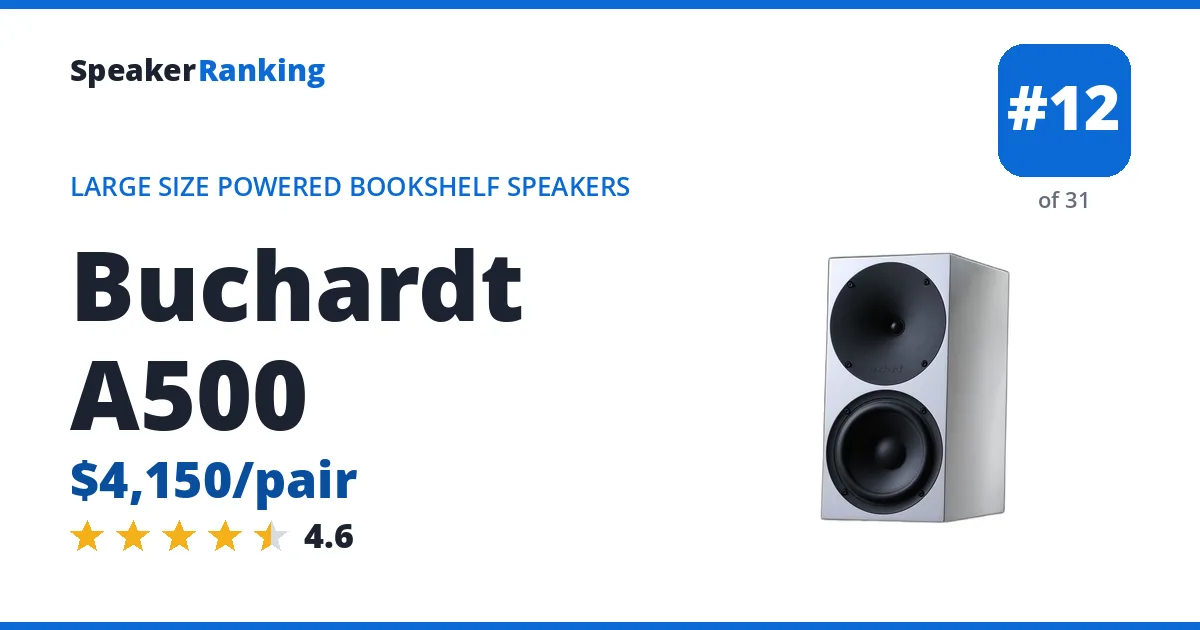
Pros: Erin measured unusually deep bass for the cabinet size: 24.9Hz at -3dB. A 1.8dB response span from 300Hz to 5kHz and 7.02 standalone preference score support balanced, full-range listening. Master Tunings and optional wireless integration provide practical flexibility. Measured bass extension of 24.9Hz (-3dB).
Cons: Bass extension depends on the selected tuning and comes with output tradeoffs at high levels. The 7.92 ideal-subwoofer score is good but not class-leading. A rear-facing woofer does not by itself establish cardioid radiation, and alternate Master Tunings should not inherit the measured configuration’s score. Discontinued.
Full Buchardt A500 review and specifications →
| AES Input | No |
|---|---|
| Amplifier Power | 3 x 150W per speaker |
| Aux Input | No |
| Bass Extension | Master-tuning dependent; approximately 25–40Hz |
| Bass Extension (-10dB) | 23.4Hz (measured, Erin’s Audio Corner) |
| Bass Extension (-3dB) | 24.9Hz (measured, Erin’s Audio Corner) |
| Bluetooth | No |
| Coaxial Input | No |
| Dimensions | 14.4H x 7W x 11D inches |
| Drivers | 0.74-inch dome; front and rear 6-inch long-throw woofers |
| Frequency Response | 25Hz - 40kHz (+/- 1.5dB) (Manufacturer specified) |
| HDMI Input | No |
| Inputs | XLR, WiSA |
| Optical Input | No |
| RCA Input | No |
| Spinorama Preference Score | 7.02 |
| Spinorama Preference Score with Perfect Sub | 7.92 |
| TRS Input | No |
| USB Input | No |
| Weight | 55.1 lbs (25kg)/pair |
| XLR Input | Yes |
- Links
- Reviews, Comparisons and Sound Samples
- Head-to-Head Comparisons
 Buchardt A10: $4300 per pair Buchardt Audio eBay
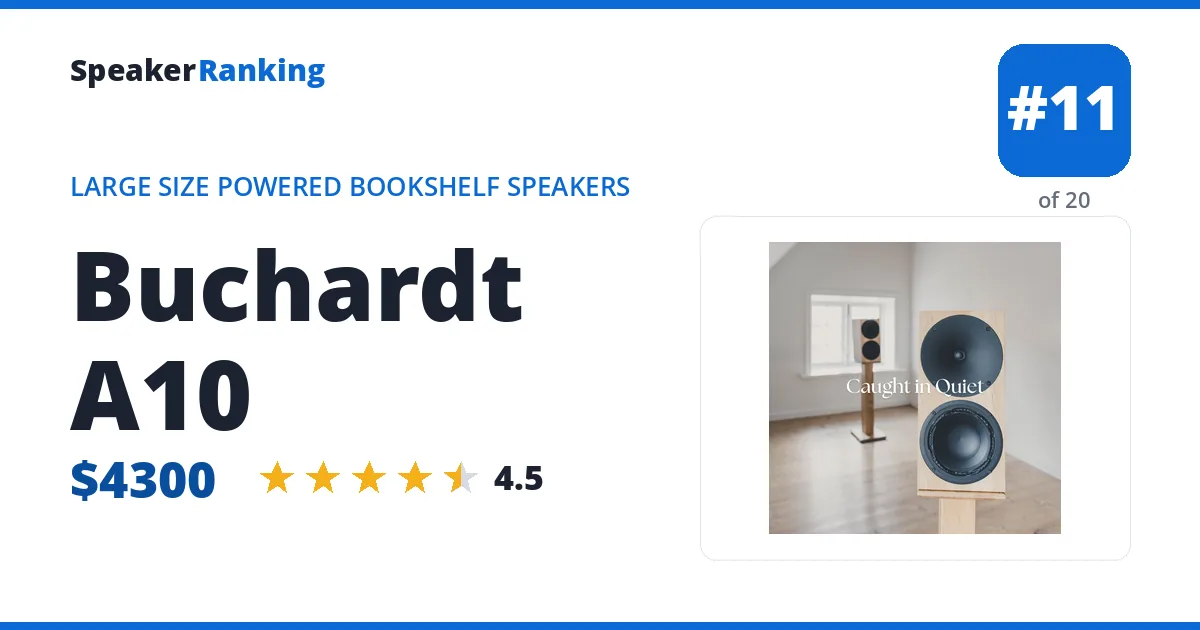
Pros: The measured tuning combines 31.5Hz -3dB bass extension with preference scores of 7.28 standalone and 8.00 with an ideal subwoofer. A 1.9dB response span from 300Hz to 5kHz supports broadly even mids, and selectable DSP tunings offer useful flexibility. Measured bass extension of 30Hz (-3dB).
Cons: The rising treble balance can sound brighter on axis; toe-out or a different tuning may suit some rooms. Deep-bass demands cause compression before the largest monitors reach their limits. A subwoofer with appropriate high-pass filtering can improve headroom; alternate presets should not be assumed to share the quoted scores.
Full Buchardt A10 review and specifications →
| AES Input | No |
|---|---|
| Amplifier Power | 200w Per Speaker |
| App | No |
| Aux Input | No |
| Bass Extension (-10dB) | 21Hz (measured, Erin’s Audio Corner) |
| Bass Extension (-3dB) | 30Hz (measured, Erin’s Audio Corner) |
| Bluetooth | No |
| Coaxial Input | No |
| DSP | No |
| Dimensions | 14.6”H x 7”W x 9.6”D (370.8 x 177.8 x 243.8 mm) |
| Drivers | 6.5” PURIFI Extended Stroke Driver with Ultra Low Distortion, Custom made with triple Voice Coil woofer, 19 mm / 0.74” Resonance Free Aluminum dome with CDC aluminum waveguide tweeter |
| EQ | Yes (Room adjustment) |
| Frequency Response | 28Hz - 40kHz (±1.5dB) (Manufacturer specified) |
| HDMI Input | No |
| Inputs | XLR |
| Optical Input | No |
| RCA Input | No |
| Spinorama Preference Score | 7.28 |
| Spinorama Preference Score with Perfect Sub | 8.00 |
| TRS Input | No |
| USB Input | No |
| Weight | 15 lbs (6.8 kg) each |
| Woofer Cabinet | sealed |
| XLR Input | Yes |
- Links
- Reviews, Comparisons and Sound Samples
- Head-to-Head Comparisons
- Buchardt A10 vs Pitt & Giblin Flare
- Buchardt A10 vs Aalto Speakers Aalto 3 Active Pro
- Buchardt A10 vs Neumann KH 150
- Buchardt A10 vs LOGProfessional Alpha
- Buchardt A10 vs Neumann KH 310 A
- Buchardt A10 vs HEDD Type 20 MK2
- Buchardt A10 vs Kii THREE
- Buchardt A10 vs Mesanovic CDM65
- See all 24 comparisons