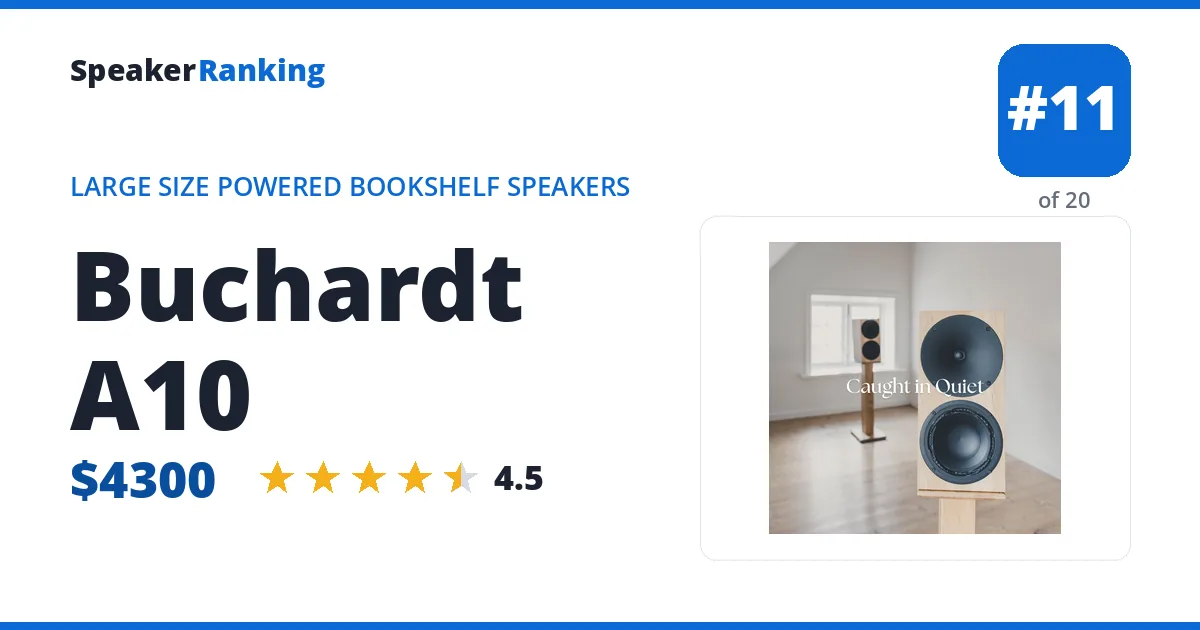
Short answer: the Buchardt A10. It ranks #11 of 68 powered bookshelf speakers by sound quality, rated 4.7/5, at $4,300; the JBL 4329P ranks #45, rated 4.1/5, and costs $4,500, so there is little reason to consider the other one.
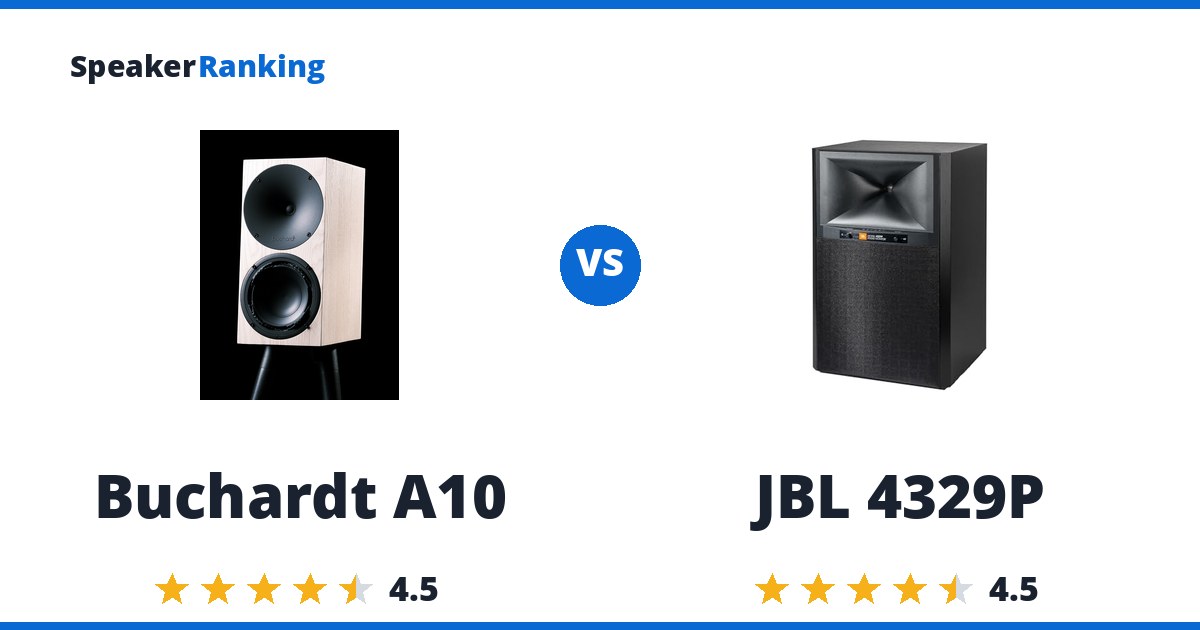
What the Buchardt A10 does well: The measured tuning combines 31.5Hz -3dB bass extension with preference scores of 7.28 standalone and 8.00 with an ideal subwoofer. The catch: The rising treble balance can sound brighter on axis; toe-out or a different tuning may suit some rooms.
Why pick the JBL 4329P: Measured -3dB extension of 32.2Hz provides deeper native bass than the smaller 4305P. The tradeoff: The measured 4.5dB response span from 300Hz to 5kHz includes a notable midrange dip, so it is not as neutral as its size and price might suggest.
Worth knowing: the JBL 4329P has been discontinued and is hard to find new at this point.
Buy the Buchardt A10. It is rated higher for sound quality than the JBL 4329P and costs less, so only choose the other one for a particular feature it does better.
Looking for alternatives? See the complete Powered Home rankings.
Specifications Side By Side
| Buchardt A10 | JBL 4329P | |
|---|---|---|
| Price | $4300 per pair | $4,500 per pair Discontinued |
| Ranked | #11 of 68 in Large Size Powered Bookshelf Speakers | #45 of 68 in Large Size Powered Bookshelf Speakers |
| Bass Extension (-10dB) | 21Hz (measured, Erin’s Audio Corner) | 27Hz (measured, Erin’s Audio Corner) |
| Bass Extension (-3dB) | 30Hz (measured, Erin’s Audio Corner) | 31Hz (measured, Erin’s Audio Corner) |
| Dimensions | 14.6”H x 7”W x 9.6”D (370.8 x 177.8 x 243.8 mm) | 20.3”H x 12.6”W x 12.7”D |
| Inputs | XLR | USB, Optical, Bluetooth, Analog, 3.5mm, AirPlay 2 |
| Drivers | 6.5” PURIFI Extended Stroke Driver with Ultra Low Distortion, Custom made with triple Voice Coil woofer, 19 mm / 0.74” Resonance Free Aluminum dome with CDC aluminum waveguide tweeter | 8” midwoofer, 1” compression driver with JBL High-Definition Imaging horn |
| Weight | 15 lbs (6.8 kg) each | 34.4 lbs (15.6 kg) (primary), 34.4 lbs (15.6 kg) (secondary) |
| Woofer Cabinet | sealed | ported |
| App | No | - |
| Bluetooth | No | Yes, 5.3 |
| EQ | Yes (Room adjustment) | - |
| DSP | No | - |
| Amplifier Power | 200w Per Speaker | 300W RMS per speaker (600W total system power) |
| Spinorama Preference Score | 7.28 | 5.40 |
| Spinorama Preference Score with Perfect Sub | 8.00 | 6.72 |
| XLR Input | Yes | No |
| RCA Input | No | No |
| TRS Input | No | No |
| Optical Input | No | Yes |
| Coaxial Input | No | No |
| USB Input | No | Yes |
| HDMI Input | No | No |
| AES Input | No | No |
| Aux Input | No | Yes |
| Frequency Response | 28Hz - 40kHz (±1.5dB) (Manufacturer specified) | 30Hz - 20kHz (anechoic, manufacturer specified) |
| Sensitivity | - | 102.2dB (measured at 0.3V/1m, Erin’s Audio Corner) |
| Bluetooth Codecs | - | SBC, aptX Adaptive |
Related Speaker Comparisons
More top alternatives to Buchardt A10:
- AsciLab C8C vs Buchardt A10
- Mesanovic CDM65 vs Buchardt A10
- Kii THREE vs Buchardt A10
- Neumann KH 150 vs Buchardt A10
- Aalto Speakers Aalto 3 Active Pro vs Buchardt A10
Prices on this page were last checked September 29, 2026 at 3:43 PM UTC. Product prices and availability are accurate as of that date/time and are subject to change; the price and availability shown on Amazon at the time of purchase will apply to the purchase of this product.
As an eBay Partner, we may be compensated if you make a purchase.
The Two Speakers In Full
 Buchardt A10: $4300 per pair Buchardt Audio eBay
Pros: The measured tuning combines 31.5Hz -3dB bass extension with preference scores of 7.28 standalone and 8.00 with an ideal subwoofer. A 1.9dB response span from 300Hz to 5kHz supports broadly even mids, and selectable DSP tunings offer useful flexibility. Measured bass extension of 30Hz (-3dB).
Cons: The rising treble balance can sound brighter on axis; toe-out or a different tuning may suit some rooms. Deep-bass demands cause compression before the largest monitors reach their limits. A subwoofer with appropriate high-pass filtering can improve headroom; alternate presets should not be assumed to share the quoted scores.
Full Buchardt A10 review and specifications →
| AES Input | No |
|---|---|
| Amplifier Power | 200w Per Speaker |
| App | No |
| Aux Input | No |
| Bass Extension (-10dB) | 21Hz (measured, Erin’s Audio Corner) |
| Bass Extension (-3dB) | 30Hz (measured, Erin’s Audio Corner) |
| Bluetooth | No |
| Coaxial Input | No |
| DSP | No |
| Dimensions | 14.6”H x 7”W x 9.6”D (370.8 x 177.8 x 243.8 mm) |
| Drivers | 6.5” PURIFI Extended Stroke Driver with Ultra Low Distortion, Custom made with triple Voice Coil woofer, 19 mm / 0.74” Resonance Free Aluminum dome with CDC aluminum waveguide tweeter |
| EQ | Yes (Room adjustment) |
| Frequency Response | 28Hz - 40kHz (±1.5dB) (Manufacturer specified) |
| HDMI Input | No |
| Inputs | XLR |
| Optical Input | No |
| RCA Input | No |
| Spinorama Preference Score | 7.28 |
| Spinorama Preference Score with Perfect Sub | 8.00 |
| TRS Input | No |
| USB Input | No |
| Weight | 15 lbs (6.8 kg) each |
| Woofer Cabinet | sealed |
| XLR Input | Yes |
- Links
- Reviews, Comparisons and Sound Samples
- Head-to-Head Comparisons
 JBL 4329P: $4,500 per pair Discontinued eBay
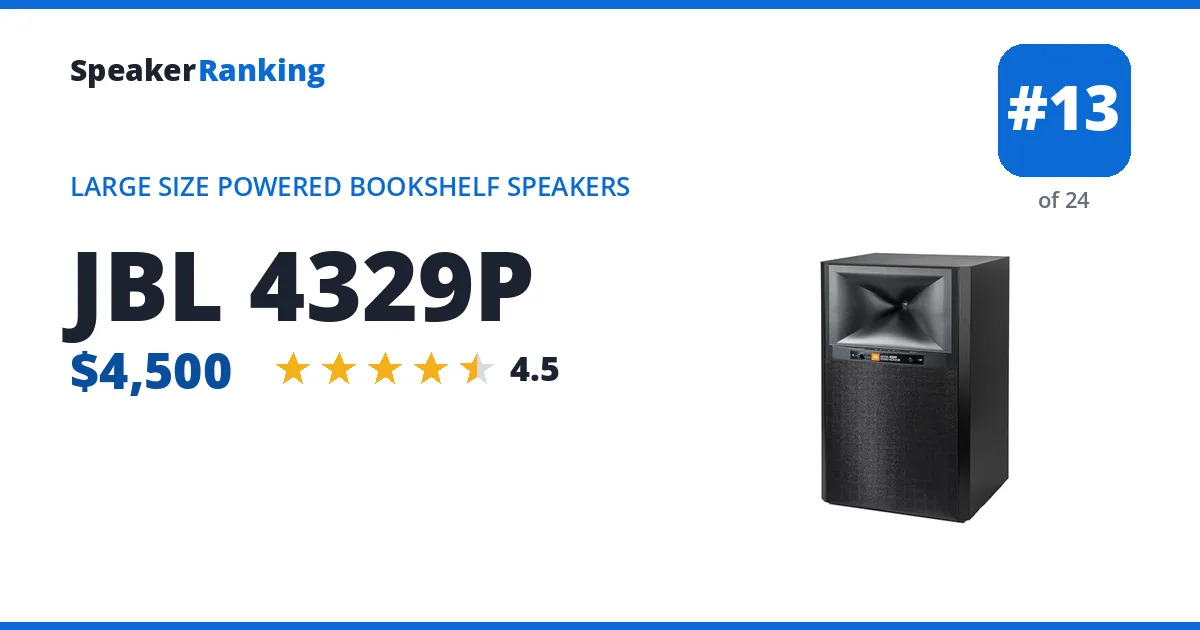
Pros: Measured -3dB extension of 32.2Hz provides deeper native bass than the smaller 4305P. Integrated amplification and streaming make it convenient for a full-range living-room system, and its larger format is useful when scale matters. Measured bass extension of 31Hz (-3dB), with a measured sensitivity of 102.2dB.
Cons: The measured 4.5dB response span from 300Hz to 5kHz includes a notable midrange dip, so it is not as neutral as its size and price might suggest. Its 6.72 ideal-subwoofer score trails the 4305P. There is no HDMI connection for the simplest TV hookup. Discontinued.
Full JBL 4329P review and specifications →
| AES Input | No |
|---|---|
| Amplifier Power | 300W RMS per speaker (600W total system power) |
| Aux Input | Yes |
| Bass Extension (-10dB) | 27Hz (measured, Erin’s Audio Corner) |
| Bass Extension (-3dB) | 31Hz (measured, Erin’s Audio Corner) |
| Bluetooth | Yes, 5.3 |
| Bluetooth Codecs | SBC, aptX Adaptive |
| Coaxial Input | No |
| Dimensions | 20.3”H x 12.6”W x 12.7”D |
| Drivers | 8” midwoofer, 1” compression driver with JBL High-Definition Imaging horn |
| Frequency Response | 30Hz - 20kHz (anechoic, manufacturer specified) |
| HDMI Input | No |
| Inputs | USB, Optical, Bluetooth, Analog, 3.5mm, AirPlay 2 |
| Optical Input | Yes |
| RCA Input | No |
| Sensitivity | 102.2dB (measured at 0.3V/1m, Erin’s Audio Corner) |
| Spinorama Preference Score | 5.40 |
| Spinorama Preference Score with Perfect Sub | 6.72 |
| TRS Input | No |
| USB Input | Yes |
| Weight | 34.4 lbs (15.6 kg) (primary), 34.4 lbs (15.6 kg) (secondary) |
| Woofer Cabinet | ported |
| XLR Input | No |
- Links
- Reviews, Comparisons and Sound Samples
- Head-to-Head Comparisons