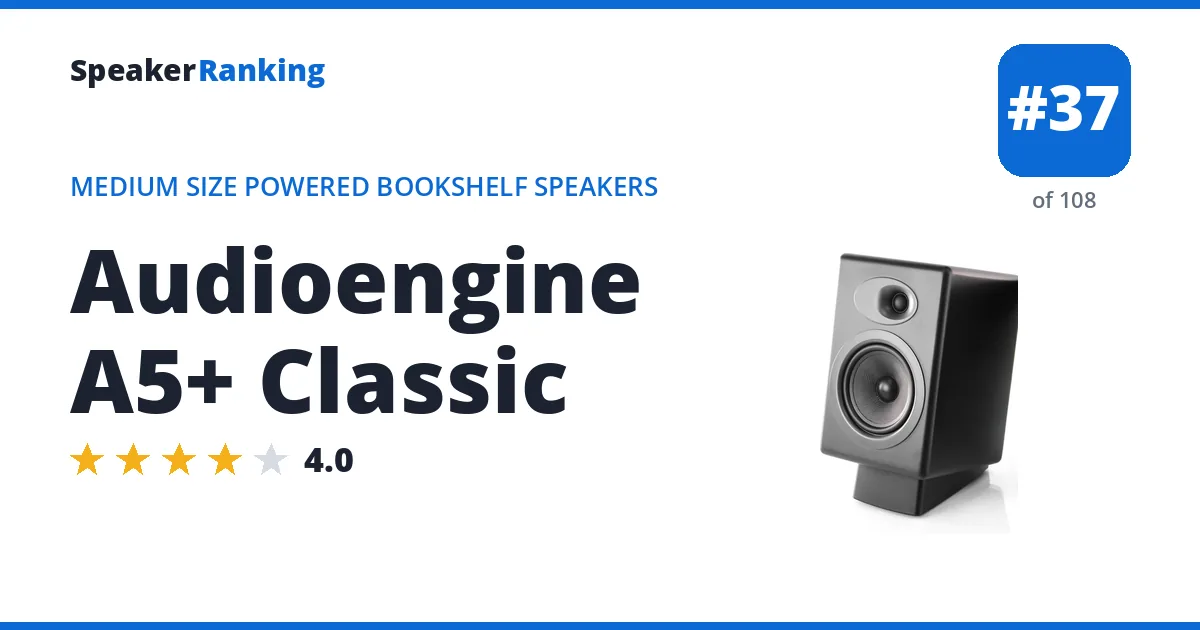
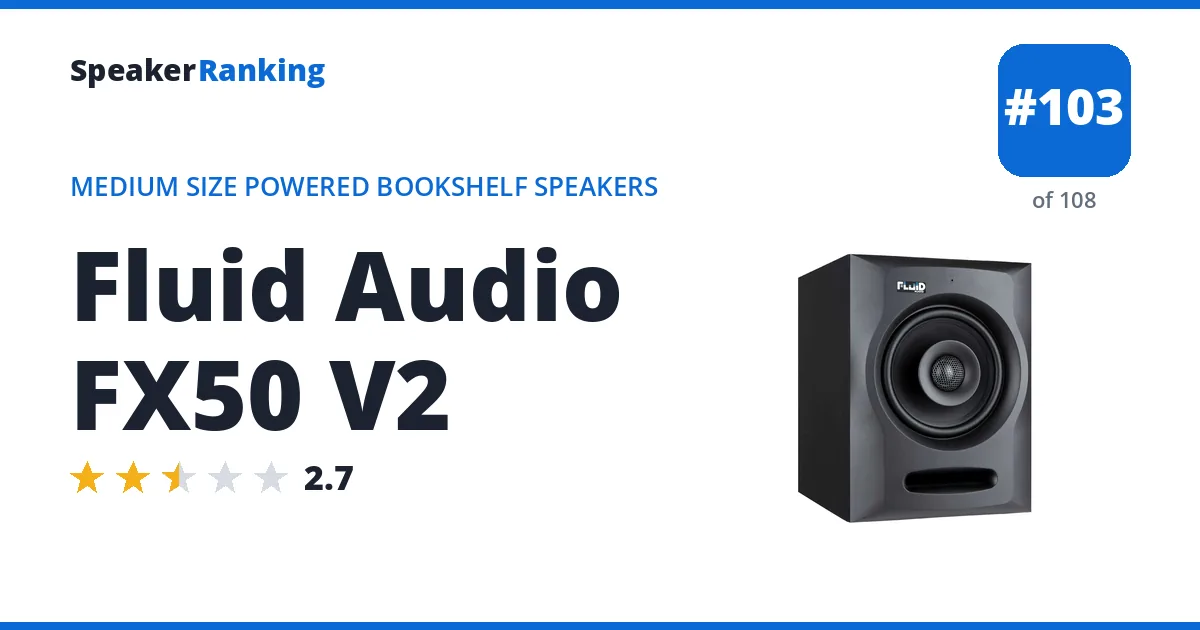
Short answer: the Audioengine A5+ Classic. It ranks #37 of 108 powered bookshelf speakers by sound quality, rated 4.0/5, at $399. The Fluid Audio FX50 V2 ranks #103, rated 2.7/5, at $298, $101 cheaper, a saving that is not big enough to make up the sound-quality gap.
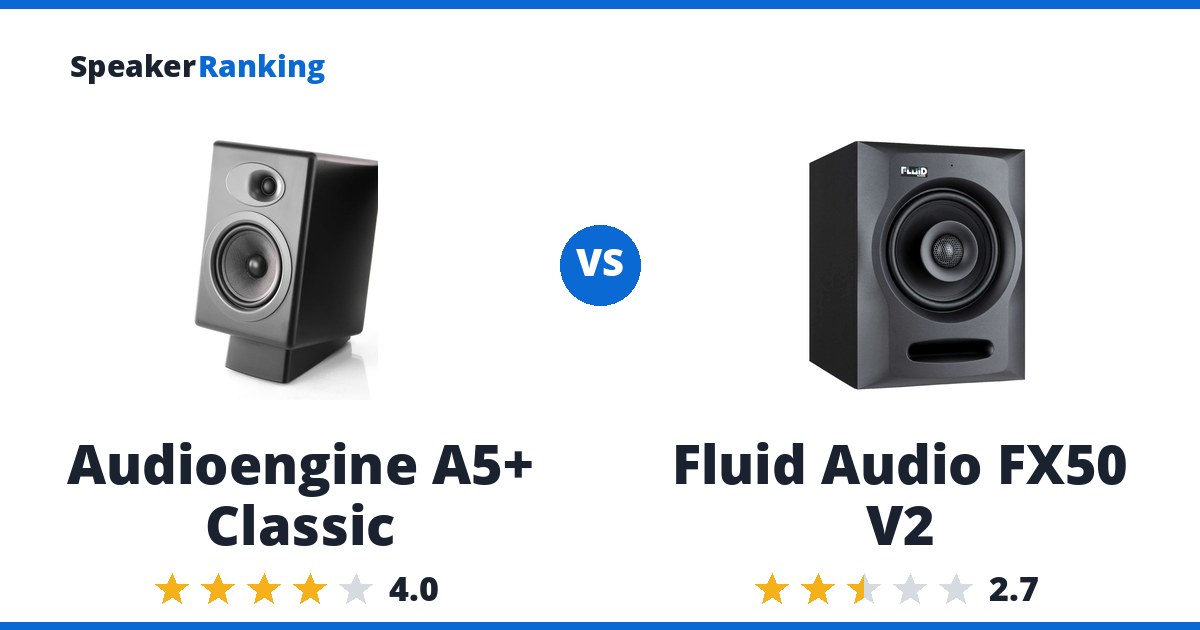
The Audioengine A5+ Classic is the more accurate option. ASR’s A5+ Powered measurements give 4.59 standalone and 7.06 with an ideal subwoofer, with a 2.7dB midrange span. Its measured preference score, a predictor of how neutral it sounds, is 4.59 against 1.80 for the Fluid Audio FX50 V2. It keeps a wired aux input, which the Fluid Audio FX50 V2 lacks. The catch: The measured -3dB point is around 69Hz, and the upper-bass recession can reduce body in voices and instruments.
Why pick the Fluid Audio FX50 V2: The coaxial geometry and mounting provisions allow flexible physical orientation, while balanced inputs and boundary controls suit a compact studio installation. Watch for: Scores of 1.80 standalone and 4.42 with an ideal subwoofer indicate poor native tonal accuracy.
Buy the Audioengine A5+ Classic. It is rated higher for sound quality, and the $101 you would save on the Fluid Audio FX50 V2 does not close the gap.
Still deciding? The full Powered Home rankings cover every ranked option.
Specifications Side By Side
| Audioengine A5+ Classic | Fluid Audio FX50 V2 | |
|---|---|---|
| Price | $399.00 per pair | $298 per pair |
| Ranked | #37 of 108 in Medium Size Powered Bookshelf Speakers | #103 of 108 in Medium Size Powered Bookshelf Speakers |
| Bass Extension (-3dB) | 68Hz (measured, Audio Science Review) | - |
| Bass Extension (-10dB) | 50Hz (measured, Audio Science Review) | - |
| Dimensions | 10.9”H x 7.2”W x 9.7”D (276.2 x 182.6 x 247.6 mm) | 9.2H x 6.9W x 9.1D in |
| Frequency Response | 50Hz - 22kHz (+/-1.5dB) (Manufacturer specified) | 49Hz-22kHz +/-2dB |
| Weight | 15.4 lbs (7 kg) (left/powered), 9.7 lbs (4.4 kg) (right) | 8.4 lbs (3.8 kg) each |
| Drivers | 5” Kevlar woofer, 0.75” silk dome tweeter | 1-inch silk tweeter coaxially mounted in 5-inch paper woofer |
| App | No | - |
| EQ | No | - |
| DSP | No | - |
| Amplifier Power | 50W RMS / 75W peak | 90W each |
| Spinorama Preference Score | 4.59 | 1.80 |
| Spinorama Preference Score with Perfect Sub | 7.06 | 4.42 |
| Subwoofer Output | Yes | - |
| Outputs | RCA variable output (subwoofer) | - |
| Inputs | RCA, Aux | XLR/TRS and RCA |
| XLR Input | No | Yes |
| RCA Input | Yes | Yes |
| TRS Input | No | Yes |
| Optical Input | No | No |
| Coaxial Input | No | No |
| USB Input | No | No |
| HDMI Input | No | No |
| AES Input | No | No |
| Aux Input | Yes | No |
| Bluetooth | No | No |
| Enclosure | - | Active coaxial, front-ported |
| Maximum SPL | - | 110dB |
Frequency Response Compared
Both speakers’ spinorama measurements, overlaid. A flatter line is more neutral: peaks sound forward or harsh, dips sound recessed. Each curve is shifted so its average from 300 Hz to 3 kHz sits at 0 dB, so loudness differences between the two are removed and only the shape is compared.
Measurement data: Audioengine A5+ Classic (measured by Audio Science Review) and Fluid Audio FX50 V2 (measured by Audio Science Review), via spinorama.org.
Related Speaker Comparisons
More top alternatives to Audioengine A5+ Classic:
- Audioengine A5+ Classic vs Genelec 8331A
- Audioengine A5+ Classic vs Neumann KH120 MKII
- Audioengine A5+ Classic vs Genelec 8030C
- Neumann KH80 DSP vs Audioengine A5+ Classic
- Audioengine A5+ Classic vs Dynaudio LYD 5
Prices on this page were last checked October 14, 2026 at 2:38 PM UTC. Product prices and availability are accurate as of that date/time and are subject to change; the price and availability shown on Amazon at the time of purchase will apply to the purchase of this product.
As an eBay Partner, we may be compensated if you make a purchase.
The Two Speakers In Full
 Audioengine A5+ Classic: $399.00 per pair Amazon $399.00 B&H Photo Video $469 eBay
Same family: the Audioengine A2+ (smaller bookshelf, rated 3.4/5).
Pros: ASR’s A5+ Powered measurements give 4.59 standalone and 7.06 with an ideal subwoofer, with a 2.7dB midrange span. The analog powered pair is straightforward to use without an external amplifier. The measured result supports a more capable tonal balance than its former low position suggested. Measured bass extension of 68Hz (-3dB).
Cons: The measured -3dB point is around 69Hz, and the upper-bass recession can reduce body in voices and instruments. The existing review reports crossover-region directivity errors and a distortion feature around 800-900Hz. The score does not make it a reference monitor, and adding a subwoofer cannot correct those midrange and off-axis issues.
Full Audioengine A5+ Classic review and specifications →
| Released | Oct 2011 (15 years ago) |
|---|---|
| AES Input | No |
| Amplifier Power | 50W RMS / 75W peak |
| App | No |
| Aux Input | Yes |
| Bass Extension (-10dB) | 50Hz (measured, Audio Science Review) |
| Bass Extension (-3dB) | 68Hz (measured, Audio Science Review) |
| Bluetooth | No |
| Coaxial Input | No |
| DSP | No |
| Dimensions | 10.9”H x 7.2”W x 9.7”D (276.2 x 182.6 x 247.6 mm) |
| Drivers | 5” Kevlar woofer, 0.75” silk dome tweeter |
| EQ | No |
| Frequency Response | 50Hz - 22kHz (+/-1.5dB) (Manufacturer specified) |
| HDMI Input | No |
| Inputs | RCA, Aux |
| Optical Input | No |
| Outputs | RCA variable output (subwoofer) |
| RCA Input | Yes |
| Spinorama Preference Score | 4.59 |
| Spinorama Preference Score with Perfect Sub | 7.06 |
| Subwoofer Output | Yes |
| TRS Input | No |
| USB Input | No |
| Weight | 15.4 lbs (7 kg) (left/powered), 9.7 lbs (4.4 kg) (right) |
| XLR Input | No |
- Links
- Reviews, Comparisons and Sound Samples
- Head-to-Head Comparisons
- Audioengine A5+ Classic vs KEF LSX II LT
- Audioengine A5+ Classic vs ADAM Audio T5V
- Audioengine A5+ Classic vs Airpulse A100
- Audioengine A5+ Classic vs Pioneer DJ VM-50
- Audioengine A5+ Classic vs Kanto YU6
- Audioengine A5+ Classic vs Mackie MR524
- Audioengine A5+ Classic vs M-Audio BX5 D3
- Audioengine A5+ Classic vs IK Multimedia iLoud MTM
- See all 61 comparisons
 Fluid Audio FX50 V2: $298 per pair Fluid Audio $149 eBay
Older model: the Fluid Audio FX50 (ranked higher, rated 2.8/5). See every Fluid Audio FX50 generation.
Pros: The coaxial geometry and mounting provisions allow flexible physical orientation, while balanced inputs and boundary controls suit a compact studio installation. Bass reaches -3dB around 67Hz in ASR’s selected measurement.
Cons: Scores of 1.80 standalone and 4.42 with an ideal subwoofer indicate poor native tonal accuracy. Listening-window and predicted-room narrow-band deviations are both around 0.80, showing irregular sound for both the listener and room reflections. Coaxial construction does not guarantee smooth dispersion or neutral reproduction, and correction features should not be credited as a proven fix.
Full Fluid Audio FX50 V2 review and specifications →
| Released | Jul 2025 (1 year ago) |
|---|---|
| AES Input | No |
| Amplifier Power | 90W each |
| Aux Input | No |
| Bluetooth | No |
| Coaxial Input | No |
| Dimensions | 9.2H x 6.9W x 9.1D in |
| Drivers | 1-inch silk tweeter coaxially mounted in 5-inch paper woofer |
| Enclosure | Active coaxial, front-ported |
| Frequency Response | 49Hz-22kHz +/-2dB |
| HDMI Input | No |
| Inputs | XLR/TRS and RCA |
| Maximum SPL | 110dB |
| Optical Input | No |
| RCA Input | Yes |
| Spinorama Preference Score | 1.80 |
| Spinorama Preference Score with Perfect Sub | 4.42 |
| TRS Input | Yes |
| USB Input | No |
| Weight | 8.4 lbs (3.8 kg) each |
| XLR Input | Yes |
- Links
- Reviews, Comparisons and Sound Samples
- Head-to-Head Comparisons
- Fluid Audio FX50 V2 vs JBL One Series 104-BT
- Fluid Audio FX50 V2 vs Fluid Audio FX50
- Fluid Audio FX50 V2 vs Avantone Pro Active MixCube
- Fluid Audio FX50 V2 vs Midiplus MI5 II
- Fluid Audio FX50 V2 vs Edifier R1280T
- Fluid Audio FX50 V2 vs Edifier R1280DB
- Fluid Audio FX50 V2 vs Edifier R1700BT
- Fluid Audio FX50 V2 vs Audioengine HD4
- See all 22 comparisons