Short answer: the Audio First Cadentia 3 on measured sound quality, the Buchardt Audio E50 on price. The Audio First Cadentia 3 ranks #8 of 130 bookshelf speakers at $7199. The Buchardt Audio E50 ranks #16 at $4600, $2599 cheaper.
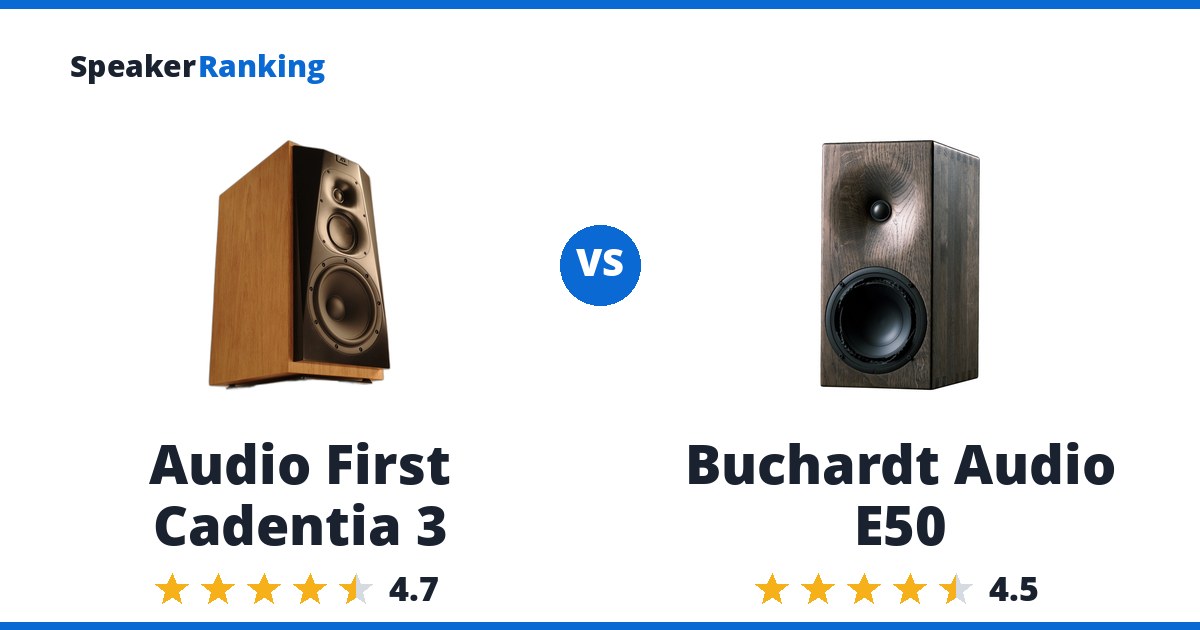
What the Audio First Cadentia 3 offers: Near-textbook measurements - excellent on-axis linearity, listening window, and directivity, with only minor deviations. Extremely low distortion and compression, holding steady even at 102dB with barely any loss. Very wide, consistent horizontal dispersion (~70 degrees) gives a big, enveloping soundstage with strong image specificity outside the speaker boundaries. Strong bass extension for a bookshelf (F3 43Hz, F10 26Hz) with a punchy, guttural mid-bass. Watch for: A mild scoop through the upper midrange/lower treble slightly softens the attack of snares, hand claps, and sibilants - fixable with a single-band EQ (2.5kHz, +1dB, Q~1). High-frequency dispersion narrows quickly above about 4kHz, so off-axis listeners lose some air and detail. Very high asking price for a bookshelf-class speaker, and the complete (finished) version has a long lead time; the loaner kit version ships as an unfinished cabinet you assemble and finish yourself.
What the Buchardt Audio E50 offers: Exceptional bass extension for a bookshelf - F3 at 40Hz, F10 at 34Hz - with genuinely low-end weight the reviewer kept noticing track after track, not just a single room-boosted note. Mid and lower-midrange are very neutral with no coloration and well-executed baffle-step compensation, so it doesn’t need to sit close to a wall like many bookshelf designs. Low distortion throughout the midrange, controlled ~60-degree horizontal directivity, and a striking driver/waveguide integration that looks genuinely upscale. Watch for: A roughly 3dB dip in the upper midrange/lower treble softens attack and dialogue clarity - the reviewer’s main complaint, and it’s baked into the crossover rather than a directivity artifact, so it’s audible both on and off axis. Sounds too bright pointed directly at the listener; needs about 10-20 degrees of toe-out to tame the treble and slightly smooth (not eliminate) that dip. Below-average sensitivity (measured 83.1dB vs 85dB spec) calls for a beefier amp, and the speaker’s tonal balance is unusually sensitive to amplifier output impedance - a poor tube amp can shift the midrange by up to 2dB.
Buy the Audio First Cadentia 3 if sound quality is the priority over the price, or the Buchardt Audio E50 if the price is the priority over sound quality.
Looking for alternatives? See the complete Passive Home rankings.
Specifications Side By Side
| Audio First Cadentia 3 | Buchardt Audio E50 | |
|---|---|---|
| Price | $7199 per pair | $4600 per pair |
| Ranked | #8 of 130 in Large Size Bookshelf Speakers | #16 of 130 in Large Size Bookshelf Speakers |
| Bass Extension (-10dB) | 26Hz (measured, Erin's Audio Corner) | 34Hz (measured, Erin's Audio Corner) |
| Bass Extension (-3dB) | 43Hz (measured, Erin's Audio Corner) | 40Hz (measured, Erin's Audio Corner) |
| Dimensions | 23.2" x 11.8" x 17" (590 x 300 x 433 mm) | 15.6" x 7.5" x 11.2" (395 x 190 x 284 mm) |
| Impedance | 4 ohms nominal (3.1 ohms minimum, measured by Erin's Audio Corner) | 4 ohms nominal |
| Sensitivity | 86.4dB (2.83V/1m, measured by Erin's Audio Corner) | 83.1dB (2.83V/1m, measured by Erin's Audio Corner) |
| Drivers | 1.1" tweeter, 4.5" midrange, 9" woofer | 1" Scanspeak dome tweeter with waveguide, 6.5" Purifi extended-stroke woofer, dual 6.5" passive radiators |
| Weight | 45.9 lbs (20.8 kg) each | 19 lbs (8.6 kg) each |
| Woofer Cabinet | 3-way, bass reflex | Passive radiator loaded |
| Country | United Kingdom (Cambridge) | Denmark |
| Spinorama Preference Score | 7.38 | 5.03 |
| Spinorama Preference Score with Perfect Sub | 8.74 | 6.80 |
| Crossover Frequency | - | 2000Hz |
| Frequency Response | - | 36Hz - 30kHz ±3dB (Manufacturer specified) |
| Recommended Power | - | 60W - 200W |
Related Speaker Comparisons
More top alternatives to Audio First Cadentia 3:
- Perlisten S4b vs Audio First Cadentia 3
- Audio First Cadentia 3 vs KEF Reference 1 Meta
- Audio First Cadentia 3 vs GR-Research NX-Studio
- March Audio Sointuva vs Audio First Cadentia 3
- AsciLab C6B vs Audio First Cadentia 3
Prices on this page were last checked September 16, 2026 at 12:41 AM UTC. Product prices and availability are accurate as of that date/time and are subject to change; the price and availability shown on Amazon at the time of purchase will apply to the purchase of this product.
As an eBay Partner, we may be compensated if you make a purchase.
The Two Speakers In Full
 Audio First Cadentia 3: $7199 per pair Audio First Designs eBay
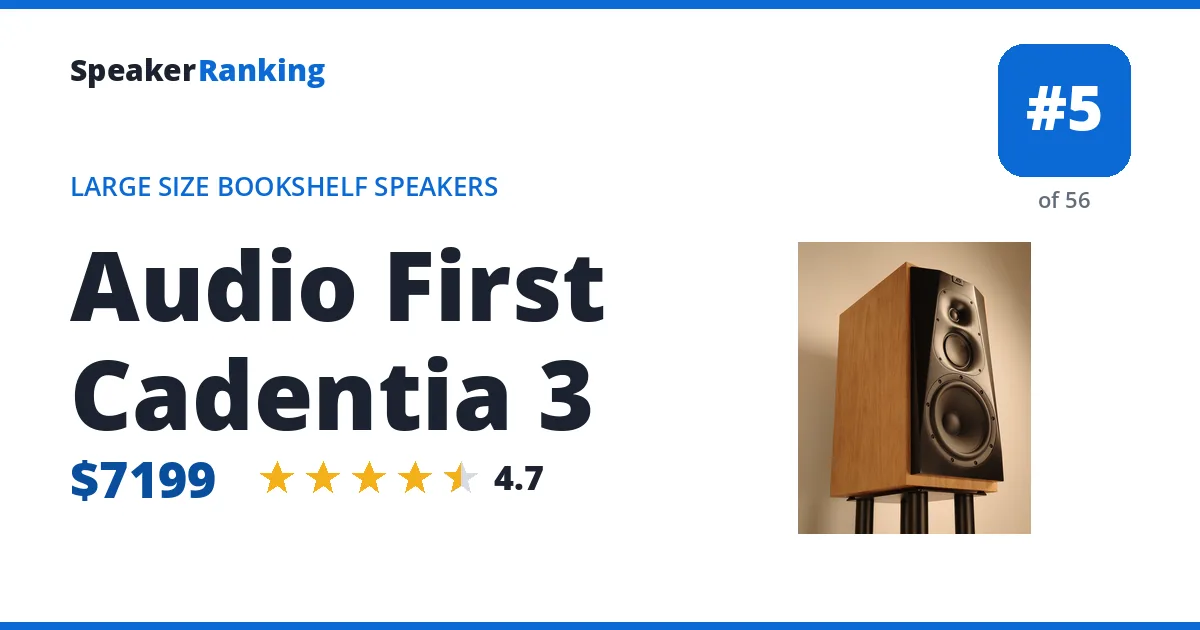
Pros: Near-textbook measurements - excellent on-axis linearity, listening window, and directivity, with only minor deviations. Extremely low distortion and compression, holding steady even at 102dB with barely any loss. Very wide, consistent horizontal dispersion (~70 degrees) gives a big, enveloping soundstage with strong image specificity outside the speaker boundaries. Strong bass extension for a bookshelf (F3 43Hz, F10 26Hz) with a punchy, guttural mid-bass. Measured bass extension of 43Hz (-3dB), with a measured sensitivity of 86.4dB.
Cons: A mild scoop through the upper midrange/lower treble slightly softens the attack of snares, hand claps, and sibilants - fixable with a single-band EQ (2.5kHz, +1dB, Q~1). High-frequency dispersion narrows quickly above about 4kHz, so off-axis listeners lose some air and detail. Very high asking price for a bookshelf-class speaker, and the complete (finished) version has a long lead time; the loaner kit version ships as an unfinished cabinet you assemble and finish yourself.
Full Audio First Cadentia 3 review and specifications →
| Bass Extension (-10dB) | 26Hz (measured, Erin's Audio Corner) |
|---|---|
| Bass Extension (-3dB) | 43Hz (measured, Erin's Audio Corner) |
| Country | United Kingdom (Cambridge) |
| Dimensions | 23.2" x 11.8" x 17" (590 x 300 x 433 mm) |
| Drivers | 1.1" tweeter, 4.5" midrange, 9" woofer |
| Impedance | 4 ohms nominal (3.1 ohms minimum, measured by Erin's Audio Corner) |
| Sensitivity | 86.4dB (2.83V/1m, measured by Erin's Audio Corner) |
| Spinorama Preference Score | 7.38 |
| Spinorama Preference Score with Perfect Sub | 8.74 |
| Weight | 45.9 lbs (20.8 kg) each |
| Woofer Cabinet | 3-way, bass reflex |
- Links
- Reviews, Comparisons and Sound Samples
- Head-to-Head Comparisons
- Audio First Cadentia 3 vs AsciLab C6B
- Audio First Cadentia 3 vs March Audio Sointuva
- Audio First Cadentia 3 vs KEF R3 Meta
- Audio First Cadentia 3 vs KEF Q Concerto Meta
- Audio First Cadentia 3 vs GR-Research NX-Studio
- Audio First Cadentia 3 vs Wharfedale Aura 2
- Audio First Cadentia 3 vs KEF Reference 1 Meta
- Audio First Cadentia 3 vs Perlisten S4b
- See all 45 comparisons
 Buchardt Audio E50: $4600 per pair Buchardt Audio eBay
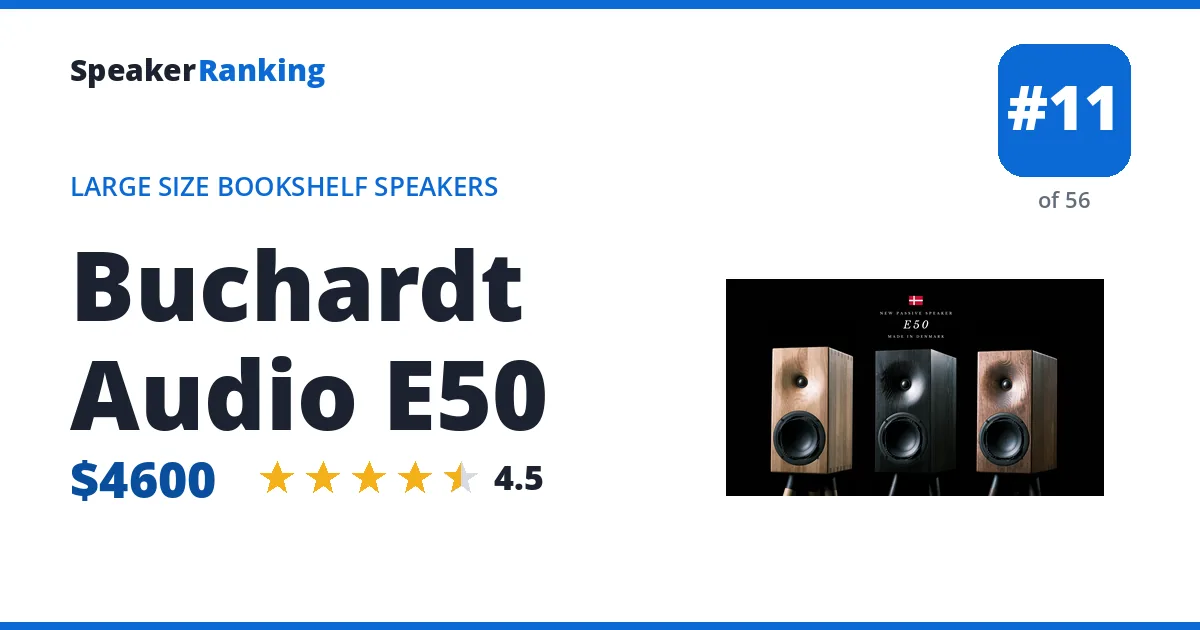
Pros: Exceptional bass extension for a bookshelf - F3 at 40Hz, F10 at 34Hz - with genuinely low-end weight the reviewer kept noticing track after track, not just a single room-boosted note. Mid and lower-midrange are very neutral with no coloration and well-executed baffle-step compensation, so it doesn’t need to sit close to a wall like many bookshelf designs. Low distortion throughout the midrange, controlled ~60-degree horizontal directivity, and a striking driver/waveguide integration that looks genuinely upscale. Measured bass extension of 40Hz (-3dB), with a measured sensitivity of 83.1dB.
Cons: A roughly 3dB dip in the upper midrange/lower treble softens attack and dialogue clarity - the reviewer’s main complaint, and it’s baked into the crossover rather than a directivity artifact, so it’s audible both on and off axis. Sounds too bright pointed directly at the listener; needs about 10-20 degrees of toe-out to tame the treble and slightly smooth (not eliminate) that dip. Below-average sensitivity (measured 83.1dB vs 85dB spec) calls for a beefier amp, and the speaker’s tonal balance is unusually sensitive to amplifier output impedance - a poor tube amp can shift the midrange by up to 2dB.
Full Buchardt Audio E50 review and specifications →
| Bass Extension (-10dB) | 34Hz (measured, Erin's Audio Corner) |
|---|---|
| Bass Extension (-3dB) | 40Hz (measured, Erin's Audio Corner) |
| Country | Denmark |
| Crossover Frequency | 2000Hz |
| Dimensions | 15.6" x 7.5" x 11.2" (395 x 190 x 284 mm) |
| Drivers | 1" Scanspeak dome tweeter with waveguide, 6.5" Purifi extended-stroke woofer, dual 6.5" passive radiators |
| Frequency Response | 36Hz - 30kHz ±3dB (Manufacturer specified) |
| Impedance | 4 ohms nominal |
| Recommended Power | 60W - 200W |
| Sensitivity | 83.1dB (2.83V/1m, measured by Erin's Audio Corner) |
| Spinorama Preference Score | 5.03 |
| Spinorama Preference Score with Perfect Sub | 6.80 |
| Weight | 19 lbs (8.6 kg) each |
| Woofer Cabinet | Passive radiator loaded |
- Links
- Reviews, Comparisons and Sound Samples
- Head-to-Head Comparisons
- Buchardt Audio E50 vs KEF R3
- Buchardt Audio E50 vs MoFi SourcePoint 8
- Buchardt Audio E50 vs Wharfedale Aura 2
- Buchardt Audio E50 vs AsciLab F6Bs
- Buchardt Audio E50 vs KEF Q Concerto Meta
- Buchardt Audio E50 vs Arendal 1528 Monitor 8
- Buchardt Audio E50 vs KEF R3 Meta
- Buchardt Audio E50 vs Ascend Acoustics CMT-340 SE2
- See all 45 comparisons