Short answer: the AsciLab F6B. It ranks #12 of 131 bookshelf speakers by sound quality (rated 4.6/5); the DIYSG HTM-12 v2 ranks #14 (rated 4.5/5).
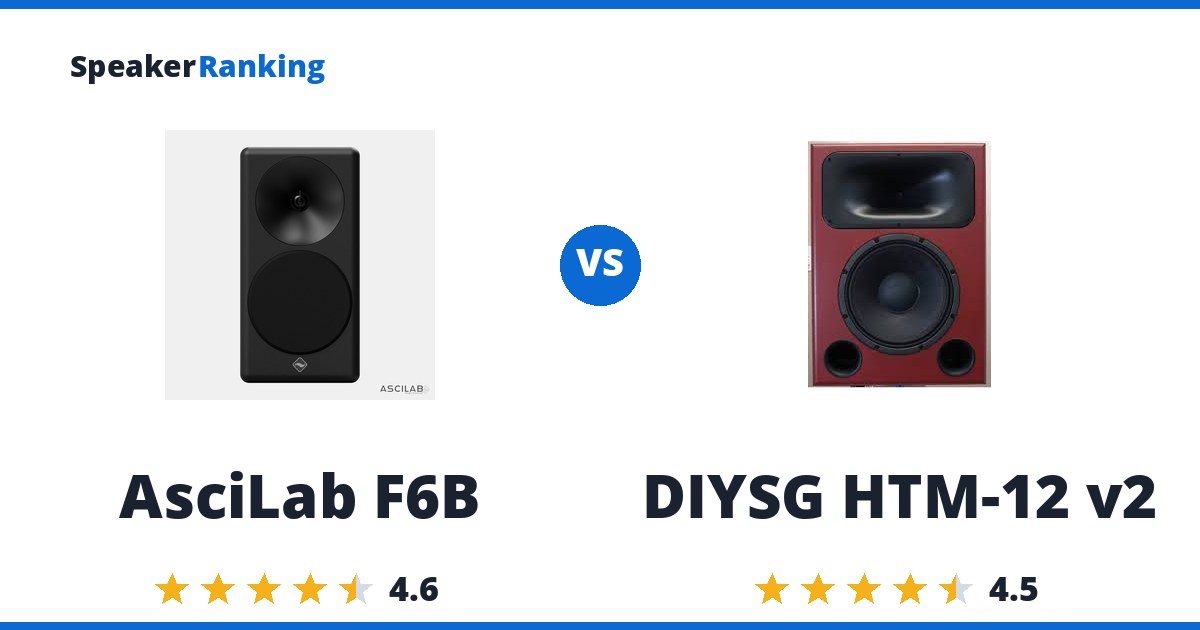
The case for the AsciLab F6B: Called by the reviewer the best sub-$1000 pair of speakers he’s come across to date. The tradeoff: A mild sibilance-inducing lift around 6-8kHz, most noticeable on female vocals, paired with a shallow dip in the upper midrange: correctable with a simple 3-band EQ the reviewer provided.
The case for the DIYSG HTM-12 v2: Purpose-built high-output cinema kit pairing a 12-inch woofer with a compression driver in a large SEOS waveguide. Watch for: Erin measured F3 at approximately 67Hz, the normal efficiency/bass-extension tradeoff of a high-sensitivity 12-inch design, so a subwoofer is mandatory.
Worth knowing: the DIYSG HTM-12 v2 is discontinued, though it still ranks #14 of 131 bookshelf speakers by sound quality, so a used unit beats most of what is still sold new.
Buy the AsciLab F6B. It is rated higher for sound quality than the DIYSG HTM-12 v2.
Still deciding? The full Passive Home rankings cover every ranked option.
Specifications Side By Side
| AsciLab F6B | DIYSG HTM-12 v2 | |
|---|---|---|
| Price | $980 per pair | $920 per pair per kit, Discontinued |
| Ranked | #12 of 131 in Large Size Bookshelf Speakers | #14 of 131 in Large Size Bookshelf Speakers |
| Bass Extension (-10dB) | 38Hz (measured, Erin’s Audio Corner) | 45Hz (measured, Erin’s Audio Corner) |
| Bass Extension (-3dB) | 56Hz (measured, Erin’s Audio Corner) | 67Hz (measured, Erin’s Audio Corner) |
| Dimensions | 15.7” x 8” x 10.4” (400 x 203 x 265 mm) | 25”H x 18”W x 9.5”D (635 x 457.2 x 241.3 mm) |
| Impedance | 4 ohms nominal (3.5 ohms minimum above 80Hz, measured by Erin’s Audio Corner) | AVR-compatible impedance profile (measured, Erin’s Audio Corner) |
| Sensitivity | 85dB (2.83V/1m, measured by Erin’s Audio Corner) | 91dB/2.83V/1m (measured, Erin’s Audio Corner) |
| Drivers | 1” aluminum dome tweeter, 6” fiber cone woofer | 12” woofer; compression driver in SEOS waveguide |
| Weight | 16.5 lbs (7.5 kg) each | 39.9 lbs (18.1 kg) assembled |
| Woofer Cabinet | Passive radiator loaded | ported |
| Crossover Frequency | 1000Hz | - |
| Recommended Power | up to 125W | - |
| Spinorama Preference Score | 6.32 | 3.26 |
| Spinorama Preference Score with Perfect Sub | 8.26 | 5.88 |
| DIY Kit | No | Yes |
Related Speaker Comparisons
More top alternatives to AsciLab F6B:
- KEF R3 Meta vs AsciLab F6B
- KEF Q Concerto Meta vs AsciLab F6B
- ELAC Debut 3.0 DB63 vs AsciLab F6B
- Klipsch RP-600M II vs AsciLab F6B
- AsciLab F6B vs JBL Studio 630
Prices on this page were last checked September 29, 2026 at 3:43 PM UTC. Product prices and availability are accurate as of that date/time and are subject to change; the price and availability shown on Amazon at the time of purchase will apply to the purchase of this product.
As an eBay Partner, we may be compensated if you make a purchase.
The Two Speakers In Full
 AsciLab F6B: $980 per pair Ascilab eBay
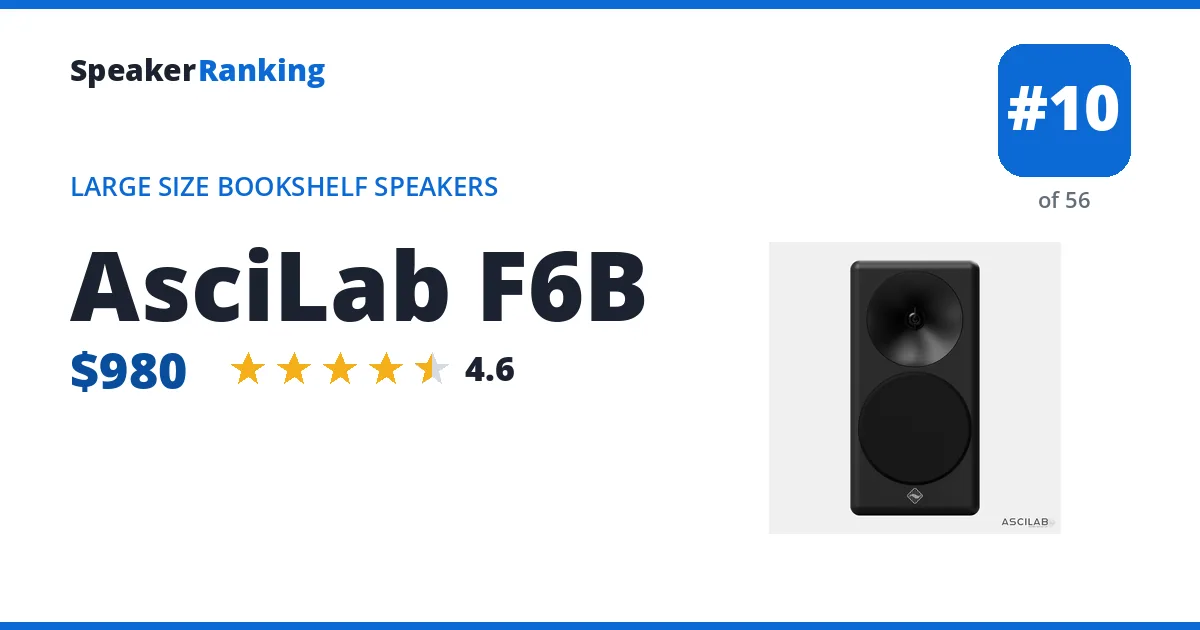
Pros: Called by the reviewer the best sub-$1000 pair of speakers he’s come across to date. Very good on-axis linearity and directivity for the price, with a large waveguide-loaded 1” aluminum dome tweeter that keeps a two-way design well-behaved through the crossover. Nice midbass punch from a slightly undersized enclosure alignment that gives kick drums extra impact. Solid, unfussy tonal balance overall. Measured bass extension of 56Hz (-3dB), with a measured sensitivity of 85dB.
Cons: A mild sibilance-inducing lift around 6-8kHz, most noticeable on female vocals, paired with a shallow dip in the upper midrange: correctable with a simple 3-band EQ the reviewer provided. In-room bass extension is only about 50-60Hz despite a 6” woofer, trading some low-end reach for that extra midbass punch. Compression and graininess creep in at higher volumes (upper 80s to low 90s dB at 10ft), and directivity (~50-60 degrees horizontal) is narrower than the reviewer’s other current favorite, the Audio First Cadentia 3.
Full AsciLab F6B review and specifications →
| Bass Extension (-10dB) | 38Hz (measured, Erin’s Audio Corner) |
|---|---|
| Bass Extension (-3dB) | 56Hz (measured, Erin’s Audio Corner) |
| Crossover Frequency | 1000Hz |
| DIY Kit | No |
| Dimensions | 15.7” x 8” x 10.4” (400 x 203 x 265 mm) |
| Drivers | 1” aluminum dome tweeter, 6” fiber cone woofer |
| Impedance | 4 ohms nominal (3.5 ohms minimum above 80Hz, measured by Erin’s Audio Corner) |
| Recommended Power | up to 125W |
| Sensitivity | 85dB (2.83V/1m, measured by Erin’s Audio Corner) |
| Spinorama Preference Score | 6.32 |
| Spinorama Preference Score with Perfect Sub | 8.26 |
| Weight | 16.5 lbs (7.5 kg) each |
| Woofer Cabinet | Passive radiator loaded |
- Links
- Reviews, Comparisons and Sound Samples
- Head-to-Head Comparisons
 DIYSG HTM-12 v2: $920 per pair per kit Discontinued DIY Sound Group eBay
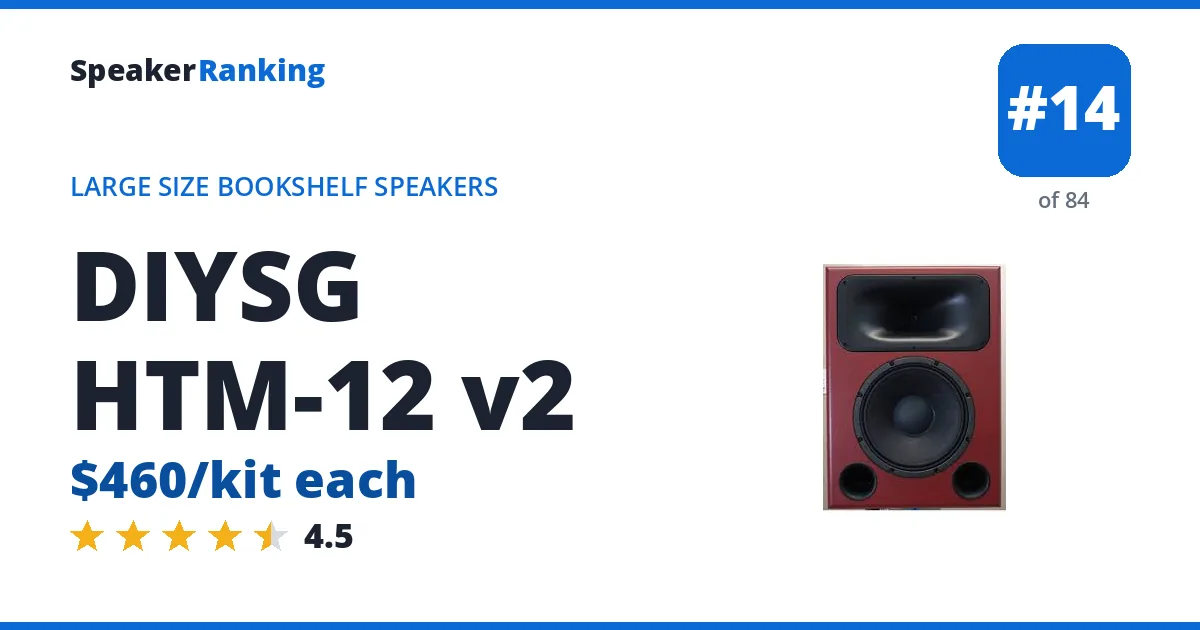
Pros: Purpose-built high-output cinema kit pairing a 12-inch woofer with a compression driver in a large SEOS waveguide. Erin measured 91dB/2.83V/1m sensitivity, extraordinarily low distortion (still below 1% to about 60Hz at 102dB) and only about 0.5dB tweeter compression at the same level. Horizontal directivity is consistent and crossover integration is unusually good, so response corrections remain EQ-friendly. The benign impedance curve can be driven by many capable AVRs. Measured bass extension of 67Hz (-3dB), with a measured sensitivity of 91dB.
Cons: Erin measured F3 at approximately 67Hz, the normal efficiency/bass-extension tradeoff of a high-sensitivity 12-inch design, so a subwoofer is mandatory. A few narrow resonances appear in the response, impedance and decay plots; Erin suggested crossover/component investigation could improve them. Vertical radiation narrows around the crossover, the unfinished kit requires cabinet assembly and finishing, and its broad baffle is visually and physically substantial. Discontinued.
Full DIYSG HTM-12 v2 review and specifications →
| Bass Extension (-10dB) | 45Hz (measured, Erin’s Audio Corner) |
|---|---|
| Bass Extension (-3dB) | 67Hz (measured, Erin’s Audio Corner) |
| DIY Kit | Yes |
| Dimensions | 25”H x 18”W x 9.5”D (635 x 457.2 x 241.3 mm) |
| Drivers | 12” woofer; compression driver in SEOS waveguide |
| Impedance | AVR-compatible impedance profile (measured, Erin’s Audio Corner) |
| Sensitivity | 91dB/2.83V/1m (measured, Erin’s Audio Corner) |
| Spinorama Preference Score | 3.26 |
| Spinorama Preference Score with Perfect Sub | 5.88 |
| Weight | 39.9 lbs (18.1 kg) assembled |
| Woofer Cabinet | ported |
- Links
- Reviews, Comparisons and Sound Samples
- Head-to-Head Comparisons