Short answer: the AsciLab C8C for better sound quality, the Neumann KH 150 for the lower price. The AsciLab C8C ranks #1 of 67 powered bookshelf speakers at $5799. The Neumann KH 150 ranks #8 at $3398, $2401 cheaper.
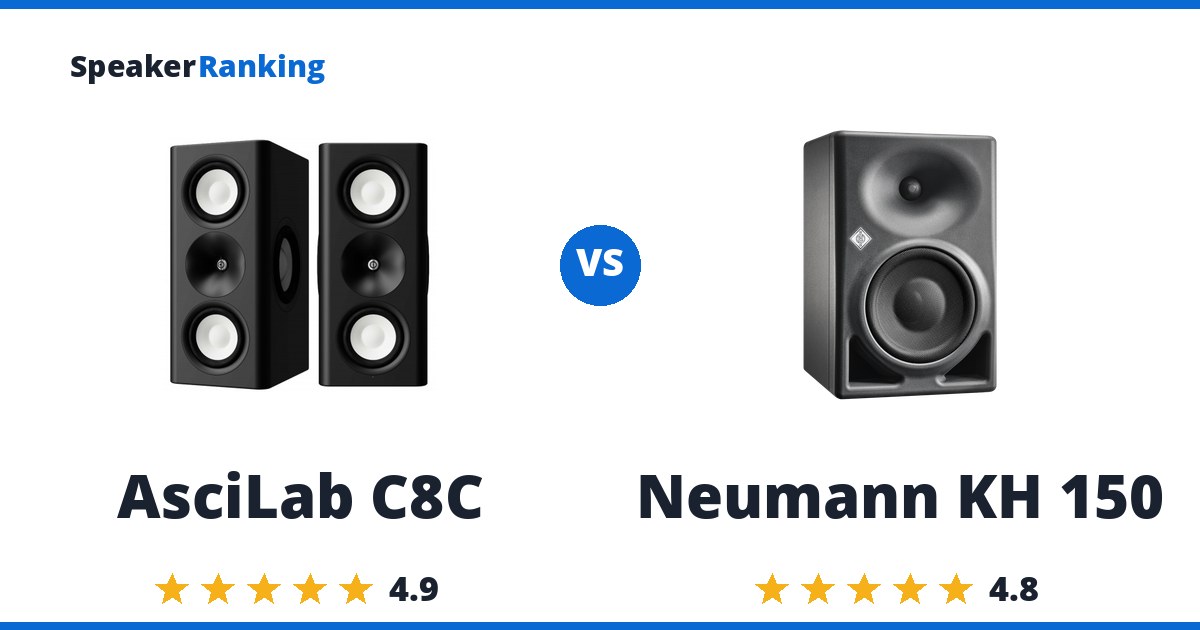
What the AsciLab C8C offers: ASR’s revised measurement combines an 8.02 ideal-subwoofer preference score with a 1.7dB response span from 300Hz to 5kHz, supporting highly even vocal and instrumental balance. Bass reaches 30.8Hz at -3dB and 23.4Hz at -6dB, giving substantial low-end reach without an added subwoofer. Watch for: The result applies to the revised measured configuration; confirm that the speaker’s tuning matches it. Each cabinet weighs about 27.5kg and needs a substantial stand. Deep extension and excellent tonality do not guarantee unlimited bass output or eliminate the need to adjust placement.
What the Neumann KH 150 offers: An exceptionally tight 1.0dB response span from 300Hz to 5kHz supports neutral vocals and instruments. The measured ideal-subwoofer score is 7.58, with -3dB bass extension to 39.6Hz. DSP and optional MA 1 alignment offer useful control over room-related response errors. Watch for: A two-way nearfield monitor cannot match the largest three-way systems for deep-bass output at distance. Keep the tweeter near ear height to avoid crossover-related changes off the vertical axis. MA 1 calibration requires additional equipment, and studio connections are less convenient than a consumer streaming system.
Buy the AsciLab C8C when sound quality outweighs the price for you, and the Neumann KH 150 when the price outweighs sound quality instead.
Still deciding? The full Powered Home rankings cover every ranked option.
Specifications Side By Side
| AsciLab C8C | Neumann KH 150 | |
|---|---|---|
| Price | $6,200 per pair | $3,398 per pair |
| Ranked | #1 of 67 in Large Size Powered Bookshelf Speakers | #8 of 67 in Large Size Powered Bookshelf Speakers |
| Enclosure | sealed | ported |
| Drivers | 1" alumina ceramic dome tweeter with waveguide, 2x 6" alumina ceramic midrange/woofers, 2x 8" side mounted opposed cardioid subwoofers | 1" tweeter, 6.5" woofer |
| Dimensions | 22"H x 10"W x 13.8"D (560 x 254 x 350 mm) | 13.6"H x 8.9"W x 10.7"D (345 x 225 x 273 mm) |
| Weight | 60.6 lbs (27.5 kg) each | 17.6 lbs (8.0 kg) each |
| Amplifier Power | 600W total (100W tweeter, 250W midrange, 250W subwoofer) | 245W total (145W woofer, 100W tweeter, 10% THD+N) |
| Bass Extension (-6dB) | 23.4Hz (measured, Audio Science Review) | - |
| Bass Extension (-3dB) | 30.8Hz (measured, Audio Science Review) | 39.6Hz (measured, Audio Science Review) |
| Bass Extension (-10dB) | 20.5Hz (measured, Audio Science Review) | 34.2Hz (measured, Audio Science Review) |
| Crossover Frequency | 150Hz, 1.2kHz | 1.7kHz |
| Warranty | 2 years | 2 years |
| Country | South Korea | Germany |
| Spinorama Preference Score | 7.25 | 5.84 |
| Spinorama Preference Score with Perfect Sub | 8.02 | 7.58 |
| Frequency Response | - | 39Hz-20.4kHz +/-3dB |
| Maximum SPL | - | 118.7dB @ 1m half space (manufacturer specified) |
Related Speaker Comparisons
How AsciLab C8C compares with other leading options:
- AsciLab C8C vs Mesanovic CDM65
- AsciLab C8C vs Buchardt A10
- AsciLab C8C vs GGNTKT M1
- AsciLab C8C vs Neumann KH 310 A
- AsciLab C8C vs HEDD Type 20 MK2
Prices on this page were last checked September 16, 2026 at 12:41 AM UTC. Product prices and availability are accurate as of that date/time and are subject to change; the price and availability shown on Amazon at the time of purchase will apply to the purchase of this product.
As an eBay Partner, we may be compensated if you make a purchase.
The Two Speakers In Full
 AsciLab C8C: $6,200 per pair Audiophonics eBay
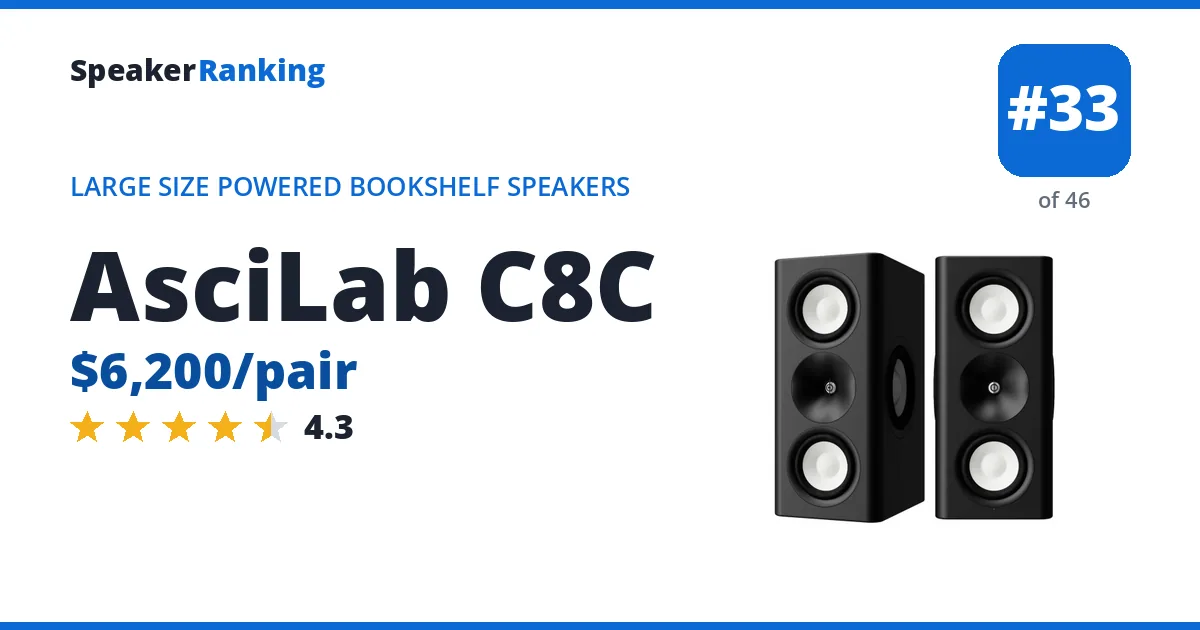
Pros: ASR’s revised measurement combines an 8.02 ideal-subwoofer preference score with a 1.7dB response span from 300Hz to 5kHz, supporting highly even vocal and instrumental balance. Bass reaches 30.8Hz at -3dB and 23.4Hz at -6dB, giving substantial low-end reach without an added subwoofer. Measured bass extension of 30.8Hz (-3dB).
Cons: The result applies to the revised measured configuration; confirm that the speaker’s tuning matches it. Each cabinet weighs about 27.5kg and needs a substantial stand. Deep extension and excellent tonality do not guarantee unlimited bass output or eliminate the need to adjust placement.
Full AsciLab C8C review and specifications →
| Amplifier Power | 600W total (100W tweeter, 250W midrange, 250W subwoofer) |
|---|---|
| Bass Extension (-10dB) | 20.5Hz (measured, Audio Science Review) |
| Bass Extension (-3dB) | 30.8Hz (measured, Audio Science Review) |
| Bass Extension (-6dB) | 23.4Hz (measured, Audio Science Review) |
| Country | South Korea |
| Crossover Frequency | 150Hz, 1.2kHz |
| Dimensions | 22"H x 10"W x 13.8"D (560 x 254 x 350 mm) |
| Drivers | 1" alumina ceramic dome tweeter with waveguide, 2x 6" alumina ceramic midrange/woofers, 2x 8" side mounted opposed cardioid subwoofers |
| Enclosure | sealed |
| Spinorama Preference Score | 7.25 |
| Spinorama Preference Score with Perfect Sub | 8.02 |
| Warranty | 2 years |
| Weight | 60.6 lbs (27.5 kg) each |
- Links
- Reviews, Comparisons and Sound Samples
- Head-to-Head Comparisons
 Neumann KH 150: $3,398 per pair B&H Photo Video eBay
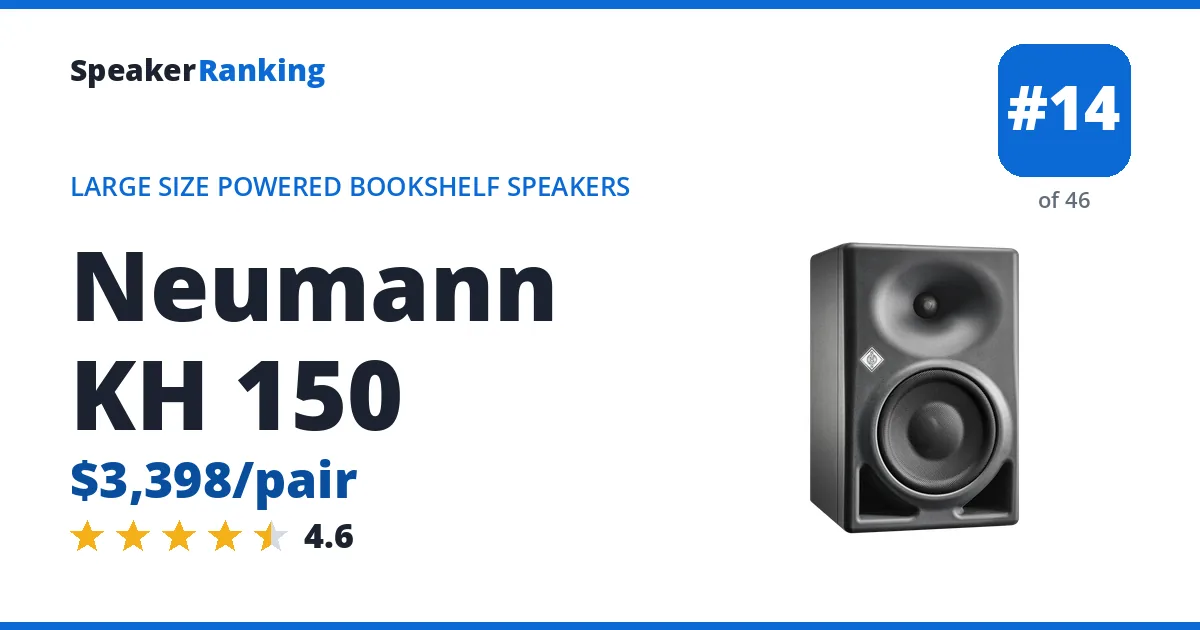
Pros: An exceptionally tight 1.0dB response span from 300Hz to 5kHz supports neutral vocals and instruments. The measured ideal-subwoofer score is 7.58, with -3dB bass extension to 39.6Hz. DSP and optional MA 1 alignment offer useful control over room-related response errors. Measured bass extension of 39.6Hz (-3dB).
Cons: A two-way nearfield monitor cannot match the largest three-way systems for deep-bass output at distance. Keep the tweeter near ear height to avoid crossover-related changes off the vertical axis. MA 1 calibration requires additional equipment, and studio connections are less convenient than a consumer streaming system.
Full Neumann KH 150 review and specifications →
| Amplifier Power | 245W total (145W woofer, 100W tweeter, 10% THD+N) |
|---|---|
| Bass Extension (-10dB) | 34.2Hz (measured, Audio Science Review) |
| Bass Extension (-3dB) | 39.6Hz (measured, Audio Science Review) |
| Country | Germany |
| Crossover Frequency | 1.7kHz |
| Dimensions | 13.6"H x 8.9"W x 10.7"D (345 x 225 x 273 mm) |
| Drivers | 1" tweeter, 6.5" woofer |
| Enclosure | ported |
| Frequency Response | 39Hz-20.4kHz +/-3dB |
| Maximum SPL | 118.7dB @ 1m half space (manufacturer specified) |
| Spinorama Preference Score | 5.84 |
| Spinorama Preference Score with Perfect Sub | 7.58 |
| Warranty | 2 years |
| Weight | 17.6 lbs (8.0 kg) each |
- Links
- Reviews, Comparisons and Sound Samples
- Head-to-Head Comparisons