Short answer: the AsciLab C6B on measured sound quality, the SVS Prime Bookshelf on price. The AsciLab C6B ranks #7 of 130 bookshelf speakers at $1145. The SVS Prime Bookshelf ranks #88 at $699, $446 cheaper.
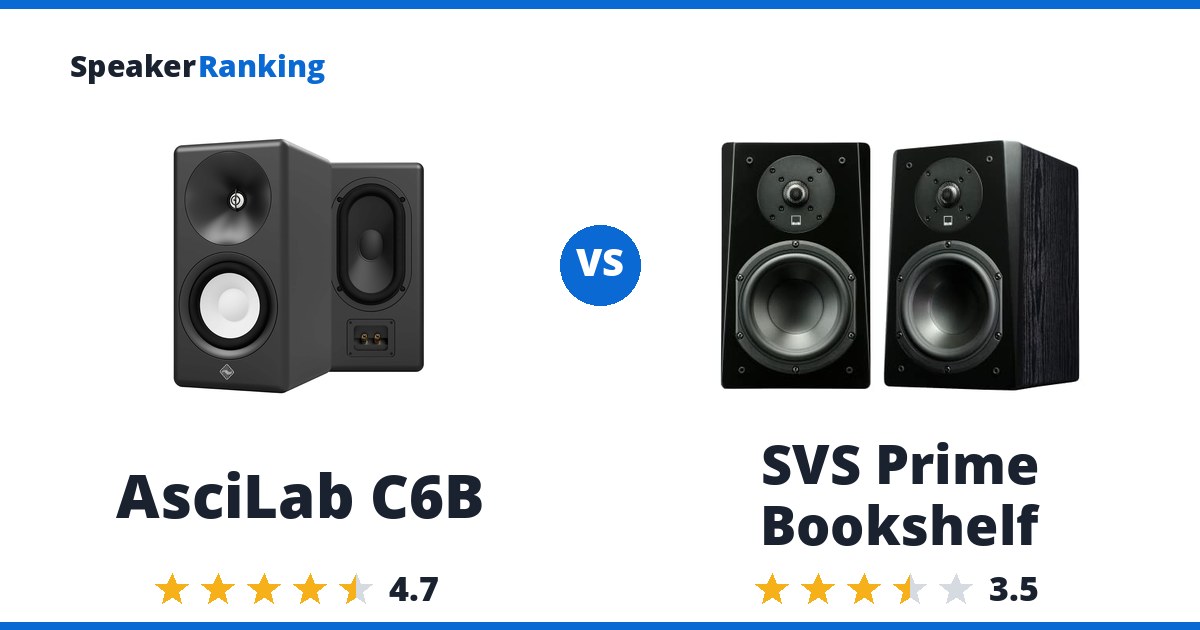
What the AsciLab C6B offers: Two-way design pairing a 1” aluminum ceramic dome tweeter on a large waveguide with a 6” aluminum ceramic cone woofer, crossed over at 1.1kHz, plus a rear passive radiator. Unusual trait: horizontal radiation actually widens at higher frequencies instead of narrowing like most two-way designs, which keeps image focus and soundstage depth consistent whether you toe the speakers in or out (5-10° off-axis was the sweet spot in testing). Vertical radiation also stays wide straight through the 2kHz crossover region, so the sound doesn’t collapse when standing up - unusual at this price. CA2034 measurements show strong on-axis linearity, listening window, early reflections, and directivity. Midrange and tweeter distortion stay very low even at 96dB, holding up against a $5,900 Arendal speaker in that regard despite roughly a 5x price gap. At $935 (about $1,135 shipped to the US), the reviewer calls it the best-value bookshelf speaker he’s tested, rivaling speakers 2-5x the price. Watch for: Bass rolls off around 50Hz in-room (F3 54Hz, F10 35Hz), so a subwoofer is needed for real extension below that. Low-frequency harmonic distortion increases substantially at 96dB versus 86dB, though it’s second-order and less audible than it looks on paper. Minimum impedance dips to 2.6 ohms (EPDR as low as 1.2 ohms), so it wants an amplifier comfortable driving 4-ohm loads, ideally 100W or more. At 102dB, compression noticeably eats into midrange, bass, and some treble output. Shipping to the US adds roughly $200 on top of the $935 price. Against the reviewer’s reference Audiofirst Fidelia at a similar price, has slightly less lower-midrange body (about 1dB difference) and a smaller perceived soundstage size.
What the SVS Prime Bookshelf offers: Reasonable sensitivity for the price at about 87dB, and the 6.5” woofer sits in its own dedicated sealed sub-compartment inside the cabinet for cleaner midrange/bass separation. Overall response stays within about ±3dB from 80Hz-16kHz, which the reviewer calls reasonable for the price point. Wide, consistent horizontal radiation. Toeing the speakers 30 degrees off-axis smooths the in-room response noticeably if the on-axis tonal balance isn’t to your taste. Watch for: A scooped mid-range paired with a boosted upper mid-range creates an audibly uneven tonal balance, and there’s an additional dip in the treble around 4-5kHz that reads as slightly tinny relative to the recessed mid-range. Measured minimum impedance dips below 4 ohms (EPDR even lower), so an 8-ohm-only amplifier or AVR may struggle - a 4-ohm-stable amp or separate amplification is recommended. Bass extension is modest (F3 72Hz, F10 49Hz measured) - SVS clearly designed this to be paired with one of their subwoofers rather than to stand fully alone. Compared directly against its pricier sibling, the SVS Ultra Bookshelf, in the same review, the reviewer found the Ultra noticeably more tonally neutral.
Buy the AsciLab C6B when sound quality outweighs the price for you, and the SVS Prime Bookshelf when the price outweighs sound quality instead.
Still deciding? The full Passive Home rankings cover every ranked option.
Specifications Side By Side
| AsciLab C6B | SVS Prime Bookshelf | |
|---|---|---|
| Price | $1145 per pair | $699.00 per pair |
| Ranked | #7 of 130 in Large Size Bookshelf Speakers | #88 of 130 in Large Size Bookshelf Speakers |
| Bass Extension (-10dB) | 35Hz (measured, Erin's Audio Corner) | 49Hz (measured, Erin's Audio Corner) |
| Bass Extension (-3dB) | 54Hz (measured, Erin's Audio Corner) | 72Hz (measured, Erin's Audio Corner) |
| Dimensions | 15.7"H x 8"W x 10.4"D (398.8 x 203.2 x 264.2 mm) | - |
| Impedance | 4 ohms nominal, 2.6 ohms minimum (measured, Erin's Audio Corner) | 8 ohms nominal, 3.9 ohms minimum (measured, Erin's Audio Corner) |
| Sensitivity | 85.6dB (measured, Erin's Audio Corner) | 87dB (measured average, Erin's Audio Corner) |
| Drivers | 6" Aluminium Ceramic Cone with cast Aluminium Chassis woofer, 1" Aluminium Ceramic Dome tweeter | 6.5" polypropylene cone woofer with aluminum shorting ring (sealed sub-compartment), 1" aluminum dome tweeter |
| Weight | 18.5 lbs (8.4 kg) each | 15.5 lbs (7.03 kg) each |
| Woofer Cabinet | passive radiator | - |
| Spinorama Preference Score | 5.66 | 4.26 |
| Spinorama Preference Score with Perfect Sub | 7.60 | 6.88 |
| Frequency Response | - | 48Hz - 25kHz ±3dB (manufacturer specified) |
Related Speaker Comparisons
How AsciLab C6B compares with other leading options:
- AsciLab C6B vs Perlisten S4b
- AsciLab C6B vs KEF Reference 1 Meta
- AsciLab C6B vs GR-Research NX-Studio
- AsciLab C6B vs March Audio Sointuva AWG
- AsciLab C6B vs Audio First Cadentia 3
Prices on this page were last checked September 16, 2026 at 12:41 AM UTC. Product prices and availability are accurate as of that date/time and are subject to change; the price and availability shown on Amazon at the time of purchase will apply to the purchase of this product.
As an eBay Partner, we may be compensated if you make a purchase.
The Two Speakers In Full
 AsciLab C6B: $1145 per pair Ascilab eBay
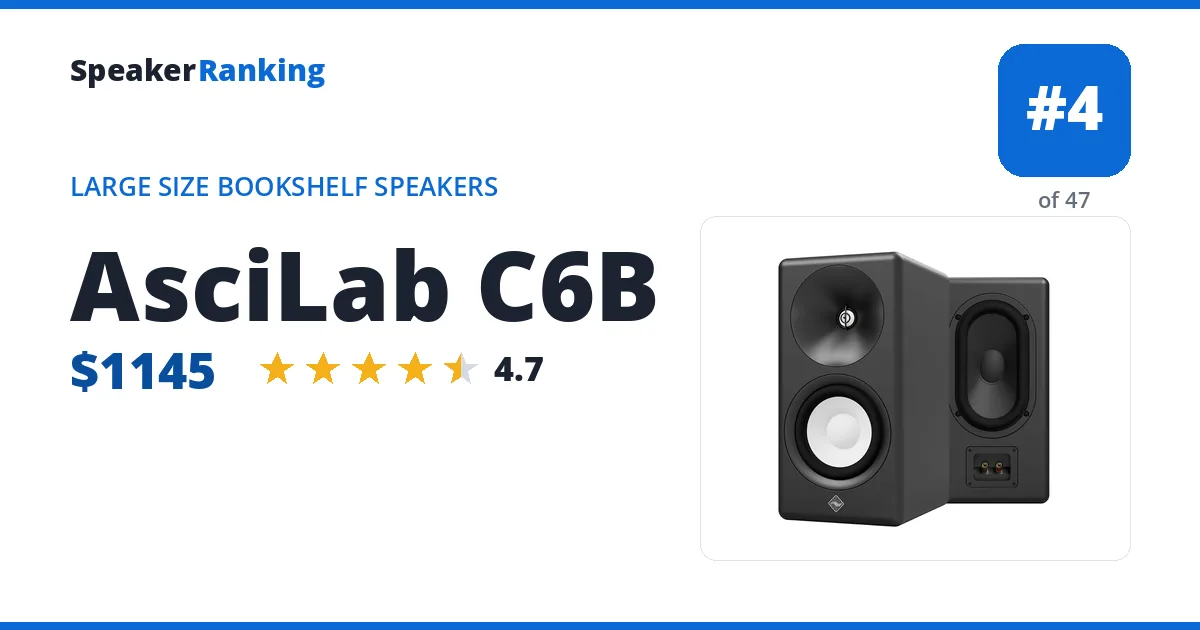
Pros: Two-way design pairing a 1” aluminum ceramic dome tweeter on a large waveguide with a 6” aluminum ceramic cone woofer, crossed over at 1.1kHz, plus a rear passive radiator. Unusual trait: horizontal radiation actually widens at higher frequencies instead of narrowing like most two-way designs, which keeps image focus and soundstage depth consistent whether you toe the speakers in or out (5-10° off-axis was the sweet spot in testing). Vertical radiation also stays wide straight through the 2kHz crossover region, so the sound doesn’t collapse when standing up - unusual at this price. CA2034 measurements show strong on-axis linearity, listening window, early reflections, and directivity. Midrange and tweeter distortion stay very low even at 96dB, holding up against a $5,900 Arendal speaker in that regard despite roughly a 5x price gap. At $935 (about $1,135 shipped to the US), the reviewer calls it the best-value bookshelf speaker he’s tested, rivaling speakers 2-5x the price. Measured bass extension of 54Hz (-3dB), with a measured sensitivity of 85.6dB.
Cons: Bass rolls off around 50Hz in-room (F3 54Hz, F10 35Hz), so a subwoofer is needed for real extension below that. Low-frequency harmonic distortion increases substantially at 96dB versus 86dB, though it’s second-order and less audible than it looks on paper. Minimum impedance dips to 2.6 ohms (EPDR as low as 1.2 ohms), so it wants an amplifier comfortable driving 4-ohm loads, ideally 100W or more. At 102dB, compression noticeably eats into midrange, bass, and some treble output. Shipping to the US adds roughly $200 on top of the $935 price. Against the reviewer’s reference Audiofirst Fidelia at a similar price, has slightly less lower-midrange body (about 1dB difference) and a smaller perceived soundstage size.
Full AsciLab C6B review and specifications →
| Bass Extension (-10dB) | 35Hz (measured, Erin's Audio Corner) |
|---|---|
| Bass Extension (-3dB) | 54Hz (measured, Erin's Audio Corner) |
| Dimensions | 15.7"H x 8"W x 10.4"D (398.8 x 203.2 x 264.2 mm) |
| Drivers | 6" Aluminium Ceramic Cone with cast Aluminium Chassis woofer, 1" Aluminium Ceramic Dome tweeter |
| Impedance | 4 ohms nominal, 2.6 ohms minimum (measured, Erin's Audio Corner) |
| Sensitivity | 85.6dB (measured, Erin's Audio Corner) |
| Spinorama Preference Score | 5.66 |
| Spinorama Preference Score with Perfect Sub | 7.60 |
| Weight | 18.5 lbs (8.4 kg) each |
| Woofer Cabinet | passive radiator |
- Links
- Reviews, Comparisons and Sound Samples
- Head-to-Head Comparisons
 SVS Prime Bookshelf: $699.00 per pair Amazon eBay
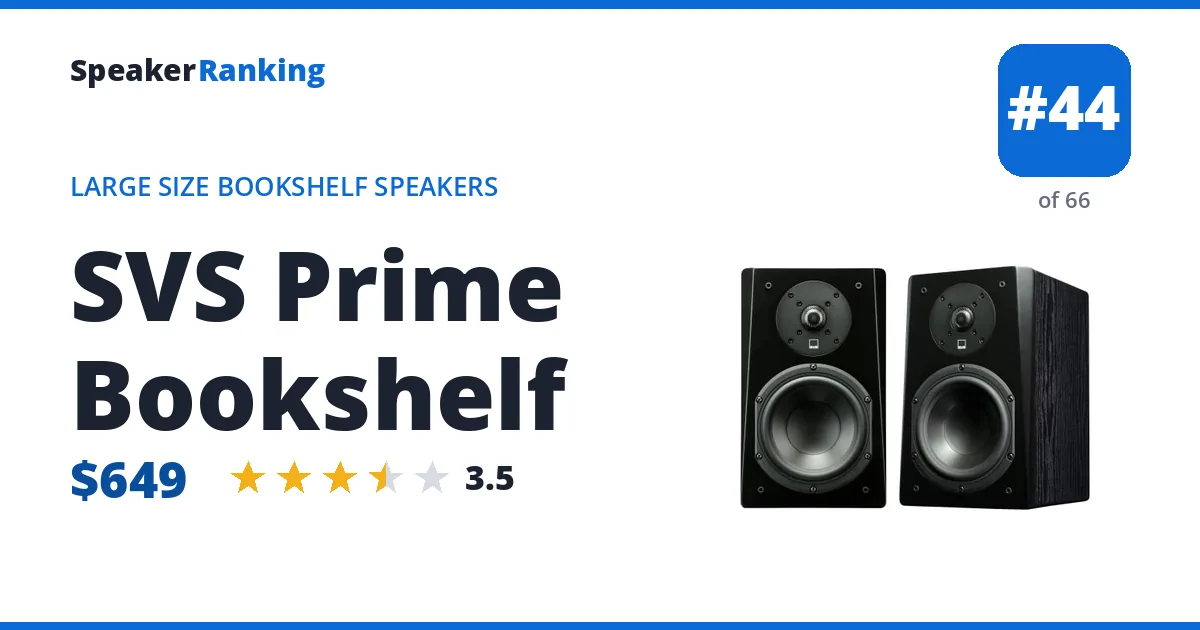
Pros: Reasonable sensitivity for the price at about 87dB, and the 6.5” woofer sits in its own dedicated sealed sub-compartment inside the cabinet for cleaner midrange/bass separation. Overall response stays within about ±3dB from 80Hz-16kHz, which the reviewer calls reasonable for the price point. Wide, consistent horizontal radiation. Toeing the speakers 30 degrees off-axis smooths the in-room response noticeably if the on-axis tonal balance isn’t to your taste. Measured bass extension of 72Hz (-3dB), with a measured sensitivity of 87dB.
Cons: A scooped mid-range paired with a boosted upper mid-range creates an audibly uneven tonal balance, and there’s an additional dip in the treble around 4-5kHz that reads as slightly tinny relative to the recessed mid-range. Measured minimum impedance dips below 4 ohms (EPDR even lower), so an 8-ohm-only amplifier or AVR may struggle - a 4-ohm-stable amp or separate amplification is recommended. Bass extension is modest (F3 72Hz, F10 49Hz measured) - SVS clearly designed this to be paired with one of their subwoofers rather than to stand fully alone. Compared directly against its pricier sibling, the SVS Ultra Bookshelf, in the same review, the reviewer found the Ultra noticeably more tonally neutral.
Full SVS Prime Bookshelf review and specifications →
| Bass Extension (-10dB) | 49Hz (measured, Erin's Audio Corner) |
|---|---|
| Bass Extension (-3dB) | 72Hz (measured, Erin's Audio Corner) |
| Drivers | 6.5" polypropylene cone woofer with aluminum shorting ring (sealed sub-compartment), 1" aluminum dome tweeter |
| Frequency Response | 48Hz - 25kHz ±3dB (manufacturer specified) |
| Impedance | 8 ohms nominal, 3.9 ohms minimum (measured, Erin's Audio Corner) |
| Sensitivity | 87dB (measured average, Erin's Audio Corner) |
| Spinorama Preference Score | 4.26 |
| Spinorama Preference Score with Perfect Sub | 6.88 |
| Weight | 15.5 lbs (7.03 kg) each |
- Links
- Reviews, Comparisons and Sound Samples
- Head-to-Head Comparisons
- SVS Prime Bookshelf vs KEF Q3 Meta
- SVS Prime Bookshelf vs ELAC Debut 2.0 B6.2
- SVS Prime Bookshelf vs Polk Monitor XT20
- SVS Prime Bookshelf vs Dynaudio Special Forty
- SVS Prime Bookshelf vs Sonus Faber Lumina II
- SVS Prime Bookshelf vs Infinity IL10
- SVS Prime Bookshelf vs XTZ Spirit 4
- SVS Prime Bookshelf vs Focal Aria 906
- See all 55 comparisons