Short answer: the AsciLab C6B for a more neutral top end, the Polk Monitor XT20 if the budget rules. The XT20 pairs a 1” tweeter with a 6.5” woofer, but its treble is notably bright, sitting roughly 1-5dB above the midrange depending on frequency, a trait shared across the whole Polk XT line. The C6B costs $1145 versus $279, and its 1” aluminum ceramic dome and 6” ceramic cone woofer roll off around 50Hz in-room.
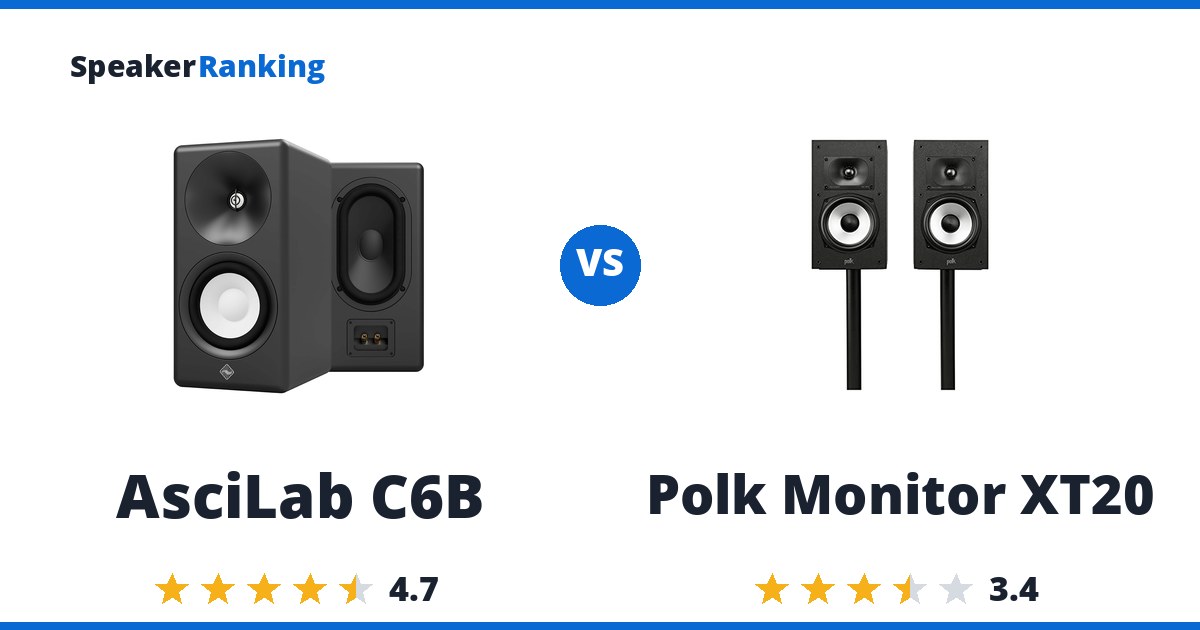
On the AsciLab C6B side: Two-way design pairing a 1” aluminum ceramic dome tweeter on a large waveguide with a 6” aluminum ceramic cone woofer. Set against that: Bass rolls off around 50Hz in-room (F3 54Hz, F10 35Hz), so a subwoofer is needed for real extension below that.
The case for the Polk Monitor XT20: Two-way bookshelf design with a 1” tweeter and 6.5” woofer. The tradeoff: Notably bright treble, elevated roughly 1-5dB above the midrange depending on frequency - a characteristic shared across the whole Polk XT.
Buy the AsciLab C6B if sound quality is the priority over the price, or the Polk Monitor XT20 if the price is the priority over sound quality.
Want more options? Browse the full Passive Home rankings.
Specifications Side By Side
| AsciLab C6B | Polk Monitor XT20 | |
|---|---|---|
| Price | $1145 per pair | $279.00 per pair |
| Ranked | #7 of 130 in Large Size Bookshelf Speakers | #90 of 130 in Large Size Bookshelf Speakers |
| Bass Extension (-10dB) | 35Hz (measured, Erin's Audio Corner) | 50Hz (measured, Erin's Audio Corner) |
| Bass Extension (-3dB) | 54Hz (measured, Erin's Audio Corner) | 75Hz (measured, Erin's Audio Corner) |
| Dimensions | 15.7"H x 8"W x 10.4"D (398.8 x 203.2 x 264.2 mm) | 13"H x 7.5"W x 11"D (330.2 x 190.5 x 279.4 mm) |
| Impedance | 4 ohms nominal, 2.6 ohms minimum (measured, Erin's Audio Corner) | 8 ohms nominal (measured, Erin's Audio Corner) |
| Sensitivity | 85.6dB (measured, Erin's Audio Corner) | 86dB (measured by Erin's Audio Corner; 87dB manufacturer specified) |
| Drivers | 6" Aluminium Ceramic Cone with cast Aluminium Chassis woofer, 1" Aluminium Ceramic Dome tweeter | 6.5" bilaminate paper cone woofer, 1" Terylene dome tweeter |
| Weight | 18.5 lbs (8.4 kg) each | 11.9 lbs (5.4 kg) each |
| Woofer Cabinet | passive radiator | ported |
| Spinorama Preference Score | 5.66 | 3.79 |
| Spinorama Preference Score with Perfect Sub | 7.60 | 6.16 |
| DIY Kit | No | No |
Related Speaker Comparisons
How AsciLab C6B compares with other leading options:
- AsciLab C6B vs Perlisten S4b
- AsciLab C6B vs KEF Reference 1 Meta
- AsciLab C6B vs GR-Research NX-Studio
- AsciLab C6B vs March Audio Sointuva AWG
- AsciLab C6B vs Audio First Cadentia 3
Prices on this page were last checked September 23, 2026 at 11:24 PM UTC. Product prices and availability are accurate as of that date/time and are subject to change; the price and availability shown on Amazon at the time of purchase will apply to the purchase of this product.
As an eBay Partner, we may be compensated if you make a purchase.
The Two Speakers In Full
 AsciLab C6B: $1145 per pair Ascilab eBay
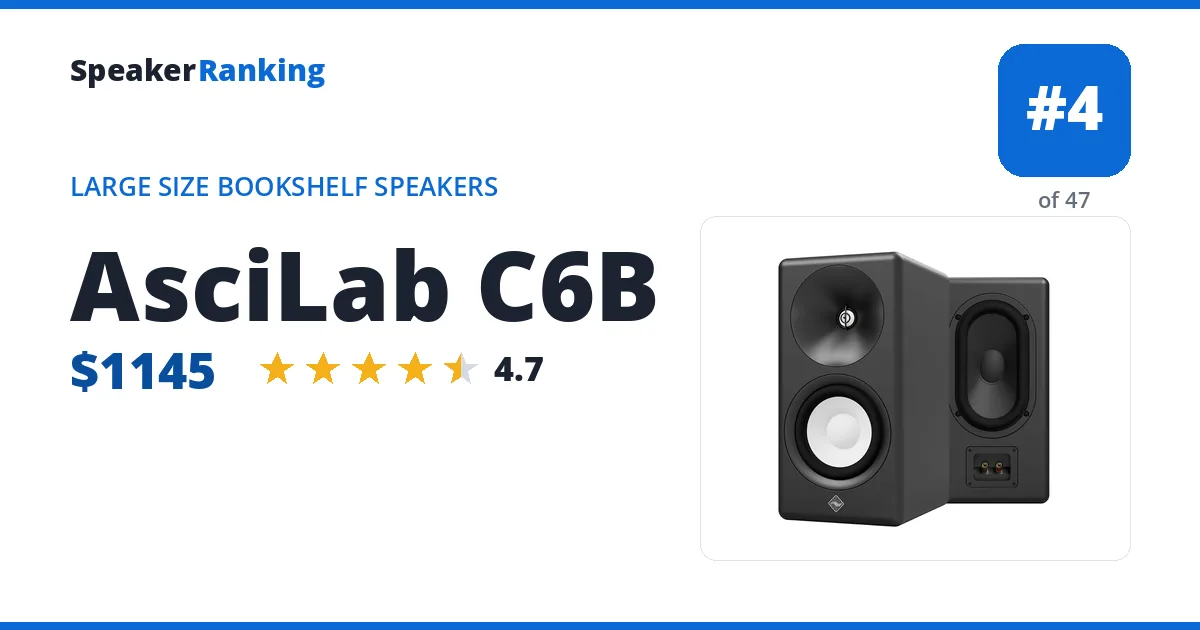
Pros: Two-way design pairing a 1” aluminum ceramic dome tweeter on a large waveguide with a 6” aluminum ceramic cone woofer, crossed over at 1.1kHz, plus a rear passive radiator. Unusual trait: horizontal radiation actually widens at higher frequencies instead of narrowing like most two-way designs, which keeps image focus and soundstage depth consistent whether you toe the speakers in or out (5-10° off-axis was the sweet spot in testing). Vertical radiation also stays wide straight through the 2kHz crossover region, so the sound doesn’t collapse when standing up - unusual at this price. CA2034 measurements show strong on-axis linearity, listening window, early reflections, and directivity. Midrange and tweeter distortion stay very low even at 96dB, holding up against a $5,900 Arendal speaker in that regard despite roughly a 5x price gap. At $935 (about $1,135 shipped to the US), the reviewer calls it the best-value bookshelf speaker he’s tested, rivaling speakers 2-5x the price. Measured bass extension of 54Hz (-3dB), with a measured sensitivity of 85.6dB.
Cons: Bass rolls off around 50Hz in-room (F3 54Hz, F10 35Hz), so a subwoofer is needed for real extension below that. Low-frequency harmonic distortion increases substantially at 96dB versus 86dB, though it’s second-order and less audible than it looks on paper. Minimum impedance dips to 2.6 ohms (EPDR as low as 1.2 ohms), so it wants an amplifier comfortable driving 4-ohm loads, ideally 100W or more. At 102dB, compression noticeably eats into midrange, bass, and some treble output. Shipping to the US adds roughly $200 on top of the $935 price. Against the reviewer’s reference Audiofirst Fidelia at a similar price, has slightly less lower-midrange body (about 1dB difference) and a smaller perceived soundstage size.
Full AsciLab C6B review and specifications →
| Bass Extension (-10dB) | 35Hz (measured, Erin's Audio Corner) |
|---|---|
| Bass Extension (-3dB) | 54Hz (measured, Erin's Audio Corner) |
| DIY Kit | No |
| Dimensions | 15.7"H x 8"W x 10.4"D (398.8 x 203.2 x 264.2 mm) |
| Drivers | 6" Aluminium Ceramic Cone with cast Aluminium Chassis woofer, 1" Aluminium Ceramic Dome tweeter |
| Impedance | 4 ohms nominal, 2.6 ohms minimum (measured, Erin's Audio Corner) |
| Sensitivity | 85.6dB (measured, Erin's Audio Corner) |
| Spinorama Preference Score | 5.66 |
| Spinorama Preference Score with Perfect Sub | 7.60 |
| Weight | 18.5 lbs (8.4 kg) each |
| Woofer Cabinet | passive radiator |
- Links
- Reviews, Comparisons and Sound Samples
- Head-to-Head Comparisons
 Polk Monitor XT20: $279.00 per pair Amazon Crutchfield eBay
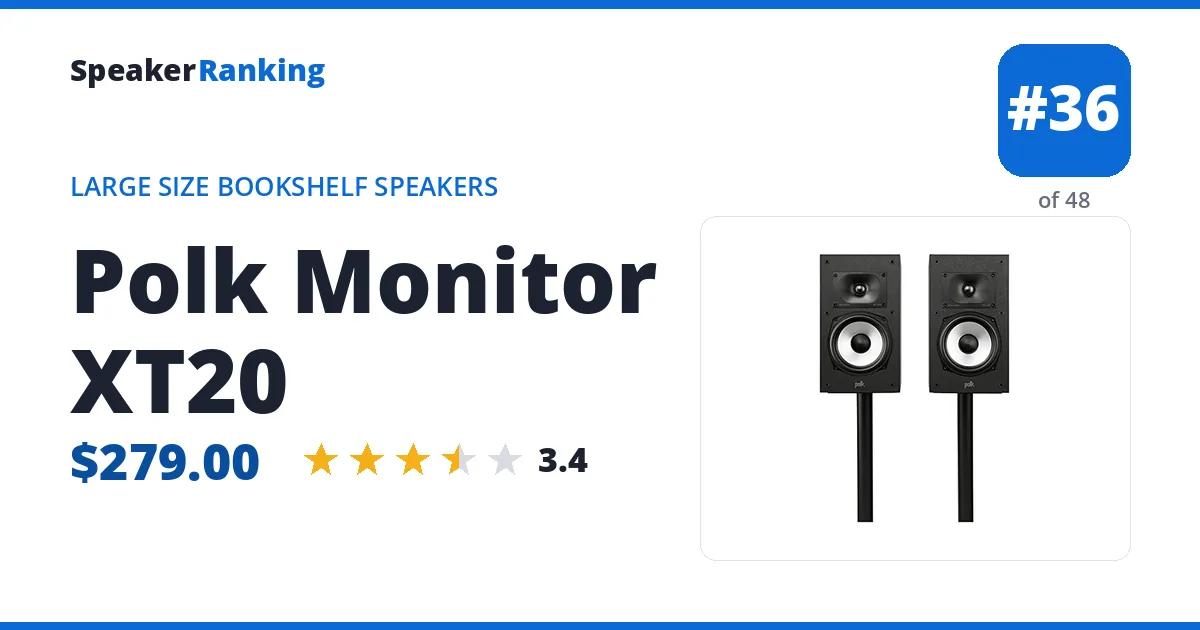
Pros: Two-way bookshelf design with a 1” tweeter and 6.5” woofer, part of Polk’s budget-friendly XT lineup (spanning roughly $200-700 across the series). Measures more linear and has fewer/smaller cabinet resonances than its smaller sibling, the XT15, making it - by the reviewer’s own assessment - probably the better of the two based on data alone. Reasonably good bass output for the price and size, with an F3 of 63Hz. Horizontal radiation of about ±50° gives a respectable, enjoyable soundstage width. Takes well to EQ correction - the early-reflections directivity trend is decently linear, meaning tonal adjustments can meaningfully improve the sound. Provides usable, respectable volume when paired with a subwoofer crossover, even though it isn’t intended to play extremely loud on its own. Measured bass extension of 75Hz (-3dB), with a measured sensitivity of 86dB.
Cons: Notably bright treble, elevated roughly 1-5dB above the midrange depending on frequency - a characteristic shared across the whole Polk XT lineup, requiring either EQ or toe-out to tame. Small resonances appear around 300Hz and 800Hz, with some of that energy leaking from the port area. Vertical listening window is narrow - best kept close to the tweeter axis, with only a couple of degrees of tolerance above or below before the sound changes. Still needs a subwoofer for real low-end extension despite the decent F3. Overall linearity isn’t state-of-the-art flat, and while the reviewer found it pleasant, some artificial brightness remains even after basic EQ correction in the crossover region.
Full Polk Monitor XT20 review and specifications →
| Bass Extension (-10dB) | 50Hz (measured, Erin's Audio Corner) |
|---|---|
| Bass Extension (-3dB) | 75Hz (measured, Erin's Audio Corner) |
| DIY Kit | No |
| Dimensions | 13"H x 7.5"W x 11"D (330.2 x 190.5 x 279.4 mm) |
| Drivers | 6.5" bilaminate paper cone woofer, 1" Terylene dome tweeter |
| Impedance | 8 ohms nominal (measured, Erin's Audio Corner) |
| Sensitivity | 86dB (measured by Erin's Audio Corner; 87dB manufacturer specified) |
| Spinorama Preference Score | 3.79 |
| Spinorama Preference Score with Perfect Sub | 6.16 |
| Weight | 11.9 lbs (5.4 kg) each |
| Woofer Cabinet | ported |
- Links
- Reviews, Comparisons and Sound Samples
- Erin’s Audio Corner: Polk’s new budget XT Speakers. Reviewed! More from Erin’s Audio Corner →
- Erin’s Audio Corner Website Polk Monitor XT20
- Erin’s Audio Corner: 10 Great (and Terrible) Speakers Under $300!
- Erin’s Audio Corner: Budget Stereo Systems You Will Love
- Erin’s Audio Corner Measurements (spinorama.org)
- Head-to-Head Comparisons
- Polk Monitor XT20 vs KEF Q3 Meta
- Polk Monitor XT20 vs Sonus Faber Lumina II
- Polk Monitor XT20 vs SVS Prime Bookshelf
- Polk Monitor XT20 vs ELAC Debut 2.0 B6.2
- Polk Monitor XT20 vs Focal Aria 906
- Polk Monitor XT20 vs Revel Performa M22
- Polk Monitor XT20 vs Dynaudio Special Forty
- Polk Monitor XT20 vs Infinity IL10
- See all 39 comparisons