Short answer: the AsciLab C6B on value, the MoFi SourcePoint 10 for directivity. The Andrew Jones-designed SourcePoint 10 concentric driver delivers best-in-class sound power and early-reflections directivity, but like virtually all coincident designs it sounds notably bright pointed directly on-axis due to a deliberate treble lift. At $1145 versus $3795, the C6B is far cheaper, and its bass rolls off around 50Hz in-room.
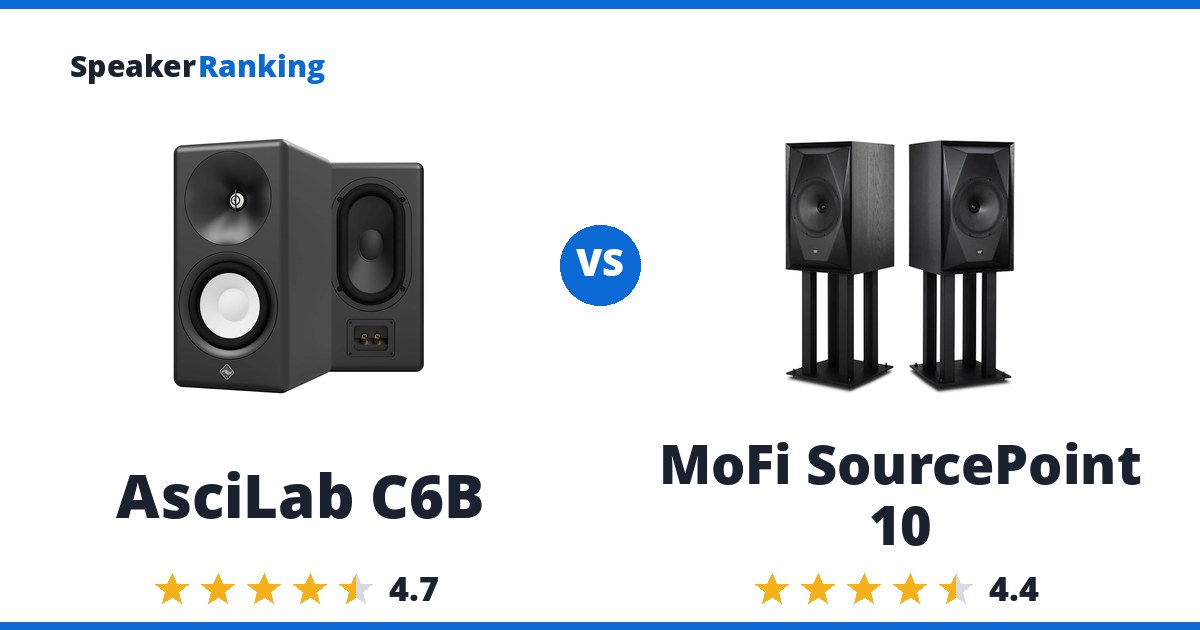
What the AsciLab C6B gets right: Two-way design pairing a 1” aluminum ceramic dome tweeter on a large waveguide with a 6” aluminum ceramic cone woofer. The catch: Bass rolls off around 50Hz in-room (F3 54Hz, F10 35Hz), so a subwoofer is needed for real extension below that.
Why pick the MoFi SourcePoint 10: Andrew Jones-designed concentric/coincident driver delivers best-in-class sound power and early-reflections directivity in the reviewer’s testing - a genuine “point source” design. The catch: Like virtually all coincident designs, sounds notably bright pointed directly on-axis due to a deliberate treble lift (meant to compensate for the 28mm tweeter’s earlier beaming versus a typical 25mm/1” tweeter) combined with a diffraction dip/peak from the waveguide edge; needs about 15° of toe-out to sound neutral, and even then benefits from an extra 1-2dB of treble EQ.
Buy the AsciLab C6B. It is rated higher for sound quality than the MoFi SourcePoint 10 and costs less, so the other one has nothing left to offer.
Still deciding? The full Passive Home rankings cover every ranked option.
Specifications Side By Side
| AsciLab C6B | MoFi SourcePoint 10 | |
|---|---|---|
| Price | $1145 per pair | $3795 per pair |
| Ranked | #7 of 130 in Large Size Bookshelf Speakers | #26 of 130 in Large Size Bookshelf Speakers |
| Bass Extension (-10dB) | 35Hz (measured, Erin's Audio Corner) | 38Hz (measured, Erin's Audio Corner) |
| Bass Extension (-3dB) | 54Hz (measured, Erin's Audio Corner) | 56Hz (measured, Erin's Audio Corner) |
| Dimensions | 15.7"H x 8"W x 10.4"D (398.8 x 203.2 x 264.2 mm) | 22.5"H x 14.5"W x 16.6"D (571.5 x 368.3 x 421.6 mm) |
| Impedance | 4 ohms nominal, 2.6 ohms minimum (measured, Erin's Audio Corner) | 8 ohms nominal, 6.4 ohms minimum (measured, Erin's Audio Corner) |
| Sensitivity | 85.6dB (measured, Erin's Audio Corner) | 88.2dB (measured, Erin's Audio Corner) |
| Drivers | 6" Aluminium Ceramic Cone with cast Aluminium Chassis woofer, 1" Aluminium Ceramic Dome tweeter | 10" Paper-pulp Cone woofer, 1.25-inch soft-dome tweeter |
| Weight | 18.5 lbs (8.4 kg) each | 46.3 lbs (21.0 kg) each |
| Woofer Cabinet | passive radiator | ported, rear |
| Spinorama Preference Score | 6.33 | 4.16 |
| Spinorama Preference Score with Perfect Sub | 8.28 | 6.17 |
| DIY Kit | No | No |
Related Speaker Comparisons
More top alternatives to AsciLab C6B:
- AsciLab C6B vs Perlisten S4b
- AsciLab C6B vs KEF Reference 1 Meta
- AsciLab C6B vs GR-Research NX-Studio
- AsciLab C6B vs March Audio Sointuva AWG
- AsciLab C6B vs Audio First Cadentia 3
Prices on this page were last checked September 23, 2026 at 11:24 PM UTC. Product prices and availability are accurate as of that date/time and are subject to change; the price and availability shown on Amazon at the time of purchase will apply to the purchase of this product.
As an eBay Partner, we may be compensated if you make a purchase.
The Two Speakers In Full
 AsciLab C6B: $1145 per pair Ascilab eBay
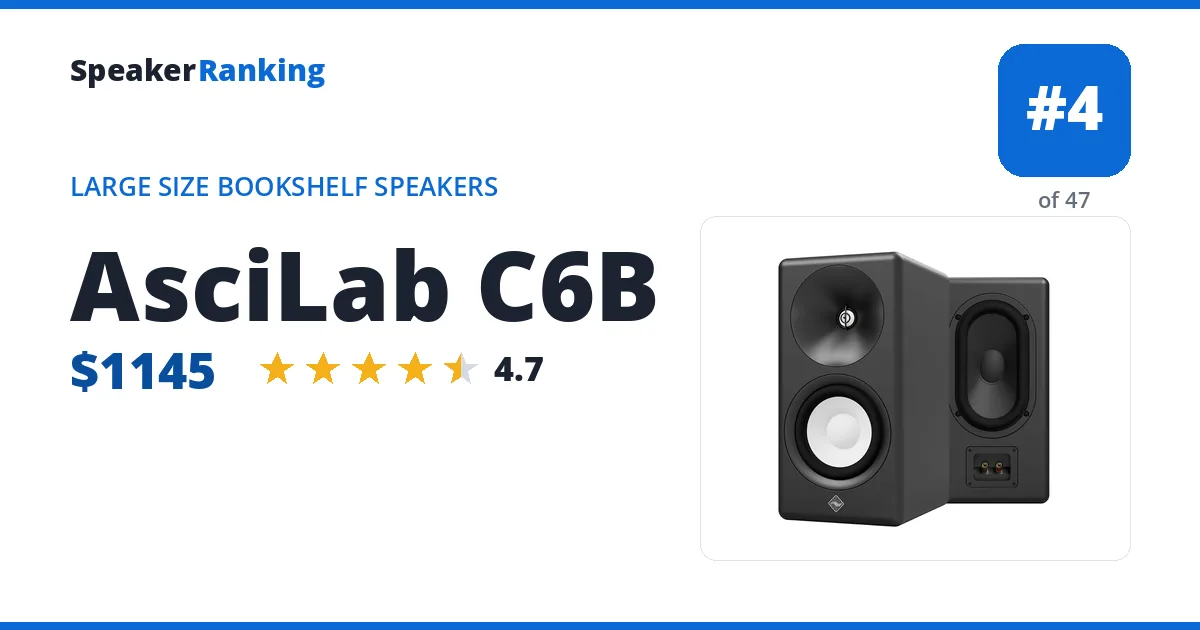
Pros: Two-way design pairing a 1” aluminum ceramic dome tweeter on a large waveguide with a 6” aluminum ceramic cone woofer, crossed over at 1.1kHz, plus a rear passive radiator. Unusual trait: horizontal radiation actually widens at higher frequencies instead of narrowing like most two-way designs, which keeps image focus and soundstage depth consistent whether you toe the speakers in or out (5-10° off-axis was the sweet spot in testing). Vertical radiation also stays wide straight through the 2kHz crossover region, so the sound doesn’t collapse when standing up - unusual at this price. CA2034 measurements show strong on-axis linearity, listening window, early reflections, and directivity. Midrange and tweeter distortion stay very low even at 96dB, holding up against a $5,900 Arendal speaker in that regard despite roughly a 5x price gap. At $935 (about $1,135 shipped to the US), the reviewer calls it the best-value bookshelf speaker he’s tested, rivaling speakers 2-5x the price. Measured bass extension of 54Hz (-3dB), with a measured sensitivity of 85.6dB.
Cons: Bass rolls off around 50Hz in-room (F3 54Hz, F10 35Hz), so a subwoofer is needed for real extension below that. Low-frequency harmonic distortion increases substantially at 96dB versus 86dB, though it’s second-order and less audible than it looks on paper. Minimum impedance dips to 2.6 ohms (EPDR as low as 1.2 ohms), so it wants an amplifier comfortable driving 4-ohm loads, ideally 100W or more. At 102dB, compression noticeably eats into midrange, bass, and some treble output. Shipping to the US adds roughly $200 on top of the $935 price. Against the reviewer’s reference Audiofirst Fidelia at a similar price, has slightly less lower-midrange body (about 1dB difference) and a smaller perceived soundstage size.
Full AsciLab C6B review and specifications →
| Bass Extension (-10dB) | 35Hz (measured, Erin's Audio Corner) |
|---|---|
| Bass Extension (-3dB) | 54Hz (measured, Erin's Audio Corner) |
| DIY Kit | No |
| Dimensions | 15.7"H x 8"W x 10.4"D (398.8 x 203.2 x 264.2 mm) |
| Drivers | 6" Aluminium Ceramic Cone with cast Aluminium Chassis woofer, 1" Aluminium Ceramic Dome tweeter |
| Impedance | 4 ohms nominal, 2.6 ohms minimum (measured, Erin's Audio Corner) |
| Sensitivity | 85.6dB (measured, Erin's Audio Corner) |
| Spinorama Preference Score | 6.33 |
| Spinorama Preference Score with Perfect Sub | 8.28 |
| Weight | 18.5 lbs (8.4 kg) each |
| Woofer Cabinet | passive radiator |
- Links
- Reviews, Comparisons and Sound Samples
- Head-to-Head Comparisons
 MoFi SourcePoint 10: $3795 per pair Crutchfield eBay
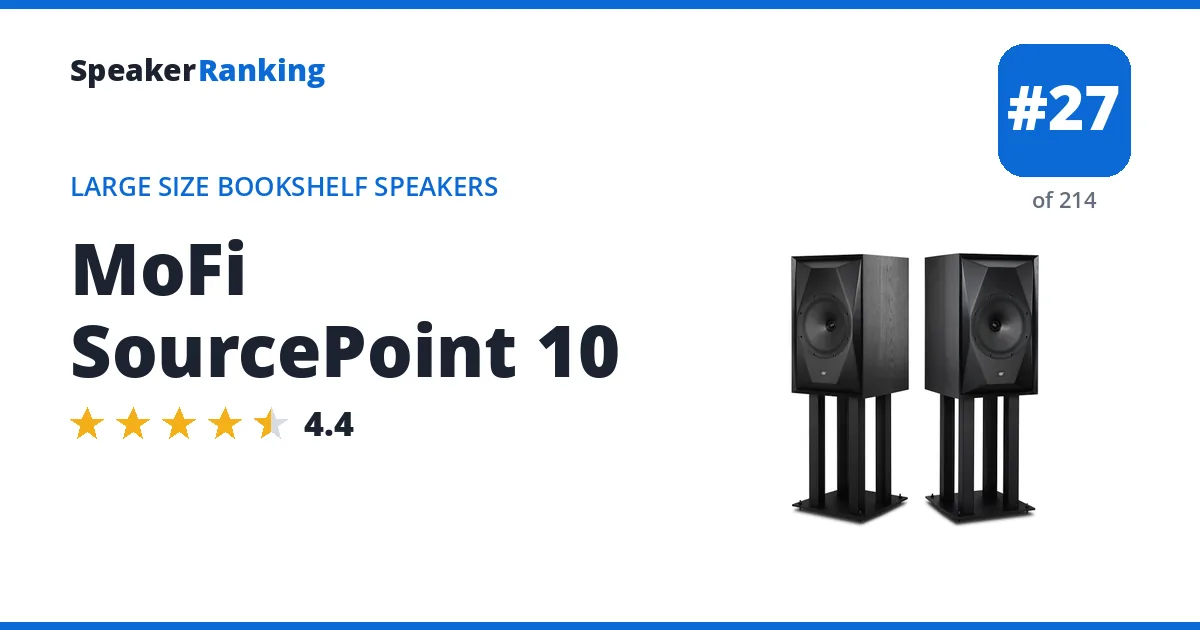
Pros: Andrew Jones-designed concentric/coincident driver delivers best-in-class sound power and early-reflections directivity in the reviewer’s testing - a genuine “point source” design. Vertical and horizontal radiation patterns closely match each other (about ±50° horizontal, ±30-40° vertical), a hallmark benefit of a well-executed concentric driver. Distortion stays low - under 1% above 100Hz at 86dB, and under 3% up to 100Hz even at 96dB, better than the reviewer expected from a low-excursion waveguide-loaded woofer. Surprisingly strong dynamic capability with little audible compression at both low and high volume. Widely spaced (about 11 feet apart) with roughly 15° of toe-out produced a huge, expansive soundstage without significant loss of imaging precision. Solidly built cabinet (about 40 lbs, heavily braced) minimizes cabinet resonance. Measured bass extension of 56Hz (-3dB), with a measured sensitivity of 88.2dB.
Cons: Like virtually all coincident designs, sounds notably bright pointed directly on-axis due to a deliberate treble lift (meant to compensate for the 28mm tweeter’s earlier beaming versus a typical 25mm/1” tweeter) combined with a diffraction dip/peak from the waveguide edge; needs about 15° of toe-out to sound neutral, and even then benefits from an extra 1-2dB of treble EQ. Toeing out further (to 30°) flattens the treble further but introduces a dip in the midrange-to-tweeter crossover region - there’s no single toe-out angle that fixes everything at once. F3 of 56Hz and F10 of 38Hz (about 40Hz in-room) mean genuine deep bass is limited; the reviewer would pair it with a sealed 10” or 12” subwoofer for regular daily listening. Bass extension and cabinet placement trade off against midrange cleanliness: placing it close to a wall for more bass risks a wall-bounce suckout in the midrange (roughly 200-500Hz depending on distance). Not perfectly time-aligned between tweeter and woofer (about 0.4ms delta), an inherent limitation of passive coincident drivers versus actively time-corrected designs. Some resonances appear in measurements, likely port-related. Minimum impedance around 6.4 ohms with EPDR near 3 ohms, so the reviewer recommends sticking with a 4-ohm-rated amplifier to be safe.
Full MoFi SourcePoint 10 review and specifications →
| Bass Extension (-10dB) | 38Hz (measured, Erin's Audio Corner) |
|---|---|
| Bass Extension (-3dB) | 56Hz (measured, Erin's Audio Corner) |
| DIY Kit | No |
| Dimensions | 22.5"H x 14.5"W x 16.6"D (571.5 x 368.3 x 421.6 mm) |
| Drivers | 10" Paper-pulp Cone woofer, 1.25-inch soft-dome tweeter |
| Impedance | 8 ohms nominal, 6.4 ohms minimum (measured, Erin's Audio Corner) |
| Sensitivity | 88.2dB (measured, Erin's Audio Corner) |
| Spinorama Preference Score | 4.16 |
| Spinorama Preference Score with Perfect Sub | 6.17 |
| Weight | 46.3 lbs (21.0 kg) each |
| Woofer Cabinet | ported, rear |
- Links
- Reviews, Comparisons and Sound Samples
- Head-to-Head Comparisons
- MoFi SourcePoint 10 vs Radiant Acoustics Clarity 6.2
- MoFi SourcePoint 10 vs Wharfedale Super Linton
- MoFi SourcePoint 10 vs Dynaudio Heritage Special
- MoFi SourcePoint 10 vs Ascend Acoustics CMT-340 SE2
- MoFi SourcePoint 10 vs Arendal 1528 Monitor 8
- MoFi SourcePoint 10 vs Wharfedale Linton 85
- MoFi SourcePoint 10 vs AsciLab F6Bs
- MoFi SourcePoint 10 vs Ascend Acoustics Sierra-LX
- See all 48 comparisons