Short answer: the Ascend Acoustics ELX Ribbon Horizon. It ranks #2 of 98 center channel speakers by sound quality, rated 4.6/5, at $3,098; the KEF Reference 2 Meta ranks #5, rated 4.4/5, and costs $5,999.99, which makes this an easy call rather than a real tradeoff.
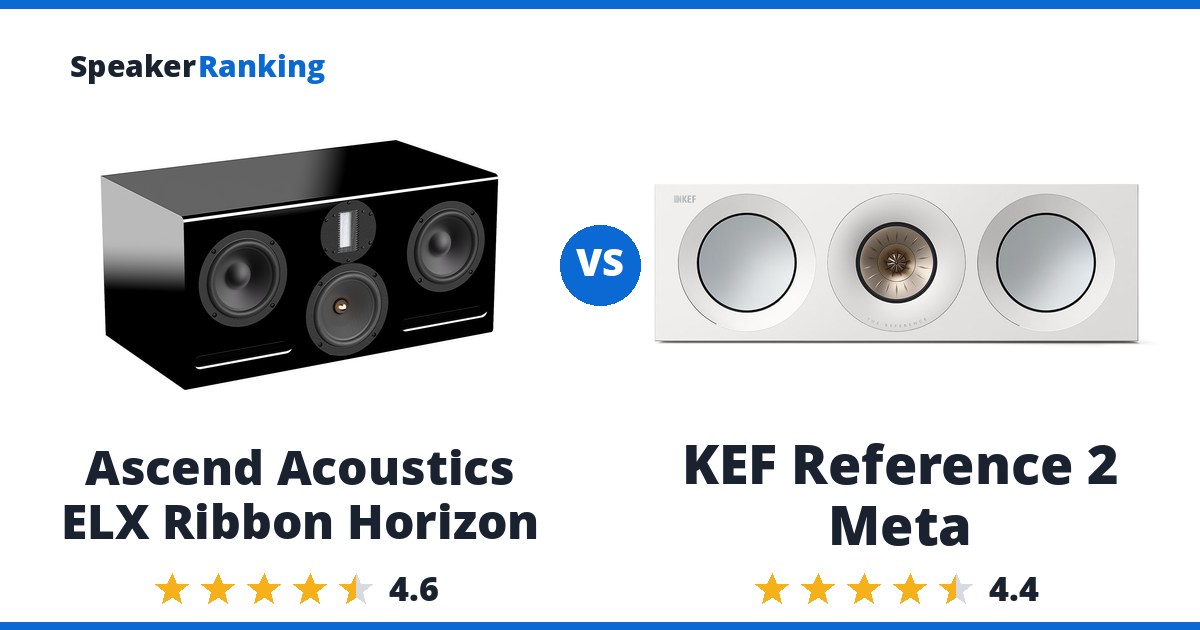
The Ascend Acoustics ELX Ribbon Horizon is the more accurate, deeper-bass option. A RAAL true ribbon tweeter and a 6” SEAS Curv midrange in its own sealed chamber sit between two 6” long-throw SEAS woofers in a laminated bamboo cabinet. Its measured preference score, a predictor of how neutral it sounds, is 6.17 against 5.23 for the KEF Reference 2 Meta. Its bass reaches about 51.3Hz before falling 3dB, against 76.9Hz for the KEF Reference 2 Meta. The tradeoff: The measurements come from Ascend itself, not an independent reviewer.
The case for the KEF Reference 2 Meta: A three-way sealed center with KEF’s 12th generation Uni-Q coaxial driver (25mm aluminium tweeter with MAT inside a 125mm midrange) between two 6.5” bass drivers. The catch: Bass rolls off at 76.9Hz (-3dB) and about 46Hz (-10dB) in the sealed cabinet, so plan on a subwoofer.
Buy the Ascend Acoustics ELX Ribbon Horizon. It is rated higher for sound quality than the KEF Reference 2 Meta and costs less, so only choose the other one for a particular feature it does better.
Looking for alternatives? See the complete Passive Home rankings.
Specifications Side By Side
| Ascend Acoustics ELX Ribbon Horizon | KEF Reference 2 Meta | |
|---|---|---|
| Price | $3,098 each | $5,999.99 each |
| Ranked | #2 of 98 in Center Channel Speakers | #5 of 98 in Center Channel Speakers |
| Drivers | RAAL 70-20xram ribbon tweeter, 6” SEAS Curv cone midrange (sealed chamber), 2x 6” aluminum cone woofers | Uni-Q: 25mm aluminium dome tweeter with MAT, 125mm aluminium midrange; 2x 165mm (6.5”) aluminium bass units |
| Frequency Response | 36Hz-27kHz ±3dB anechoic (manufacturer specified) | 80Hz-35kHz ±3dB (manufacturer specified) |
| Sensitivity | 88dB anechoic, 91dB in-room (2.83V/1m, manufacturer specified) | 86dB (2.83V/1m, manufacturer specified) |
| Impedance | 8 ohms nominal (manufacturer specified) | 4 ohms nominal, 3.2 ohms minimum (manufacturer specified) |
| Woofer Cabinet | ported (dual front slots) | sealed |
| Dimensions | 11”H x 23”W x 12.5”D (279 x 584 x 318 mm) | 8.1”H x 24.8”W x 13.2”D (205 x 630 x 335 mm) |
| Weight | 52 lbs (23.6 kg) | 50.3 lbs (22.8 kg) |
| Bass Extension (-3dB) | 51.3Hz (measured, manufacturer data via spinorama.org) | 76.9Hz (measured, Erin’s Audio Corner) |
| Bass Extension (-10dB) | about 29.8Hz (measured, manufacturer data via spinorama.org) | about 46.2Hz (measured, Erin’s Audio Corner) |
| Spinorama Preference Score | 6.17 | 5.23 |
| Spinorama Preference Score with Perfect Sub | 7.83 | 7.84 |
| DIY Kit | No | No |
| Maximum SPL | - | 113.5dB (manufacturer specified) |
Related Speaker Comparisons
How Ascend Acoustics ELX Ribbon Horizon compares with other leading options:
- Ascend Acoustics ELX Ribbon Horizon vs Perlisten R5c
- Ascend Acoustics ELX Ribbon Horizon vs Ascend Acoustics Sierra Horizon V2
- Perlisten R5c vs KEF Reference 2 Meta
- KEF Reference 2 Meta vs KEF R2 Meta
- KEF Reference 2 Meta vs Revel C426Be
Prices on this page were last checked October 5, 2026 at 10:21 PM UTC. Product prices and availability are accurate as of that date/time and are subject to change; the price and availability shown on Amazon at the time of purchase will apply to the purchase of this product.
As an eBay Partner, we may be compensated if you make a purchase.
The Two Speakers In Full
 Ascend Acoustics ELX Ribbon Horizon: $3,098 each Ascend Acoustics eBay
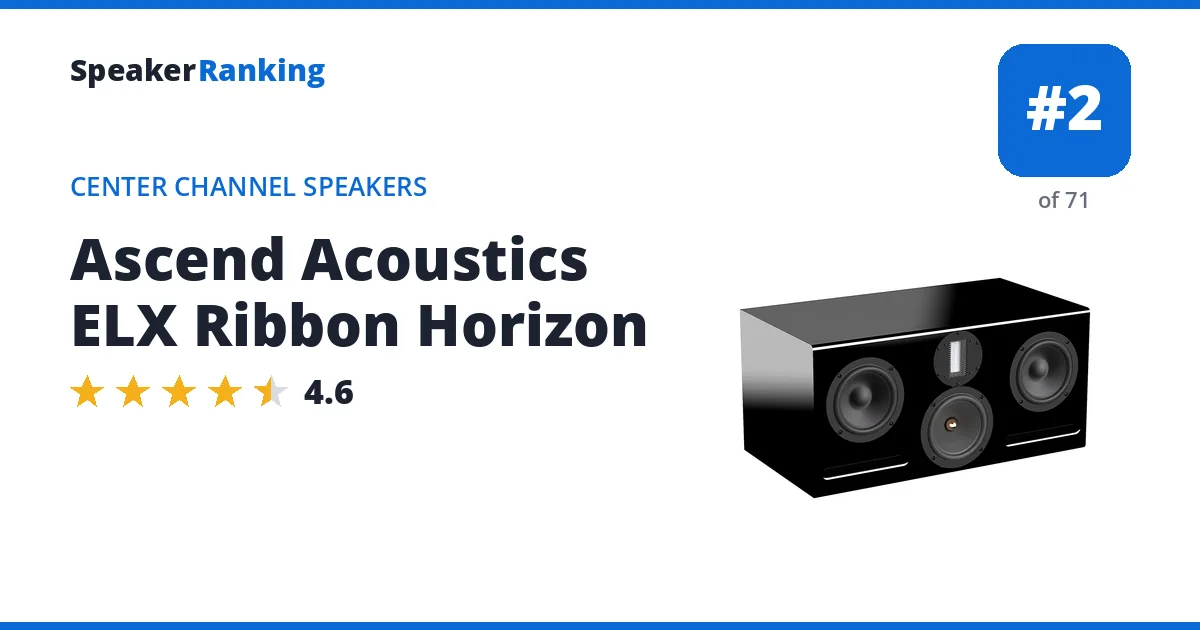
Pros: A RAAL true ribbon tweeter and a 6” SEAS Curv midrange in its own sealed chamber sit between two 6” long-throw SEAS woofers in a laminated bamboo cabinet. Ascend’s Klippel near-field measurements show the lowest on-axis deviation of any center channel ranked here (0.15) and a listening window within 1.9dB from 300Hz to 5kHz, and its preference score of 6.17 without a subwoofer is second only to Perlisten’s S7c. Bass is among the deepest of any center here, reaching 51.3Hz (-3dB) and about 30Hz (-10dB), so it can play full range in most rooms. Dispersion is wide horizontally (about ±60 degrees), which keeps dialogue consistent for off-center seats.
Cons: The measurements come from Ascend itself, not an independent reviewer. The ribbon’s vertical dispersion is narrow (about ±25 degrees), so aim the tweeter at ear height rather than tilting it from far above or below the screen. It is sold only direct from Ascend, and at 584mm wide and 52 lb it needs a deep, sturdy shelf.
Full Ascend Acoustics ELX Ribbon Horizon review and specifications →
| Bass Extension (-10dB) | about 29.8Hz (measured, manufacturer data via spinorama.org) |
|---|---|
| Bass Extension (-3dB) | 51.3Hz (measured, manufacturer data via spinorama.org) |
| DIY Kit | No |
| Dimensions | 11”H x 23”W x 12.5”D (279 x 584 x 318 mm) |
| Drivers | RAAL 70-20xram ribbon tweeter, 6” SEAS Curv cone midrange (sealed chamber), 2x 6” aluminum cone woofers |
| Frequency Response | 36Hz-27kHz ±3dB anechoic (manufacturer specified) |
| Impedance | 8 ohms nominal (manufacturer specified) |
| Sensitivity | 88dB anechoic, 91dB in-room (2.83V/1m, manufacturer specified) |
| Spinorama Preference Score | 6.17 |
| Spinorama Preference Score with Perfect Sub | 7.83 |
| Weight | 52 lbs (23.6 kg) |
| Woofer Cabinet | ported (dual front slots) |
- Links
- Reviews, Comparisons and Sound Samples
- Head-to-Head Comparisons
 KEF Reference 2 Meta: $5,999.99 each KEF eBay
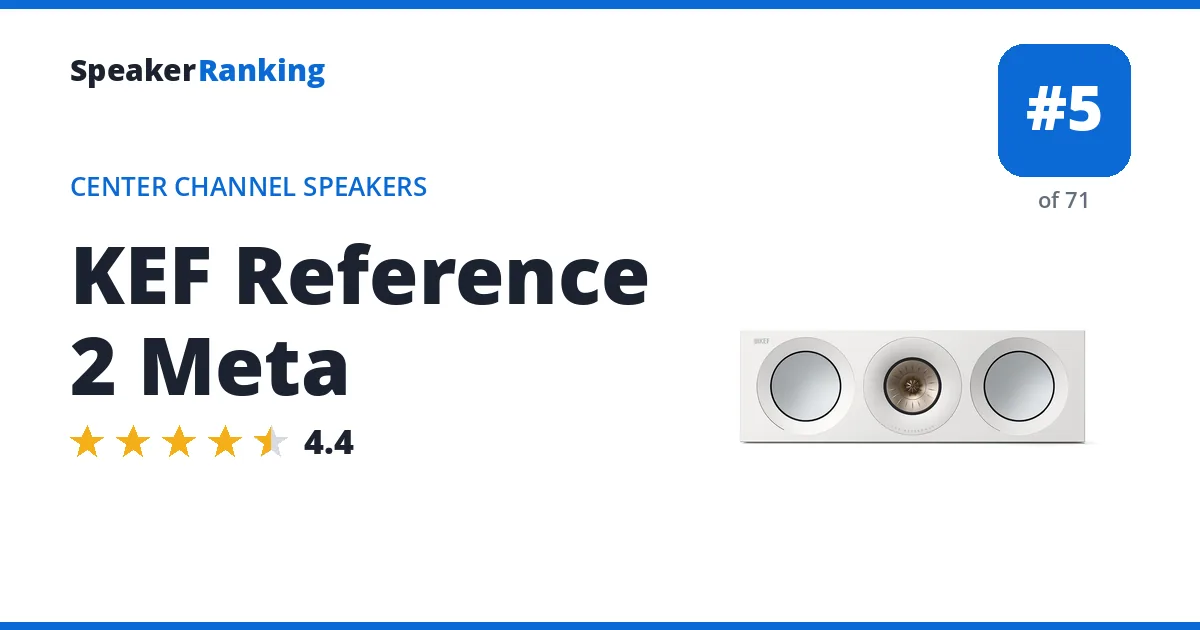
Pros: A three-way sealed center with KEF’s 12th generation Uni-Q coaxial driver (25mm aluminium tweeter with MAT inside a 125mm midrange) between two 6.5” bass drivers. Measured by Erin’s Audio Corner, the listening window stays within 2.1dB from 300Hz to 5kHz and the coaxial driver spreads sound evenly out to about ±50 degrees, so dialogue sounds the same from every seat on a wide sofa. Preference score 5.23, rising to 7.84 with an ideal subwoofer. Measured bass extension of 76.9Hz (-3dB).
Cons: Bass rolls off at 76.9Hz (-3dB) and about 46Hz (-10dB) in the sealed cabinet, so plan on a subwoofer. Sensitivity is a modest 86dB and the impedance dips to 3.2 ohms, so it needs a capable amplifier. At $6000 it costs far more than KEF’s R2 Meta, which measures nearly as well.
Full KEF Reference 2 Meta review and specifications →
| Bass Extension (-10dB) | about 46.2Hz (measured, Erin’s Audio Corner) |
|---|---|
| Bass Extension (-3dB) | 76.9Hz (measured, Erin’s Audio Corner) |
| DIY Kit | No |
| Dimensions | 8.1”H x 24.8”W x 13.2”D (205 x 630 x 335 mm) |
| Drivers | Uni-Q: 25mm aluminium dome tweeter with MAT, 125mm aluminium midrange; 2x 165mm (6.5”) aluminium bass units |
| Frequency Response | 80Hz-35kHz ±3dB (manufacturer specified) |
| Impedance | 4 ohms nominal, 3.2 ohms minimum (manufacturer specified) |
| Maximum SPL | 113.5dB (manufacturer specified) |
| Sensitivity | 86dB (2.83V/1m, manufacturer specified) |
| Spinorama Preference Score | 5.23 |
| Spinorama Preference Score with Perfect Sub | 7.84 |
| Weight | 50.3 lbs (22.8 kg) |
| Woofer Cabinet | sealed |
- Links
- Reviews, Comparisons and Sound Samples
- Head-to-Head Comparisons