Short answer: the Arendal 1528 Monitor 8. It ranks #22 of 130 bookshelf speakers by sound quality; the Aalto Speakers Aalto 3 Passive ranks #45.
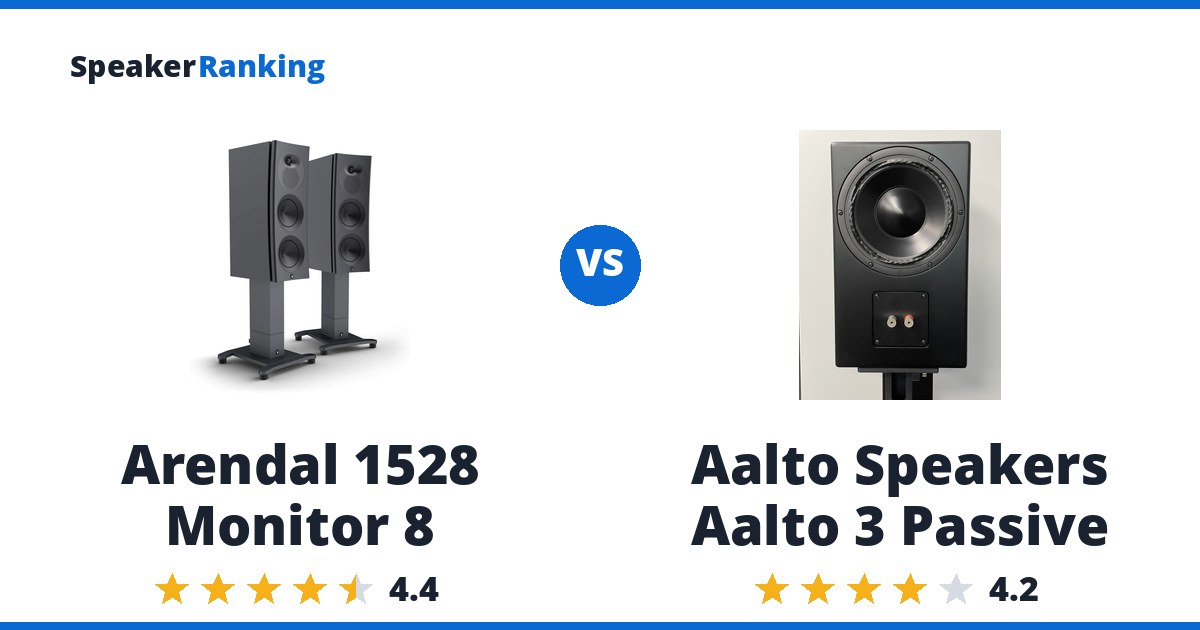
What the Arendal 1528 Monitor 8 offers: Three-way design featuring a 28mm tweeter, 5” mid-range, and dual 8” mid-bass drivers in a convertible sealed/ported HDF cabinet, with a supplied port bung for sealed operation near a wall. In ported configuration, reaches down to about 35Hz in most rooms (F3 41Hz, F10 26Hz) - deep enough that many listeners could skip a subwoofer unless they want output below 40Hz. Extremely low distortion and compression across the board (harmonic, multitone, and both long- and short-term compression testing) - among the best the reviewer has tested at this price, beating speakers costing twice as much. Wide, consistent horizontal soundstage of about ±60°. Smooth, non-fatiguing high frequency rather than the elevated “detail” boost common on speakers marketed for resolution. A slight forwardness around 1.5kHz adds a touch of attack without tipping into brightness. Watch for: A dip in the midbase around 100Hz noticeably reduces the “chestiness” of male vocals compared to the reviewer’s reference speaker. A diffraction-related flare in the upper-midrange/lower-treble (around 1.5-2kHz) gives a mild forwardness that benefits from sidewall absorption panels, though it’s not a major issue. Vertical sweet spot is fairly narrow at about ±20° - a bigger consideration for multi-row home theater seating than rivals like the MoFi SourcePoint 8, which manages about ±60°. The MoFi SourcePoint 8, a similarly-priced rival, also has more linear bass with no midbase dip, at the cost of a more elevated top end. Minor resonances appear around 400Hz and 800Hz in measurements, though the reviewer considers them inaudible or insignificant. Very heavy (about 104 lbs each) HDF cabinet requires dedicated, sturdy stands. Low EPDR (dips to about 1.9 ohms in two spots) means a Class AB amplifier needs to comfortably handle a 4-ohm load without overheating; a Class D amp is a safer choice for full-range use.
What the Aalto Speakers Aalto 3 Passive offers: The passive version of the same cabinet as Aalto’s Active Pro model, sharing its 26mm aluminum tweeter and 6.5” bass-midrange driver but without the built-in amp module, for buyers who already have their own amplification. Measures a -3dB extension of 56.6Hz with an on-axis deviation of 0.192dB, close to tonally neutral, a well-damped bass-alignment Q of 0.64, and reaches a deeper 34Hz Harman in-room extension estimate. Watch for: Requires an external amplifier (50-250W recommended) that the Active Pro doesn’t, and shares the same review gap: no independent editorial coverage found, only manufacturer-supplied specs, with factory-direct-only sales from Finland.
Buy the Arendal 1528 Monitor 8 when sound quality outweighs the price for you, and the Aalto Speakers Aalto 3 Passive when the price outweighs sound quality instead.
Want more options? Browse the full Passive Home rankings.
Specifications Side By Side
| Arendal 1528 Monitor 8 | Aalto Speakers Aalto 3 Passive | |
|---|---|---|
| Price | $6000 per pair | €3,490 per pair |
| Ranked | #22 of 130 in Large Size Bookshelf Speakers | #45 of 130 in Large Size Bookshelf Speakers |
| Bass Extension (-10dB) | 26Hz (measured, Erin's Audio Corner) | - |
| Bass Extension (-3dB) | 41Hz (measured, Erin's Audio Corner) | - |
| Dimensions | 31.8"H x 11.4"W x 17.6"D (807.7 x 289.6 x 447 mm) | 9.4"W x 15.7"H x 9.8"D (240 x 400 x 250 mm) |
| Impedance | 4 ohms nominal, 3.8 ohms minimum (measured, Erin's Audio Corner) | 4 ohms nominal (min 4 ohms @ 18kHz) |
| Drivers | Dual 8" woofers, 5" midrange, 28mm tweeter | 26mm aluminum dome tweeter, 6.5" long-throw bass-midrange, 8" passive radiator |
| Sensitivity | 84.4dB (measured, Erin's Audio Corner) | 83.5dB @ 2.83V/1m |
| Weight | 103.6 lbs (47 kg) each | 20.7 lbs (9.4 kg) each |
| Woofer Cabinet | ported | - |
| Spinorama Preference Score | 4.70 | 6.11 |
| Spinorama Preference Score with Perfect Sub | 6.16 | 7.74 |
| Enclosure | - | 2-way, passive-radiator loaded, MDF |
| Power Handling | - | 50-250W RMS recommended amplifier power |
| Country | - | Finland |
Related Speaker Comparisons
How Arendal 1528 Monitor 8 compares with other leading options:
- Arendal 1528 Monitor 8 vs Perlisten S4b
- KEF Reference 1 Meta vs Arendal 1528 Monitor 8
- Arendal 1528 Monitor 8 vs GR-Research NX-Studio
- AsciLab C6B vs Arendal 1528 Monitor 8
- Audio First Cadentia 3 vs Arendal 1528 Monitor 8
Prices on this page were last checked September 16, 2026 at 12:41 AM UTC. Product prices and availability are accurate as of that date/time and are subject to change; the price and availability shown on Amazon at the time of purchase will apply to the purchase of this product.
As an eBay Partner, we may be compensated if you make a purchase.
The Two Speakers In Full
 Arendal 1528 Monitor 8: $6000 per pair Arendalsound eBay
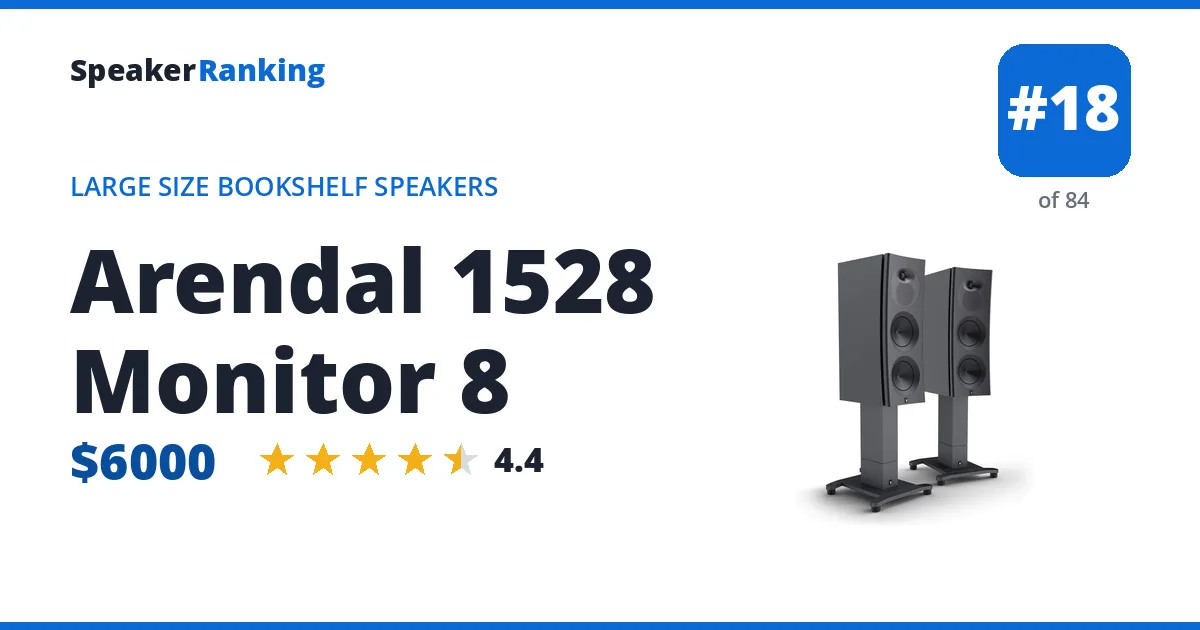
Pros: Three-way design featuring a 28mm tweeter, 5” mid-range, and dual 8” mid-bass drivers in a convertible sealed/ported HDF cabinet, with a supplied port bung for sealed operation near a wall. In ported configuration, reaches down to about 35Hz in most rooms (F3 41Hz, F10 26Hz) - deep enough that many listeners could skip a subwoofer unless they want output below 40Hz. Extremely low distortion and compression across the board (harmonic, multitone, and both long- and short-term compression testing) - among the best the reviewer has tested at this price, beating speakers costing twice as much. Wide, consistent horizontal soundstage of about ±60°. Smooth, non-fatiguing high frequency rather than the elevated “detail” boost common on speakers marketed for resolution. A slight forwardness around 1.5kHz adds a touch of attack without tipping into brightness. Measured bass extension of 41Hz (-3dB), with a measured sensitivity of 84.4dB.
Cons: A dip in the midbase around 100Hz noticeably reduces the “chestiness” of male vocals compared to the reviewer’s reference speaker. A diffraction-related flare in the upper-midrange/lower-treble (around 1.5-2kHz) gives a mild forwardness that benefits from sidewall absorption panels, though it’s not a major issue. Vertical sweet spot is fairly narrow at about ±20° - a bigger consideration for multi-row home theater seating than rivals like the MoFi SourcePoint 8, which manages about ±60°. The MoFi SourcePoint 8, a similarly-priced rival, also has more linear bass with no midbase dip, at the cost of a more elevated top end. Minor resonances appear around 400Hz and 800Hz in measurements, though the reviewer considers them inaudible or insignificant. Very heavy (about 104 lbs each) HDF cabinet requires dedicated, sturdy stands. Low EPDR (dips to about 1.9 ohms in two spots) means a Class AB amplifier needs to comfortably handle a 4-ohm load without overheating; a Class D amp is a safer choice for full-range use.
Full Arendal 1528 Monitor 8 review and specifications →
| Bass Extension (-10dB) | 26Hz (measured, Erin's Audio Corner) |
|---|---|
| Bass Extension (-3dB) | 41Hz (measured, Erin's Audio Corner) |
| Dimensions | 31.8"H x 11.4"W x 17.6"D (807.7 x 289.6 x 447 mm) |
| Drivers | Dual 8" woofers, 5" midrange, 28mm tweeter |
| Impedance | 4 ohms nominal, 3.8 ohms minimum (measured, Erin's Audio Corner) |
| Sensitivity | 84.4dB (measured, Erin's Audio Corner) |
| Spinorama Preference Score | 4.70 |
| Spinorama Preference Score with Perfect Sub | 6.16 |
| Weight | 103.6 lbs (47 kg) each |
| Woofer Cabinet | ported |
- Links
- Reviews, Comparisons and Sound Samples
- Head-to-Head Comparisons
- Arendal 1528 Monitor 8 vs Ascend Acoustics CMT-340 SE2
- Arendal 1528 Monitor 8 vs Wharfedale Super Linton
- Arendal 1528 Monitor 8 vs AsciLab F6Bs
- Arendal 1528 Monitor 8 vs MoFi SourcePoint 10
- Arendal 1528 Monitor 8 vs MoFi SourcePoint 8
- Arendal 1528 Monitor 8 vs Radiant Acoustics Clarity 6.2
- Arendal 1528 Monitor 8 vs Dynaudio Heritage Special
- Arendal 1528 Monitor 8 vs Buchardt Audio E50
- See all 44 comparisons
 Aalto Speakers Aalto 3 Passive: €3,490 per pair Aalto Speakers eBay
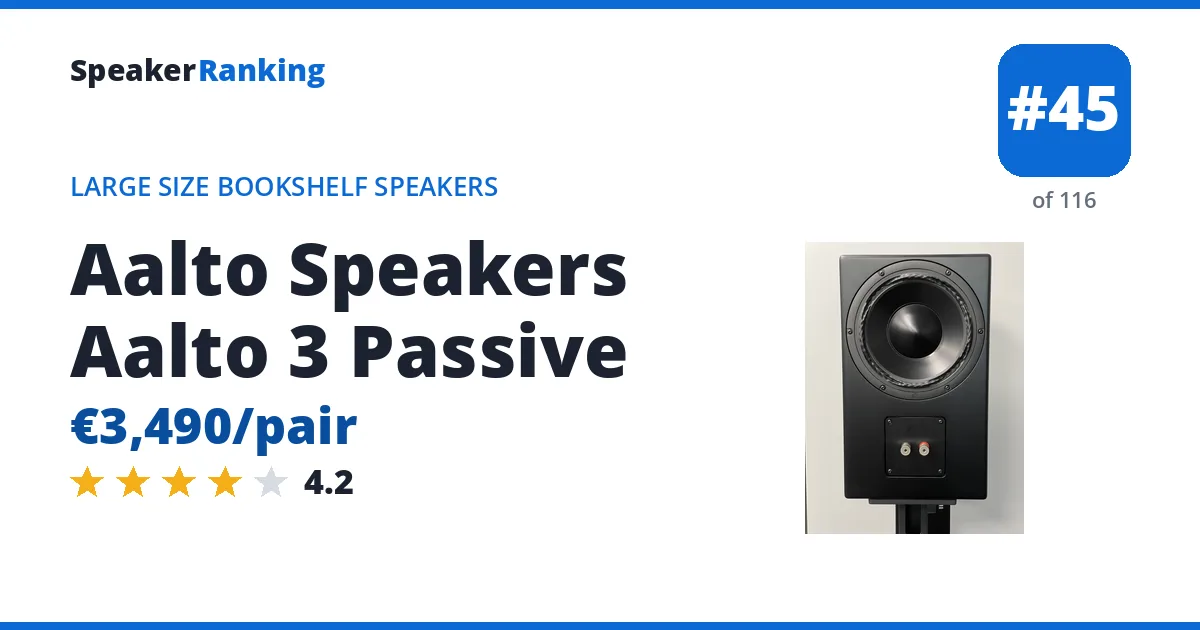
Pros: The passive version of the same cabinet as Aalto’s Active Pro model, sharing its 26mm aluminum tweeter and 6.5” bass-midrange driver but without the built-in amp module, for buyers who already have their own amplification. Measures a -3dB extension of 56.6Hz with an on-axis deviation of 0.192dB, close to tonally neutral, a well-damped bass-alignment Q of 0.64, and reaches a deeper 34Hz Harman in-room extension estimate.
Cons: Requires an external amplifier (50-250W recommended) that the Active Pro doesn’t, and shares the same review gap: no independent editorial coverage found, only manufacturer-supplied specs, with factory-direct-only sales from Finland.
Full Aalto Speakers Aalto 3 Passive review and specifications →
| Country | Finland |
|---|---|
| Dimensions | 9.4"W x 15.7"H x 9.8"D (240 x 400 x 250 mm) |
| Drivers | 26mm aluminum dome tweeter, 6.5" long-throw bass-midrange, 8" passive radiator |
| Enclosure | 2-way, passive-radiator loaded, MDF |
| Impedance | 4 ohms nominal (min 4 ohms @ 18kHz) |
| Power Handling | 50-250W RMS recommended amplifier power |
| Sensitivity | 83.5dB @ 2.83V/1m |
| Spinorama Preference Score | 6.11 |
| Spinorama Preference Score with Perfect Sub | 7.74 |
| Weight | 20.7 lbs (9.4 kg) each |
- Links
- Reviews, Comparisons and Sound Samples
- Head-to-Head Comparisons
- Aalto Speakers Aalto 3 Passive vs JBL HDI-1600
- Aalto Speakers Aalto 3 Passive vs Perlisten A3m
- Aalto Speakers Aalto 3 Passive vs ELAC Debut 3.0 DB63
- Aalto Speakers Aalto 3 Passive vs Emotiva Airmotiv XB2
- Aalto Speakers Aalto 3 Passive vs Ascend Acoustics Sierra-2EX V2
- Aalto Speakers Aalto 3 Passive vs Philharmonic BMR (v1)
- Aalto Speakers Aalto 3 Passive vs ELAC DBR62
- Aalto Speakers Aalto 3 Passive vs Ascend Acoustics Sierra-LX
- See all 45 comparisons