Short answer: the Apple HomePod 2nd Gen. It ranks #5 of 19 powered desktop speakers by sound quality, rated 4.0/5, at $297.71; the Bose Lifestyle Ultra Speaker ranks #12, rated 3.7/5, and costs $299, so there is little reason to consider the other one.
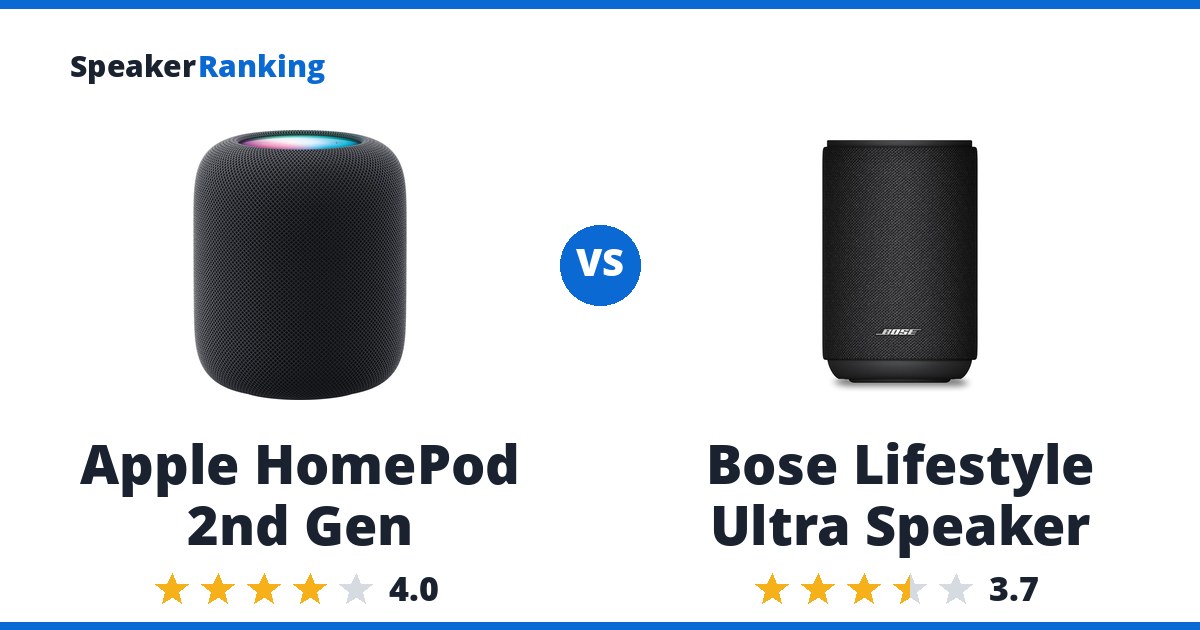
Why pick the Apple HomePod 2nd Gen: What Hi-Fi gave it a perfect 5 stars for sound and a What Hi-Fi Award, calling it natural, solid and energetic with a spacious, three-dimensional presentation on Dolby Atmos content. The catch: What Hi-Fi’s own comparison found the pricier Sonos Era 300 has more power, punch and detail, and Siri cannot launch Spotify, Tidal or other non-Apple services directly, only Apple Music by voice; everything else has to be sent over AirPlay from a phone.
What the Bose Lifestyle Ultra Speaker does well: Three drivers (a 3in woofer and 1in tweeter facing forward, plus a 1.5in driver firing upward) give it a noticeably taller sound than most compact home speakers. The catch: RTINGS lists sub-par directivity as its main weakness, and reviewers agree a single unit sounds narrow from side to side, so it works best as a stereo pair.
Buy the Apple HomePod 2nd Gen. It is rated higher for sound quality than the Bose Lifestyle Ultra Speaker and costs less, which makes it the one to get unless you need something the other one does better.
Want more options? Browse the full Powered Home rankings.
Specifications Side By Side
| Apple HomePod 2nd Gen | Bose Lifestyle Ultra Speaker | |
|---|---|---|
| Price | $297.71 each | $299.00 each |
| Ranked | #5 of 19 in Medium Size Powered Desktop Speakers | #12 of 19 in Medium Size Powered Desktop Speakers |
| Aux Input | No | Yes |
| Battery Life | No Battery | No Battery |
| IP Rating | None | None |
| Party Mode | Yes (AirPlay 2 multi-room) | Yes (Bose app multi-room, AirPlay 2, Google Cast) |
| Power Input | External AC adapter (detachable cable) | AC power cord |
| Stereo | No | No |
| Weight | 5.1 lbs (2.3 kg) | 3.7 lbs (1.68 kg) |
| Wi-Fi | Yes | Yes |
| App | Yes (Apple Home) | Yes (Bose) |
| Built-in Microphone | Yes (far-field array, no physical mute switch) | Yes (far-field, mic mute button) |
| EQ | Yes (Reduce Bass toggle + automatic room correction) | Yes (Bass/Mid/Treble + up-firing driver level) |
| Power Bank | No | No |
| TWS | Yes (stereo pairing via Home app) | Yes (stereo pairing via Bose app) |
| Drivers | 4in high-excursion woofer, 5x horn-loaded tweeters | 3in woofer, 1in tweeter, 1.5in up-firing mid/high driver |
| Inputs | Wi-Fi, AirPlay 2 | Wi-Fi, Bluetooth, 3.5mm aux |
| XLR Input | No | No |
| RCA Input | No | No |
| TRS Input | No | Yes (3.5mm) |
| Optical Input | No | No |
| Coaxial Input | No | No |
| USB Input | No | No |
| HDMI Input | No | No |
| AES Input | No | No |
| Bluetooth | No | Yes, 5.3 |
| Dimensions | 6.7” x 5.6” x 5.6” (170 x 142 x 142 mm) | 7.2” x 4.8” x 6.6” (184 x 121 x 167 mm) (H x W x D) |
| Voice Assistants | Apple Siri | Amazon Alexa / Alexa+ |
| Streaming Services | AirPlay 2, Apple Music (direct voice control); other services via AirPlay only | AirPlay 2, Google Cast, Spotify Connect |
Related Speaker Comparisons
How Apple HomePod 2nd Gen compares with other leading options:
- Apple HomePod 2nd Gen vs Audio Pro C5 MkII
- Apple HomePod 2nd Gen vs Marshall Woburn III
- Apple HomePod 2nd Gen vs Marshall Stanmore III
- Apple HomePod 2nd Gen vs Edifier D12
- Apple HomePod 2nd Gen vs JBL Authentics 200
Prices on this page were last checked September 26, 2026 at 11:14 PM UTC. Product prices and availability are accurate as of that date/time and are subject to change; the price and availability shown on Amazon at the time of purchase will apply to the purchase of this product.
As an eBay Partner, we may be compensated if you make a purchase.
The Two Speakers In Full
 Apple HomePod 2nd Gen: $297.71 each Amazon eBay
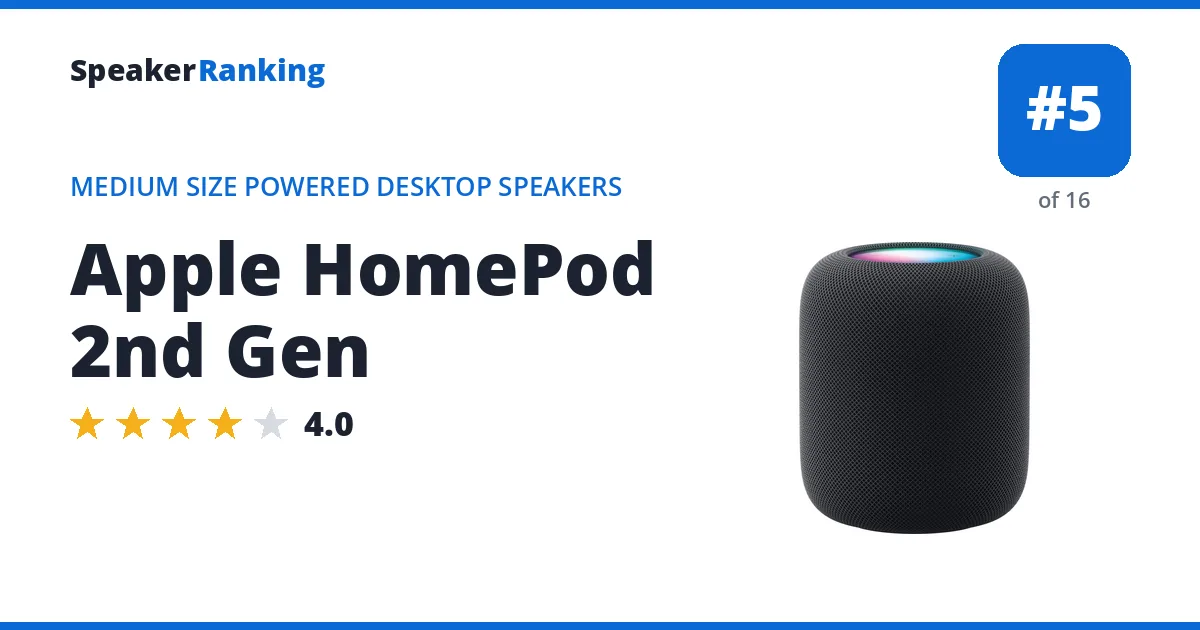
Pros: What Hi-Fi gave it a perfect 5 stars for sound and a What Hi-Fi Award, calling it natural, solid and energetic with a spacious, three-dimensional presentation on Dolby Atmos content. A 4-inch high-excursion woofer moves 20mm of travel, paired with five angled horn-loaded tweeters, and the S7 chip continuously measures the room and re-tunes the output in real time, even as you move the speaker. “Hey Siri” is reliably heard from across a room even at full volume, and two units can be stereo-paired for a genuinely bigger sound.
Cons: What Hi-Fi’s own comparison found the pricier Sonos Era 300 has more power, punch and detail, and Siri cannot launch Spotify, Tidal or other non-Apple services directly, only Apple Music by voice; everything else has to be sent over AirPlay from a phone. There is no way to stream to it over Bluetooth at all, no 3.5mm or other wired input, no battery, and no IP rating, so it’s an AC-only speaker for an already-committed Apple household.
Full Apple HomePod 2nd Gen review and specifications →
| AES Input | No |
|---|---|
| App | Yes (Apple Home) |
| Aux Input | No |
| Battery Life | No Battery |
| Bluetooth | No |
| Built-in Microphone | Yes (far-field array, no physical mute switch) |
| Coaxial Input | No |
| Dimensions | 6.7” x 5.6” x 5.6” (170 x 142 x 142 mm) |
| Drivers | 4in high-excursion woofer, 5x horn-loaded tweeters |
| EQ | Yes (Reduce Bass toggle + automatic room correction) |
| HDMI Input | No |
| IP Rating | None |
| Inputs | Wi-Fi, AirPlay 2 |
| Optical Input | No |
| Party Mode | Yes (AirPlay 2 multi-room) |
| Power Bank | No |
| Power Input | External AC adapter (detachable cable) |
| RCA Input | No |
| Stereo | No |
| Streaming Services | AirPlay 2, Apple Music (direct voice control); other services via AirPlay only |
| TRS Input | No |
| TWS | Yes (stereo pairing via Home app) |
| USB Input | No |
| Voice Assistants | Apple Siri |
| Weight | 5.1 lbs (2.3 kg) |
| Wi-Fi | Yes |
| XLR Input | No |
- Links
- Reviews, Comparisons and Sound Samples
- Head-to-Head Comparisons
- Apple HomePod 2nd Gen vs Marshall Stanmore III
- Apple HomePod 2nd Gen vs Edifier D12
- Apple HomePod 2nd Gen vs JBL Authentics 200
- Apple HomePod 2nd Gen vs Marshall Woburn III
- Apple HomePod 2nd Gen vs Marshall Acton III
- Apple HomePod 2nd Gen vs Audio Pro C5 MkII
- Apple HomePod 2nd Gen vs Denon Home 250
- Apple HomePod 2nd Gen vs Google Home Max
- See all 34 comparisons
 Bose Lifestyle Ultra Speaker: $299.00 each Amazon eBay
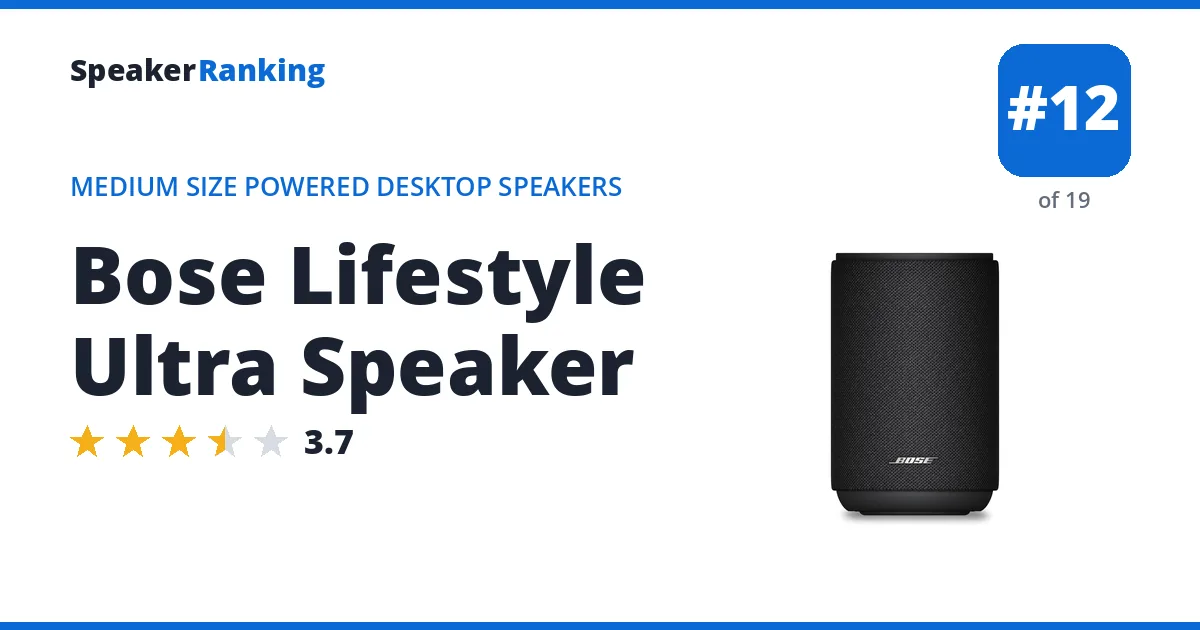
Pros: Three drivers (a 3in woofer and 1in tweeter facing forward, plus a 1.5in driver firing upward) give it a noticeably taller sound than most compact home speakers. Stuff gave it the edge over the Sonos Era 100, and TechRadar called its tonal balance fairly neutral, with tight bass control and high detail. Alexa, including Alexa+, is built in, and RTINGS found its microphones picked up commands easily from across a noisy room. It streams over AirPlay 2, Google Cast, Spotify Connect and Bluetooth 5.3, keeps a 3.5mm aux input that the Era 100 lacks, and two units can be stereo paired or used as rear surrounds with the Lifestyle Ultra Soundbar.
Cons: RTINGS lists sub-par directivity as its main weakness, and reviewers agree a single unit sounds narrow from side to side, so it works best as a stereo pair. Deep bass is limited: Engadget found the low end restrained and preferred the Denon Home 200’s sound, Stuff noted it can’t separate sub-bass from the bassline and that DSP pulls bass back at maximum volume, and TechRadar heard a slight toothiness in the treble that needed EQ to calm. The EQ is only bass, mid and treble with no automatic room calibration. Bose warns the aux and Bluetooth inputs add lip sync delay for TV use, it has no battery or IP rating, and both SoundGuys and Engadget needed several restarts to get stereo pairing working.
Full Bose Lifestyle Ultra Speaker review and specifications →
| AES Input | No |
|---|---|
| App | Yes (Bose) |
| Aux Input | Yes |
| Battery Life | No Battery |
| Bluetooth | Yes, 5.3 |
| Built-in Microphone | Yes (far-field, mic mute button) |
| Coaxial Input | No |
| Dimensions | 7.2” x 4.8” x 6.6” (184 x 121 x 167 mm) (H x W x D) |
| Drivers | 3in woofer, 1in tweeter, 1.5in up-firing mid/high driver |
| EQ | Yes (Bass/Mid/Treble + up-firing driver level) |
| HDMI Input | No |
| IP Rating | None |
| Inputs | Wi-Fi, Bluetooth, 3.5mm aux |
| Optical Input | No |
| Party Mode | Yes (Bose app multi-room, AirPlay 2, Google Cast) |
| Power Bank | No |
| Power Input | AC power cord |
| RCA Input | No |
| Stereo | No |
| Streaming Services | AirPlay 2, Google Cast, Spotify Connect |
| TRS Input | Yes (3.5mm) |
| TWS | Yes (stereo pairing via Bose app) |
| USB Input | No |
| Voice Assistants | Amazon Alexa / Alexa+ |
| Weight | 3.7 lbs (1.68 kg) |
| Wi-Fi | Yes |
| XLR Input | No |
- Links
- Reviews, Comparisons and Sound Samples
- Head-to-Head Comparisons
- Bose Lifestyle Ultra Speaker vs Denon Home 250
- Bose Lifestyle Ultra Speaker vs Sonos Era 100
- Bose Lifestyle Ultra Speaker vs Marshall Acton III
- Bose Lifestyle Ultra Speaker vs JBL Authentics 200
- Bose Lifestyle Ultra Speaker vs Edifier D12
- Bose Lifestyle Ultra Speaker vs Marshall Stanmore III
- Bose Lifestyle Ultra Speaker vs Klipsch The One II
- Bose Lifestyle Ultra Speaker vs Marshall Woburn III
- See all 33 comparisons