Short answer: the Alcons Audio VR5 V1. It ranks #3 of 16 compact 5 to 6.5-inch pa speakers by sound quality (rated 4.0/5); the Meyer Sound Ultra X22 ranks #5 (rated 3.9/5).
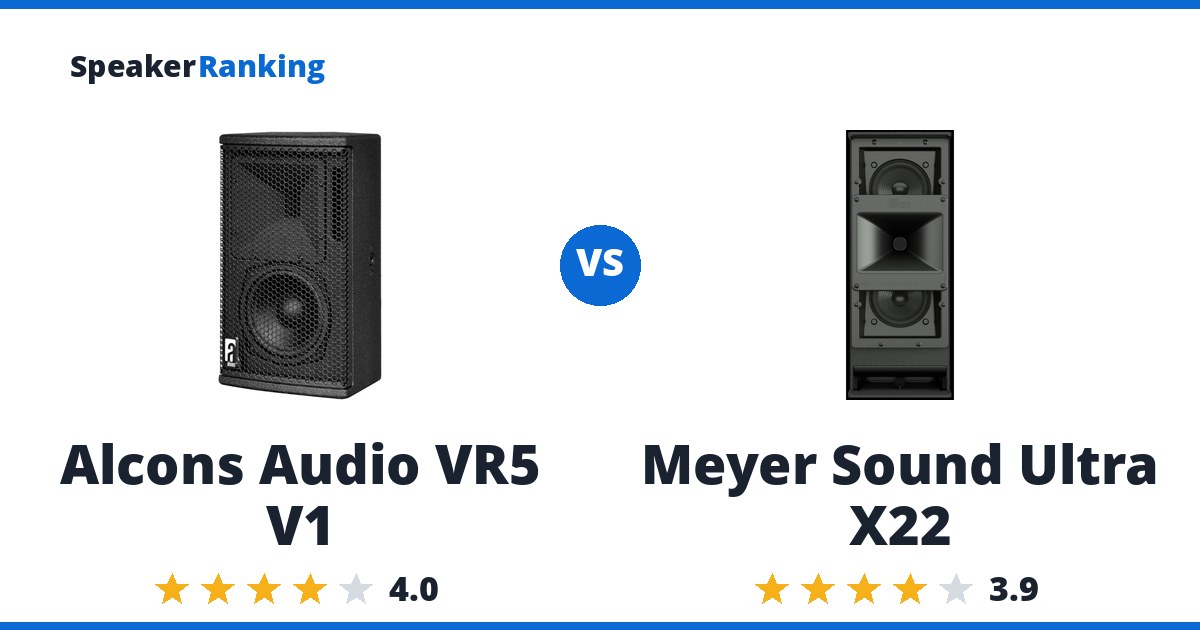
Why pick the Alcons Audio VR5 V1: High-quality vendor Spinorama data gives preference scores of 4.04 standalone and 7.06 with an ideal subwoofer, and predicted in-room smoothness is 0.73. The tradeoff: Bass reaches only about 80Hz (-3dB), and listening-window narrow-band deviation is 0.408, so a subwoofer is needed for music.
Why pick the Meyer Sound Ultra X22: A self-powered coaxial design with a rotatable 80° x 50° horn, dual 5-inch drivers and 860W of total power, reaching 128.5dB peak. Watch for: On-axis narrow-band deviation is 0.478 and predicted in-room smoothness is 0.51, less even than the best compact boxes here.
Buy the Alcons Audio VR5 V1. It is rated higher for sound quality than the Meyer Sound Ultra X22.
Want more options? Browse the full PA & Live Sound rankings.
Specifications Side By Side
| Alcons Audio VR5 V1 | Meyer Sound Ultra X22 | |
|---|---|---|
| Price | - | - |
| Ranked | #3 of 16 in Compact 5 to 6.5-Inch PA Speakers | #5 of 16 in Compact 5 to 6.5-Inch PA Speakers |
| Configuration | Passive 2-way compact monitor | Active 2-way coaxial PA speaker |
| Drivers | 5” mid-bass with Active Coil, RBN202 pro-ribbon | Dual 5” low-frequency drivers, 2” compression driver (concentric) |
| Amplifier Power | Passive speaker; requires external amplification (500W peak input to the ribbon section) | 860W total peak |
| DSP | No (passive) | Yes |
| Bass Extension (-3dB) | 80Hz (measured, vendor Spinorama data) | 71Hz (measured, vendor Spinorama data) |
| Bluetooth | No | No |
| Spinorama Preference Score | 4.04 | 3.44 |
| Spinorama Preference Score with Perfect Sub | 7.06 | 6.25 |
| XLR Input | No | Yes |
| RCA Input | No | No |
| TRS Input | No | No |
| Optical Input | No | No |
| Coaxial Input | No | No |
| USB Input | No | No |
| HDMI Input | No | No |
| AES Input | No | No |
| Aux Input | No | No |
| Microphone Input | No | No |
| Guitar Input | No | No |
| Maximum SPL | - | 128.5dB peak (manufacturer specified, M-noise) |
| Coverage | - | 80° x 50° (rotatable constant-Q horn) |
| IP Rating | - | Weather-protected version available |
Related Speaker Comparisons
How Alcons Audio VR5 V1 compares with other leading options:
- DAS Audio ARTEC 526A vs Alcons Audio VR5 V1
- DAS Audio ARTEC 506A vs Alcons Audio VR5 V1
- Alcons Audio VR5 V1 vs L-Acoustics X6i
- Alcons Audio VR5 V1 vs Coda Audio HOPS5
- DAS Audio ARTEC 526A vs Meyer Sound Ultra X22
Prices on this page were last checked September 26, 2026 at 11:14 PM UTC. Product prices and availability are accurate as of that date/time and are subject to change; the price and availability shown on Amazon at the time of purchase will apply to the purchase of this product.
As an eBay Partner, we may be compensated if you make a purchase.
The Two Speakers In Full
 Alcons Audio VR5 V1 Passive eBay
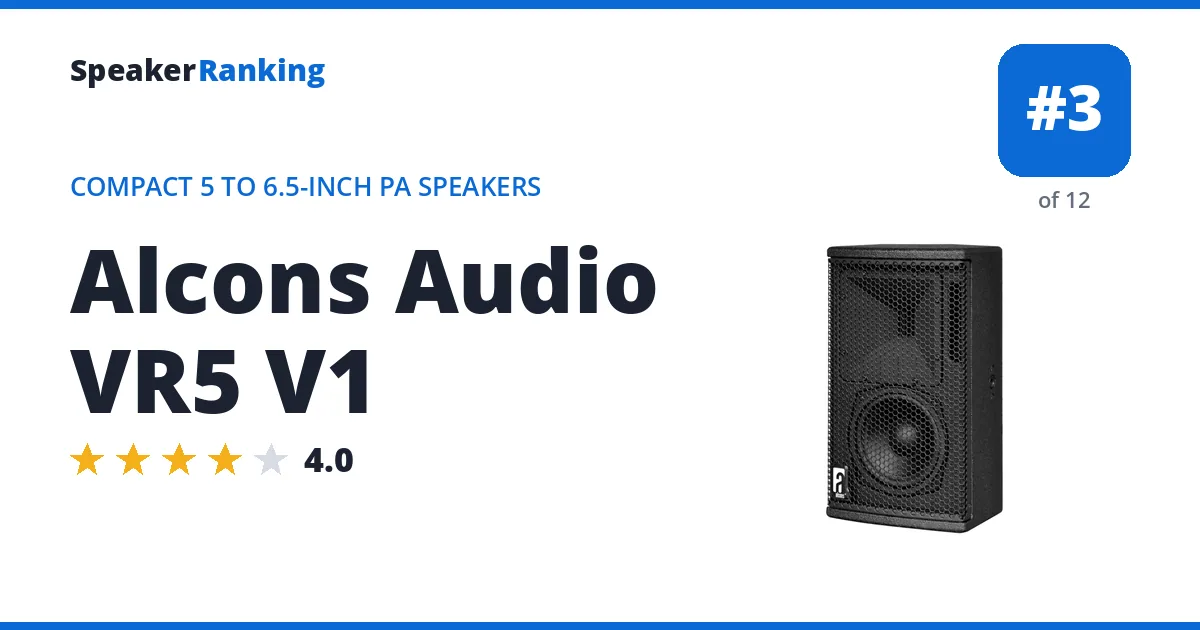
Pros: High-quality vendor Spinorama data gives preference scores of 4.04 standalone and 7.06 with an ideal subwoofer, and predicted in-room smoothness is 0.73. The pro-ribbon high-frequency driver stays linear at any level, and the compact cabinet suits near-field and stage monitor duty. Measured bass extension of 80Hz (-3dB).
Cons: Bass reaches only about 80Hz (-3dB), and listening-window narrow-band deviation is 0.408, so a subwoofer is needed for music. It is passive and priced by dealers well above ordinary compact monitors.
Full Alcons Audio VR5 V1 review and specifications →
| AES Input | No |
|---|---|
| Amplifier Power | Passive speaker; requires external amplification (500W peak input to the ribbon section) |
| Aux Input | No |
| Bass Extension (-3dB) | 80Hz (measured, vendor Spinorama data) |
| Bluetooth | No |
| Coaxial Input | No |
| Configuration | Passive 2-way compact monitor |
| DSP | No (passive) |
| Drivers | 5” mid-bass with Active Coil, RBN202 pro-ribbon |
| Guitar Input | No |
| HDMI Input | No |
| Microphone Input | No |
| Optical Input | No |
| RCA Input | No |
| Spinorama Preference Score | 4.04 |
| Spinorama Preference Score with Perfect Sub | 7.06 |
| TRS Input | No |
| USB Input | No |
| XLR Input | No |
- Links
- Reviews, Comparisons and Sound Samples
- Head-to-Head Comparisons
 Meyer Sound Ultra X22 eBay
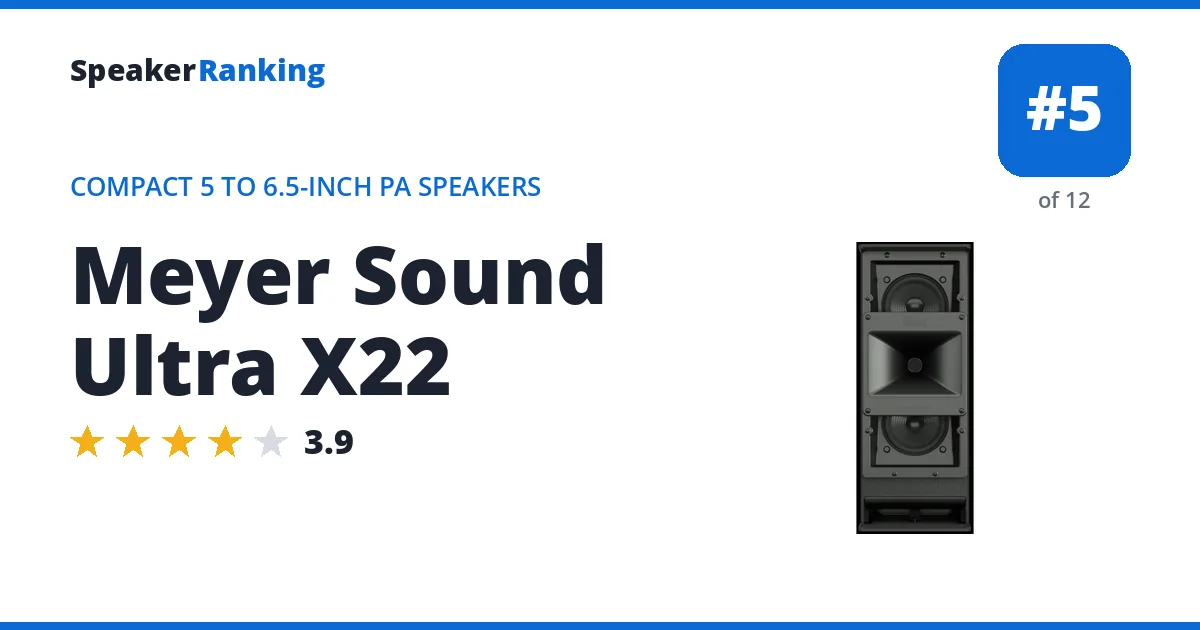
Pros: A self-powered coaxial design with a rotatable 80° x 50° horn, dual 5-inch drivers and 860W of total power, reaching 128.5dB peak. Vendor Spinorama data gives preference scores of 3.44 standalone and 6.25 with an ideal subwoofer, and bass reaches about 71Hz (-3dB). Measured bass extension of 71Hz (-3dB).
Cons: On-axis narrow-band deviation is 0.478 and predicted in-room smoothness is 0.51, less even than the best compact boxes here. Pricing is high for a compact box, and it is built as an installation loudspeaker rather than a grab-and-go monitor.
Full Meyer Sound Ultra X22 review and specifications →
| AES Input | No |
|---|---|
| Amplifier Power | 860W total peak |
| Aux Input | No |
| Bass Extension (-3dB) | 71Hz (measured, vendor Spinorama data) |
| Bluetooth | No |
| Coaxial Input | No |
| Configuration | Active 2-way coaxial PA speaker |
| Coverage | 80° x 50° (rotatable constant-Q horn) |
| DSP | Yes |
| Drivers | Dual 5” low-frequency drivers, 2” compression driver (concentric) |
| Guitar Input | No |
| HDMI Input | No |
| IP Rating | Weather-protected version available |
| Maximum SPL | 128.5dB peak (manufacturer specified, M-noise) |
| Microphone Input | No |
| Optical Input | No |
| RCA Input | No |
| Spinorama Preference Score | 3.44 |
| Spinorama Preference Score with Perfect Sub | 6.25 |
| TRS Input | No |
| USB Input | No |
| XLR Input | Yes |
- Links
- Reviews, Comparisons and Sound Samples
- Head-to-Head Comparisons