Short answer: the Aiwa Exos-10. It ranks #39 of 91 boombox speakers by sound quality (rated 3.5/5) at $159.99 and is still sold new; the Turtlebox ranks #87 (rated 2.1/5) and is discontinued, so it is only an option used.
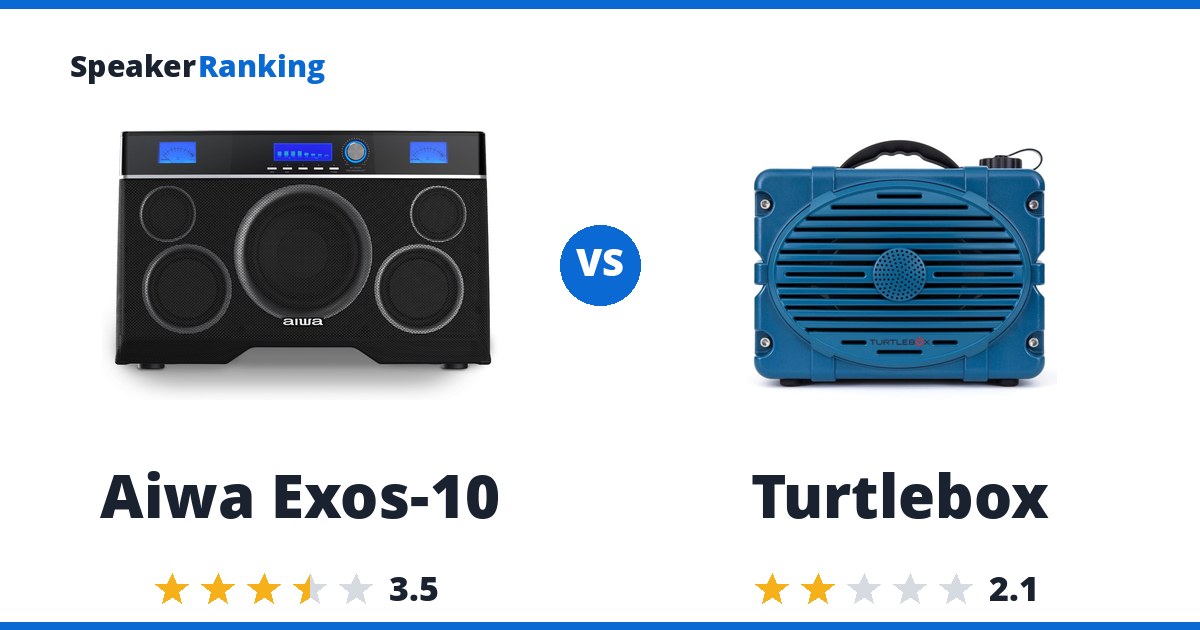
The Aiwa Exos-10 is the better-sounding option. Clear, clean treble with good separation of instruments and vocals, and no distortion even near full volume in a side by side test against the W-King X20, where it kept up in loudness at 90%. It links with other speakers (Party Sync, 100+ speakers), which the Turtlebox cannot. It has an adjustable EQ, which the Turtlebox lacks. The tradeoff: It lacks deep bass: even with bass maxed it rolls off around 50Hz, where the W-King X20 and Zealot boomboxes reach deeper, and it is about 2dB quieter at full volume.
The Turtlebox is the longer-running option. Waterproof and crushproof, loud with punchy bass. It is rated for 25 hours of battery against 12 for the Aiwa Exos-10. The catch: Sounds basically identical to the later Gen 2 and Gen 3: each generation mainly added features, not sound quality.
Buy the Aiwa Exos-10. It is rated higher for sound quality and still sold new, while the Turtlebox is discontinued.
Want more options? Browse the full Portable Bluetooth rankings.
Specifications Side By Side
| Aiwa Exos-10 | Turtlebox | |
|---|---|---|
| Price | $159.99 | $329 Discontinued |
| Ranked | #39 of 91 in Boombox Size Portable Bluetooth Speakers | #87 of 91 in Boombox Size Portable Bluetooth Speakers |
| Drivers | 6.5” (165mm) subwoofer + full-range drivers, 4 passive radiators | 1x 6x9” (152x228mm) woofer + 1x 1” (25mm) tweeter |
| Amplifier Power | 200W RMS (40W x 2 + 120W) | 50W |
| Battery Life | 12 hours (Manufacturer specified) | 25 hours (Manufacturer specified) |
| Removable Battery | No | - |
| Bluetooth | Yes | Yes |
| Bluetooth Version | 5.0 | 4.0 |
| Aux Input | Yes | Yes |
| USB Playback | Yes | No |
| FM Tuner | Yes | - |
| Party Mode | Yes (Party Sync, 100+ speakers) | No |
| EQ | Yes (bass and treble) | No |
| Stereo | Partially | Yes |
| Bass Extension (-10dB) | - | ~65Hz |
| IP Rating | - | IP67 |
| MicroSD Playback | - | Yes |
| Omnidirectional | - | No |
| Weight | - | 10 lbs (4.54 kg) |
| Bluetooth Codecs | - | SBC |
| App | - | No |
| TWS | - | Yes |
| Power Bank | - | No |
| Built-in Microphone | - | No |
| Power Input | - | AC Power brick |
| Dimensions | - | 12” x 7” x 8.7” (305 x 178 x 222 mm) |
| Digital Aux Input | - | No |
Related Speaker Comparisons
How Aiwa Exos-10 compares with other leading options:
- Tribit Stormbox Blast vs Aiwa Exos-10
- JBL Partybox Encore 2 vs Aiwa Exos-10
- JBL PartyBox On-The-Go 2 Plus vs Aiwa Exos-10
- JBL Partybox Encore Essential 2 vs Aiwa Exos-10
- JBL Partybox Encore Essential vs Aiwa Exos-10
Prices on this page were last checked October 4, 2026 at 9:58 PM UTC. Product prices and availability are accurate as of that date/time and are subject to change; the price and availability shown on Amazon at the time of purchase will apply to the purchase of this product.
As an eBay Partner, we may be compensated if you make a purchase.
The Two Speakers In Full
 Aiwa Exos-10: $159.99 Amazon eBay
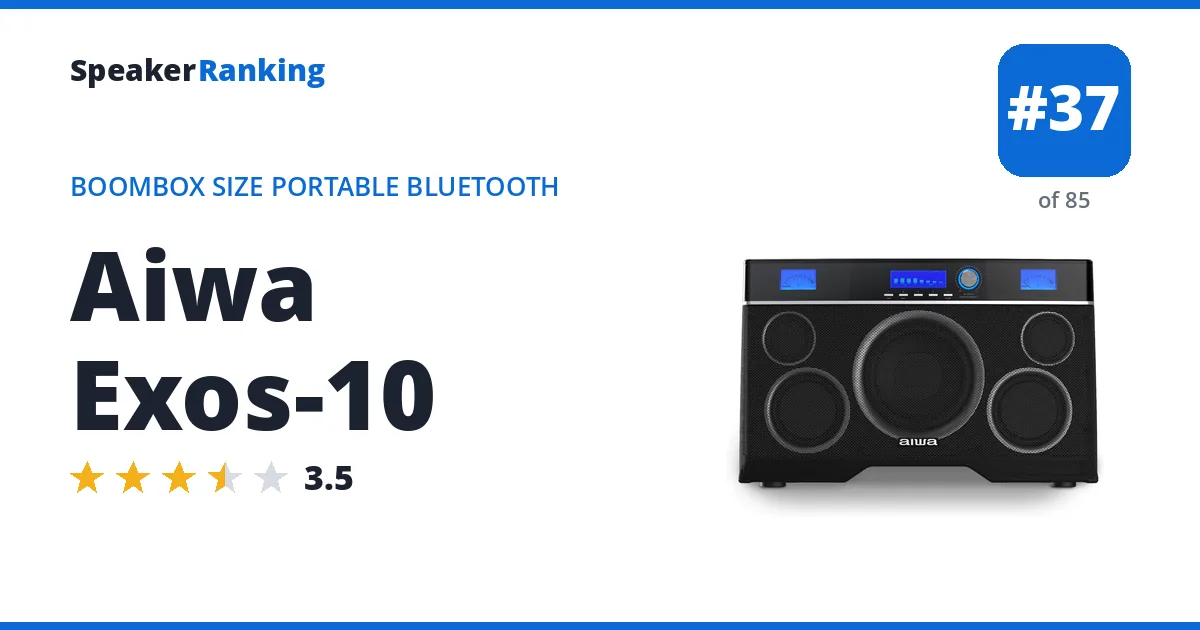
Older model: the Aiwa Exos-9 (ranked higher, rated 4.2/5).
Pros: Clear, clean treble with good separation of instruments and vocals, and no distortion even near full volume in a side by side test against the W-King X20, where it kept up in loudness at 90%. A 200W RMS tri-amplified design with a 6.5” woofer and four passive radiators, FM radio with presets, aux and USB inputs, a remote, analog-style VU meters and Party Sync with 100+ speakers.
Cons: It lacks deep bass: even with bass maxed it rolls off around 50Hz, where the W-King X20 and Zealot boomboxes reach deeper, and it is about 2dB quieter at full volume. Owners comparing it with the Aiwa Exos 9 it replaces find the older model clearer with tighter bass, and the Exos 10 drops the Exos 9’s 5-band EQ (only bass and treble) and removable battery. Claimed battery life is 12 hours.
Full Aiwa Exos-10 review and specifications →
| Amplifier Power | 200W RMS (40W x 2 + 120W) |
|---|---|
| Aux Input | Yes |
| Battery Life | 12 hours (Manufacturer specified) |
| Bluetooth | Yes |
| Bluetooth Version | 5.0 |
| Drivers | 6.5” (165mm) subwoofer + full-range drivers, 4 passive radiators |
| EQ | Yes (bass and treble) |
| FM Tuner | Yes |
| Party Mode | Yes (Party Sync, 100+ speakers) |
| Removable Battery | No |
| Stereo | Partially |
| USB Playback | Yes |
- Links
- Reviews, Comparisons and Sound Samples
- Head-to-Head Comparisons
 Turtlebox: $329 Discontinued eBay
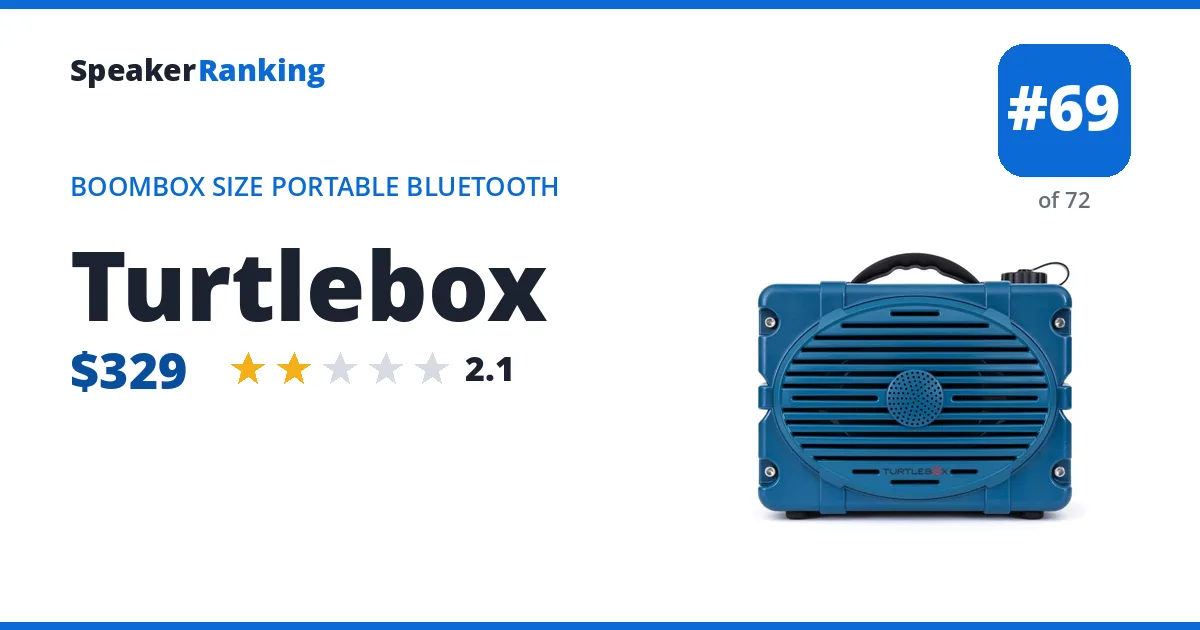
Newer model: the Turtlebox Gen 3, ranked higher, rated 2.1/5.
Pros: Waterproof and crushproof, loud with punchy bass. 25 hour battery life (6 hours at full volume). Pairs with a second unit for stereo. Measured bass extension of ~65Hz (-10dB).
Cons: Sounds basically identical to the later Gen 2 and Gen 3: each generation mainly added features, not sound quality. The nearly identical Gen 3 measured a V shaped tuning, with boosted lows and highs and dipped mids, yet bass only down 10dB at about 65Hz, and only about 12W RMS from its amp; Turtlebox rated this one at just 50W. It rattles at high volume. Nowhere near its claimed 120dB at a standard one meter distance. It charges from an external AC power brick. Inside is essentially a car audio 6x9 two way speaker in a plastic box. Discontinued.
Full Turtlebox review and specifications →
| Amplifier Power | 50W |
|---|---|
| App | No |
| Aux Input | Yes |
| Bass Extension (-10dB) | ~65Hz |
| Battery Life | 25 hours (Manufacturer specified) |
| Bluetooth | Yes |
| Bluetooth Codecs | SBC |
| Bluetooth Version | 4.0 |
| Built-in Microphone | No |
| Digital Aux Input | No |
| Dimensions | 12” x 7” x 8.7” (305 x 178 x 222 mm) |
| Drivers | 1x 6x9” (152x228mm) woofer + 1x 1” (25mm) tweeter |
| EQ | No |
| IP Rating | IP67 |
| MicroSD Playback | Yes |
| Omnidirectional | No |
| Party Mode | No |
| Power Bank | No |
| Power Input | AC Power brick |
| Stereo | Yes |
| TWS | Yes |
| USB Playback | No |
| Weight | 10 lbs (4.54 kg) |
- Links
- Reviews, Comparisons and Sound Samples
- Head-to-Head Comparisons