Short answer: the Neumann KH80 DSP is the more accurate compact monitor with room-correction capability, while the ADAM Audio T5V is the better budget choice for a little more bass weight. The Adam’s AMT presentation has appeal, but it is not as even through the top octave.
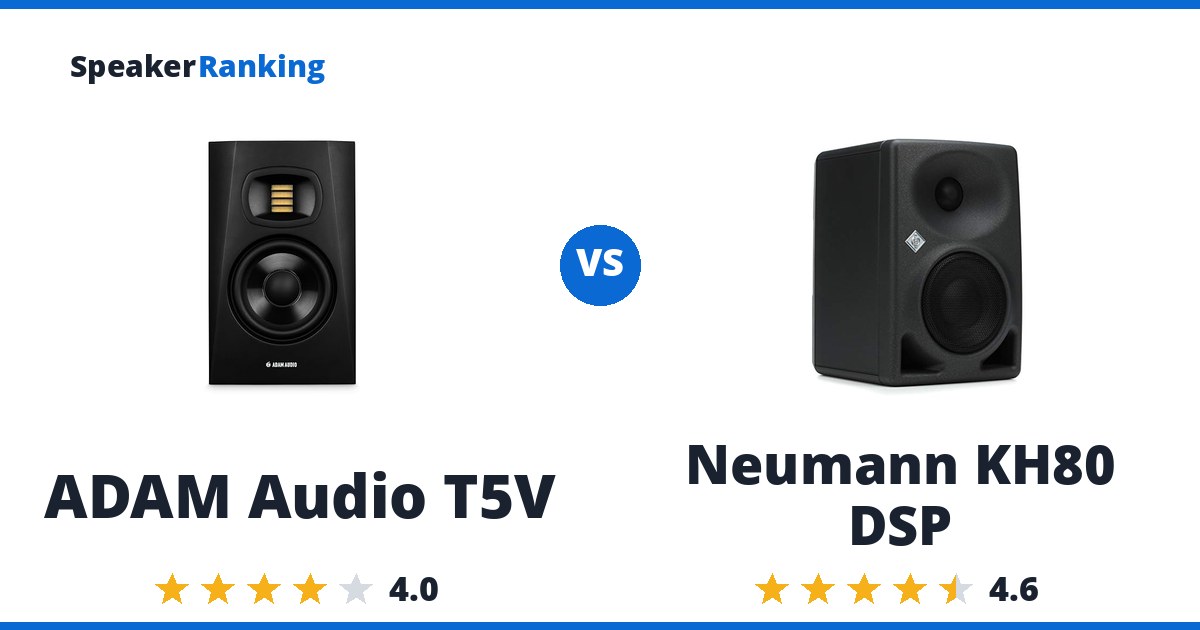
What the ADAM Audio T5V gets right: Better than the HS5 in terms of vocals detail and better low end. Set against that: Elevated, slightly uneven top end from the AMT tweeter, shared with Adam’s other T-series monitors; the rear treble trim only tilts.
On the Neumann KH80 DSP side: Near identical sound to the 8020D. The tradeoff: High price.
The T5V delivers useful vocal detail and stronger low end than several entry-level monitors, but its elevated treble is only broadly adjustable through a rear tilt control. The KH80 DSP is expensive for its small size and has limited bass reach, yet its neutral behavior and DSP correction make it the more reliable production tool.
Buy the ADAM Audio T5V for affordable nearfield monitoring with fuller low end.
Buy the Neumann KH80 DSP for compact reference monitoring and DSP-based room alignment.
Still deciding? The full Powered Home rankings cover every ranked option.
Prices on this page were last checked November 7, 2026 at 7:34 PM UTC. Product prices and availability are accurate as of that date/time and are subject to change; the price and availability shown on Amazon at the time of purchase will apply to the purchase of this product.
As an eBay Partner, we may be compensated if you make a purchase.
Specifications Side By Side
| ADAM Audio T5V | Neumann KH80 DSP | |
|---|---|---|
| Price | $464 per pair | $1,198 per pair |
| Ranked | #38 of 108 in Medium Size Powered Bookshelf Speakers | #4 of 108 in Medium Size Powered Bookshelf Speakers |
| Bass Extension (-3dB) | 58.6Hz (measured, Audio Science Review) | 57Hz (measured, Erin’s Audio Corner) |
| Bass Extension (-10dB) | 45.9Hz (derived, log-interpolated between spinorama.org -9dB/-12dB points) | 51Hz (measured, Erin’s Audio Corner) |
| Dimensions | 11.7”H x 7”W x 11.7”D (297.2 x 177.8 x 297.2 mm) | 13.6”H x 10.8”W x 9.6”D (345.4 x 274.3 x 243.8 mm) |
| Frequency Response | 58Hz - 24kHz (-3dB) (Manufacturer specified) | 57 Hz - 25 kHz (+-3 dB) (Manufacturer specified) |
| Inputs | XLR, RCA | XLR |
| Weight | 12.6 lbs (5.7 kg) each | 9 lbs (4.1 kg) each |
| Drivers | 5” (127mm) woofer | 4.1” woofer, 1” fabric dome tweeter |
| App | No | Yes (MA 1 alignment) |
| Bluetooth | No | No |
| EQ | Yes (Room adjustment) | Yes (via DSP) |
| Amplifier Power | 70w Per Speaker | 140W (90W woofer + 50W tweeter) |
| Spinorama Preference Score | 4.65 | 5.89 |
| Spinorama Preference Score with Perfect Sub | 7.02 | 8.25 |
| XLR Input | Yes | Yes |
| RCA Input | Yes | No |
| TRS Input | No | No |
| Optical Input | No | No |
| Coaxial Input | No | No |
| USB Input | No | No |
| HDMI Input | No | No |
| AES Input | No | No |
| Aux Input | No | No |
| DSP | - | Yes |
| Sensitivity | - | 91.9dB (measured at 0.3V/1m, Erin’s Audio Corner) |
| Maximum SPL | - | 110.7dB @ 1m (manufacturer specified) |
Related Speaker Comparisons
How Neumann KH80 DSP compares with other leading options: