Short answer: the Palmer STUDIMON 5. Both are rated 3.6/5 for sound quality (#44 and #43 of 67 powered bookshelf speakers), and the Palmer STUDIMON 5 costs $175 against $599.99 for the Adam Audio A4V, so with nothing between them on sound quality, price settles it.
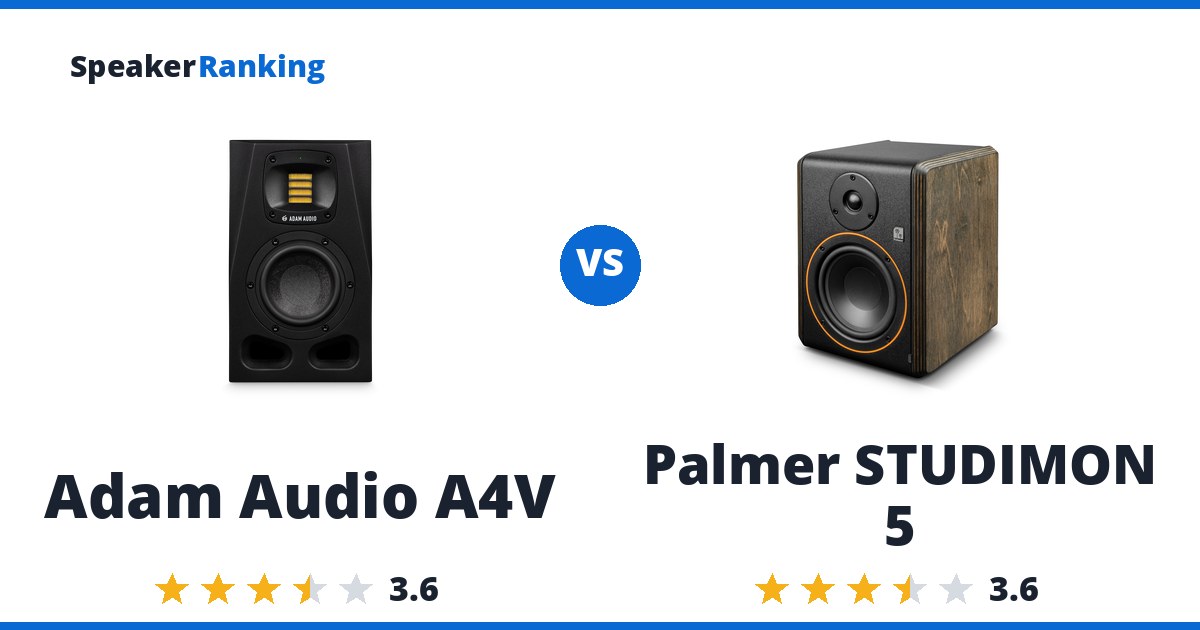
The case for the Adam Audio A4V: Compact monitor with onboard DSP, placement controls and room-correction integration. The catch: A small average-deviation figure hides a major localized response irregularity: the selected measurement spans 10.8dB from 300Hz to 5kHz, and listening-window narrow-band deviation is 0.547.
What the Palmer STUDIMON 5 does well: The available third-party measurements predict 3.48 standalone and 6.37 with an ideal subwoofer. Watch for: The trace spans 4.0dB from 300Hz to 5kHz and estimates -3dB bass around 80Hz, with local irregularities despite the level overall trend.
Buy the Palmer STUDIMON 5. Both are rated the same for sound quality, and it costs $424.99 less than the Adam Audio A4V.
Looking for alternatives? See the complete Powered Home rankings.
Specifications Side By Side
| Adam Audio A4V | Palmer STUDIMON 5 | |
|---|---|---|
| Price | $1,199.98 per pair | $350 per pair |
| Ranked | #43 of 67 in Medium Size Powered Bookshelf Speakers | #44 of 67 in Medium Size Powered Bookshelf Speakers |
| Enclosure | 2-way active, dual front ports | 2-way active, rear-ported |
| Drivers | X-ART folded-ribbon tweeter, 4" MLM woofer | 0.75" soft-dome tweeter, 5" woofer |
| Dimensions | 10.6H x 6.2W x 8.7D in | 10.6H x 7.5W x 8.5D in |
| Weight | 12.8 lbs (5.8 kg) each | 8.6 lbs (3.9 kg) each |
| Amplifier Power | 130W RMS each | 60W each (30W LF, 30W HF) |
| Inputs | XLR and RCA; Ethernet for control | Balanced XLR and 1/4" TRS |
| Spinorama Preference Score | 3.92 | 3.48 |
| Spinorama Preference Score with Perfect Sub | 6.33 | 6.37 |
| XLR Input | Yes | Yes |
| RCA Input | Yes | No |
| TRS Input | No | Yes |
| Optical Input | No | No |
| Coaxial Input | No | No |
| USB Input | No | No |
| HDMI Input | No | No |
| AES Input | No | No |
| Aux Input | No | No |
| Bluetooth | No | No |
| Frequency Response | 58Hz - 41kHz (-3dB) (Manufacturer specified) | 70Hz - 20kHz (-3dB) (Manufacturer specified) |
| Country | - | Germany (design) |
Related Speaker Comparisons
More top alternatives to Adam Audio A4V:
- Adam Audio A4V vs Genelec 8331A
- Neumann KH120 MKII vs Adam Audio A4V
- Genelec 8030C vs Adam Audio A4V
- Neumann KH80 DSP vs Adam Audio A4V
- Adam Audio A4V vs Dynaudio LYD 5
Prices on this page were last checked September 23, 2026 at 11:24 PM UTC. Product prices and availability are accurate as of that date/time and are subject to change; the price and availability shown on Amazon at the time of purchase will apply to the purchase of this product.
As an eBay Partner, we may be compensated if you make a purchase.
The Two Speakers In Full
 Adam Audio A4V: $1,199.98 per pair B&H Photo Video eBay
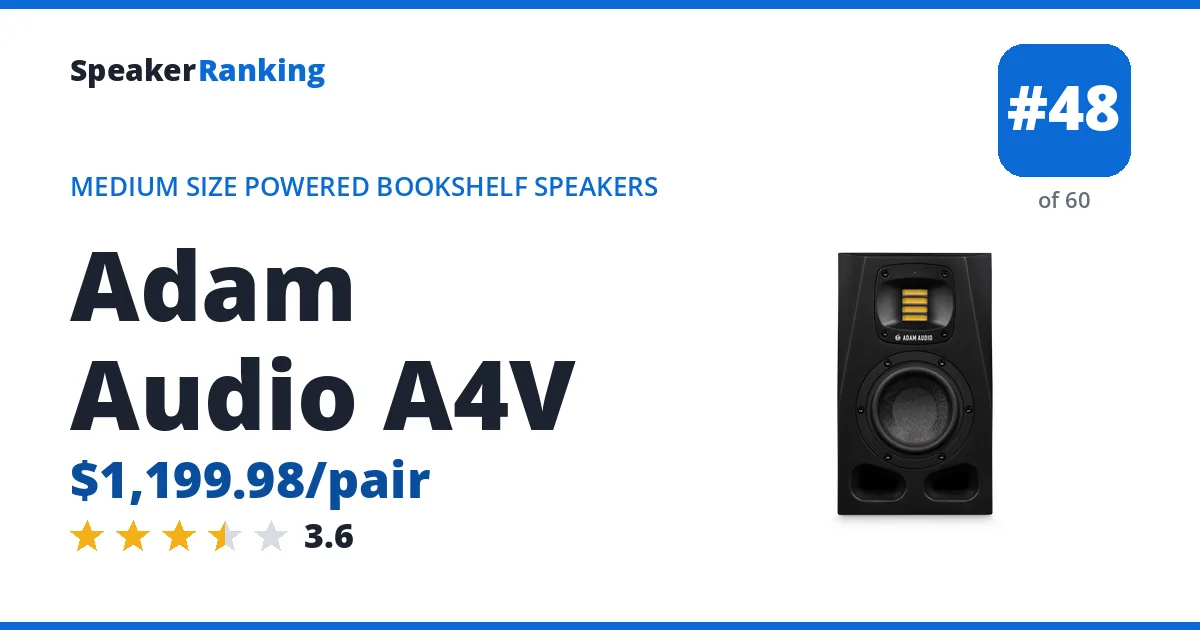
Pros: Compact monitor with onboard DSP, placement controls and room-correction integration. ASR’s Klippel data gives a -3dB point around 59Hz and preference scores of 3.92 standalone and 6.33 with an ideal subwoofer. Its adjustment facilities are useful when placement or tonal correction is needed.
Cons: A small average-deviation figure hides a major localized response irregularity: the selected measurement spans 10.8dB from 300Hz to 5kHz, and listening-window narrow-band deviation is 0.547. The native response should therefore not be called smoothly neutral. Correction potential is not the same as stock performance, and analog audio inputs mean a separate interface is needed for USB sources.
Full Adam Audio A4V review and specifications →
| AES Input | No |
|---|---|
| Amplifier Power | 130W RMS each |
| Aux Input | No |
| Bluetooth | No |
| Coaxial Input | No |
| Dimensions | 10.6H x 6.2W x 8.7D in |
| Drivers | X-ART folded-ribbon tweeter, 4" MLM woofer |
| Enclosure | 2-way active, dual front ports |
| Frequency Response | 58Hz - 41kHz (-3dB) (Manufacturer specified) |
| HDMI Input | No |
| Inputs | XLR and RCA; Ethernet for control |
| Optical Input | No |
| RCA Input | Yes |
| Spinorama Preference Score | 3.92 |
| Spinorama Preference Score with Perfect Sub | 6.33 |
| TRS Input | No |
| USB Input | No |
| Weight | 12.8 lbs (5.8 kg) each |
| XLR Input | Yes |
- Links
- Reviews, Comparisons and Sound Samples
- Head-to-Head Comparisons
 Palmer STUDIMON 5: $350 per pair Thomann eBay
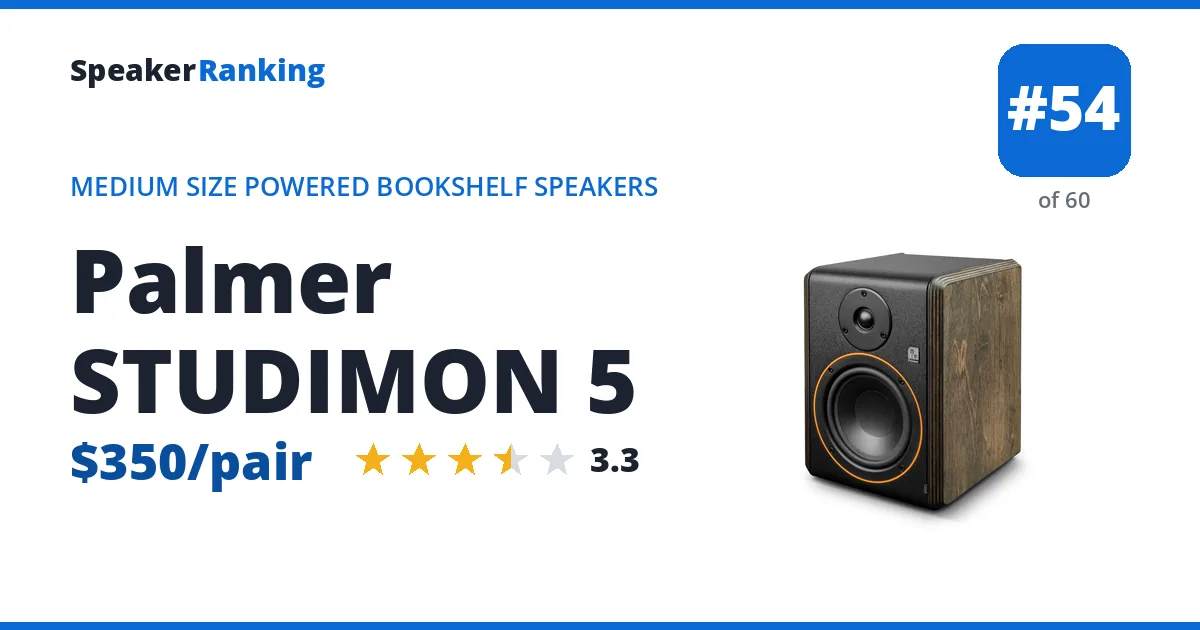
Pros: The available third-party measurements predict 3.48 standalone and 6.37 with an ideal subwoofer. Balanced inputs and a conventional compact monitor cabinet make it straightforward to use with studio equipment. The broad response trend is approximately level rather than strongly bright or dark.
Cons: The trace spans 4.0dB from 300Hz to 5kHz and estimates -3dB bass around 80Hz, with local irregularities despite the level overall trend. There are no room-EQ controls to address broad placement errors, and the available score does not establish clean output.
Full Palmer STUDIMON 5 review and specifications →
| AES Input | No |
|---|---|
| Amplifier Power | 60W each (30W LF, 30W HF) |
| Aux Input | No |
| Bluetooth | No |
| Coaxial Input | No |
| Country | Germany (design) |
| Dimensions | 10.6H x 7.5W x 8.5D in |
| Drivers | 0.75" soft-dome tweeter, 5" woofer |
| Enclosure | 2-way active, rear-ported |
| Frequency Response | 70Hz - 20kHz (-3dB) (Manufacturer specified) |
| HDMI Input | No |
| Inputs | Balanced XLR and 1/4" TRS |
| Optical Input | No |
| RCA Input | No |
| Spinorama Preference Score | 3.48 |
| Spinorama Preference Score with Perfect Sub | 6.37 |
| TRS Input | Yes |
| USB Input | No |
| Weight | 8.6 lbs (3.9 kg) each |
| XLR Input | Yes |
- Links
- Reviews, Comparisons and Sound Samples
- Head-to-Head Comparisons
- Palmer STUDIMON 5 vs Edifier MR4.5
- Palmer STUDIMON 5 vs Yamaha HS5
- Palmer STUDIMON 5 vs Presonus Eris E5 XT
- Palmer STUDIMON 5 vs Edifier S2000MKIII
- Palmer STUDIMON 5 vs Kanto YU
- Palmer STUDIMON 5 vs KRK Classic 5
- Palmer STUDIMON 5 vs Onkyo GX-30ARC
- Palmer STUDIMON 5 vs Edifier MR5
- See all 19 comparisons