Coverage note. Speaker Ranking currently covers 3 Razer models across headphones. These are the products in our database, not a complete list of everything Razer makes.
What this page covers. The Razer models ranked here span headphones, including Razer BlackShark V2 Pro, Razer Barracuda X and Razer BlackShark V2 X. Use each model’s category position to compare it with alternatives of the same size and use case.
This page lists all 3 Razer speakers ranked on this site across headphones. Each model is shown in the category where it competes, with its current rank and the size of that ranking.
Use the category position rather than the brand name alone: speakers from the same manufacturer can perform very differently by size, price and product family.
Prices on this page were last checked October 10, 2026 at 5:37 PM UTC. Product prices and availability are accurate as of that date/time and are subject to change; the price and availability shown on Amazon at the time of purchase will apply to the purchase of this product.
As an eBay Partner, we may be compensated if you make a purchase.
Over-Ear Headphones
 Ranked #110 of 134 in Over-Ear Headphones - Razer BlackShark V2 Pro: $109.99 Amazon eBay
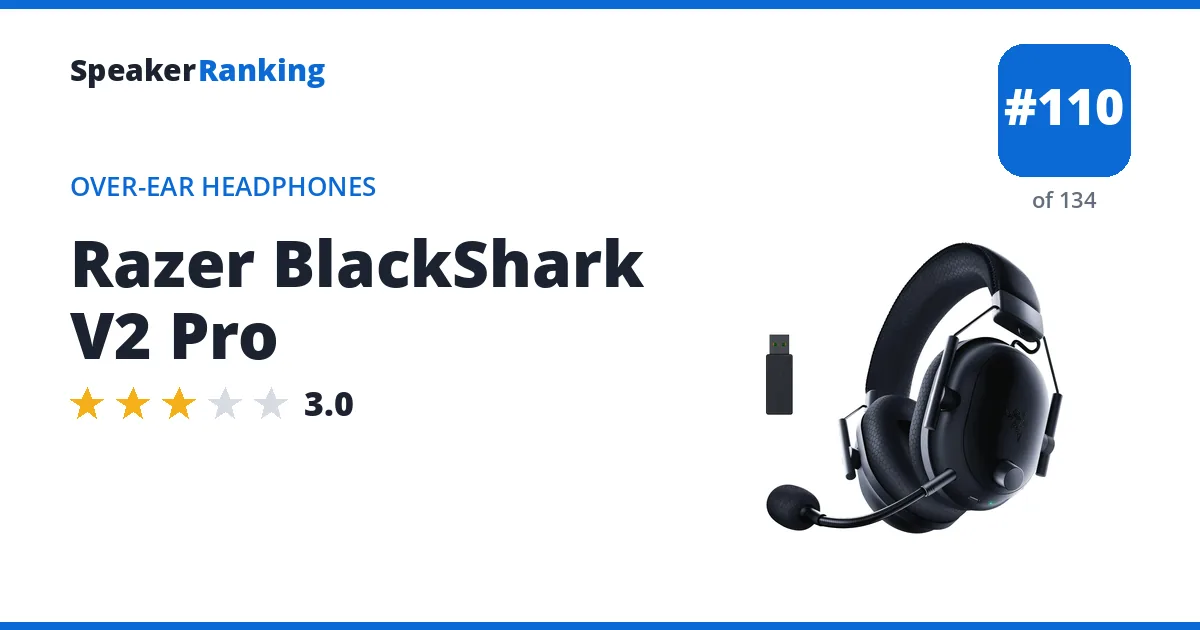
Pros: A wireless gaming headset with a built-in microphone, Bluetooth 5.2 and a rated 70 hours of battery, so it rarely needs charging. Its Harman preference score of 60 in crinacle’s measurement is fairly close to the target for a gaming headset. The 50mm driver at 32 ohms and 100 dB SPL/mW is easy to drive, and the price is low.
Cons: The response is uneven, with a standard deviation near 3.5 dB, so tonal balance drifts from the target in music. It has no active noise cancelling, and at 320 g it is on the heavy side. The Anker Soundcore Space One has a higher rating and offers ANC and LDAC for a lower price.
Full Razer BlackShark V2 Pro review and specifications →
| Released | Jun 2023 (3 years ago) |
|---|---|
| Active Noise Cancelling | No |
| Back | Closed |
| Battery Life | 70 hours (Manufacturer specified) |
| Bluetooth Version | 5.2 |
| Built-in Microphone | Yes |
| Connection | Wireless |
| Deviation From Target | 3.47 dB standard deviation |
| Driver Type | Dynamic |
| Drivers | 1 x 50mm dynamic |
| Form Factor | Over-ear |
| Frequency Response | 12Hz - 28kHz (Manufacturer specified) |
| Harman Preference Score | 60 (measured by crinacle, via AutoEQ) |
| IP Rating | None |
| Impedance | 32 ohms |
| Sensitivity | 100 dB SPL/mW |
| Tonal Tilt | -0.69 (negative is warmer, positive brighter) |
| Weight | 0.7 lbs (320 g) |
EQ preset to match the Harman target
Set a preamp of -5.4 dB, then add these filters in any parametric equalizer (Wavelet, Equalizer APO, Peace, or a player with parametric EQ). Calculated by AutoEQ from its measured frequency response.
| Filter | Frequency | Gain | Q |
|---|---|---|---|
| Low shelf | 105 Hz | +1.9 dB | 0.70 |
| Peak | 153 Hz | -7.6 dB | 0.72 |
| Peak | 625 Hz | +5.9 dB | 0.85 |
| Peak | 3,612 Hz | -4.0 dB | 4.82 |
| Peak | 398 Hz | +2.5 dB | 2.18 |
| High shelf | 10,000 Hz | -1.5 dB | 0.70 |
| Peak | 2,525 Hz | +2.7 dB | 3.01 |
| Peak | 1,373 Hz | -1.5 dB | 2.52 |
| Peak | 1,953 Hz | +1.0 dB | 3.23 |
| Peak | 3,166 Hz | -1.8 dB | 5.42 |
- Reviews, Comparisons and Sound Samples
- Head-to-Head Comparisons
 Ranked #132 of 134 in Over-Ear Headphones - Razer Barracuda X: $69.00 Amazon eBay
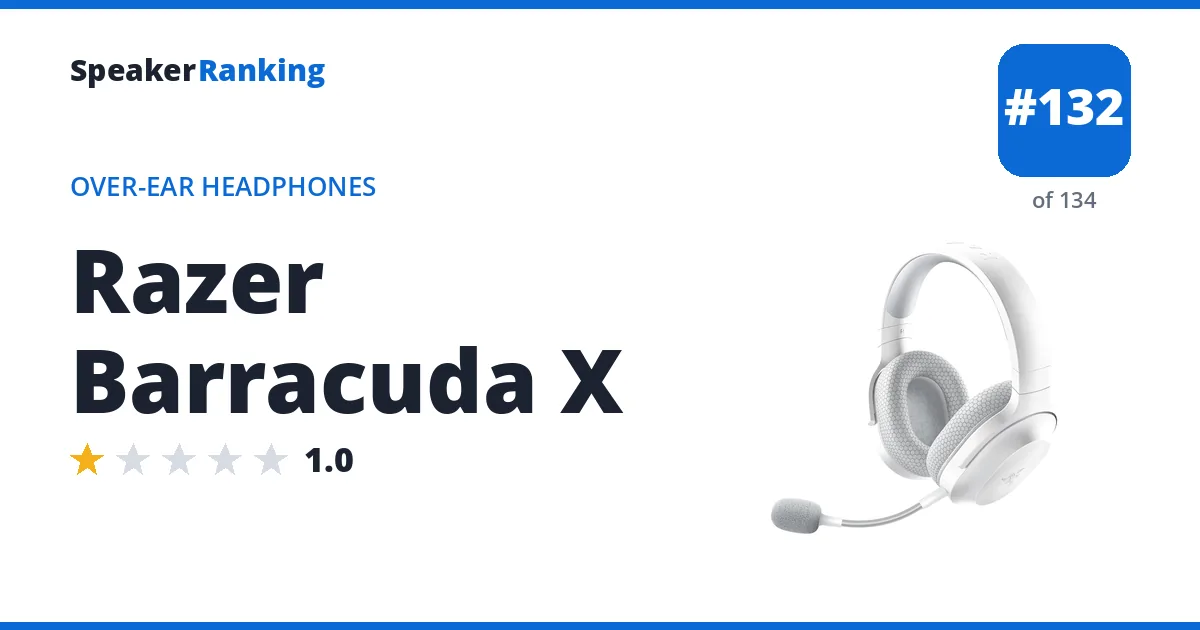
Pros: Wireless with a rated 50 hours of battery, Bluetooth 5.2, a built-in microphone and a wired option. At 250 g with 32 ohms and 96 dB sensitivity it is easy to drive. It has no active noise cancelling, so the battery goes a long way.
Cons: Crinacle’s measurement gives a preference score of just 7, among the furthest from the Harman target in the class, with a warm tilt and a very uneven response. Without noise cancelling it offers no real isolation from outside noise. The Logitech G Pro X is rated higher at a somewhat higher price.
Full Razer Barracuda X review and specifications →
| Released | Jul 2021 (5 years ago) |
|---|---|
| Active Noise Cancelling | No |
| Back | Closed |
| Battery Life | 50 hours (Manufacturer specified) |
| Bluetooth Version | 5.2 |
| Built-in Microphone | Yes |
| Connection | Wireless and wired |
| Deviation From Target | 5.15 dB standard deviation |
| Driver Type | Dynamic |
| Drivers | 1 x 40mm dynamic |
| Form Factor | Over-ear |
| Frequency Response | 20Hz - 20kHz (Manufacturer specified) |
| Harman Preference Score | 7 (measured by crinacle, via AutoEQ) |
| IP Rating | None |
| Impedance | 32 ohms |
| Sensitivity | 96 dB SPL/mW |
| Tonal Tilt | -2.74 (negative is warmer, positive brighter) |
| Weight | 0.6 lbs (250 g) |
EQ preset to match the Harman target
Set a preamp of -6.4 dB, then add these filters in any parametric equalizer (Wavelet, Equalizer APO, Peace, or a player with parametric EQ). Calculated by AutoEQ from its measured frequency response.
| Filter | Frequency | Gain | Q |
|---|---|---|---|
| Low shelf | 105 Hz | -2.4 dB | 0.70 |
| Peak | 4,094 Hz | +6.1 dB | 1.10 |
| Peak | 130 Hz | -9.0 dB | 1.11 |
| Peak | 607 Hz | -4.1 dB | 1.80 |
| Peak | 1,766 Hz | +4.0 dB | 1.64 |
| High shelf | 10,000 Hz | -2.5 dB | 0.70 |
| Peak | 286 Hz | +3.7 dB | 3.33 |
| Peak | 194 Hz | -2.2 dB | 2.83 |
| Peak | 440 Hz | -1.5 dB | 3.10 |
| Peak | 309 Hz | +0.8 dB | 2.49 |
- Reviews, Comparisons and Sound Samples
- Head-to-Head Comparisons
 Ranked #134 of 134 in Over-Ear Headphones - Razer BlackShark V2 X: $34.99 Amazon eBay
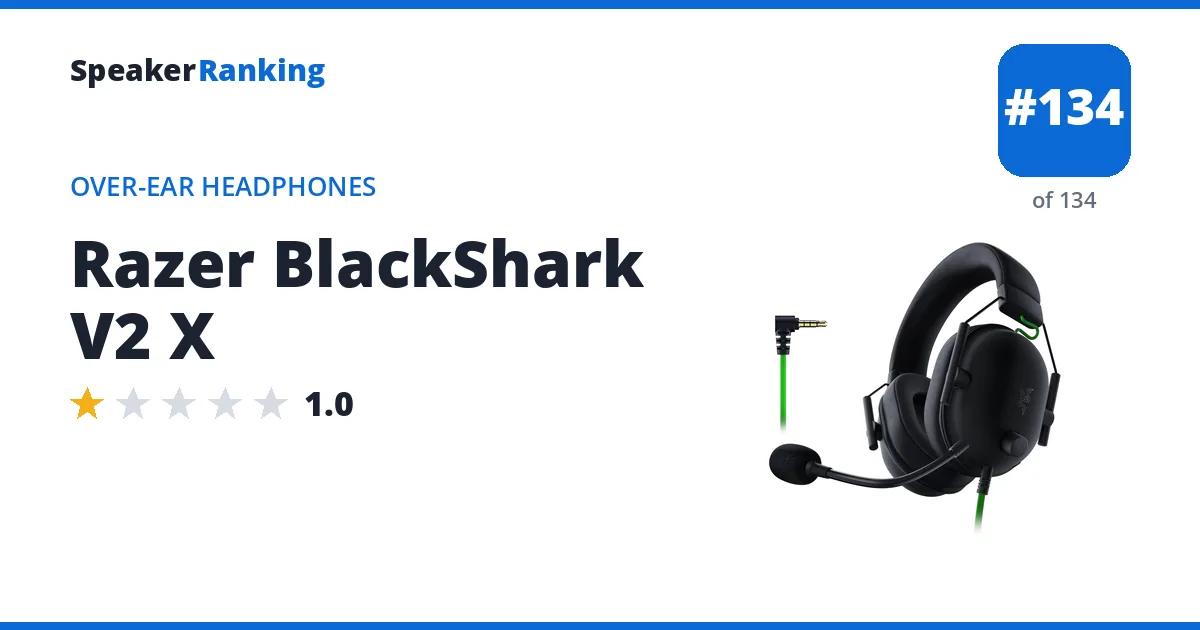
Pros: A built-in microphone makes it usable for voice chat without a separate headset. The 32 ohm impedance suits PC, console and phone outputs with no amp needed, and the closed back keeps game audio from leaking into the room. At 240 g with 50 mm drivers it is a straightforward wired gaming option at a low price.
Cons: Crinacle’s measurement gives a Harman score of just 1, so the tonal balance is a long way from what most listeners prefer. The response is uneven, with a deviation of about 5.4 dB and a warm tilt, which tends to cloud vocals and detail in music. It is better suited to casual gaming and chat than to critical listening.
Full Razer BlackShark V2 X review and specifications →
| Released | Aug 2020 (6 years ago) |
|---|---|
| Back | Closed |
| Built-in Microphone | Yes |
| Connection | Wired |
| Deviation From Target | 5.39 dB standard deviation |
| Driver Type | Dynamic |
| Drivers | 1 x 50mm dynamic |
| Form Factor | Over-ear |
| Frequency Response | 12Hz - 28kHz (Manufacturer specified) |
| Harman Preference Score | 1 (measured by crinacle, via AutoEQ) |
| Impedance | 32 ohms |
| Sensitivity | 100 dB SPL/mW |
| Tonal Tilt | -2.96 (negative is warmer, positive brighter) |
| Weight | 0.5 lbs (240 g) |
EQ preset to match the Harman target
Set a preamp of -5.6 dB, then add these filters in any parametric equalizer (Wavelet, Equalizer APO, Peace, or a player with parametric EQ). Calculated by AutoEQ from its measured frequency response.
| Filter | Frequency | Gain | Q |
|---|---|---|---|
| Low shelf | 105 Hz | -3.9 dB | 0.70 |
| Peak | 158 Hz | -13.0 dB | 0.91 |
| Peak | 825 Hz | +8.9 dB | 0.18 |
| Peak | 7,600 Hz | +3.5 dB | 3.10 |
| Peak | 808 Hz | -10.8 dB | 0.68 |
| High shelf | 10,000 Hz | +0.5 dB | 0.70 |
| Peak | 312 Hz | +3.1 dB | 3.28 |
| Peak | 477 Hz | -1.6 dB | 2.83 |
| Peak | 4,275 Hz | +1.7 dB | 4.98 |
| Peak | 216 Hz | -1.8 dB | 3.70 |
- Reviews, Comparisons and Sound Samples
- Head-to-Head Comparisons