Coverage note. Speaker Ranking currently covers 2 HyperX models across headphones. These are the products in our database, not a complete list of everything HyperX makes.
What this page covers. The HyperX models ranked here span headphones, including HyperX Cloud Alpha and HyperX Cloud II. Use each model’s category position to compare it with alternatives of the same size and use case.
This page lists all 2 HyperX speakers ranked on this site across headphones. Each model is shown in the category where it competes, with its current rank and the size of that ranking.
Use the category position rather than the brand name alone: speakers from the same manufacturer can perform very differently by size, price and product family.
Prices on this page were last checked October 10, 2026 at 5:37 PM UTC. Product prices and availability are accurate as of that date/time and are subject to change; the price and availability shown on Amazon at the time of purchase will apply to the purchase of this product.
As an eBay Partner, we may be compensated if you make a purchase.
Over-Ear Headphones
 Ranked #93 of 134 in Over-Ear Headphones - HyperX Cloud Alpha: $44.99 Amazon eBay
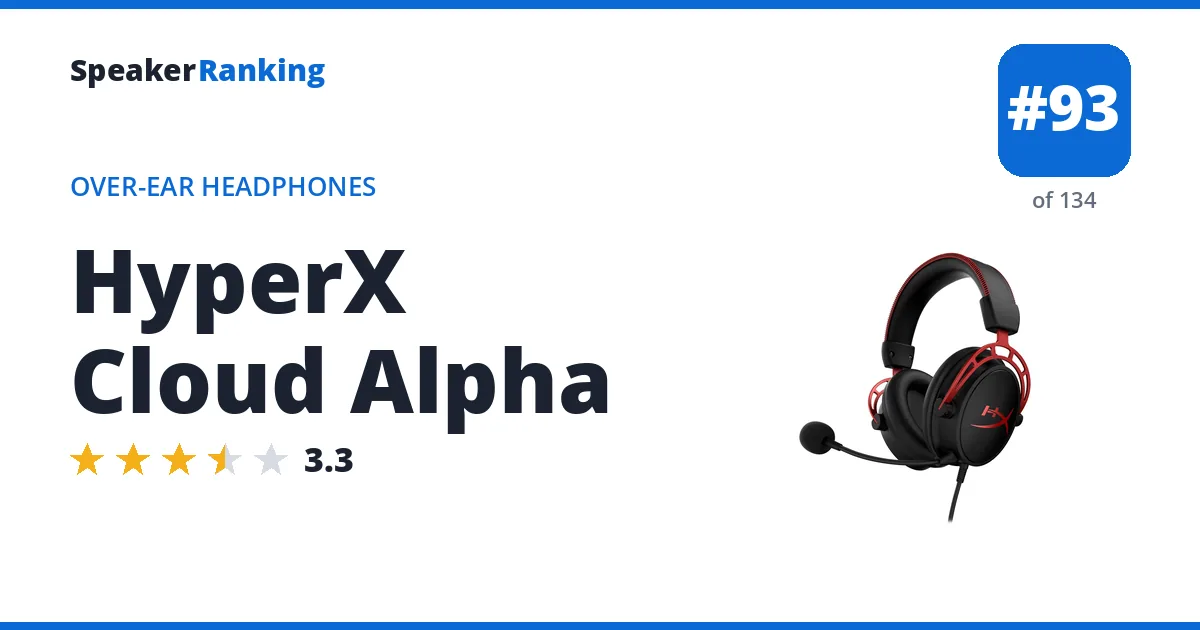
Pros: Bass from 60 to 200 Hz sits about 4 dB above the Harman target in oratory1990’s measurement, which gives kick drums and bass guitar extra weight for games and pop. The closed 50mm driver at 98 dB sensitivity and 65 ohms runs easily from a phone or console controller, and the built-in microphone suits voice chat.
Cons: Treble is uneven, with a 4.6 dB peak near 8 kHz that can make cymbals and sibilants sharp and a 5.8 dB dip near 4 kHz that pulls vocals slightly back. Air above 10 kHz runs about 4 dB hot, adding a hint of fizz on top of the warm tilt.
Full HyperX Cloud Alpha review and specifications →
| Released | Sep 2017 (9 years ago) |
|---|---|
| Back | Closed |
| Built-in Microphone | Yes |
| Connection | Wired |
| Deviation From Target | 2.80 dB standard deviation |
| Driver Type | Dynamic |
| Drivers | 1 x 50mm dynamic |
| Form Factor | Over-ear |
| Frequency Response | 13Hz - 27kHz (Manufacturer specified) |
| Harman Preference Score | 66 (measured by oratory1990, via AutoEQ) |
| Impedance | 65 ohms |
| Sensitivity | 98 dB SPL/mW |
| Tonal Tilt | -0.87 (negative is warmer, positive brighter) |
| Weight | 0.7 lbs (298 g) |
EQ preset to match the Harman target
Set a preamp of -6.3 dB, then add these filters in any parametric equalizer (Wavelet, Equalizer APO, Peace, or a player with parametric EQ). Calculated by AutoEQ from its measured frequency response.
| Filter | Frequency | Gain | Q |
|---|---|---|---|
| Low shelf | 105 Hz | +7.1 dB | 0.70 |
| Peak | 104 Hz | -5.9 dB | 0.23 |
| Peak | 733 Hz | +4.5 dB | 0.92 |
| Peak | 4,324 Hz | +6.7 dB | 2.87 |
| Peak | 6,110 Hz | -3.0 dB | 3.21 |
| High shelf | 10,000 Hz | -5.6 dB | 0.70 |
| Peak | 41 Hz | -0.4 dB | 2.00 |
| Peak | 159 Hz | +0.5 dB | 3.01 |
| Peak | 212 Hz | -0.5 dB | 3.66 |
| Peak | 1,964 Hz | +0.5 dB | 4.33 |
- Reviews, Comparisons and Sound Samples
- Head-to-Head Comparisons
 Ranked #113 of 134 in Over-Ear Headphones - HyperX Cloud II: $47.48 Amazon eBay
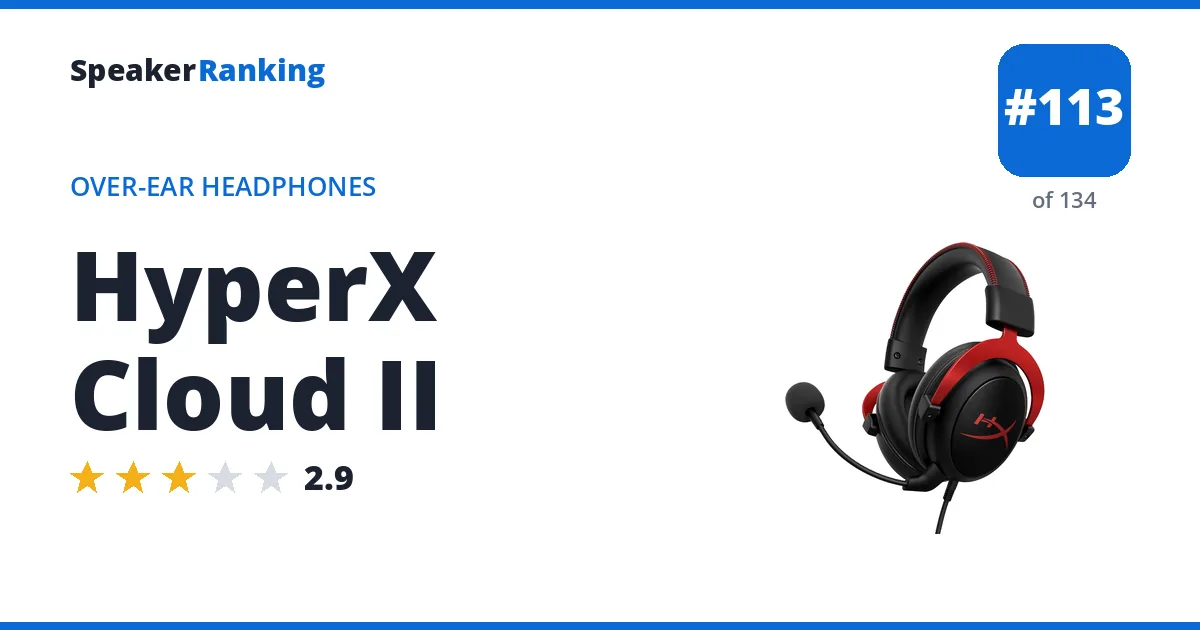
Pros: A built-in microphone and a closed-back design make it a ready-made gaming headset, and the 60 ohm impedance with 98 dB sensitivity means it runs easily from a PC or console. The large 53mm driver delivers bass about 4 dB above the Harman target, which suits listeners who want punchy explosions and a warm, bass-forward presentation. Sub-bass and the lower midrange sit close to target, so the low end is fuller without being muddy.
Cons: A deep dip of roughly 15 dB near 4.2 kHz hollows out presence, so voices and the attack of instruments sound recessed, while a peak of about 9 dB near 8.6 kHz adds a sharp, sizzly edge to cymbals and sibilance. Treble above 6 kHz runs about 4 to 5 dB hot, which can become fatiguing at higher volumes. The HyperX Cloud Alpha has a higher rating at a lower price.
Full HyperX Cloud II review and specifications →
| Released | Feb 2015 (11 years ago) |
|---|---|
| Back | Closed |
| Built-in Microphone | Yes |
| Connection | Wired |
| Deviation From Target | 3.60 dB standard deviation |
| Driver Type | Dynamic |
| Drivers | 1 x 53mm dynamic |
| Form Factor | Over-ear |
| Frequency Response | 15Hz - 25kHz (Manufacturer specified) |
| Harman Preference Score | 58 (measured by oratory1990, via AutoEQ) |
| Impedance | 60 ohms |
| Sensitivity | 98 dB SPL/mW |
| Tonal Tilt | -0.74 (negative is warmer, positive brighter) |
EQ preset to match the Harman target
Set a preamp of -6.4 dB, then add these filters in any parametric equalizer (Wavelet, Equalizer APO, Peace, or a player with parametric EQ). Calculated by AutoEQ from its measured frequency response.
| Filter | Frequency | Gain | Q |
|---|---|---|---|
| Low shelf | 105 Hz | +4.1 dB | 0.70 |
| Peak | 170 Hz | -7.0 dB | 1.06 |
| Peak | 271 Hz | +3.7 dB | 0.58 |
| Peak | 3,828 Hz | +5.4 dB | 3.60 |
| Peak | 57 Hz | -4.8 dB | 0.58 |
| High shelf | 10,000 Hz | -7.0 dB | 0.70 |
| Peak | 8,085 Hz | -3.0 dB | 3.98 |
| Peak | 2,378 Hz | -1.9 dB | 2.78 |
| Peak | 3,700 Hz | +1.3 dB | 2.71 |
| Peak | 1,123 Hz | +1.1 dB | 3.29 |
- Reviews, Comparisons and Sound Samples
- Head-to-Head Comparisons