Coverage note. Speaker Ranking currently covers 9 Dynaudio models across powered speakers and passive speakers (plus 1 not yet ranked). These are the products in our database, not a complete list of everything Dynaudio makes.
What this page covers. The Dynaudio models ranked here span powered speakers and passive speakers, including Dynaudio LYD 5, Dynaudio Heritage Special and Dynaudio Contour 20i. Use each model’s category position to compare it with alternatives of the same size and use case.
This page lists all 9 Dynaudio speakers ranked on this site across powered speakers and passive speakers. Each model is shown in the category where it competes, with its current rank and the size of that ranking.
Use the category position rather than the brand name alone: speakers from the same manufacturer can perform very differently by size, price and product family.
Prices on this page were last checked September 30, 2026 at 2:57 PM UTC. Product prices and availability are accurate as of that date/time and are subject to change; the price and availability shown on Amazon at the time of purchase will apply to the purchase of this product.
As an eBay Partner, we may be compensated if you make a purchase.
Quick Navigation
- Medium Size Powered Bookshelf Speakers
- Large Size Bookshelf Speakers
- Large Size Floorstanding Speakers
- Discontinued Dynaudio Models
- Dynaudio Models Not Yet Ranked
Medium Size Powered Bookshelf Speakers
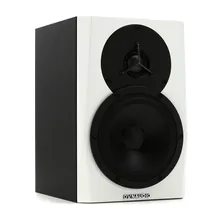 Ranked #6 of 68 in Medium Size Powered Bookshelf Speakers - Dynaudio LYD 5: $998 per pair B&H Photo Video eBay
Pros: ASR’s Klippel data is substantially stronger than a low ranking suggests: 4.72 standalone and 7.38 with an ideal subwoofer, with a 1.9dB span from 300Hz to 5kHz. Low listening-window narrow-band deviation of 0.242 supports relatively uncolored midrange reproduction. It is particularly competitive when used with a subwoofer rather than judged only by bass reach. Measured bass extension of 68Hz (-3dB).
Cons: Bass reaches -3dB around 72Hz, so it gives up low-frequency weight to deeper-reaching monitors. The existing review identifies a dip near 1.6kHz, upper-bass emphasis and uneven crossover-region dispersion. These issues and limited deep-bass capability keep it below the leading all-rounders despite its strong bass-normalized score. A subwoofer does not correct upper-frequency directivity errors.
Full Dynaudio LYD 5 review and specifications →
| AES Input | No |
|---|---|
| Amplifier Power | 100W total (50W LF, 50W HF) |
| App | No |
| Aux Input | No |
| Bass Extension (-10dB) | 50Hz (measured, Audio Science Review) |
| Bass Extension (-3dB) | 68Hz (measured, Audio Science Review) |
| Bluetooth | No |
| Coaxial Input | No |
| DSP | No |
| Dimensions | 10.2”H x 6.7”W x 8.3”D (260 x 170 x 211 mm) |
| Drivers | 5” woofer, 28mm soft dome tweeter |
| EQ | No |
| Frequency Response | 50Hz - 21kHz (Manufacturer specified) |
| HDMI Input | No |
| Inputs | XLR, RCA |
| Optical Input | No |
| RCA Input | Yes |
| TRS Input | No |
| USB Input | No |
| Weight | 11.9 lbs (5.4 kg) each |
| XLR Input | Yes |
- Links
- Reviews, Comparisons and Sound Samples
- Head-to-Head Comparisons
Large Size Bookshelf Speakers
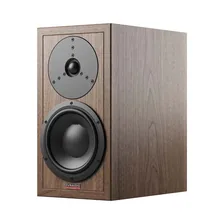 Ranked #28 of 134 in Large Size Bookshelf Speakers - Dynaudio Heritage Special: $7,000 per pair Safe and Sound HQ eBay
Pros: One of the rare cases where the reviewer measured a speaker as flawed but still genuinely enjoyed listening to it. A massive 4” voice coil on the midwoofer gives it exceptional output capability for a bookshelf speaker: averaged 100dB at 3.5 meters with no audible mechanical noise, port chuffing, or woofer bottoming even when deliberately pushed hard. Bass is very robust and doesn’t noticeably give up output as volume increases, staying solid at both low and high listening levels. Big, well-proportioned soundstage: wide without losing image focus. Limited run of 2,500 pairs with genuine collectible/heritage value; the tweeter (Esotar 3) and midwoofer both use premium Dynaudio-made drivers with an unusually wide, stout voice coil. Measured bass extension of 52Hz (-3dB), with a measured sensitivity of 85dB.
Cons: At lower listening volumes, dynamic range and kick-drum punch fell short of higher-sensitivity speakers the reviewer has tested (JBL 4367, KEF Reference 1 Meta): the sheer output ceiling is impressive, but it isn’t a highly dynamic-sounding speaker at modest levels. A degree of “softness” in the upper mid-range. Selective sibilance in the 4-6kHz treble region that shows up on some tracks but not others, which the reviewer found mildly aggravating and would want to EQ down given the choice. Neither the tweeter nor the woofer is fully flush-mounted to the baffle, likely intentional as part of the heritage-styled look, but the reviewer wonders how much this affected linearity. At $7000/pair MSRP (and a discontinued limited run, so used/open-box pricing around $5,000/pair is about the best you’ll do now), this is a serious investment for a bookshelf speaker.
Full Dynaudio Heritage Special review and specifications →
| Bass Extension (-10dB) | 38Hz (measured, Erin’s Audio Corner) |
|---|---|
| Bass Extension (-3dB) | 52Hz (measured, Erin’s Audio Corner) |
| Country | Denmark |
| DIY Kit | No |
| Dimensions | 15.2”H x 8.2”W x 12.6”D (385 x 208 x 320 mm) |
| Drivers | 18cm MSP cone woofer, 28mm Esotar 3 dome tweeter |
| Impedance | 5.1 ohms minimum, ported mode (measured, Erin’s Audio Corner) |
| Sensitivity | 85dB (measured at 2.83V/1m, Erin’s Audio Corner) |
| Spinorama Preference Score | 4.32 |
| Spinorama Preference Score with Perfect Sub | 6.33 |
| Weight | 24.3 lbs (11 kg) each |
- Links
- Reviews, Comparisons and Sound Samples
- Head-to-Head Comparisons
- Dynaudio Heritage Special vs Radiant Acoustics Clarity 6.2
- Dynaudio Heritage Special vs MoFi SourcePoint 10
- Dynaudio Heritage Special vs Wharfedale Linton 85
- Dynaudio Heritage Special vs Wharfedale Super Linton
- Dynaudio Heritage Special vs Ascend Acoustics Sierra-LX
- Dynaudio Heritage Special vs Ascend Acoustics CMT-340 SE2
- Dynaudio Heritage Special vs Arendal 1528 Monitor 8
- Dynaudio Heritage Special vs Revel M126Be
- See all 48 comparisons
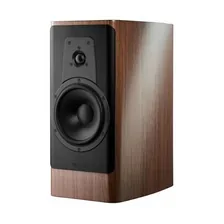 Ranked #62 of 134 in Large Size Bookshelf Speakers - Dynaudio Contour 20i: $5750 per pair Safe and Sound HQ eBay
Pros: Two-way design with a 1.125” Esotar2i silk dome tweeter and a 7” magnesium silicate polymer woofer in a vented enclosure. A shallow bass rolloff profile lets it sit closer to a wall (about 1-2 feet worked best in testing) without becoming boomy, and makes subwoofer integration comparatively easy. Very wide horizontal radiation (about ±70° through the midrange) gives an enveloping, spacious sound in a suitably sized room. On-axis response holds within about ±3dB overall and ±1.5dB through the midrange. Attractive build quality with a distinctive metal front baffle and gloss finish options. Long-term compression stays good up to 96dB, and short-term compression is within about 0.5dB at that same level. Measured bass extension of 56Hz (-3dB).
Cons: Notably room-dependent: sounds too bright in the lower treble in smaller rooms with close sidewalls, needing sidewall absorption to sound neutral, while performing better in larger or more open rooms without that treatment. A roughly 2dB lift in the lower treble combined with wide dispersion means more energy reflecting off sidewalls than some listeners will prefer. Relatively low sensitivity (about 82.5dB measured). Unusually sensitive to amplifier output impedance: high-output-impedance amps like tube or SET designs introduce up to a 2dB dip in the midrange, making the sound more mellow rather than “warmer,” the opposite of what many tube-amp buyers expect. Elevated harmonic and multitone distortion around 700Hz, which the reviewer attributes to typical cone-edge/surround behavior common across many driver brands, though it stands out on the measurement graphs. An upper-midrange dip around 2kHz can reduce attack and clarity on vocals and brass instruments. Vertical listening window is fairly narrow (roughly -20° to +30°): moving outside that range causes a noticeable tonal shift, unlike coaxial designs that tolerate more vertical movement.
Full Dynaudio Contour 20i review and specifications →
| Bass Extension (-10dB) | 32Hz (measured, Erin’s Audio Corner) |
|---|---|
| Bass Extension (-3dB) | 56Hz (measured, Erin’s Audio Corner) |
| DIY Kit | No |
| Dimensions | 17.4”H x 8.5”W x 14.2”D (442 x 215.9 x 360.7 mm) |
| Drivers | 18 cm MSP woofer, 28mm Esotar 2i with Hexis tweeter |
| Impedance | 4 ohms |
| Sensitivity | 82.5dB |
| Weight | 30.9 lbs (14 kg) each |
| Woofer Cabinet | ported, rear |
- Links
- Reviews, Comparisons and Sound Samples
- Head-to-Head Comparisons
- Dynaudio Contour 20i vs SVS Ultra Bookshelf
- Dynaudio Contour 20i vs Technics SB-C700
- Dynaudio Contour 20i vs Definitive Technology Demand D11
- Dynaudio Contour 20i vs Yamaha NS-800A
- Dynaudio Contour 20i vs ELAC DBR62
- Dynaudio Contour 20i vs Infinity Reference R162
- Dynaudio Contour 20i vs Ascend CBM-170 SE2
- Dynaudio Contour 20i vs ELAC Uni-Fi Reference UBR62
- See all 58 comparisons
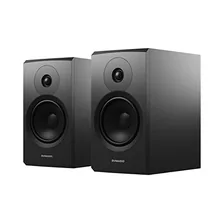 Ranked #77 of 134 in Large Size Bookshelf Speakers - Dynaudio Emit 20: $1,049.00 per pair Amazon eBay
Pros: Two-way design with a 28mm Esotar soft dome tweeter (Hexis-damped) and an 18cm mid-woofer, using a first-order crossover on the tweeter and second-order on the woofer. Exceptional bass extension for a bookshelf speaker: reaches a clean, authoritative 40Hz in-room, rare enough that the reviewer says most listeners could skip a subwoofer for typical music. Very low distortion across the board, staying below 1% THD down to 40Hz at 86dB and below 3% even at 96dB: unusually clean bass performance where most two-way bookshelf speakers start rising in distortion around 80Hz. Wide, remarkably consistent horizontal directivity (about ±50-60°) that holds steady up to roughly 13kHz: rare for a speaker in this format, thanks to a beveled tweeter edge that acts as a mild waveguide. Excellent compression and dynamic-range linearity at the frequency extremes, actually showing slight bass enhancement rather than the sharp low-end compression common in similarly-sized bookshelf speakers. Measured bass extension of 54Hz (-3dB), with a measured sensitivity of 83.5dB.
Cons: A resonance around 600-800Hz gives snares and similar percussion a muffled, flat quality lacking impact: confirmed as originating in the woofer itself (isolated via measurements of the raw driver out of the cabinet), and attempts at constrained-layer damping didn’t resolve it. A peak around 4kHz adds a sharp, edgy quality to some male vocals. A roughly 5dB boost above 10kHz gives cymbals and hi-hats excess shimmer that can sound unnatural, especially pointed directly on-axis. Vertical dispersion shows two separate crossover-related notches (above and below the tweeter reference line around 5kHz) rather than the usual single one, a direct consequence of the shallow crossover slopes used on both drivers. Multitone distortion is elevated in the midrange, possibly due to the woofer’s magnet structure lacking a shorting ring. Best aimed slightly off-axis (about 10-15° of toe-out) to tame the excess high-frequency shimmer, rather than pointed straight at the listener.
Full Dynaudio Emit 20 review and specifications →
| Bass Extension (-10dB) | 33Hz (measured, Erin’s Audio Corner) |
|---|---|
| Bass Extension (-3dB) | 54Hz (measured, Erin’s Audio Corner) |
| DIY Kit | No |
| Dimensions | 14.6”H x 8.1”W x 12.3”D (370.0 x 205.0 x 312.0 mm) |
| Drivers | 7.1” Magnesium Silicate Polymer woofer, 1.1” Cerotar soft dome with Hexis tweeter |
| Impedance | 6 ohms nominal (5.5 ohms minimum above 80Hz, measured, Erin’s Audio Corner) |
| Sensitivity | 83.5dB (measured, Erin’s Audio Corner; 86dB manufacturer specified) |
| Spinorama Preference Score | 4.22 |
| Spinorama Preference Score with Perfect Sub | 5.92 |
| Weight | 12.8 lbs (5.8 kg) |
| Woofer Cabinet | ported, rear |
- Links
- Reviews, Comparisons and Sound Samples
- Head-to-Head Comparisons
- Dynaudio Emit 20 vs Philharmonic BMR Monitor
- Dynaudio Emit 20 vs Klipsch RP-600M II
- Dynaudio Emit 20 vs JBL Studio 630
- Dynaudio Emit 20 vs Behringer B2030P
- Dynaudio Emit 20 vs Mission LX-3 MKII
- Dynaudio Emit 20 vs Polk Signature Elite ES20
- Dynaudio Emit 20 vs Ascend CBM-170 SE2
- Dynaudio Emit 20 vs GR-Research X-LS Encore
- See all 68 comparisons
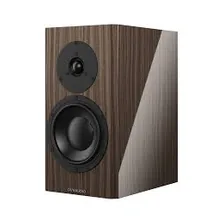 Ranked #88 of 134 in Large Size Bookshelf Speakers - Dynaudio Special Forty: $3600 per pair Safe and Sound HQ eBay
Pros: Smooth, “buttery” overall tonal character consistent with Dynaudio’s house sound. Surprisingly precise, focused imaging despite wide horizontal radiation (about ±70°): atypical, since wide-radiating speakers usually sacrifice some image precision in reflective rooms. Strong output capability: reached 100-101dB average at 3.5 meters with no audible distortion or woofer distress, and compression testing at 102dB shows the cabinet holding up mechanically well at extreme output. Bass reaches a genuine 50Hz (potentially 40Hz) in most rooms from a rear-ported design. Distortion stays below 1% at 86dB and doesn’t cross 3% THD until about 50Hz even at 96dB. Extra weight and impact on snares and percussion around 700-800Hz that the reviewer found appealing on many tracks. Measured bass extension of 54Hz (-3dB), with a measured sensitivity of 83.5dB.
Cons: A glaring, sometimes sibilant quality around 3-4kHz was the most noticeable issue in listening, the one thing the reviewer would want notched out with EQ. Multiple enclosure resonances appear between 500Hz-1kHz across on-axis, listening window, early-reflections, and sound-power measurements, corroborated by independent third-party CSD data showing similar 500-800Hz cabinet resonances. A dip around 1.2kHz traces to a cone-edge-to-surround compliance mismatch in the driver itself (confirmed by testing the bare driver’s impedance): a known artifact common to many similarly-sized drivers across several manufacturers, contributing to elevated second-order distortion in that region. A somewhat laid-back, recessed 1-2kHz character (sometimes described as a “BBC dip”) gives an overall subdued quality that isn’t overtly problematic but shapes the tonal balance. Impedance drops below 3 ohms in the 100-200Hz region, requiring a genuinely 4-ohm-stable amplifier rather than an AVR. Rear port means it can’t be placed directly against a wall.
Full Dynaudio Special Forty review and specifications →
| Bass Extension (-10dB) | 39Hz (measured, Erin’s Audio Corner) |
|---|---|
| Bass Extension (-3dB) | 54Hz (measured, Erin’s Audio Corner) |
| DIY Kit | No |
| Dimensions | 14.1”H x 7.7”W x 12.1”D (358.1 x 195.6 x 307.3 mm) |
| Drivers | 5.9” MSP (Magnesium Silicate Polymer) cone woofer, 1” Esotar soft dome tweeter |
| Impedance | 6 ohms nominal (4.9 ohms minimum above 80Hz, measured, Erin’s Audio Corner) |
| Sensitivity | 83.5dB (measured, Erin’s Audio Corner; 86dB manufacturer specified) |
| Spinorama Preference Score | 4.73 |
| Spinorama Preference Score with Perfect Sub | 6.74 |
| Weight | 17.9 lbs (8.1 kg) each |
| Woofer Cabinet | ported |
- Links
- Reviews, Comparisons and Sound Samples
- Head-to-Head Comparisons
- Dynaudio Special Forty vs ELAC Debut 2.0 B6.2
- Dynaudio Special Forty vs Infinity IL10
- Dynaudio Special Forty vs SVS Prime Bookshelf
- Dynaudio Special Forty vs GR-Research X-LS Encore
- Dynaudio Special Forty vs KEF Q3 Meta
- Dynaudio Special Forty vs Polk Monitor XT20
- Dynaudio Special Forty vs Sonus Faber Lumina II
- Dynaudio Special Forty vs Mission LX-3 MKII
- See all 56 comparisons
Large Size Floorstanding Speakers
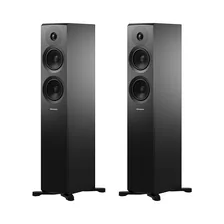 Ranked #50 of 74 in Large Size Floorstanding Speakers - Dynaudio Emit 30: $1,274.25 per pair Amazon eBay
Pros: A 2.5-way floorstander: two 5.25” mid-woofers paired with a roughly 1” dome tweeter, driven through dual rear bass-reflex ports. The two woofers hand off at staggered crossover points (around 1kHz and 3.5kHz) rather than sharing one, which avoids the acoustic lobing a shared crossover point would cause between the tweeter and the lower woofer, and adds a few dB of sensitivity in the process. Genuinely deep bass for a speaker around this price: measured F3 near 44Hz and extends audibly down to about 40Hz in-room without much difficulty. Harmonic distortion measures clean and low at both 86dB and 96dB SPL/1m. Good CTA-2034 sound power and uniform directivity mean the speaker takes EQ correction well if a listener wants to dial in its one tonal weak point. Dynamic range and compression performance are strong overall, with only a minor, high-Q compression artifact tied to a cone-edge resonance that’s unlikely to be audible. Wide, consistent horizontal dispersion around ±70° with just a small ~10° narrowing between 1-3kHz, and a reasonably forgiving ±20° vertical window centered on the tweeter axis. Measured bass extension of 44Hz (-3dB).
Cons: A dip and inconsistency in the lower-treble presence region (roughly 2-5kHz) makes the top end sound uneven (sometimes soft, sometimes forward) depending on the specific instrument or frequency being reproduced; male vocals can lack presence and cymbals can lack sizzle as a result. A cone-edge surround resonance shows up around 1-1.3kHz in burst-decay measurements (a trait the reviewer has also seen on other Dynaudio models) and lines up with elevated multitone distortion across roughly 600Hz-1.5kHz. An enclosure resonance appears around 350Hz in the impedance curve. Placed too close to a rear wall, the dual ports make the bass noticeably boomy: pulling the speaker out is needed to keep the low end from overloading the room. Fully resolving the top-end inconsistency needs a modest EQ correction (roughly +2dB with a Q of about 1, centered 3-6kHz), so out-of-the-box tonal accuracy in that band isn’t quite class-leading despite otherwise strong measured performance.
Full Dynaudio Emit 30 review and specifications →
| Bass Extension (-10dB) | 36Hz (measured, Erin’s Audio Corner) |
|---|---|
| Bass Extension (-3dB) | 44Hz (measured, Erin’s Audio Corner) |
| Country | Denmark |
| DIY Kit | No |
| Dimensions | 35.4”H x 6.7”W x 10.7”D (900.0 x 170.0 x 272.0 mm) |
| Drivers | Dual 5.25” mid-woofers, 1” soft dome tweeter |
| Frequency Response | 44Hz - 25kHz (±3dB, manufacturer specified) |
| Impedance | 4 ohms |
| Power Handling | 180W (IEC rated) |
| Sensitivity | 87dB |
| Spinorama Preference Score | 3.84 |
| Spinorama Preference Score with Perfect Sub | 5.69 |
| Weight | 34.2 lbs (15.5 kg) |
| Woofer Cabinet | ported, rear (dual) |
- Links
- Reviews, Comparisons and Sound Samples
- Head-to-Head Comparisons
- Dynaudio Emit 30 vs Klipsch RP-6000F II
- Dynaudio Emit 30 vs Klipsch RP-8000F II
- Dynaudio Emit 30 vs Definitive Technology BP-9020
- Dynaudio Emit 30 vs SVS Ultra Evolution Pinnacle
- Dynaudio Emit 30 vs Polk T50
- Dynaudio Emit 30 vs Klipsch RP-5000F II
- Dynaudio Emit 30 vs KEF Q11 Meta
- Dynaudio Emit 30 vs Focal Aria Evo X N°2
- See all 44 comparisons
Discontinued Dynaudio Models
Still ranked, and often still worth buying used, but no longer in production. Check availability before planning around one of these.
Large Size Powered Bookshelf Speakers
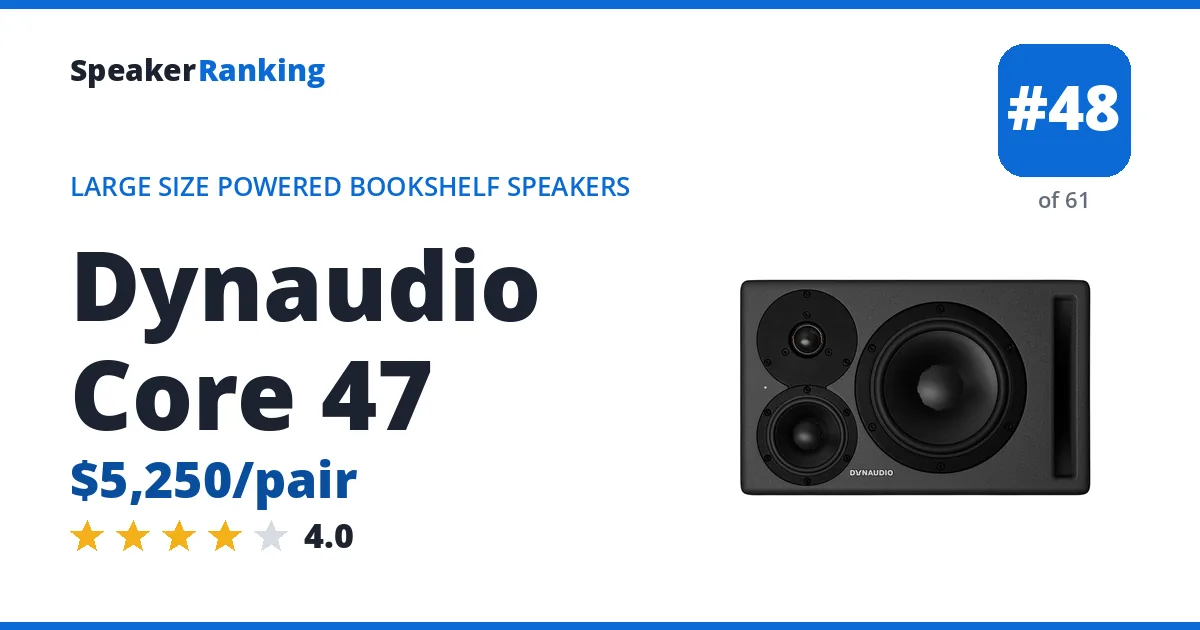
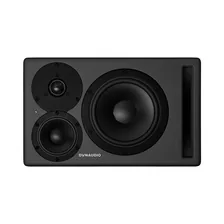 Ranked #47 of 68 in Large Size Powered Bookshelf Speakers - Dynaudio Core 47: $5,250 per pair Discontinued eBay
Pros: A professional three-way monitor with 42.5Hz measured -3dB extension and flexible installation controls. Its 6.65 ideal-subwoofer score supports a usable studio foundation when paired with appropriate room setup.
Cons: The measured 3.1dB response span from 300Hz to 5kHz and listening-window unevenness keep it below the leading accuracy choices. A nearly flat overall response slope does not mean the individual frequencies are equally balanced. Premium construction and amplifier power do not resolve those response variations. Discontinued.
Full Dynaudio Core 47 review and specifications →
| AES Input | No |
|---|---|
| Amplifier Power | 1,150W each (150W HF, 500W MF, 500W LF) |
| Aux Input | No |
| Bluetooth | No |
| Coaxial Input | No |
| Country | Denmark |
| Dimensions | 9.4H x 15.4W x 14D in |
| Drivers | 1” Esotar Pro tweeter, 4” MSP midrange, 7” MSP woofer |
| Enclosure | 3-way active, bass-reflex |
| Frequency Response | 41Hz - 24kHz (±3dB) (Manufacturer specified) |
| HDMI Input | No |
| Inputs | Analog XLR, AES3 digital XLR, word clock |
| Optical Input | No |
| RCA Input | No |
| Spinorama Preference Score | 4.99 |
| Spinorama Preference Score with Perfect Sub | 6.65 |
| TRS Input | No |
| USB Input | No |
| Weight | 33.3 lbs (15.1 kg) each |
| XLR Input | Yes |
- Links
- Reviews, Comparisons and Sound Samples
- Head-to-Head Comparisons
- Dynaudio Core 47 vs Kali Audio LP-8 V2
- Dynaudio Core 47 vs Cambridge Audio L/R X
- Dynaudio Core 47 vs JBL 4329P
- Dynaudio Core 47 vs Barefoot Footprint 01
- Dynaudio Core 47 vs Fluid Audio Image 2
- Dynaudio Core 47 vs JBL 708P
- Dynaudio Core 47 vs Meyer Sound Amie
- Dynaudio Core 47 vs Focal Trio6 ST6
- See all 10 comparisons
Medium Size Bookshelf Speakers
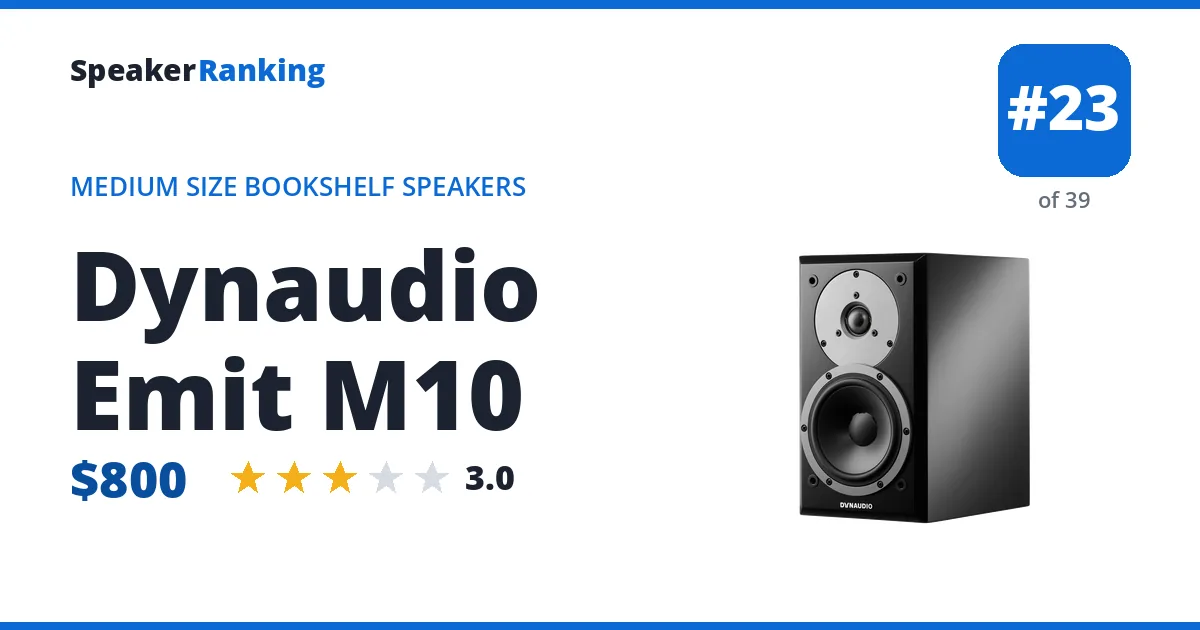
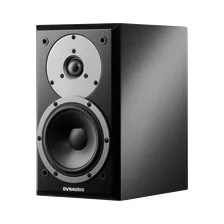 Ranked #59 of 90 in Medium Size Bookshelf Speakers - Dynaudio Emit M10: $800 per pair Discontinued eBay
Newer model: the Dynaudio Emit 10. It’s likely to perform similarly, though we don’t have measurements to confirm that yet.
Pros: CEA2034 spinorama shows impressive, headphone-level distortion through the midrange and tweeter at 86dB SPL, with a well-executed port that keeps resonance low below the crossover. 28mm soft dome tweeter and 14cm MSP mid/bass driver. Measured bass extension of 60.1Hz (-3dB), with a measured sensitivity of 83.5dB.
Cons: Tuned toward a mild showroom sound with boosted upper bass and treble and a recessed midrange: the reviewer prefers speakers that get the 100Hz-3kHz range right, which this doesn’t. His verdict: cheaper speakers deliver much more balanced tonality, so he wouldn’t buy it for himself. Discontinued.
Full Dynaudio Emit M10 review and specifications →
| Bass Extension (-10dB) | 46.8Hz (derived, log-interpolated between spinorama.org -9dB/-12dB points) |
|---|---|
| Bass Extension (-3dB) | 60.1Hz (measured, Audio Science Review) |
| DIY Kit | No |
| Dimensions | 11.5”H x 6.7”W x 9.4”D (292 x 170 x 240 mm) |
| Drivers | 28mm soft dome tweeter, 14cm MSP mid/bass driver |
| Frequency Response | 50Hz - 23kHz (+/-3dB) (Manufacturer specified) |
| Impedance | 6 ohms nominal |
| Sensitivity | 83.5dB (2.83V/1m, measured, Audio Science Review) |
| Spinorama Preference Score | 4.56 (spinorama.org) |
| Spinorama Preference Score with Perfect Sub | 6.93 (spinorama.org) |
| Weight | 12.3 lbs (5.6 kg) each |
| Woofer Cabinet | ported |
- Links
- Reviews, Comparisons and Sound Samples
- Head-to-Head Comparisons
- Dynaudio Emit M10 vs ELAC BS U5
- Dynaudio Emit M10 vs Dynaudio X14
- Dynaudio Emit M10 vs Pioneer SP-BS22-LR (Philharmonic AAM Mod)
- Dynaudio Emit M10 vs JBL Stage 250B
- Dynaudio Emit M10 vs JBL L52 Classic
- Dynaudio Emit M10 vs Paradigm Monitor SE Atom
- Dynaudio Emit M10 vs Sony SS-CS5 M2
- Dynaudio Emit M10 vs JBL Stage A120
- See all 40 comparisons
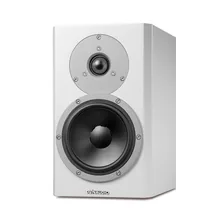 Ranked #62 of 90 in Medium Size Bookshelf Speakers - Dynaudio X14: $1500 per pair Discontinued eBay
Pros: 1” silk-dome tweeter and 5.7” magnesium-silicate-polymer woofer in a compact two-way stand-mount, rated at 85dB sensitivity. Measured bass extension of 67.4Hz (-3dB), with a measured sensitivity of 82dB.
Cons: CEA2034 spinorama shows an uneven on-axis response from the lack of a waveguide to control tweeter beam width, plus a port resonance that boosts the lower midrange and imperfect crossover matching between the drivers. Too much energy in the lower and upper treble reads as bright, and directivity narrows at higher frequencies rather than staying controlled. The reviewer’s verdict: out of the box, the objective performance isn’t that great, though EQ can make it a satisfying speaker. Discontinued.
Full Dynaudio X14 review and specifications →
| Bass Extension (-10dB) | 43.9Hz (derived, log-interpolated between spinorama.org -9dB/-12dB points) |
|---|---|
| Bass Extension (-3dB) | 67.4Hz (measured, Audio Science Review) |
| DIY Kit | No |
| Dimensions | 11.2”H x 6.7”W x 10”D (285 x 170 x 255 mm) |
| Drivers | 1” silk dome tweeter, 5.7” magnesium-silicate-polymer woofer |
| Frequency Response | 50Hz - 23kHz (+/-3dB) (Manufacturer specified) |
| Impedance | 8 ohms nominal |
| Sensitivity | 82dB (2.83V/1m, measured, Audio Science Review) |
| Spinorama Preference Score | 4.57 (spinorama.org) |
| Spinorama Preference Score with Perfect Sub | 6.94 (spinorama.org) |
| Weight | 14.3 lbs (6.5 kg) each |
| Woofer Cabinet | ported |
- Reviews, Comparisons and Sound Samples
- Head-to-Head Comparisons
Dynaudio Models Not Yet Ranked
Newer or recently added Dynaudio models we track but haven’t ranked yet, because no measurements we can rank them on have been published. See speakers not yet ranked for how that works.
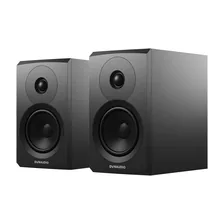 Not yet ranked, replaces Dynaudio Emit M10 - Dynaudio Emit 10: $599.00 per pair Amazon eBay
Older model: the Dynaudio Emit M10 (rated 3/5).
Pros: A two-way bookshelf speaker with a 28mm Cerotar soft-dome tweeter and a 14cm MSP mid-bass driver, crossed over at 3,700Hz. Dynaudio rates it at 64Hz-25kHz within 3dB, 86dB sensitivity and 6 ohms, with a rear double-flared port. Magnetic grilles are included.
Cons: No independent measurements yet, so its sound can’t be compared with ranked speakers. The rear port needs some space from the wall, and 86dB sensitivity asks for a reasonably powerful amplifier.
Full Dynaudio Emit 10 review and specifications →
| Crossover Frequency | 3700Hz |
|---|---|
| Dimensions | 11.4”H x 6.7”W x 10.7”D (290 x 170 x 272 mm) |
| Drivers | 28mm Cerotar soft dome tweeter + 14cm MSP mid-bass |
| Enclosure | ported, rear |
| Frequency Response | 64Hz - 25kHz (+/-3dB) (Manufacturer specified) |
| Impedance | 6 ohms |
| Sensitivity | 86dB (2.83V/1m) |
| Weight | 14.1 lbs (6.4 kg) |
- Links
- Reviews, Comparisons and Sound Samples
- These figures are manufacturer-specified rather than independently measured.
- Head-to-Head Comparisons