Short answer: the Kanto YU. It ranks #40 of 67 powered bookshelf speakers by sound quality, rated 3.7/5, at $349.99. The Edifier MR4.5 ranks #45, rated 3.6/5, at $249, $100.99 cheaper, not enough of a saving to outweigh the sound-quality gap.
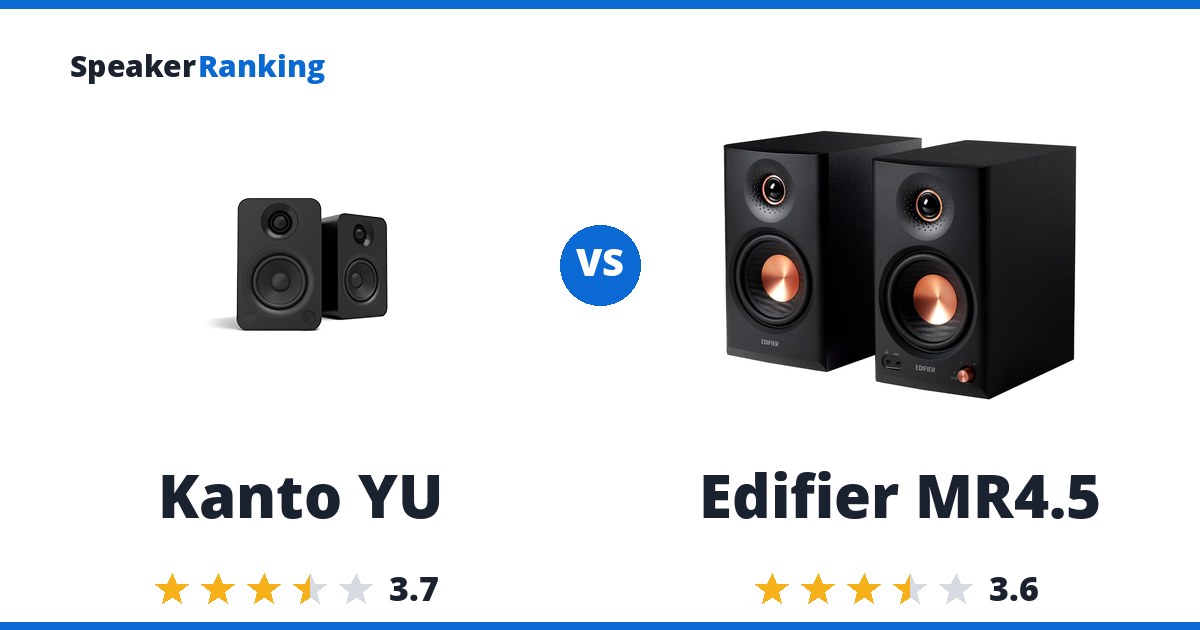
What the Kanto YU does well: RCA and Bluetooth inputs, remote control, tone adjustment and a subwoofer output make this compact pair simple to use. The tradeoff: Standalone preference is 3.46 and the -3dB point is about 85Hz, so it lacks low-bass weight.
The case for the Edifier MR4.5: Bass reaches about 60Hz at -3dB and 44Hz at -10dB in Erin’s measurements, notably deep for a 4.5-inch desktop monitor and well beyond the smaller MR4. The catch: The response is uneven, with a broad upper-bass bump around 120 to 150Hz, a presence dip of roughly 3dB around 2 to 3kHz and brighter treble above it (listening-window tilt +0.22dB per octave), which holds its preference score to about 3.9 on its own and 6.1 with an ideal subwoofer.
Buy the Kanto YU. It is rated higher for sound quality, and the $100.99 saving on the Edifier MR4.5 is not enough to make up the difference.
Still deciding? The full Powered Home rankings cover every ranked option.
Specifications Side By Side
| Kanto YU | Edifier MR4.5 | |
|---|---|---|
| Price | $349.99 per pair | $249 per pair |
| Ranked | #40 of 67 in Medium Size Powered Bookshelf Speakers | #45 of 67 in Medium Size Powered Bookshelf Speakers |
| Enclosure | 2-way powered, rear-ported MDF | - |
| Drivers | 1" silk-dome tweeter, 4" Kevlar woofer | 4.5-inch mid-bass driver + 1-inch silk-dome tweeter (each) |
| Dimensions | 8.7H x 5.5W x 7.5D in | 5.5"W x 9.6"H x 9"D (140 x 244 x 229 mm) (active); 140W x 244H x 208D mm (passive) |
| Weight | 6.2 lbs (2.8 kg) active, 5.3 lbs (2.4 kg) passive | 14.6 lbs (6.63 kg) |
| Amplifier Power | 70W RMS / 140W peak per pair | 80W RMS total (Manufacturer specified) |
| Inputs | RCA and Bluetooth 4.2 aptX | Balanced XLR, balanced 6.35mm TRS, RCA, 3.5mm Aux, Bluetooth |
| Bluetooth Codecs | SBC, aptX | LDAC, SBC |
| Country | Canada (design) | - |
| Spinorama Preference Score | 3.46 | 3.86 (calculated from Erin's Audio Corner CEA2034 data) |
| Spinorama Preference Score with Perfect Sub | 6.38 | 6.10 (calculated from Erin's Audio Corner CEA2034 data) |
| Subwoofer Output | Yes | - |
| Outputs | Subwoofer | 3.5mm headphone |
| XLR Input | No | Yes |
| RCA Input | Yes | Yes |
| TRS Input | No | Yes |
| Optical Input | No | No |
| Coaxial Input | No | No |
| USB Input | No | No |
| HDMI Input | No | No |
| AES Input | No | No |
| Aux Input | No | Yes |
| Bluetooth | Yes, 4.2 | Yes, 6.0 |
| Frequency Response | 60Hz - 20kHz (Manufacturer specified) | 50Hz-40kHz (Manufacturer specified) |
| App | - | Yes (Edifier ConneX) |
| Bluetooth Version | - | 6.0 |
| EQ | - | Yes (app EQ, room compensation settings and rear high/low controls) |
| Maximum SPL | - | 98dB (Manufacturer specified, 1m) |
| Bass Extension (-3dB) | - | 60Hz (measured, Erin's Audio Corner) |
| Bass Extension (-10dB) | - | 44Hz (measured, Erin's Audio Corner) |
| Measurement Source | - | Erin's Audio Corner |
| Headphone Output | - | Yes |
Related Speaker Comparisons
More worthwhile head-to-heads for Kanto YU:
- Genelec 8331A vs Kanto YU
- Neumann KH120 MKII vs Kanto YU
- Genelec 8030C vs Kanto YU
- Neumann KH80 DSP vs Kanto YU
- Kanto YU vs Dynaudio LYD 5
Prices on this page were last checked September 23, 2026 at 11:24 PM UTC. Product prices and availability are accurate as of that date/time and are subject to change; the price and availability shown on Amazon at the time of purchase will apply to the purchase of this product.
As an eBay Partner, we may be compensated if you make a purchase.
The Two Speakers In Full
 Kanto YU: $349.99 per pair Kanto Audio eBay
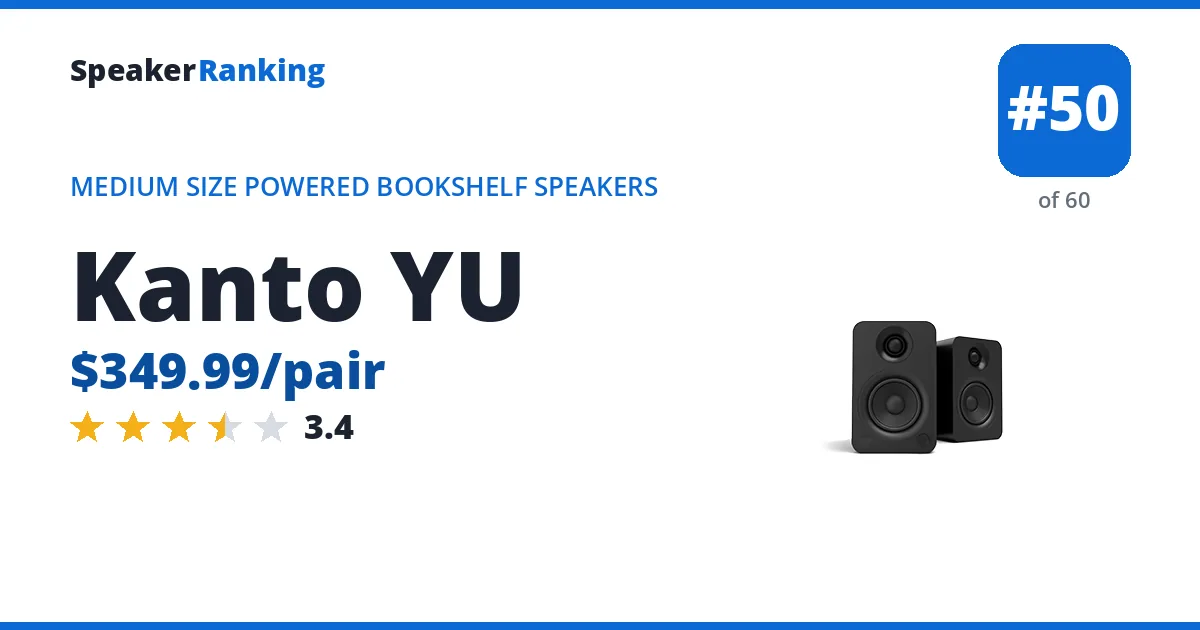
Pros: RCA and Bluetooth inputs, remote control, tone adjustment and a subwoofer output make this compact pair simple to use. ASR’s measurements show a 2.9dB midrange span and a 6.38 preference score with an ideal subwoofer, supporting moderate desktop use with bass assistance.
Cons: Standalone preference is 3.46 and the -3dB point is about 85Hz, so it lacks low-bass weight. The response trends upward toward the treble and retains local irregularities across the listening window. A subwoofer adds bandwidth but does not make the speaker neutral. Connectivity is basic compared with models offering USB, optical or HDMI.
Full Kanto YU review and specifications →
| AES Input | No |
|---|---|
| Amplifier Power | 70W RMS / 140W peak per pair |
| Aux Input | No |
| Bluetooth | Yes, 4.2 |
| Bluetooth Codecs | SBC, aptX |
| Coaxial Input | No |
| Country | Canada (design) |
| Dimensions | 8.7H x 5.5W x 7.5D in |
| Drivers | 1" silk-dome tweeter, 4" Kevlar woofer |
| Enclosure | 2-way powered, rear-ported MDF |
| Frequency Response | 60Hz - 20kHz (Manufacturer specified) |
| HDMI Input | No |
| Inputs | RCA and Bluetooth 4.2 aptX |
| Optical Input | No |
| Outputs | Subwoofer |
| RCA Input | Yes |
| Spinorama Preference Score | 3.46 |
| Spinorama Preference Score with Perfect Sub | 6.38 |
| Subwoofer Output | Yes |
| TRS Input | No |
| USB Input | No |
| Weight | 6.2 lbs (2.8 kg) active, 5.3 lbs (2.4 kg) passive |
| XLR Input | No |
- Links
- Reviews, Comparisons and Sound Samples
- Head-to-Head Comparisons
 Edifier MR4.5: $249 per pair Amazon eBay
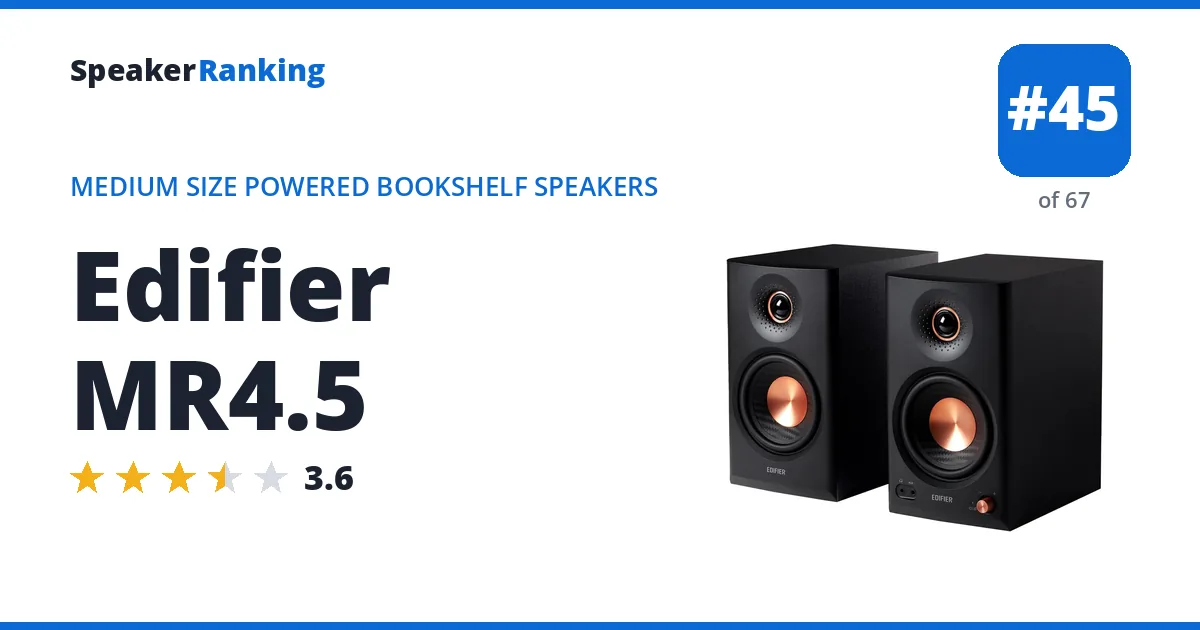
Pros: Bass reaches about 60Hz at -3dB and 44Hz at -10dB in Erin’s measurements, notably deep for a 4.5-inch desktop monitor and well beyond the smaller MR4. It connects to nearly anything: balanced XLR and TRS, RCA and 3.5mm aux inputs, Bluetooth 6.0 with LDAC and multipoint, plus a front headphone output. Rear high and low shelving knobs and the ConneX app’s room compensation settings help tune it for desk or wall placement. Measured bass extension of 60Hz (-3dB).
Cons: The response is uneven, with a broad upper-bass bump around 120 to 150Hz, a presence dip of roughly 3dB around 2 to 3kHz and brighter treble above it (listening-window tilt +0.22dB per octave), which holds its preference score to about 3.9 on its own and 6.1 with an ideal subwoofer. Vertical lobing means the tweeter should be aimed at ear height. Compression is already meaningful at 96dB and distortion climbs sharply between 700Hz and 3kHz when pushed, so it suits nearfield desk listening rather than filling a room.
Full Edifier MR4.5 review and specifications →
| AES Input | No |
|---|---|
| Amplifier Power | 80W RMS total (Manufacturer specified) |
| App | Yes (Edifier ConneX) |
| Aux Input | Yes |
| Bass Extension (-10dB) | 44Hz (measured, Erin's Audio Corner) |
| Bass Extension (-3dB) | 60Hz (measured, Erin's Audio Corner) |
| Bluetooth | Yes, 6.0 |
| Bluetooth Codecs | LDAC, SBC |
| Bluetooth Version | 6.0 |
| Coaxial Input | No |
| Dimensions | 5.5"W x 9.6"H x 9"D (140 x 244 x 229 mm) (active); 140W x 244H x 208D mm (passive) |
| Drivers | 4.5-inch mid-bass driver + 1-inch silk-dome tweeter (each) |
| EQ | Yes (app EQ, room compensation settings and rear high/low controls) |
| Frequency Response | 50Hz-40kHz (Manufacturer specified) |
| HDMI Input | No |
| Headphone Output | Yes |
| Inputs | Balanced XLR, balanced 6.35mm TRS, RCA, 3.5mm Aux, Bluetooth |
| Maximum SPL | 98dB (Manufacturer specified, 1m) |
| Measurement Source | Erin's Audio Corner |
| Optical Input | No |
| Outputs | 3.5mm headphone |
| RCA Input | Yes |
| Spinorama Preference Score | 3.86 (calculated from Erin's Audio Corner CEA2034 data) |
| Spinorama Preference Score with Perfect Sub | 6.10 (calculated from Erin's Audio Corner CEA2034 data) |
| TRS Input | Yes |
| USB Input | No |
| Weight | 14.6 lbs (6.63 kg) |
| XLR Input | Yes |
- Links
- Reviews, Comparisons and Sound Samples
- Head-to-Head Comparisons