Short answer: the JBL Go 5 for durability, the Boat Stone 190/193 for a lighter carry. The Go 5 steps up to an IP68 rating from the Go 4’s IP67 and adds AirTouch tap-to-pair stereo linking, but it is still overpriced and not very different from the Go 4 besides the lights. The Boat Stone is quite light for the performance, though it has not much bass with slightly boosted mids and rolled off highs.
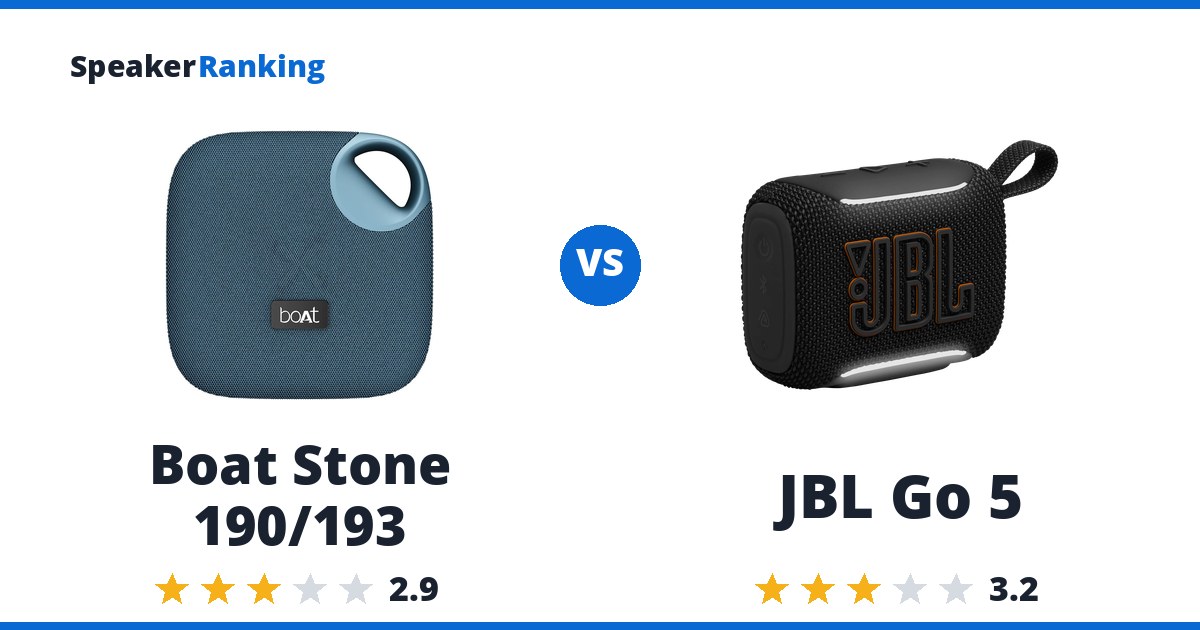
The case for the Boat Stone 190/193: Quite light for the performance. Set against that: Not much bass, mids slightly boosted, highs a little rolled off.Same hardware as the Monster Bluetooth Speaker and Dayton Audio Boost Mini.
What the JBL Go 5 gets right: IP68 rating, up from the Go 4’s IP67. AirTouch tap-to-pair stereo linking. The catch: Still overpriced for what it delivers, not very different from the Go 4 besides the lights.
Buy the Boat Stone 190/193 if the price is the priority over sound quality, or the JBL Go 5 if sound quality is the priority over the price.
Looking for alternatives? See the complete Portable Bluetooth rankings.
Specifications Side By Side
| Boat Stone 190/193 | JBL Go 5 | |
|---|---|---|
| Price | $39 | $39.95 |
| Ranked | #32 of 47 in Small Size Portable Bluetooth Speakers | #24 of 47 in Small Size Portable Bluetooth Speakers |
| App | No | Yes |
| Aux Input | Yes | No |
| Bass Extension (-10dB) | 95Hz | - |
| Battery Life | 6.5 hours (Manufacturer specified) | 8 hours, 10 with Playtime Boost (Manufacturer specified) |
| EQ | No | Yes |
| IP Rating | IPX7 | IP68 |
| MicroSD Playback | Yes | - |
| Party Mode | No | Yes (Auracast) |
| Power Bank | No | No |
| Power Input | USB-C | USB-C |
| Stereo | No | Yes (AirTouch tap-to-pair) |
| Omnidirectional | Pointing up | Pointing up |
| TWS | Yes | Yes |
| Weight | 0.4 lbs (185 g) | 0.5 lbs (230 g) |
| Bluetooth Codecs | SBC | SBC, AAC, LC3 |
| Built-in Microphone | Yes | No |
| Bluetooth Version | 5.0 | 6.0 |
| Drivers | 52mm | 45mm |
| Frequency Response | 70Hz - 70kHz (Manufacturer specified) | 100Hz - 19kHz (Manufacturer specified) |
| Charging Time | 1.5 hours | 3 hours |
| Amplifier Power | 5W | 4.8W |
| Dimensions | 4.1" x 4.1" x 2.6" (105 x 105 x 67 mm) | 4" x 3" x 1.7" (101 x 77 x 43 mm) |
| Digital Aux Input | No | Yes (USB-C) |
| Lights | - | Yes |
Related Speaker Comparisons
More top alternatives to JBL Go 5:
- JBL Go 5 vs Tribit Stormbox Micro 2
- JBL Go 5 vs Soundcore Boom Go 3i
- JBL Go 5 vs Minirig Mini 2
- JBL Go 5 vs Minirig Mini
- JBL Go 5 vs Tribit Stormbox Micro
Prices on this page were last checked September 22, 2026 at 5:11 AM UTC. Product prices and availability are accurate as of that date/time and are subject to change; the price and availability shown on Amazon at the time of purchase will apply to the purchase of this product.
As an eBay Partner, we may be compensated if you make a purchase.
The Two Speakers In Full
 Boat Stone 190/193: $39 Amazon eBay
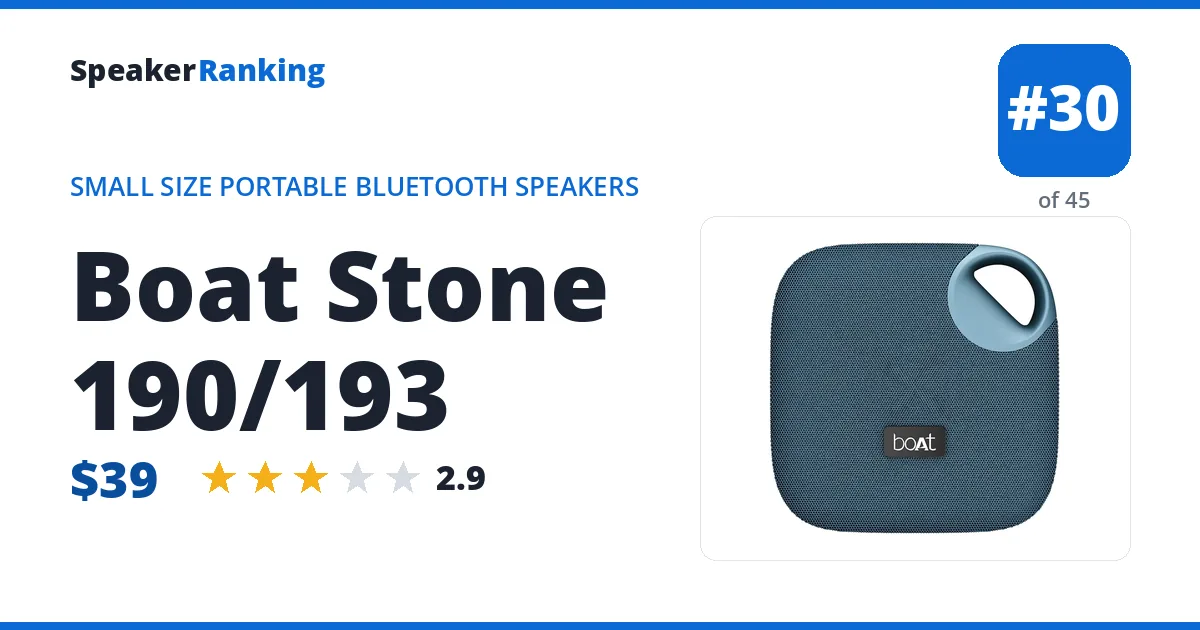
Pros: Quite light for the performance. Measured bass extension of 95Hz (-10dB).
Cons: Not much bass, mids slightly boosted, highs a little rolled off.Same hardware as the Monster Bluetooth Speaker and Dayton Audio Boost Mini
Full Boat Stone 190/193 review and specifications →
| Amplifier Power | 5W |
|---|---|
| App | No |
| Aux Input | Yes |
| Bass Extension (-10dB) | 95Hz |
| Battery Life | 6.5 hours (Manufacturer specified) |
| Bluetooth Codecs | SBC |
| Bluetooth Version | 5.0 |
| Built-in Microphone | Yes |
| Charging Time | 1.5 hours |
| Digital Aux Input | No |
| Dimensions | 4.1" x 4.1" x 2.6" (105 x 105 x 67 mm) |
| Drivers | 52mm |
| EQ | No |
| Frequency Response | 70Hz - 70kHz (Manufacturer specified) |
| IP Rating | IPX7 |
| MicroSD Playback | Yes |
| Omnidirectional | Pointing up |
| Party Mode | No |
| Power Bank | No |
| Power Input | USB-C |
| Stereo | No |
| TWS | Yes |
| Weight | 0.4 lbs (185 g) |
- Links
- Reviews, Comparisons and Sound Samples
- No independent measurement review is linked for this model; it is ranked from hands-on listening and comparison against similarly priced speakers.
- Head-to-Head Comparisons
 JBL Go 5: $39.95 Amazon eBay
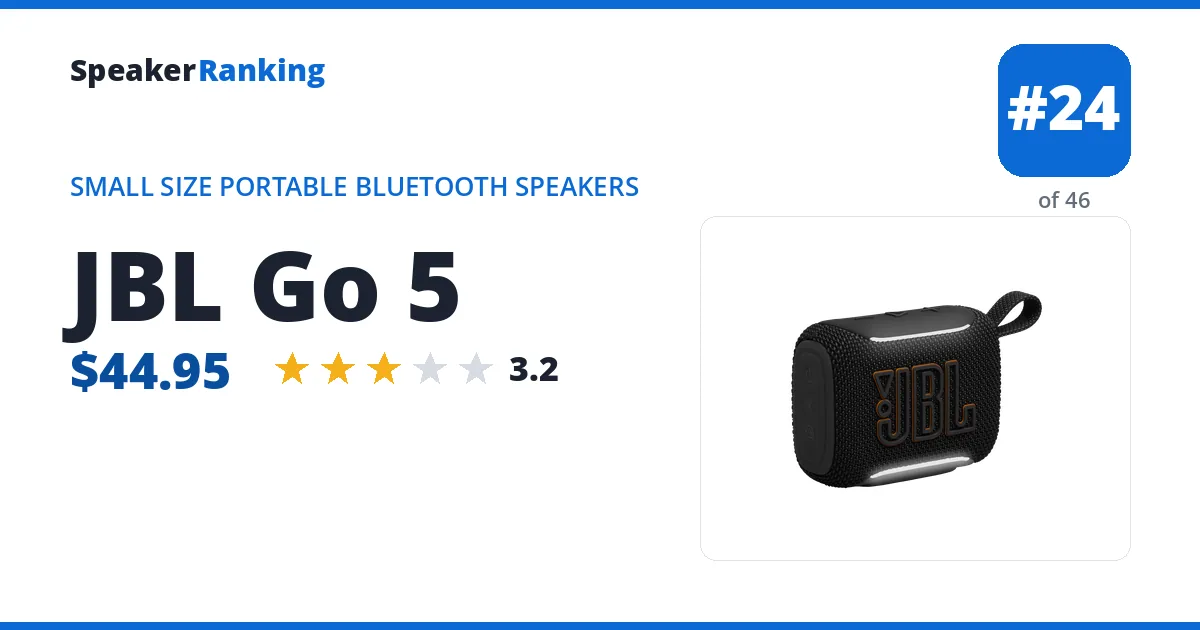
Pros: IP68 rating, up from the Go 4’s IP67. AirTouch tap-to-pair stereo linking. 7-band custom app EQ, up from the Go 4’s 5-band. USB-C wired audio input.
Cons: Still overpriced for what it delivers, not very different from the Go 4 besides the lights. Still lacking bass and not very clear overall. Mono downmixing produces an audible growling artifact, the same issue noted on the JBL Charge 6. Falls well short of similarly priced rivals like the Tribit Stormbox Micro 2. Weak off-axis dispersion and an uneven, upper-mid-heavy tonal balance. Doesn’t get meaningfully louder at max volume, just harsher.
Full JBL Go 5 review and specifications →
| Amplifier Power | 4.8W |
|---|---|
| App | Yes |
| Aux Input | No |
| Battery Life | 8 hours, 10 with Playtime Boost (Manufacturer specified) |
| Bluetooth Codecs | SBC, AAC, LC3 |
| Bluetooth Version | 6.0 |
| Built-in Microphone | No |
| Charging Time | 3 hours |
| Digital Aux Input | Yes (USB-C) |
| Dimensions | 4" x 3" x 1.7" (101 x 77 x 43 mm) |
| Drivers | 45mm |
| EQ | Yes |
| Frequency Response | 100Hz - 19kHz (Manufacturer specified) |
| IP Rating | IP68 |
| Lights | Yes |
| Omnidirectional | Pointing up |
| Party Mode | Yes (Auracast) |
| Power Bank | No |
| Power Input | USB-C |
| Stereo | Yes (AirTouch tap-to-pair) |
| TWS | Yes |
| Weight | 0.5 lbs (230 g) |
- Links
- Reviews, Comparisons and Sound Samples
- Head-to-Head Comparisons